Feeds:
Posts
Comments

Posts Tagged ‘amp’

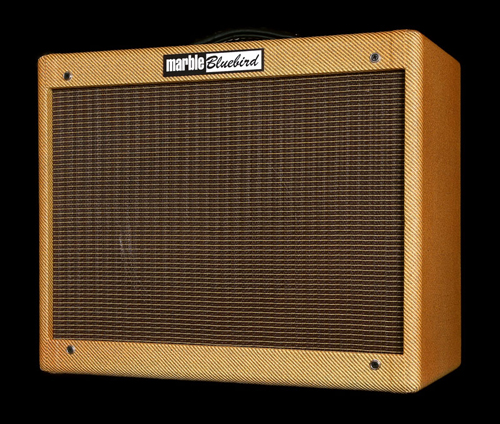
I was perusing The Gear Page today, and while in a thread, happened upon a post where a guy mentioned he had recently purchased an amp made by a company called Marble Amps. He said they specialized in Fender-style reproductions with tweed covering, all hand-wired for a reasonable price. He wasn’t kidding. He got a used head for $800! Oh well… we all can’t be that lucky.

However, I did a little digging and found their web site. Talk about oozing classic Fender mojo! They apparently have a US distributor, the Alternative Guitar and Amp Company in Southern California, but they don’t have any information on them (although I left them a message).

Very cool stuff!

Read Full Post »

In a word, lots. Admittedly, I’m a recent Marshall convert, having been primarily a Fender guy for years. I blame Jeff Aragaki, owner of Aracom Amps for this. His amps, that are steeped in Marshall mojo got me craving for that type of sound. BUT, it wasn’t until I got the PLX18 BB, a Plexi “Bluesbreaker” replica that I “got” that Plexi vibe.

At least to me, the response I get is visceral. When I hear a cranked up Plexi, there’s something that just sparks within me. I literally sink into the tone! A bit dramatic? Probably, but to me, there’s nothing that defines classic rock more than a cranked Plexi. Here’s a video I found of some classic Cream with Eric Clapton, playing “Sunshine of Your Love:”

Mm, mm, good….

Read Full Post »

For the DIY guitar enthusiast, having a good source for parts is crucial. There are lots of parts sites out there, but this new site really intrigues me. It’s professional looking and well laid out, and for goodness’ sake, you can find stuff!

I don’t know how many times I’ve gone to parts sites that are just not very well done, and their search function actually works! I particularly like the home page. There are only a few areas to interact with, but they’re meaningful. For instance, I found myself perusing the new items, featured products, and most popular products boxes for quite awhile.

The only problem with sites like this is that I start experiencing GAS!!! Damn, I’ve been looking at getting another speaker, like a Celestion Alnico Blue… OH STOP IT!!!

Anyway, even for a new site, their prices are in line with other retailers. But I do like the fact that they specialize in amp parts. Now THAT’s useful!

They’re good enough to get a banner on GuitarGear.org. Click on the banner to the right, or click here to go to their site!

Read Full Post »

I’ve been using the Aracom PLX18 BB Trem in my studio for the past couple of months, and it is simply a great amp. As I’ve written in the past about this amp, I’ve made some modifications to it such as replacing all the stock pre-amps with NOS (the JJ EL84’s are killer in this amp, so no need to even look for NOS for these), and replacing the stock speaker with a Fane Medusa 150.

As most GuitarGear readers know, my go-to gigging amp is my beloved, customized Aracom VRX22. But every now and then, I like to take my other amps out for a spin. For this evening’s church gig, I took the PLX18. Based upon tonight’s experience, it looks like I’m going to gig with this amp a lot more.

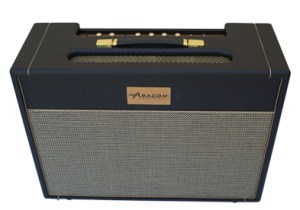
One thing that I’ve come to love about Jeff Aragaki’s amp designs, is that he has got the vintage Marshall mojo down. Mind you, he doesn’t make clones. He takes the original circuit designs and innovates on top of them. The PLX18 BB started out as a classic “Bluesbreaker” design, but with improvements to the circuit to make it much more efficient. The result is a real smooth-sounding amp that – like the amp it is modeled after – has tons of clean headroom, and needs to be absolutely cranked to get grind. But when it grinds, it’s so rich and smooth and dynamic, you just close your eyes and let your fingers do the talking!

Such was the case tonight. About a year ago, I re-arranged a classic Catholic hymn and gave it a bluesy, folk-punk vibe (think a cross between Death Cab and Clapton). I know, it sounds like a weird mix, but amazingly enough, it works. People know the song really well, but this arrangement gets them nodding their head in time – it’s cool to see! In any case, I also arranged it so that there was plenty of room in between verses for little solos. It’s a somewhat slow song, so you can’t go overboard, but the phrasing really lends itself to a lead played with an amp just at the edge of breakup, with lots of bends and vibrato.

And it helps to have an amp that has a lot of natural sustain. The PLX is just so damn good at that! I played the amp in the “clean” channel that I had almost cranked up all the way, since that’s where a vintage Marshall sounds great, and of course, it was plugged into my attenuator so I could crank it and still have a manageable volume level. The PLX is so responsive to attack and volume knob adjustments that it makes playing just a dream. Throughout the song, I just closed my eyes and got into pure expression mode. It was one of those occasional experiences where the tone just takes you right into the Zone! When you’re in the Zone, you just can’t do wrong. Hearing the PLX sing with my Squier CV Tele – I just floated away in absolute bliss.

For our closing song, I actually didn’t play, and gave “Blondie” over to my guitar cohort Dave so I could thump out on bass. For that song, I activated the wonderful Kasha overdrive pedal, in the Hot channel to really slam the amp with gain. The great thing about the Kasha overdrive is that it’s a really transparent overdrive pedal, and allows you amp to do it’s magic. With the OD engaged, the PLX took on this incredible character. It’s a bright amp by nature, but the tone became really jangly and ringy, with just a touch of compression coming from the EL84’s. It helps that I replaced the original JJ pre-amps with the NOS ones. In any case, talk about creamy smooth but articulate overdrive! Listening to that just got me thumpin’ out on the bass! We had a lot of fun with that song. Kind of felt like the White Stripes as we only had two instrumentalists (though it was two guitars, or a bass and guitar – no drums). It was raw and edgy, but oh so cool! You gotta just dig moments like this!

As I’ve mentioned, the PLX18 BB Trem is Jeff’s oldest amp design and unfortunately, his least-known amp. It’s tough to compete in the market when there are so many boutique, vintage Marshall-style amps on the market. I’ve played many, but the PLX18 BB is special. Others who own one of these will attest to just how special this amp sounds. Even though it’s not quite as versatile as the VRX22 that can get me over-the-top gain, for what it does, I can’t think of a better amp. Mind you, this ain’t just a one-trick pony. For blues, classic rock, and country, it’s simply killer. So if you’re looking for that classic “Bluesbreaker” tone at a price that won’t break you at the same time (the head is $1345, and the combo – which I have is $1750), I encourage you to check this amp out! And if you do get it, you won’t regret it in the slightest!

As far as equipping it, pay the extra for NOS pre-amps (the JJ EL84’s are just fine – I actually prefer them), and even though Jeff recommends an Eminence Red Fang Alnico to be paired with the PLX18 BB, for my personal tastes, I prefer something with a bit tighter bottom end; hence, the Fane Medusa that I swapped in. If you still want bright tone, then an Eminence Governor works insanely well, and will give you nice mids and high-mids, and I hear the Celestion Gold sounds killer in the the combo! YMMV…

For more information on this wonderful amp, check out the Aracom Amps site!

Read Full Post »
…if I’m getting too jaded. I’ve reviewed so much gear that I don’t seem so easily impressed as of late.

What got me thinking about this was my latest review of the PRS Sweet 16 amplifier. I played it. It sounded great, but I wasn’t overly impressed. I suppose from a pure tone perspective, I could give it pretty high marks, and my 4.5 Tone Bones rating reflects the overall quality of the amp. But at around $1700, even though PRS calls the Sweet 16 a “mid-priced” amp, there are lots of other amps in that power class that cost far less and sound just as good, if not better.

What’s in a name?

Or maybe I’m not falling into the hype trap. It seems that every time PRS comes out with something, people rave about it and assume it kicks ass without really even trying it. That’s great for PRS to have built up that kind of reputation, and probably a reason PRS gear can still command such high prices: People are willing to pay based upon the name because they know there is a certain level of quality of which they can assume will be in the gear they buy – even sight unseen.

I also suppose that when I factored in the price, it kept me from giving the Sweet 16 higher marks; and that’s the practical side of me speaking. For me, I don’t give a shit about the name or the model; I only care if it sounds good. If some gear’s tone or playability simply blow me away, I’ll pay a higher price. For instance, I’m looking for vintage or vintage re-issue Les Paul. My buddy has a number of them, and I just have to get one to add to my rig. I won’t mind paying a premium for that guitar when I find one not just because it’s an LP, but because I’m blown away by the tone. But with the exception of Goldie, none of my other guitars have cost over $1000, and half of them cost under $500. Furthermore, all my amps with the exception of the Aracom PLX18 cost under $1000 as well, and the PLX18 with its vintage-style circuitry sounds way better than the Sweet 16 and still costs less.

I guess the point I’m trying to make is that I don’t see the point in paying a high price for just “good” tone, as in the case of the Sweet 16. I’ll pay for great tone, but as I stated, there are lots of different gear out there that have great tone and a great price. The Dr. Z Remedy amp is a great example of that: GREAT tone at a great price. By the way, the street price of $1499 makes it a much sweeter deal than the Sweet 16.

I’m probably going to get jumped on for posting this, but so be it. I know what I like, and I know what I’d pay for some gear. It all boils down to tonal preference in the end. I’ll pay for tone that inspires me, but I’ll never pay for a name.

Read Full Post »

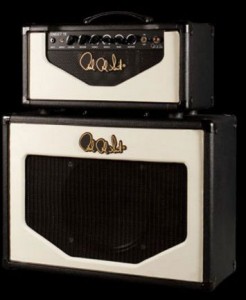
Ever since Paul Reed Smith came out with amplifiers, I’ve been a little dubious about them mostly because anything carrying the PRS logo will invariably cost an arm and a leg. Don’t get me wrong PRS makes freakin’ incredible gear, but said gear also has a relatively large barrier to entry. So it came as a nice surprise that the PRS Sweet 16 is much more reasonably priced than one might expect of a PRS. For a hand-wired amp at just under $1700, that’s getting into Dr. Z territory, and that’s a GREAT thing!

During my latest sojourn to Guitar Center, my wanderings took me to the “quiet room” where GC has a few amps and guitars for people to play, isolated from the rest of the store. I like going in there because usually they have nicer gear like Custom Shop Strats, and high-end Gibsons. For amps, there’s always nice ones like classic Fenders (they’ve had the same silverface Twin in there for awhile now), and this time, they had the PRS Sweet 16 with its matching 1 X 12 cab.

Features (from PRS)

  • Hand-wired in Stevensville, Maryland
  • 16 Clean Watts (Smooth Overdrive at Max)
  • 2x 6V6 Output Tubes
  • Cathode Bias
  • Master Volume (Exits the Circuit at Max)
  • Reverb
  • Volume, Bass, Treble, Mid, Reverb, Master, and Bright Controls
  • Vintage-style Black and White Tolex Look

Fit and Finish

What can I say that hasn’t been said of PRS gear? It’s invariably lovely stuff! The black and white tolex and black grille cloth give the amp a very cool vintage look. As expected, there’s nary a blemish or seam out of place with this amp, and as expected, both amp and cab are super-sturdy. But that’s a given with pretty much any PRS gear.

How It Sounds

Here’s where we get into a bit of murky territory, primarily because even in an isolation room in a store, it’s not an optimal place to test – at least for me because I almost invariably don’t have my own guitars available when I do “random” tests. But that’s okay, I just spend a bit of time getting guitars that are close to what I have or had. With this test, I used a Strat and a very nice ES-335.

The Sweet 16 must have a pretty hefty output transformer because this puppy puts out some volume, even with a single 1 X 12. It has TONS of clean headroom, which made me turn down the Master and crank up the volume to get even a little grind, which indicated to me that to really get this amp to get into serious breakup, the master has to be dimed as well. The predominantly pre-amp distortion just seemed a little flat-sounding to me; it wasn’t bad, but it was nothing special. I did crank up the Master for just a little while, and even with it dimed, the breakup was  lot like a classic Marshall JTM; tons of clean headroom, with a modest amount of distortion when cranked. Definitely an amp suited for classic rock/blues.

Clean was another story. Really nice cleans with this amp, especially with a Strat. The CS Strat I played produced a smooth and complex tone with a chimey top-end. Quite nice. And the ES-335 sounded gorgeous through the Sweet 16. Adding a touch of reverb, really helped fill out the sound, and it was great playing fingerstyle with both axes.

For EQ settings, I just moved everything to 12 o’clock and didn’t have to tweak at all, though I did switch on the bright control to get some top-end shimmer; especially when playing the ES-335. The Strat didn’t need it, and the fuller sound really helped bolster the natural thin tone of the Strat.

Regarding the reverb, I do have to say that I’ve heard better. It’s not that it’s bad-sounding. I just wasn’t really impressed with it. I certainly wouldn’t use it to provide a sustaining effect with this amp. The sag is enough with the amp that I can get my sustain with my fingers. The reverb is not as pronounced as a Fender reverb, and it’s not very springy. I liken it to an Aracom reverb that isn’t very intense. It’s there, but it’s a heck of a lot more subtle than a Fender. But like I said, it’s not bad, but for me, I probably wouldn’t use it. For recording, I’d record the amp dry and layer a reverb as an insert or side-chain effect. That said, that amp sounds great without a reverb.

Overall Impressions

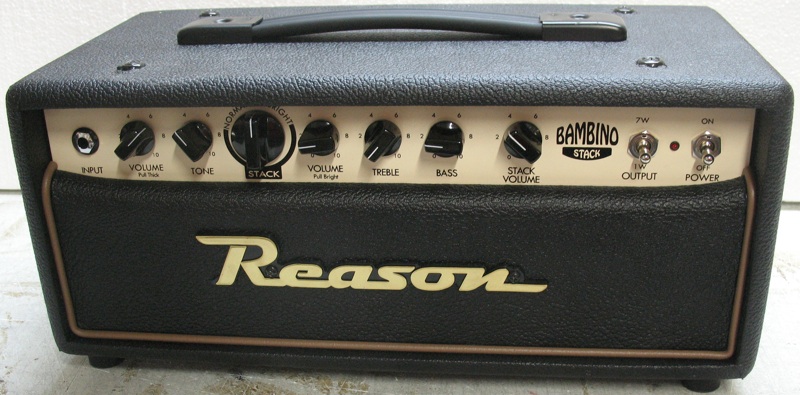
My gut impression is that it’s a great-looking and great-sounding amp, and it’s a good start for PRS’s entry into the low-wattage amp arena, but there are a lot better-sounding amps in that price range and below.Good examples of this are the Reason Bambino, the Aracom VRX series, and the Dr. Z Remedy. Don’t get me wrong, I’m not knocking the Sweet 16. I really liked it, but it’s not an amp that blew me away with its tone.

Despite my rather contrarian comments, the Sweet 16 gets a 4.5 Tone Bones rating. It’s well-made and great-sounding. If I ever get one into my studio, I’ll do a full review, and perhaps my rating will change. But it’s a solid performer nonetheless, and you could do a lot worse.

Read Full Post »

I’ve been extolling the virtues of the Reason Amps Bambino for several months, and how great it sounds. Among the things that I’ve mentioned is that for a little amp, it has a BIG sound. That was a design objective with Obeid Kahn, Reason’s amp designer, when he was designing the amp. He didn’t want to just build yet another affordable, low-powered amp. He wanted to build a great amp. Period.

Despite the sound though, what has really turned me on about this amp is its versatility. For instance, last Friday I did my regular, weekly solo gig at a local restaurant. I haven’t been very happy about my Stratacoustic’s tone into my DigiTech Vocalist Live box, so I decided to bring the Bambino to provide some pre-amplification and use its balanced line out to go directly into the restaurant’s board. What I was greeted with was simply put, a spectacular sound, and this from a line out directly from the amp! I’ve mentioned using this in the past, but this time, I had no speaker. I went direct into the board, and the only monitoring I had was from the PA. A couple of days later, I used it for my weekly church gig, with my 1 X 12 speaker cab, and also using the line out to plug into my church’s board.

For a church gig, minimal stage volume is important because voices are reinforced through the house audio, not from the band area. So to have this kind of amp where all I have to get is my stage volume, then use the house to get my sound out, it’s simply a boon.

The only other amps I’ve ever used that have this kind of versatility are acoustic amps. I realize that there are probably other tube amps that may have this capability, but getting all the great sound and versatility AND boutique quality in a $699 package is just unheard of! If you’re looking for a great amp that’ll work in variety of places, look no further!

Read Full Post »

I'm running a poll to find out how much gear GuitarGear.org visitors have.
I'll keep this post up for awhile so we can get some stats.

Read Full Post »

There are two things you should consider doing before you decide to get rid of it. I’ve done this on two amps, and have ended up keeping them both.

1. Change your speaker(s)

Let’s state the obvious: An amp’s speaker produces the sound, but it is amazing how many people I’ve come across who don’t look at replacing this vital component first when they’re not happy with their tone. I know, evaluating speakers is tough, and a lot of the time, you can only rely on people’s words and frequency response charts. I actually find frequency response charts useful in making a decision on a new speaker. If I want more mid-range and presence, I’ll look at speakers whose frequency response charts are big in the mids and high-mids, with a much more smooth bass response curve, like the Jensen P12N. If I’m looking for more bottom end, and a slightly scooped tone, I’ll look for a speaker that has those kinds of characteristics, such as the Fane Medusa 150. Of course, you have to hear the speakers in the end to decide if they work for you, but the frequency response chart is a good place to start.

2. Change your pre-amp tubes

I’m a NOS tube fanatic. To me, there’s nothing like the build and tonal quality of a good NOS tube. The ones I’ve chosen tend to have a bit less gain than newer tubes, and they break up so much more smoothly. But that’s just me. I want a smoother overdrive tone, whereas someone else may want a harsher tone. To each their own on this. However, changing tubes – especially pre-amp tubes – can have a profound effect on your tone. Like speakers, you have to try several before you find ones that fit your tastes, but it’s worth it once you do. And note, with respect to tubes, you get the most bang for your buck by replacing the pre-amp tubes as opposed to the power tubes. I use JJ power tubes for practically all my amps, and you know what? I’ve never replaced any of them because I just haven’t seen that much tone improvement by replacing them.

Where I have seen LOTS of improvements is in replacing the pre-amp tubes, as you’ll see below…

As I stated above, I saved two of my amps from the chopping block. Yeah, I had to spend a bit of money to save them, but save them I did. My most recent “save” experience was with my Aracom PLX18 BB. This amp is based upon the classic Marshall 18 Watt Plexi “Bluesbreaker.” When I first got it, I loved it, but one thing that I didn’t quite bond with was the fizz that the amp naturally produced. I really dug the mild distorted tone of the amp, but there was just something that wasn’t quite “right” when I’d crank the amp all the way.

So the first thing I did to bleed off some of the highs was to replace the stock speaker. The Red Coat Red Fang is a nice, bright speaker, but brand new, it’s pretty harsh, and I didn’t want spend a lot of time breaking it in. But even still, the amp was naturally bright, and with a bright speaker, I just didn’t feel it was a good fit. As luck would have it, I had another speaker on hand, a Fane Medusa 150. The thing about this speaker is that it has a real strong, tight bass response. Once I had it installed, I couldn’t believe my ears! It really balanced out the brightness of the amp, and curbed a lot of the fizz.

But there was still some fizz left. Knowing that there were JJ’s in the pre-amps, which have a lot of gain, my thought was that they were throwing a lot of gain at the EL84 power tubes, which can get fizzy when driven hard. So I swapped them out for a set of NOS circa 1959 GE and RCA long plate 12AX7’s, which are oh-so-smooth and a have a bit less gain than the JJ’s. The result was simply magnificent!

That clip was recorded with the Aracom PLX18 BB, and using my LP copy Prestige Heritage Elite. Sorry, I don’t have a “before” clip, but before I did those two simple modifications, the amp produced a ton of fizz that I just couldn’t connect with, even though I loved the dynamics when it was fully cranked. Now, I can crank that puppy up, and get those rich tones with no fizz.

Read Full Post »

I walked into my garage/studio this morning and looked over to my gear – there’s a lot (though probably not as much as I’ve seen from other gear sluts’ pictures). Peering over my collection, the thought struck me: What if I could only have one of each type of gear… What would I choose? What would be the basis for my decision?

After ruminating on this subject over breakfast and coffee, I decided that I’d choose the gear that gives me the most versatility with respect to tone and usability given the various types of music I play. So based upon that here are my choices:

  • Squier Classic Vibe Tele 50’s
  • Aracom VRX22 with 1 X 12 Cab
  • BOSS TU-2 Tuner
  • Aracom PRX150-Pro Attenuator

Those four things will get me through any gig or recording session. Not to say that they’re my favorite pieces of gear, but that combination will give me the most versatility with respect to versatility and usability.

What? No Goldie? Man, I love that guitar, don’t get me wrong. But that guitar is so heavy, I don’t gig with it unless I’m at a place where I have to sit down. The Tele, on the other hand, is super-light, and with its pine body, it’s very resonant, so I can get thick, almost humbucker-type sounds to nice trebly tones. Goldie offers that up and more, but she loses on usability in a variety of venues due to her weight.

The Aracom VRX22 happens to be my favorite amp in any case, but it’s my favorite because of its versatility. Once I had Jeff do the footswitch mod so I could switch between channels, and remove the clean channel from the master volume, there’s nary a tone – except for super heavy, high gain – that I can’t produce with that amp.

With respect to my TU-2 tuner, yeah, I know, there are much better ones out there, but it’s what I’ve got. But despite that, I’d rather be in tune than to have a cool effect, so that pedal would stay.

Finally, the Aracom PRX150-Pro attenuator will always be a part of any rig I put together because it allows me to set limits to my max volume in any venue. Since I play mostly small to medium venues, this box is essential for dialing in just the right amount of volume for the house. And even if I have to play at super low volumes where the Fletcher-Munson effect comes into play, I can rest assured that when my amp is miked, I’ll get my true tone.

I was actually surprised by my own choice of guitar primarily because Goldie is such a tone machine. But for as much as I move around when performing, lugging a heavy guitar is definitely not my cup of tea; especially if it makes me throw out my back, which I did a couple of weeks back. But it also says loads about that Squier Tele. I’ve got some great guitars, but that little $329 wonder creates such awesome tones and it plays so great, that it’s a clear winner. I might’ve gotten lucky with my particular guitar because I’ve read some user reviews that their tone is inconsistent. I’ll play a few more to see how that holds up.

Read Full Post »

« Newer Posts - Older Posts »