To date, this is the most popular article on this site, having held the top hits spot for the past several years now. My feeling is that it addresses the murkiness of the debate between overdrive vs. distortion. And despite many people like myself who constantly say they’re two, mutually exclusive things, it remains a subject that needs clarification. I’m glad this has been a -hopefully good – resource for people!
Remember: Distortion Is What You Hear! Overdrive Produces It!
I had an interesting conversation with a friend today regarding the difference between overdrive and distortion. Talk about two terms that are bandied about interchangeably in the guitar world! If you ask ten different guitarists the difference between them you’ll get ten different answers. But a common theme you’ll hear is what each sounds like; in other words, you’ll get a much more qualitative description as opposed to a quantitative description. What I’ve been after is a much more objective, quantitative description of each, but not necessarily too technical. So after talking about one versus the other, I decided to write down what we discussed, and throw my two-cents into the mix.
First, let’s look at the two terms, but from the perspective of an amplifier. The simplest explanation I could come up with is that overdrive, or in audiophile terms, over-powering, occurs when input gain exceeds the capacity of a device to handle the amount of gain thrown at it; in our case, a tube. What happens is that the smooth waveform that goes into the device gets “clipped” because the device’s input capacity is less than what is being thrown at it. Sonically, we perceive the result of this clipping as distortion. The higher the amplitude of the wave, the greater amount of distortion we hear.
But what about pedals? I’ll get to that in a bit, but I wanted to take the time to clarify these terms. There’s been a lot of confusion about these two terms because they’re used so loosely, and oftentimes interchangeably. For me, I’ll stick with the audiophile’s perspective of overdrive in that distortion is the result of overdrive or over-powering an amplification device. A way to think about overdrive vs. distortion is that overdrive happens in the front-end (what you put in), while distortion happens on the back-end (what you hear).
Related Articles
- Set Up an Overdrive Pedal
- Evaluating an Overdrive Pedal
- Hmm… Cranked Amp? Booster? Overdrive? Distortion?
- Are New Overdrives Irrelevant?
- I’d Like to Get Another Overdrive Pedal… I REALLY Would…
But here’s where we get into a bit of murky territory, especially with pedals. Strictly speaking, if we’re talking about overdrive as simply overpowering the front-end of an amp to make the tubes clip, the only pedal that is technically an overdrive is a boost pedal that takes your guitar’s signal and ups its voltage. But lots of manufacturers call their pedals overdrive pedals. In reality, all of those are distortion pedals as they include an internal clipping circuit which is overdriven into distortion – this includes the venerable Tube Screamer. OMG! Sacrilege!
So how do you tell the difference? That’s why I said we get into murky territory with respect to pedals. But as a rule of thumb, a distortion pedal will create a distorted sound irrespective of the amp. In other words, it’ll clip on its own. Put it front of the clean channel of an amp, switch it on, and it’ll create distortion. However, many, if not most, “distortion” pedals also provide a bit of gain boost to overdrive an amp. That’s where it gets murky, as most of the pedals termed “overdrive pedal” function as a combination of both overdrive AND distortion.
There are no real hard and fast rules, but in general, pedals that are commonly known as overdrive pedals (Tube Screamer, etc.) employ what’s called a “soft-clipping” circuit or transistor, where only a small portion of the input signal is clipped. Most distortion pedals employ a “hard-clipping” device to severely clip the input signal to get that “square wave” tone. But as I said, there are no hard and fast rules. Here’s an image that nicely describes the differences in the waveforms between soft-clipping and hard-clipping devices:

Picture courtesy of GM Arts
Sonic Differences Between Overdrive and Distortion Pedals
Many people have asked me over the years if there is a sonic difference between overdrive and distortion pedals. Having tested several of these pedals over the years, I hate to sound ambiguous, but from a practical standpoint, in some cases, it’s simply too hard to tell. For instance, if I crank up my Timmy’s gain then add a bunch of volume to slam the front-end of my amp, I get a lot of crunchy distortion out of my speaker as the signal squares off. Moreover, I get a bit of compression and sustain and it “feels” like I’m playing through a distortion box. On the other hand, if I take my EWS Little Brute Drive and turn the gain knob to about 10 am, I get a similar sounding distortion with a similar feel – even though it’s a hard clipping device! They’re tonally a little different as the EWS adds a bit of low-end punch, but nevertheless, sonically and feel-wise, they’re extremely close.
But there does exist a difference, and that is in output volume. When I do what I do with my Timmy to get that hard distortion sound, I have to use an attenuator because all the input gain creates A LOT of volume, so I attenuate the output so I can keep the volume at a manageable level. But with my EWS Little Brute Drive, because it’s a distortion pedal, it will clip irrespective of the amp, plus I set its output volume to unity. I can set my amp to any volume, then switch the pedal on to get my overdrive-like sound. I actually do this with the Little Brute Drive a lot when I don’t want to lug my attenuator to a gig.
So yes, you can set up an overdrive or a distortion pedal to make it difficult to tell the difference, but in general terms, with a hard-clipping device, you’ll experience a lot more compression than with a soft-clipping device. The tone will feel “squishy” with very little dynamics. That’s not a bad thing, mind you, because sometimes that’s what you want. Overdrive pedals, on the other hand, because they don’t produce a square wave, will feel a lot more “open” and dynamic. There will be a bit of compression at higher gain levels, but rarely will you get to the order of compression that a distortion box will make.
Gain vs. Volume
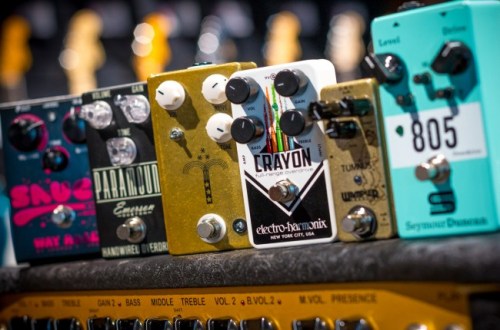
Unfortunately, this is yet another area where we get into murky territory, and where a lot of people confuse the two. So to start out, let’s just put it simply: Gain is input; volume is output.
To provide a bit more clarity, think about the function of an amp as a two-stage device. The first stage takes the relatively weak signal from your instrument, then passes it on to the second stage and amplifies the signal to produce the sound.
The first stage of an amp is called the preamp. The signal passed through the preamp is called Gain. The level of gain will have a direct effect on the volume of your amp. Typically, the more gain you introduce, the higher your volume. BUT, that said, higher and higher levels of gain will have a lesser and lesser effect on volume, as the pre-amp reaches its capacity to handle the amount of signal passed to it (commonly called saturation) and will max out sending all it can handle to the second stage or power amp.
Think of the power amp as the stage that controls the output strength of your sound, or volume, if you will. It works similarly to the pre-amp in that the more signal you throw at it, the louder your volume. Some amps come with a Master Volume. Think of it as a valve mechanism that controls the amount of signal that is allowed to pass into the power amp. When it’s wide open, all the preamp signal will pass through to the power amp. For amps without a master volume, the amount of preamp signal allowed to pass to the power amp is set by the builder.
So what does this have to do with pedals? If you look at the picture above, whether labeled or not, all come equipped with both a Gain (or Drive) and a Volume (or Level) knob. These work pretty much the same way as Gain and Master knobs on an amp. The Volume knob controls how much pedal signal will be sent to your amp’s preamp. That could be enough signal to saturate your preamp which will overdrive it into clipping and create distortion. Combined with a distorted sound from the pedal, this could – and in many cases does – create a very pleasing mix of distortion sounds.
So which kind of pedal to choose?
The pat answer is it depends on what you’re after with respect to your distorted tone. I know that this is a rather ambiguous statement, but again, there are no hard and fast rules. In the end, you should choose a pedal based on what sounds good to you. But here are a couple of guidelines:
- If you have a tube amp and just want distortion purely from overdriving the tubes, then a booster makes sense. There are several kinds of boosters. Some boost only a certain frequency range, like a Fat boost that boosts the lower frequencies. I personally prefer a clean, transparent boost that has a flat frequency response so that the distortion that occurs is my amp’s tone. I typically use a booster in conjunction with my amp set just at the edge of breakup, so when I switch it on, not only will I get a volume boost, I’ll overdrive the pre-amp tubes; and depending on how much gain I throw at the amp, I’ll get the power tubes working as well. Here’s a trick to try: If you have an effects loop, place the booster as the last pedal in your effects loop. When switched on, it will boost the gain going into your power tubes to saturate them. You don’t get a huge volume boost, especially if the power tubes are close to saturation, but you do get a bit of a kick. I learned that from Gene Baker, who does that in his rig.
- If you want to add a bit of color and overdrive your amp, then a soft-clipping pedal like a Tube Screamer works quite well. Tube Screamer-type pedals typically give you a mid-range boost that results in a much warmer and smoother distortion. Many also add sustain and a bit of compression to simulate power tube saturation at any volume. My Tone Freak Effects Abunai 2 is exceptional in this department. Then there are others, like the EHX Soul Food that add a bit color but interact well with the front-end of an amp. But that said, there are some like my beloved Timmy Overdrive that are transparent. They’ll give you the gain and boost but will not color your sound (Note: that you’ll still have to set up the pedal’s EQ). I will add though, that in general, an overdrive pedal sounds and performs best when the amp is already clipping a bit. The mixture of the two creates a more complex signal that is quite pleasing to the ears.
- If you want to get a distorted tone at any volume, then a distortion pedal is the way to go. There are lots of these on the market. My personal favorite (and the one I own) is the EWS Little Brute Drive. It’s a half-size pedal with a single knob, but it will give you TONS of distortion at any volume. I normally use it for leads, as it gives just a few dB of gain, but gives me all the distortion I need to get a great screaming tone! It also colors with a fat bottom end which makes leads sound beefy. Typically, you’ll use a distortion pedal against a clean amp. But then again, there are no hard and fast rules.
- Then if a distortion pedal still doesn’t provide enough gain for you and you need to get a hard-clipped, super-squishy, compressed distortion, then the fuzz will get you there. I call fuzz “ugly dog” distortion. To me it’s like an ugly dog that you look at and say, “holy s$%t,” but it has personality, so you can’t help but love it. Can’t say I’ve ever been into fuzz, but I’ve spoken to lots of players who use it all the time, and they love it!
You can also chain overdrive and distortion effects to great success (aka “stacking”). I do this quite a bit because you get colors that you can’t get with just your amp. One thing that I do regularly is to use an overdrive pedal to push my amp hard, then when I want to get more tube compression and sustain, I slam the front-end with a booster (which is the last pedal in my chain). This doesn’t result in a volume boost because the tubes are already saturated, but you do get much more high-gain sound, and that can really work with solos.
Again, there are no hard and fast rules. You have to play a lot of them to find your sweet spot. But that’s half the fun of it!
More Overdrive Murkiness…
I referred to my Timmy above as a “transparent” overdrive. There’s a lot of debate about transparency, but suffice it to say that while technically distortion is color, transparent overdrives are those that once their EQ is set up to match the EQ setting on your amp, they will not add any other “color” than distortion. On the other hand, once you set up a non-transparent pedal’s EQ, it will still add its own tonal characteristics to color your tone. In practical terms though, transparent overdrives fall more into the booster arena, but it’s the EQ and internal soft-clipping circuits that still define it as an overdrive.
But further exacerbating the overdrive murkiness is that many overdrive pedals are actually purpose-built to mimic the sound of a specific overdriven amplifier. These are meant to be played through a clean channel with lots of headroom. A good example of this is the Caitlinbread Dirty Little Secret that produces classic Marshall Plexi to Super Lead tones. With a pedal like that, you just set your clean channel to purely clean and let the pedal do the overdrive work.
Note: Several articles I’ve read on this topic use the generic “overdriven amp” explanation to describe all overdrive pedals. It would be okay if they described them with respect to how the pedal responds, but more often than not, they use the term to describe the sound. Unfortunately, they completely miss the pedals that are built to be transparent. I’m not saying they’re entirely wrong, but just a little narrow in scope when you consider the overall landscape of overdrive pedals available.
Now… let’s add even more murkiness to the overdrive issue, shall we? There are some overdrives like the EHX Soul Food, which is a Klon Centaur clone, that at first blush, fall into the transparent overdrive category. So one would think that you’d set your amp at the edge of breakup, then use the pedal to push it over the edge and add its own clipping. This is a common way of using an overdrive, and it’s exactly how I use my Timmy. But even though the Soul Food wasn’t purpose-built to mimic a particular amp, I use it almost exclusively as a standalone soft-clipping device played through a clean channel. Its distortion sound is so damn sweet that I don’t want to taint it by adding clipping from my amp.
So… what you choose will be wholly dependent upon what pleases you.
Update: November 26, 2012
I ended the article three years ago with the statement that you have to play a lot of pedals for find your sweet spot. Three years later, that statement remains true. You see, in a recent article where I asked if new overdrives are relevant with so many on the market, there are some pedals that work with certain rig configurations, and some that just do not. There are also some rig configurations that work great on stage that sound absolutely horrible in the studio. I’ve been in the studio for the last few weeks (grabbing studio time where I can), and when we worked on a song where I needed some high-gain sounds, my rig just did not work! I was using my trusty DV Mark Little 40 clean, with my Timmy and the Little Brute Drive for distortion. Sounded like crap when recorded. I ended up bringing in my VHT Special 6, cranking it up all the way, and slamming it with a booster! Worked like a charm, with all the high-gain character that I wanted out of that tone. So I learned a valuable lesson there.
 Guitar Gear
Great explaination!!!
Thank you for the clarifications.
What about Solid State Amps? How do you get a good sounding distortion from them? Clipping transistors do not sound good IMHO.
I haven’t found a solid state amp that can overdrive with anything even resembling good distortion. Most of the time the distortion they produce is because of a model of some sorts. I used to play with a Roland JC-120 – great amp! That was nothing but clean, but I loved it because it took to pedals so well.
What do you think a Distortion pedal is doing? Thats solid state clipping. You see, here’s the rub…many people who say they love tubes actually prefer solid state clipping–thats why a billion pedals are sold each year. People put a 90 dollar pedal in front of their 2000 dollar tube amp because they want to stiffen up the tube sound–they want a firmer sound–a solid state sound. A Tube screamer- being the destroyer of tube sound- is the biggest offender–as it doesnt scream the tubes–it bypasses the tube sag on the lowend making the sound stiff and plastic in the midrange. Put simply, guitar players are idiots 🙂
There is no sense to tone… I’ll be the first to admit that. 🙂
So an overdrive is more of a symmetrical wave and a distortion asymmetrical?
What you’re describing is two different kinds of distortion. I don’t know all the tech stuff behind all that acoustic theory, but symmetric distortion has to do with odd-ordered harmonics while assymetric distortion has to do with even-ordered harmonics. While it’s not necessarily academically recognized, a good discussion of this subject can be found here: http://en.wikipedia.org/wiki/Tube_sound.
With respect to overdrive vs. distortion, remember, in the strict sense, overdrive or over-powering causes distortion. The two terms really aren’t interchangeable as far as I understand.
I think a lot of the confusion comes from people describing the distortion they hear; for instance, “It sounds like an overdriven amp.” Unfortunately, a lot of people mistake the “overdrive” term when it’s used that way as distortion. Overdrive relates to input gain, whereas distortion is purely output and the result of input gain exceeding output capacity.
Interesting article / topic but I’m not convinced. I believe the difference lies in the type of clipping.
Overdrive was when you drive past the limits of analog componentry. As this was analog, you tend to get soft clipping rather than a more digital hard clip. I.e. overdrive /soft clipping is where the top / bottom of the waveforms are compressed -> some crazing = overdrive.
Though the wonders of science, you can hard clip things, so rather than compress the waveform over a certain limit you just chop it off = distortion.
http://upload.wikimedia.org/wikipedia/commons/2/2a/Clipping_compared_to_limiting.svg
Shows, 2nd one down being hard clipping, the wave forms are just chopped off, the last one being soft clipping, the tops are compressed.
So what does this all mean? An overdrive with soft clipping retains some shape / character of the waveform, so its likely to be less crazy and muddy. I.e. when you play things like chords when the waveforms interfere which each other, overdrive sounds good. Distortion on the other hand with the hard clip takes alot of the character of the wave form is lost, in turn gives a higher, flatter distortion and more importantly since the wave forms loose alot of their character multiple waves do not interact well -> chords sounding horrible. Look at the amount of clipping -> distortions give you more “compression” than overdrives (= flatter / smoother)
So if I want to enhance the sound of my guitar and let its sound shine, play chords etc then an overdrive ftw. If I want to flatten my sound a bit (lead), have some higher gain or something along those lines, then distortion ftw (or extreme overdrive which will be the same).
Unfortunately some pedal manufacturers are using either for whatever is more marketable.
Ah lol, didnt thoroughly read the last paragraph where you went into clipping, good stuff.
🙂 It’s all good, Jon! Thanks for the contribution!
[…] Overdrive vs. Distortion […]
You have dealt with some curious points here. I found this article by using Bing and I must admit that I am currently subscribed to the site, it is very decent 😀
I found some interesting models of Mayones guitars. What can you say about this line ?
excellent article! no one at the guitar shop could explain like this— 50+ beginner—
Check out Empress Arts Multi drive, this product has fuzz, overdrive and distortion. They run parallel not stacked, so it like blending 3 amps together. 3 band eq along with other filters and eq switches make this pedal very tweakable. Check it out on Youtube, it’s like 3 pedals in 1.
Nice. Parallel is good.
A couple of these [ http://www.behringer.com/EN/Products/MX882.aspx ] and you can parallel split/mix 6 pedals at once I guess (not sure about the balanced/unbalanced thing though – it only has XLR ins/outs….?)
Dunno but maybe this dude [http://www.uberproaudio.com/who-plays-what/155-rushs-alex-lifeson-guitar-gear-rig-and-equipment] used it for that very application..?
[…] back, I posted an article discussing Overdrive vs. Distortion, discussing what I believed were the fundamental differences between the two, but also pointing out […]
This is a great article. It really explains the differences in a way that beginners can understand it.
Thanks, Shaun! The article has evolved over time as my own understanding and experience has evolved as well; plus, I also found some nice tidbits to help explain the differences (like the oscillator images).
Thank you, thank you!!! Wow, I say finally I find a person who can explain this in a way that is so clear. You saved my sweet behind because I am doing a translating job on amplifiers and now that I understand what actually happens, I can translate it into Finnish language. I hope you are a teacher because I am sure the kids you teach will be very bright! I wish you were my teacher. Thank you again and take care,
All the best,
Kristiina
I used distortion pedals as an overdrive for along time (and suffered). Using a clean boost pedal was a real game changer after realizing that I was experiencing tons of signal loss through my chain of effects. A decent boost/overdrive pedal can recoup some of that.
You might try using a boost pedal after your pre-amp. I learned this trick from watching an interview with Gene Baker. He puts one at the end of his effects loop, right before the return jack. It provides just a little bit of volume boost, but it makes sure your power tubes get saturated.
[…] Overdrive vs. Distortion […]
Great article! Made a lot of sense. I have a question though. I’m looking at getting an overdrive pedal to use in the way you describe using your Timmy, seeing your amp up to almost break up and the pedal pushes it past that point. But if an amp has two channels wired exactly the same, you could just switch to the second channel set to an overdrive sound and get the same effect, right? If someone is able to let me know if I’ve interpreted this correctly that’d be great, thanks!
Adam, you can definitely accomplish that, but to achieve breakup, you have to increase input gain, and typically that will involve a lot more volume, unless your channels have independent master volumes, which most don’t.
When I use my two-channel amp, I have a dual-level attenuator (Aracom DRX) that has a switch that I can use to switch my amp’s channels. I set my clean channel to use the lower attenuation level, then when I switch channels, it kicks in the higher attenuation level, which also mitigates the volume jump. So when I want to get a dirty sound, I don’t have to worry about my volume jumping too much. This has been a godsend for gigging! http://aracom-amps.com/products/drx.html
One overdrive that I’ve actually been using in place of my Timmy is the EHX Soul Food. This is a Klon copy, and it absolutely rocks. I does color my tone, but in a real good way. The great thing about it is that I can set it for lots of breakup but not too much input gain, so I can benefit from my amp breaking up AND take advantage of the great clipping tones from the pedal. AND it’s only about $65-$75. Total steal!
Yikes. There’s some bad dancing in that video!
Perfect explanation, thanks!
Great blog! I use a custom-built single 6L6-powered blackface Champ amp circuit through an original 1965 Jensen C10Q speaker in a custom-built solid pine, finger-jointed cabinet about the size of a Fender Musicmaster bass amp. I mainly play a 1973 Strat with stock pups, sometimes a 2005 American Deluxe Tele. I set the amp volume so I get just a bit of overdrive, and need a transparent, no tone-coloring, NO MID-HUMP OD/distortion pedal for more drive when needed, and/or for solos. Would greatly appreciate hearing what you think. Thanks! Bill
Bill, one thing that I always have on my board is a transparent booster. I use the Creation Audio Labs Mk.4.23 Clean Boost (http://www.creationaudiolabs.com/#!mk423/cq2x). If I want a bit of extra chunk in my overdrive sound, I use either a Paul Cochrane Timmy (known for its transparency), or more recently have been using an EHX Soul Food Overdrive based upon the Klon Centaur. I love the Soul Food! While it does add a touch of color (which is extremely subtle), the sustain and voicing it provides outweigh any coloring concerns.
The Timmy was my go-to for a long time. It is also fantastic pedal. But Paul mentioned to me that it may not sound as good with Blackface amps. But that was several years ago. What’s great about getting a Timmy is you can speak with Paul directly, and he can guide you.
hello!,I really like your writing so a lot!
share we keep in touch extra approximately your article on
Great explanation. I use a MI Audio crunchbox (volume all the way up and gain at 10 o’clock) to boost my JCM 800 (preamp on 50%). It works for me. Am I doing anything wrong? I mean, can I damage my equip doing that? Do you recommend any changes? Thanks!
That shouldn’t do a thing. With master volume all the way up, all you’re doing is making sure that the whole signal goes to the power tubes. But with the preamps at 50%, you’re pretty safe. But damn! That must be loud!
[…] has a nice crunchy clean sound good for rock, and overdrive makes it […]
[…] Overdrive vs. Distortion […]
I adore you for this.
My attention span is set to 0 on good days, and I started reading because I couldn’t sleep. But I managed to read this entire article. You filled in so many blanks for me here. Very thorough. And the visualization of clipping helped oodles.
Keep on.
Awesome! So glad you enjoyed! This article has actually been a work in progress since I originally wrote it and I’ve added insights I’ve gained from experience. In any case, it’s great to hear feedback like this!
[…] Image source: Guitar Gear […]
Excellent post just found your site and wow great info been playing for years and is hard to find great info
Thanks, Alex! This is a post that I watch fairly closely because it has become my most active post – I guess I hit on something with it. As such, I actually update it as I gain more insight. 🙂 Have a great one!
I see you don’t monetize your website, don’t waste
your traffic, you can earn additional cash every month because you’ve got high quality content.
If you want to know how to make extra bucks, search for: Ercannou’s essential tools best adsense alternative
Thank for the heads up Distortion &Overdrive pretty cool tips.!!RockerRick