Summary: The littlest brother of the BOSS Katana line of amps, this amp packs heaps of tone and dynamics comparable to a valve amp. But instead of trying to cop the sound and feel of a tube amp platform, the Katana has a sound all its own, providing the characteristics one would expect from a tube amp.
Pros: Lots of praise to pile on. Use it as a clean platform – it takes pedals incredibly well. There’s access to over 50 built-in BOSS effects. The EQ is super-usable as well. Though listed as a 2-channel amp, with a second bank on each channel to set sounds, it’s effectively a 4-channel amp. The built-in acoustic preamp is not just usable, it sounds killer. Finally, with power attenuation of 50W, 25W, and all the way down to 0.5W, this amp will perform in any kind of venue. And though the smallest of the Katana line, this comes equipped with a more than capable 1 X 12.
Cons: The ONLY disappointment I have with the amp is that it doesn’t have a line out which is included with the 100 Watt models. But this is simply my nitpicking. I figured that BOSS included some really cool stuff, why not a line out? But no matter, this is still a great amp.
Tone Bone Score: 5
Maybe it’s my initial infatuation talking with this amp, but I’m loving it! Yes, I just got it, but I’ve played countless combinations of gear over the years, and I know what I like, and I absolutely love this amp!
Street Price: $219.99 ~ Yes, you read that correctly…
Swallowing my pride…
If you’ve been reading this blog for awhile, you know that I am of the mind that if it sounds good, it is good. But when it has come to amps, I have – up until recently – been of the mind that no solid state amp could even come close to the sound and performance of a tube amp. Even when I reviewed the Fender Ultra Chorus, while I loved the absolutely inspirational clean tones that amp produced, it was still fairly one-dimensional in what it could offer. But all that has changed with the Katana 50.
I’m still scratching my head, thinking how could a literally inexpensive, solid state amplifier perform on par with a tube amp with similar tonal charm and dynamic response. It’s uncanny, but it’s true. Of course, I realize that this is my own truth speaking. Someone else might think it’s crap. But I’ve spent the last 5 or so hours playing a variety of guitars through the amp – both electric and acoustic – and after dialing in the EQ for each guitar, I just haven’t found a bad sound yet.
And get this: I haven’t even begun to use the onboard effects to any extent other than just experimenting because I wanted to use this as a clean platform for my pedals. The only effect I’ve used with any regularity thus far is the very nice reverb, of which you can use three different kinds. But admittedly, I’ve only used this sparingly because for some reason, the reverb is tied into the delay, so you always get a bit of delay. It’s actually not that bad, but if you just want pure reverb, by default you won’t get it. You’ll have to go into the software to program it out. Not a big deal.
This is a real pride-swallower for me. When I got the amp, I did something that I never do when I evaluate gear. I actually tried to make it suck. Granted, you can make anything sound like crap by adjusting to the extremes. I’m more fair than that. But I threw every guitar in my usable arsenal at it, threw several kinds of pedals in front of it, but with only a few simple tweaks of the EQ, I not only got usable tones from the amp, but most were also damn good!
Not to mention the dynamics of the amp. BOSS somehow figured out how to effectively cop a voltage sag in the amp, so there’s lots of sustain which is very apparent when playing clean. With the acoustic preamp channel, this “sag” has a very nice overtone effect. My acoustic sounds gorgeous through the amp. So… hat in hand, I just can’t find anything bad about the performance of this amp.
Did I also say it’s LOUD? Typically when you’re talking tube amps, 50 Watts is searingly hot. Traditionally with solid state amps, those wattage numbers mean practically nothing. But this amp is capable of being very, very, very loud. Luckily though, the amp has built-in ouput power attenuation. You can set it to 50W for maximum clean headroom – and volume – switch it down to 25W to get some great gain at a lower volume, or 0.5W to use for bedroom practice.
Now some have commented that the attenuator is a little redundant and doesn’t make much sense since the amp has a Master volume. It’s a solid state/digital amp after all. But the Master volume acts as a variable regulator relative to the power setting, so you can’t exceed the output at that setting. This makes it very useful, at least to me.
My Original Introduction to the Amp
My first exposure to the amp was in a local Guitar Center the other day. I was checking out a Roland JC-40 and another guy was playing a Katana 100. The dude was freaking incredible, having set up the amp tone to sound like Eric Johnson. It was amazing, and the dude could play! As a test, I started playing some riffs and chord progressions to give the guy a canvas to play over, and we did an impromptu jam session. I have to say that I was quite impressed with the Katana. And to be perfectly honest, up until I played it in the shop, I knew very little about it, having dismissed it as a simple practice amp. Boy, was I wrong!
Fit and Finish
Some people have complained about the black on black color scheme. Me? I actually kind of dig it. It’s very understated. The amp also has a little kickstand underneath to tilt it back. Very nice touch. The cabinet is made of MDM board, not solid wood, but it’s thick and sturdy. But the kicker is that the amp only weighs 25 lbs. Very luggable.
How It Sounds
I’ve heaped on the praise of how the amp sounds, and I will provide a sound test entry in the next few days. But the notable thing that really stands out for me is the voicing of the amp. The open back really helps the lows resonate without dampening the tone into mush. My past experience with solid state amps is that the lows are flabby and if you turn them up to any degree, it’s like throwing a blanket over the cabinet. Not so with this amp.
And speaking of EQ, this is yet another impressive feature of the amp. The EQ is highly responsive with what seems like a very wide range for each of the three sections. Want a scooped tone? No problem! Want a midrange hump? Very easy to dial in, which makes it super-easy to get a great tone for whatever guitar you place in front of it.
And make no mistake. This amp isn’t trying to be a Fender or Marshall, and this is what endears it to me so much. It sings in its own voice, and that voice is very pleasing to me. Like I said, others may find that it’s crap, but I’m never going to be one of those people. This is a solid amp that I will be using with regularity going forward.
When I finally had a chance to play this amp where it generated lots of SPL, I was BLOWN AWAY! I played this amp on a weekend youth retreat with a full band consisting of two guitars, a keyboard, bass and drums. And I have to say that when this amp is putting out sound, it’s big and three-dimensional. Hey! It sounds fantastic at low volume, but I think it shines best when it’s pushed hard!
How It Plays
This is definitely where I fell in love with the Katana. The dynamics are absolutely incredible, responding to attack and volume changes with ease. And as far as the dirt that the amp produces. Damn! I didn’t think solid-state breakup could sound this good. But then again, dirt pedals are solid-state and they achieve their clipping with chips. BOSS definitely got it right with this!
Is the Katana a Modeling Amp?
Several reviews out there have called the Katana a modeling amp, probably because of the built-in effects and gain settings which seem to mimic a modeler. But even with my limited experience with this amp, those gain settings seem more like voicing rather than models trying to copy an amp. Unfortunately, they call their highest gain setting “Brown Sound.” But to me, it mimics the amp and power settings EVH used rather than a model of his original Marshall. Like I said, the amp has a sound all its own, so at least to me, it’s more an amp with different voicings rather than a modeling amp.
Yes, the amp uses COS-M models that – if you ever played a Roland Cube – have been at the heart of Roland’s amps for years. But it seems that these have been done in such a way that they’re not trying to mimic a particular platform. But then the question really is: Does it really matter if it’s a modeling amp or not if it sounds and performs this well? I’m convinced it doesn’t matter, but I’d encourage you to check it out for yourself.
Real World Performance (2/6/2019)
I normally save this discussion for a Gig Report article, but I thought it would be helpful since this review gets a lot of traffic. I’ve now been playing the Katana regularly for the past 4 months. The speaker is nicely broken in, and as with any new speaker, the brittleness of the speaker cone has been completely smoothed out.
My regular usage has been at weekly church services, and it has performed remarkably well in that venue. The great thing about playing at church is that the musical styles vary – a lot. My particular band doesn’t just stick to the country-infused Contemporary Christian stuff. We play reggae-inspired music as well as guitar-centric classic rock style music and, of course, soft, inspirational music thrown into the mix. No matter what style I’ve played through the Katana, I’ve not yet been left thinking that this amp isn’t enough.
I’ve also played a few larger (as in louder) venues as well, and I do have to say that when the Katana’s speaker is pushing some serious SPL, the sound is absolutely magical. I played a weekend retreat a month ago where I was able to set the amp to its full 50 Watts. At that venue, I was all about maximum clean headroom. I hit the front-end of the amp hard with an overdrive pedal (specifically, the Tone Freak Abunai 2) and the amp just SCREAMED! The cabinet is extremely resonant, and the sound that issued from the amp was lush and rich. At several points over the weekend, I just closed my eyes and let my fingers do the talking through the amp!
Overall Impression
What more is there to say? I love this amp! And no, it’s not because it was cheap. That’s definitely something to giggle about. But even if it wasn’t this cheap, the tone and dynamics alone make this an incredible amp irrespective of the price.
Read Full Post »


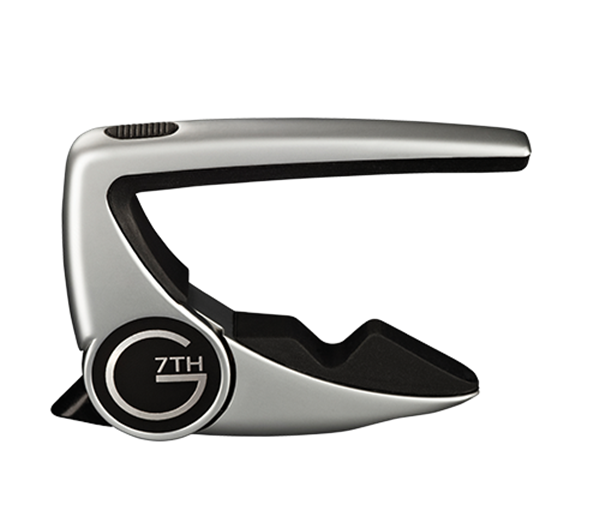 Conceivably, all capos operate pretty much the same way: Place the capo at a fret position and go. I’ve played with many capos over the years, starting out with the traditional folk guitar, elastic strap capo, then moving to Shubb then most recently, Kyser capos, of which I have several.
 Guitar Gear