Feeds:
Posts
Comments

Archive for April, 2019

Letting Go

I was listening to a radio talk show and the guest mentioned Toni Morrison, the great African-American novelist and Princeton professor. I’ve known of Dr. Morrison for years, as she won the Nobel Prize for Literature in the early ’90’s, but I needed to refresh my memory, so I googled her name and came across this wonderful quote:

You wanna fly, you got to give up the shit that weighs you down!

Toni Morrison, Nobel Prize Winner for Literature 1993

What a GREAT quote! Gear slut that I am, when I read the quote, I immediately thought of playing guitar and my own journey with this instrument these past 50 years. And looking back, I realized that my most accelerated growth periods came from giving up my shit; that is, letting go of my preconceptions and old habits to allow me to explore new and different approaches to playing.

For instance, a few years ago I really got into playing reggae. At first blush, reggae’s predominant “um-chuk um-chuk” rhythm seemed so easy. And I figured that since I had be playing guitar so long, I could easily make the transition; after all, how hard could it be? But what I realized was that the “um-chuk” was merely a rhythmic foundation that belied a musical and melodic complexity that requires immense study to master. And singing and performing reggae can be incredibly difficult because many of the melody lines are sung against the beat. This forced me to overcome my rock-and-roll, four-on-the-floor approach to guitar. Once I let go my notions and approach to playing music was I able to play reggae with any sense of proficiency.

As you can tell, this article isn’t an instructional “how-to” article, but if you want to improve your playing or expand your musical palate, you have to let go of your preconceptions. We’re human. Humans love habit. But whether it’s a habit of action or thinking, with habit, we run the risk of letting habit metastasize throughout our entire being and fixing us into set ways, ultimately limiting our ability to grow and expand. To improve – in anything, not just guitar – we have to break free of our fixed notions.

Especially if you visit online guitar discussion forums, you’ll encounter and interact with many people who are fixed in their thinking. Look at the tube amp vs. solid state amp debate, for instance; or the preponderance of jazz and metal heads spouting all their shit about modes and major scales and dismissing any other forms of music. I was “that guy” with tube amps. But when I first played my BOSS Katana 50, all those old notions were completely obliterated! It’s now my main gigging amp.

This is not to say that we all become centrist in our thinking. There is absolutely nothing wrong with passion for something. But if we want to expand our experience, as Toni Morrison says, if we want to fly, we have to give up the shit that weighs us down!

Read Full Post »

Lessons I’ve Learned

I’ve been playing guitar for almost 50 years and have been performing publicly for over 40 years. In that time, I’ve learned some valuable lessons that I thought I’d share.

There’s always someone who’s better

This is the ego check I give myself to ensure that I never get complacent and always stay humble. It’s not that I spend time comparing my skills to other guitarists’ skills, but if I found that if I let my ego get in the way, I stop learning. Simple as that.

You will never sound like the original artist

And that’s a good thing. The sound of your voice and the sound of your instrument come from YOU. I get that in some cases you want to at least get an approximation of the original artist’s performance for context’s sake. But your sound is yours. And especially with guitar, your hands are different, your strings are different, your gear is different. So own it!

Learn to get the most out of what you have first

Having gone the route of buying tons and tons of gear and eventually selling off 90% of it (though I’ve kept most of my pedals because I still like them), only to realize that I had everything I needed in the first place, I’ve learned to take a much more measured approach to gear. I now spend countless hours trying to discover different ways to eke out all the different sounds I can get with what I have. If there’s a sound that I just can’t get, then and only then do I look to new gear. By doing this, I discovered sounds I never thought possible with my existing gear, and all it took was learning techniques to achieve those sounds.

I give this advice a lot, especially to young players. For instance, one of the kids in my church band has been buying up gear at an alarming rate. He has the means, and most of the time, I’d just say que sera, sera. But this kid has the potential to be a GREAT guitarist one day, so I was honest and told him to take the time to discover the sounds he can get from his current set of gear before he moves on.

Never play in an altered state of mind

I was in a cover band a couple of years ago and we did a gig where I got drunk off my ass on half a bottle of bourbon. I thought I was ripping it until I heard the recording at our next rehearsal. I was SO embarrassed. My bandmates laughed and were very gracious, but I sounded like a hack! I vowed then and there that I’d never perform in an altered state of mind again.

And even if I don’t play drunk, I spend about 15 minutes before a performance getting myself emotionally centered. Extreme emotions can affect your performance in a bad way, especially negative emotions like anger.

Your gear is what YOU make of it

This is related to the section above about getting familiar with your gear. But this takes a different tack: Don’t ever be embarrassed by what you have. You will encounter several gear snobs – especially on the gear forums – in your life who will tell you to get such and such guitar, or as soon as you get a new guitar, swap out the pickups, etcetera, etcetera. Just remember that “truth” is purely subjective. We all look through the lens of our own experience and while it’s not wrong to listen to what other people volunteer, it’s their truth, and in the end, you’re the one who has to play your gear and more importantly, you’re the one who made the investment in the first place. Free advice costs nothing for the giver so be careful on the value you place on it.

So just remember this: If what you have inspires you to make music, then that’s all that matters! Anyone who tells you different is just a frickin’ wanker!

If it sounds good, it is good!

Yeah, I’m copping Duke Ellington, and I’ve written entire articles around this phrase, but it’s important so I’ll keep on repeating it. This phrase especially applies to the tube vs. digital/solid-state amp debate but can be applied to just about anything such as boutique pedals vs. mainstream pedals. Doesn’t matter. If it sounds good to you, and like I mentioned above, if it inspires you to make music, then that’s all that matters.

Especially with the tube solid state vs. digital/solid-state amp debate, bear in mind that some guitar greats such as Joe Satriani and Buddy Guy have used solid state amps. You’re not going to tell them their tone sucks. So please, don’t get pulled into that kind of thinking. Keep an open heart and mind, and you’ll open yourself up to a big, wide world great gear!

Read Full Post »

At noon today, I received an email from Preston Thompson Guitars. I always look forward to these emails because they usually contain news on their latest builds or cool stuff they’re working on. Plus, having met Preston Thompson at his shop in Sisters, Oregon a couple of years ago, I have always fondly remembered the time my youngest son and I spent in the shop learning about the guitars he and his team had built.

But this email was sad; announcing that he had passed away on April 11th. While I only met him in passing, and even though we didn’t have a long conversation, what I took with me when I left his shop was this sense of awe of the instruments that were being built in his shop.

I had the privilege to play one of his “Shipwreck” Brazilian rosewood guitars that was slated to go out to a customer. Based on the 1937 Herringbone Dreadnought, the deep lows and crisp highs, combined with an enormous projection was just about the most amazing acoustic tone I had ever heard. I couldn’t afford the $10k he was asking for it, but to be able to just play one of those fine instruments was simply inspirational.

They even had a custom-made ukelele for my son to pluck at, and we had a little father-son jam in the shop! Needless to say, we both left with big smiles on our faces.

Preson Thompson’s legacy will live on through his family and the wonderful team working at his shop. I wish them all the best!

Read Full Post »

Cleaning Your Guitar

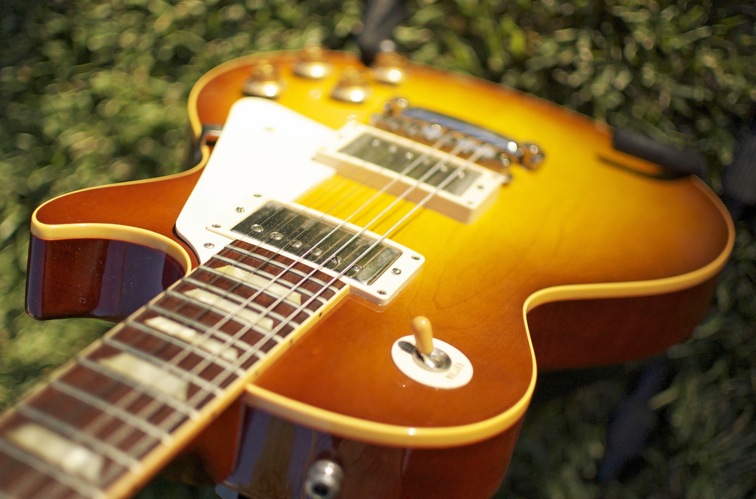
If you spend much time on forums, you’ll see threads occasionally popping up about cleaning and maintaining your guitar. Based on the threads, it seems that there are some folks who are absolutely obsessive about cleaning and oiling their fretboards, like every couple of weeks. But having spoken to my guitar tech and a couple of luthiers about this very subject, they all seem to be in agreement that people tend to clean and oil their guitars way too much.

My guitar tech put it this way: “Think about it. Your guitar is like a nice piece of furniture. In fact, the wood used for making a guitar – especially the fretboard – is almost always a higher quality than used in furniture. But even if you have a furniture piece that’s made of high-quality wood, how often do you clean and polish it? Generally, you just wipe it down with a soft cloth to remove the lint and fingerprints and what-not. The same applies to a guitar. Wiping it down regularly with a soft cloth will prevent gunk building up. Oh, and please remove pick and skin dust from your playing area.” He directed the last statement specifically at me because I’m notorious for not cleaning that area. 🙂

I got that lecture a decade ago. And since then, I followed his advice on some simple things to do to clean and maintain my guitars.

  1. First off, if you don’t see any gunk buildup, don’t be tempted to do a cleaning. Most likely the guitar’s clean, but it’s always a good idea to wipe it down with a soft cloth.
  2. If you do see some gunk buildup, before you do anything, see if you can scrape it off with some soft plastic, like a credit card. Chances are that it’s just on the surface. Then finish that off with wiping it down with a soft cloth (seeing the pattern here? Have a soft cloth always handy).
  3. There are times where even a scrape won’t do the job. But for cleaning, DON’T USE OIL! For your fretboard, use a 50-50 mixture ratio of water to white distilled vinegar (a little stronger if you have a fairly nasty buildup). Dip a cloth into the mixture – you don’t want to pour it on – and work the cloth into the gunky area. If you have a particularly pesky area, use a super-fine steel wool with the mixture. Once you’re done cleaning, thoroughly dry the wood, then use oil. Personally, I use linseed oil, though many people say to use lemon oil. Martin guitars recommends against using lemon oil because the acids in the oil can break down the fretboard wire. Hmm… In any case, use it sparingly, applying a small bit on a cloth, then wiping and working it into the wood. And by the way, you should only need to do this once or twice a year – at most.
  4. As for the body, regularly wiping it down with a soft cloth should suffice most of the time. But if you have to clean it, use a highly diluted soap and water and use circular motions to clean. There are also various cleaners compatible with nitro or poly finishes. These can be picked up at either a guitar store or even a hardware store (but you’ll have to do your research on the types of finishes they can be used on).

These are really simple things to do. And you shouldn’t have to do more than wiping your guitar down very often.

Read Full Post »

Jamstack…

I purposely made the title hanging like I did because I’ve made a name for myself by not panning products. But there are some products that really don’t make a lot of sense to me. Recently, I’ve been seeing a lot of ads pop up on my social media for the Jamstack portable amp; you know, the one that attaches to the body of your computer. It’s a novel idea, and the demo videos certainly do the product justice, BUT…

  1. I’m not sure where I would personally find this device useful. Now I realize that it’s really not meant to be a performance amp. And I can see some real usefulness for jamming at home. But if I’m just jamming and practicing, it’s just as easy for me to plug my guitar into one of my amps, or attach my iRig to my guitar and mess around with AmpliTube on my computer.
  2. At $249, it’s a pretty hefty price to pay for something that will never leave my house. Yeah, I suppose I could take it to friends’ houses to play. But when I’ve done jam sessions in the past, there’s usually some kind of drum kit. No way could this keep up with a drummer, even if he or she played really softly.
  3. I searched long and hard and couldn’t find a single review from one of the major guitar gear magazines. Maybe I missed them, but the only reviews I’ve seen on this are mostly from tech gadget sites that aren’t guitar focused. And the reviews that are on general musical instrument sites seem suspiciously like paid advertisements disguised as reviews. And more than anything else, the absence of a review from a major trade rag despite all the money that’s being spent advertising this gives me pause.

If the cost was more in line with some of the micro amps that are out there, I’d probably take a more serious look. But at more than twice the price of a micro amp, it’s a tough proposition to get me to even consider equipment like this.

Now don’t get me wrong, I’m sure that Jamstack works great for what it does. But there aren’t enough compelling features to get me to buy one.

Read Full Post »