Feeds:
Posts
Comments

Archive for October, 2019

Several years ago, I wrote an article entitled, “Are New Overdrives Irrelvant?” It was a blog entry I wrote during the heyday of this blog where I was evaluating gear left and right; especially overdrive pedals. I answered my own question with a resounding “No” because of all the different overdrive sounds available.

Think about it. You have all sorts of overdrive sounds to choose from: Op Amp, Diode, Tube, Analog Tape, MOSFET, JFET, Germanium and Silicon Transistors, not to mention profiled and modeled overdrive sounds, just to name a few. They all make different sounds. And luckily for us, there’s an overdrive sound or many overdrive sounds that will be pleasing to us.

And it’s why I’ll never tire of overdrives. For instance, this afternoon, I watched a couple of demos of the Strymon Iridium and Deco pedals. The Iridium is a modeler/IR pedal (it sounds freakishly good, by the way), while the Deco is like a dual analog tape machine that provides saturation/overdrive on one side with tape delay on the other, then uses blend and wobble knobs to adjust the mix and interaction between the two sides. That tape saturation is freakin’ awesome!

However, for a while there, about 10-15 years ago, during the heyday of boutique everything, there were lots of copycats. I couldn’t believe how many Tube Screamer knock-offs that were being released to the market with fancy packaging and cool graphics, but inside were nothing more than TS circuits. But that said, there were lots of very very cool gems out there like the Geek Driver based on the ColorSound Overdrive. Totally different approach. Even the introduction of the TC Electronic Mojo Mojo Overdrive was totally cool.

And here’s the conundrum I face with respect to all the great digital amps coming to market: I love my overdrive pedals! For instance, as much as I’ve loved both BOSS Katana amps I’ve had, I have to admit that though the sound quality of the drive models in the amps are pretty good, I’ve never been a fan of BOSS drive pedal sounds.

I love the gain sounds these produce, but something about the drive pedal sounds whether in software or hardware form has always bugged me. So I put a drive pedal in front of either amp or, in the case of the Artist, I plug my drive pedals into the effects loop as I can place the loop immediately after the input (pretty cool).

The point here is that at least for me, I’ll never tire of exploring overdrive sounds. Someone will always come up with a new twist: Use a new material, discover a different chip, configure a different kind of circuit. I suppose eventually all the possibilities will be exhausted, but for now at least, we can enjoy a variety of new ways of expressing our distortion!

Read Full Post »

I discovered this guy completely by accident when he did a demo of Strymon’s incredible modeling pedal “Iridium.” This pedal might just be a game changer, and I don’t say that lightly. Here’s the demo, then I’ll post a bit more about Keven himself.

BTW, he’s plugging directly into the pedal and getting all his overdrive from it then going straight into his DAW!

After watching the demo above and having a WTF moment about Kevin’s playing, I took a bit of time to do a bit of research on him.

Though obviously Asian, he’s actually from Norway and moved here to study at Berklee College of Music. Before coming to America, he recorded his first album when he was nineteen called “Extraterrestrial.” Here’s a video from back in 2013 of the title track:

Nineteen years old and playing with that kind of sound and technique? And from what I can tell from his review and instructional videos, he’s not at all arrogant. Kind of like the dude you’d love to hate but you can’t ’cause he’s too nice.

Anyway, he apparently now lives in Nashville, and I haven’t seen any videos or activity – at least from a songwriting and performance perspective – from him since 2017. But apparently the kid’s absolutely busy having gotten his union card, so chances are he’s a first-call musician; in other words, super-busy.

Here’s another fun video of Keven on the Opry Christmas show in ’17:

That would be totally cool to descend to the stage on a wire!

I think the thing that most impressed me about Keven’s playing is his musicality. He has technique and tricks I can only wish I had. But he doesn’t go on five-minute shreds. He lets his solos breath and takes his time where he needs to. There’s a restraint to his playing that makes me want to listen to him more.

Check out his YouTube channel here. He does lots of reviews and some very good instruction. I subscribed so I can keep up with what he’s doing.

Read Full Post »

You’ll Never Sound Like

Oh, you can get close. Damn close, like SoloDallas on YouTube. He’s an Italian guy who’s absolutely obsessed with AC/DC and specifically Angus Young. He can pretty much cop any of Angus’ licks and solos. He’s about the closest I’ve seen anyone get to Angus’ sound. BUT he still sounds like himself.

One of the greatest compliments I ever got was when a gentleman walked up to me at the restaurant I used to play at and told me my playing reminded him of Eric Clapton’s style. It was so cool to hear that. We talked a bit and I found out that he was also a guitar player and during the conversation he said, “I’ve found it’s pretty easy to play like another musician, but it’s an entirely different matter to sound like ’em. But even though the sound’s important, the emotion is more important.”

Wiser words could not have been spoken.

How we approach our playing and how we ultimately sound depends less on our gear and so much more on our emotional investment in what we play. And those emotions affect how we manipulate our instruments. So while it is possible to get pretty close to the sounds of our guitar heroes, there will always be something of ourselves that make us sound different; that is, like ourselves.

Read Full Post »

Back near the turn of the century, I purchased “Rusty,” a Gibson ES-333. It was the size and shape of an ES-335, but it was more of a budget model. The Gibson label was a sticker, it had dot inlays instead of trapezoids. It had a rear access panel on the back to get to the electronics and came equipped with uncovered Gibson 490R and 498T pickups. It was a rock guitar.

I got it for a song at the now-defunct Haight Ashbury Music store in Sunnyvale, CA, a place I frequented a lot in those days. The guitar was basically the “shop” guitar when I got it. There weren’t any dings, but there was a bit of fret wear and discoloration on the fret board due to the guys at the shop playing it. They wanted $1400 for the guitar at the time, but said they’d give it to me for $900. I talked them down to $700 after I nitpicked on the wear.

I played that guitar for a few years, then in 2008 the market came crashing down. And though the company I worked at the time didn’t lay anyone off, we all had to take temporary salary cuts and and that put my family in a financial jam. So at the urging of my wife, I sold the guitar to a local Music-Go-Round.

When I left the store, I knew that I had done the wrong thing. I was absolutely sick to my stomach as I drove away and totally pissed off that I had given into my wife’s – and my – financial worries.

When I got home, I handed the check over to my wife. But as I gave it to her, I told her that I was never going to do that again. I felt as if part of my heart was ripped out. I made sure to tell her that I wasn’t blaming her, but going forward, I wanted to consider other possibilities before I had to sell gear.

I think at that moment, when my wife saw how deeply hurt I was, she understood that my guitars were more than just “stuff” to me. And though she had a hard time accepting it, she nodded her assent, and that was the last time she ever suggested me selling stuff off when the subject of finances came up.

That didn’t stop her from telling me a few years later that I had too many guitars which, at that point in time, I actually did. 🙂 So I thinned my stock and have the guitars I’ll play for the rest of my life. Though there is one unicorn that I want and that is a Gretsch Brian Setzer. I’ve played that guitar several times, and it’s magic!

But I do regret selling that ES-333. It gets me thinking what direction my music would’ve taken had I held onto that guitar. To date, I haven’t played an ES-33x that even felt or sounded like my 333. I thought I’d bond with a gorgeous 1987 ES-335 that I picked up on vacation. It just didn’t have the mojo of my ES-333.

All that said, do I want to get another ES-333? No, not really. My Les Paul pretty much covers everything for me, and I have a few other guitars in my arsenal when I need a different sound. At this point, an ES-33x would be a bit redundant. And let’s face it, though I’d love to get a Gretsch Brian Setzer, that would be a guitar I’d get just because. I can’t justify nor could I afford spending $3600 just because.

So from another perspective, if I hadn’t sold my ES-333, I may not have eventually gotten my Les Paul. I found my sound with my Les Paul despite the ES-333 being so near and dear to me. And I do realize that it’s the optimist in me that wants a silver lining. But truth be told, my Les Paul really is the silver lining to this.

That’s doesn’t diminish the anguish I felt at the time. It’s a sickening feeling that I never want to experience ever again. I will never get rid of my Les Paul – ever. I may get another one down the road, who knows? But I’ve found my sound. I’m not going to be willing to give that up.

Read Full Post »

I Hate New Strings

A buddy of mine and I were having a discussion once about when we change our strings. He changes strings every week, whether he’s gigging or not because he likes that brightness and his hands sweat a lot. Me? I’ll only do a full change maybe once every couple to three months, if that. And in between, I just change them as they break. Plus my hands don’t sweat much, if at all, so I’ve never experienced the corrosion my friend described – yuck!

And mind you it’s not laziness. I just don’t like the bright sound of new strings. And almost never play unplugged – even with acoustic – if my sound seems a bit dead, I just add a little treble, and it usually doesn’t require much.

Plus, I like to fight with my guitar a little and older strings require a bit more work to get a good tone. To me, there’s something to digging into the fret to make a string sing. Is it weird? I don’t know. Maybe it is. And maybe my tone sucks and people are too nice to tell me to my face.

My personal preference for a guitar sound, especially with my acoustic, is for a much more subdued sound than with brand-new strings. I eventually do get to a point where I’m just not getting anything out of them and I’ll change them out entirely. But my usual practice is to just change a single string if it breaks.

But that said, I did change strings a bit more often, like every three or four weeks when I was gigging over 200 days a year. With that much time on my guitars, they got to their point of no return a lot faster. These days, I’m gigging maybe 75-80 days a year, so I just keep them on – sometimes for months.

I also think that part of it is due to the picks I use and my pick technique which has gotten much lighter. I use Wegen Picks Fatone (it’s literally misprint on the labeling for “fat tone”) picks. These are 5 mm thick with a nice bevel. Using a fat pick has made me pick a lot lighter which means less stress on the strings.

I used to use Dunlop Tortex Medium and Heavy picks (orange and yellow), and used to absolutely hammer my guitar. I’d break strings all the time. But with my Fatone, it’s more of a brushing action. So they just don’t wear out. Plus with a fat pick like the Wegen, the bevel makes a bit brighter of a strumming tone.

And I also play with coated strings (Wyres Coated Phosphor Bronze 12 16 24 36 46 56 I prefer the fat 5 and 6 strings), so they last a long time. And by the way, Wyres are awesome strings, handmade in Canada. If you’re interested in checking them out, don’t order direct. Buy them from Elder Instruments. If you order from Canada, it’ll take weeks for delivery. They offer a bunch of different gauge combinations. Great bass response!

Read Full Post »

Summary: Versatile and great-sounding, the Eon One is a perfect sound reinforcement solution for a solo artist or up to a small combo.

Pros: As you’d expect from JBL, the Eon One has a fantastic and balanced sound. The array disperses the signal pretty wide and will fill a space quite nicely. The 10″ subwoofer rounds out the bottom end without being boomy or thumpy (though you can definitely get there with EQ). There’s also no extra bag to hold the risers and array. They all fit in a compartment at the rear of the unit.

Cons: This is a nit, but it seems as if there’s a difference in power using an instrument cable versus an XLR. When I plugged my guitar straight into the input, I had to crank the volume to balance it with my vocal. Suspecting that power-handling was different, I ran my guitar into a passive DI and lo and behold, there was a definite power jump. But like I said, this is a nit. Besides, from past experience with different PA systems, it’s always a good idea to go into a DI with my instrument outs.

Tone Bone Score: 5 
Based on the sound quality alone, I give this 5. But I could also give it a 5 for its smart design. JBL really did have the solo musician in mind when they built the Eon One.

Street Price: $999 

I have to admit that it took me a while to get used to the sound projection of this unit. My old SA220, while it dispersed sound pretty good, was definitely much more directional. With the Eon One, sound dispersal is wide and it doesn’t seem like it’s loud enough. But that’s the point of a speaker array like the Eon One. It’s actually a lot louder than you think. The sound is dispersed so well that it fills the space.

For example, while I was setting up for my gig this morning – a teen retreat for my church – I connected my phone to the Bluetooth on the Eon One and played some music. At first, I didn’t think it was very loud and I cranked it. But then one of the retreat leaders arrived and we started having a conversation. It was difficult for us to hear each other which forced me to turn it down. But even at a lower volume, the awesome thing was that the room was totally filled. No matter where I was in the room, the volume was level. Damn! I love that thing!

Fit and Finish

At 40 lbs., it’s no lightweight. But the way the unit is designed, it’s actually incredibly easy to lug. I lugged it up two flights of stairs and it was like carrying a large suitcase.

It’s also durable. I tipped it over with my handcart by accident onto the blacktop in the parking lot of the retreat center. I was so nervous that I might have damaged something, but I plugged it in and it worked like a charm! Though I’m bummed because I hadn’t even used it yet and I scratched it. Crap! The body is made of high-velocity plastic, so it’s pretty tough.

How It Sounds

As I mentioned above, the sound dispersal of the Eon One is incredible. It’s actually a little unsettling because you just don’t need to be that loud to fill a space. I was so used to operating with a much louder volume with other PAs that I just didn’t think I was loud enough with the Eon One. But it’s deceptively loud because of the dispersal. You just don’t realize it until you’re in the middle of the space and you can’t hear the person next to you. 🙂 That’s a good thing!

But as far as sound quality is concerned, it’s like playing through a HiFi stereo. The sound is crisp and clean. There’s no signal noise whatsoever.

As the retreat participants were arriving at the venue yesterday, I was playing music through the Bluetooth connection. It was like listening to my surround sound system! The music sounded so good and I have to say that that subwoofer makes all the difference in the world, rounding out the bottom end and providing a richness I hadn’t experience in my old SA220.

My close friend Catherine who was a retreat leader walked up to me when she arrived and remarked, “The sound system is amazing! Did the center upgrade their system?” I laughed and said, “It’s like a HiFi, right?” She agreed. Then I pointed in the direction of the Eon One and told her all that was coming from that slim, little unit. We both cracked up at how great it sounded, and then she said, “I can’t wait until you start playing. You’re gonna sound awesome!”

I was so pleased with how I sounded yesterday. With the subwoofer on the Eon One, there was a warmth in my sound that I had never experienced with my SA200. And don’t get me wrong, the SA220 is actually a great PA, but the Eon One is on a totally different level as far as sound quality is concerned. I’m probably going to donate the SA220 to my church so they can use it for events.

Every year, I host a large party at my house where I barbecue a whole pig. It has been a family tradition since I was a little boy that I’m carrying on to this day. My son, who is learning the tradition from me, remarked that the Eon One would be great as the sound system for our pig roast when he heard it. And because its footprint isn’t nearly as much as the SA220, I could position it in the corner of my patio to keep it out of the way.

Ease of Use

I thought my SA220 was easy to set up and use. Though there are more pieces than the SA220, none of the pieces of the Eon One are bulky, and the risers and array just slide into place like Legos. And the fact that they’re right there in the back of the unit makes it so much more easy to set up.

I read some complaints from people that it’s difficult to take the unit apart as the pieces are snugly put together. People have used silicon jelly to help with that. I guess they just want to pull the risers out straight. But it’s really not that big a deal. You just use a gentle rocking motion while pulling out and the risers come out easily. For me, I’d rather not apply a lubricant on the equipment as that will collect dust.

As far as the controls are concerned. You have Bass, Treble, Volume, and Reverb Level knobs. Very straight-forward. I was concerned that there wasn’t a Midrange knob, but it’s easy to dial in a balanced tone with just the Bass and Treble.

Best Bang for the Buck

Are there better-sounding systems? Absolutely. The Bose L1 Model 2 is scary good. And the HK Audio SoundCaddy beats the shit out of the Bose in my opinion. But both cost $2500 and $2800 respectively, which put them out of my price range. And while the Eon One may not be at the level of those two systems, it’s close. Damn close. And frankly, the only person who can tell the difference is me. My audience doesn’t care as long as I present them with a pleasing sound. And that’s why we have EQ. 🙂

So at a fraction of the cost of the high-end models, I’m getting great sound that can be used for the venues I play. It’s hard to argue the value proposition of the Eon One.

Read Full Post »

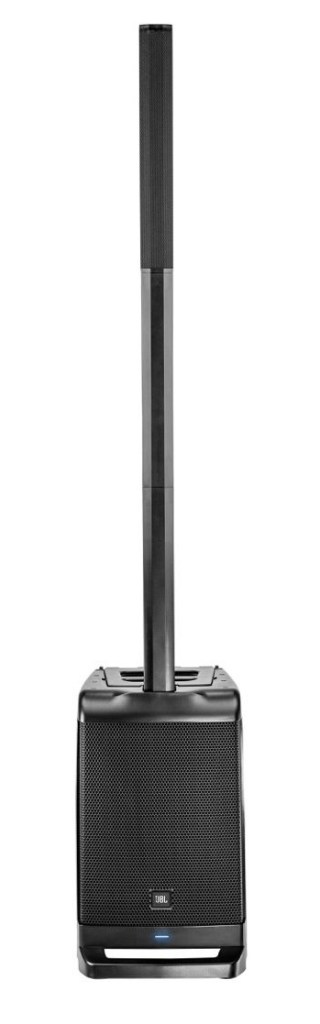
I just received my brand new JBL Eon One yesterday and of course, I had to get it out and play with it. For those who aren’t familiar with it, the Eon One is a line array PA, similar to and a competitor to the Bose L1 Compact.

I’ve been in the market for a new PA since my trusty Fishman SA220 started making a bit of a buzzing noise the last few times I played with it. And luckily for me, the venues were relatively small, so I didn’t have to go to a high volume.

When I first noticed the buzzing a few months ago, I started doing research on a new system, and after personally evaluating and doing online research on several systems, I chose the Eon One based on its excellent sound quality and portability.

As I mentioned above, I got the system yesterday. When I got it home, the first thing I noticed after opening the box was that unlike other gear, there was just the unit, some quick-start instructions, and a power cord. That was it!

And that’s all there needed to be because there are no wires to attach, no stand. The risers and speaker array fit in a compartment at the back of the cabinet, which houses the subwoofer.

The cabinet itself is not small. It’s about the size of a medium-sized suitcase. And though listed at 40 lbs., it doesn’t feel like it, nor does it seem bulky. Just looking at the picture, it’s really sleek-looking. But no matter. The important thing is that if I have a gig, I can easily put it on my handcart, throw my backpack on top and I’m off to the races.

I played with it yesterday for a few hours, setting it up with my normal acoustic setup. Both guitar and mic plug into my Harmony G XT vocal processor and harmonizer (no, I don’t use auto-tune – yuck). Then I feed the guitar through output into a Nano board with some modulation effects and a looper, so my vocal and guitar go to separate inputs allowing me to control the balance better.

The sound was SO much better than my SA220, even when it was new. Though I dug that old PA, one thing that was missing was the bass response. It was okay, but I always felt a subwoofer would round out the sound better. I wasn’t wrong. The sound of my vocals and my guitar was full and rich. Plus, this PA is LOUD. It’ll do just fine for the size of gigs that I normally play, which don’t exceed 200 people.

In addition to playing my rig through it, I also played music through it using the Bluetooth connection. What a godsend! Now when I take a break, all I need to do is open Spotify and play my break mix. And as far as the sound quality is concerned, it sounds like a HiFi system. In fact, my son came over for a visit while I had music playing, and before he even saw the Eon One, he asked me when I had gotten a HiFi! It’s pretty awesome!

I also hooked the system up to my cable box this morning to watch the 49ers game. Wow! It was great. But I kept it hooked up for most of the day so I could break the system in as TV shows provide all sorts of different sounds.

I have an all-day gig next week where I’m the praise and worship leader for a youth retreat. I am SO looking forward to making the Eon One’s debut! Also, I’m planning on doing a duo act with a buddy in the next coming months, and I’m looking forward to using the Eon One for this.

So what’s my first impression? The Eon One is a great system that I think will give me lots of great sound for years to come!

Read Full Post »

I’m a self-proclaimed gear nut, but to be clear, practically everything I’ve reviewed here is within the context of gigging or recording with it. It could be with a band or more likely than not, especially with modulation pedals, it would be used on my solo acoustic gigs. You might think that because of this my rig must be HUGE. But actually, it’s not all that big. I just have the freedom to switch things out – I hate to say it, but it’s true – depending on my mood. 🙂

But this particular article revolves around my work as a solo acoustic musician. No, I’m not a busker, though I’ve done that from time to time in my younger days. These are paid gigs at a contracted rate and I’ve been doing them for almost 40 years. In that time, I’ve learned some very valuable lessons; some more obvious than others. I’ll share them here.

Always bring spares.

This is probably the most obvious one of the lot. But frankly, it’s the most important item. This particular list is geared towards solo acoustic gigs, but you could easily apply it to playing in a band.

  • 2 extra microphone cords
  • 2 extra 1/4″ cords
  • 1 extra amp/PA power cord.
  • A backup mic, if you have one. It’s not critical, but I’ve had mics fail in the past.
  • Extra picks (I use Wengen picks, and I have a few in my guitar case).
  • A passive DI (I use a Radial Engineering Para DI – the green one). Just in case you can plug into a DJ’s system. Hey! No amp to lug!
  • Spare batteries: 9V, tuner batteries
  • Extra capo
  • Strings – I usually have 3 or 4 extra sets. I rarely break strings but they have niggling way of breaking at the most inopportune times, don’t they?
  • A 50- to a 100-foot extension cord. Never assume you’ll be placed by a plug.

One trip load-in/load-out

Especially if you’re doing gigs in a big city, being able to lug your gear in one trip is absolutely critical. I’ve done several gigs at various hotels in San Francisco, and I learned early on that I had to have a system that was modular and portable enough to do it all in one trip.

A good, durable gig bag that can hold your cords and other accessories is great, but I prefer using a backpack to haul accessories because I can stuff my Nano board, power conditioner and guitar stand in the bag. I’ve also opted – even though it is a little heavy – to just lug my hard case. I can then lash my microphone stand to it.

Circling back to a big city gig, one thing that I started to do was park my car at BART (Bay Area Rapid Transit), then take that into the City. Then I’d order a Lyft or Uber to get me to the hotel if the hotel isn’t in a place to where I can easily walk. I’ve only done that when I could plug into a DJ’s system, but when I get my new PA (I’ve decided on the JBL Eon One), I can easily take that. My Fishman SA220, though lightweight, is a bit too bulky lug on city streets.

PA

I think it’s the generally accepted norm that a line array offers the best portability for solo artists. I caught onto the trend many years ago when I got my Fishman SA220 SoloAmp. This has served me well and works great. And though it’s only 25 lbs., it’s a little bulky. So I’ve been searching for a new one as of late and have set my sights on the JBL Eon One.

To me, the Eon One offers the best balance between sound quality/PA features and portability. Weighing in at 40 lbs. it’s a bit heavier than my SA220, but the riser arms and speaker array slip into a storage compartment in the rear of the sub-woofer which makes it MUCH more compact! I’ve evaluated several other systems, and all the others have a separate bag for the arms and array. With the Eon One, I can put the risers into the unit, set it on my little hand cart and easily lug it around.

Yes, there are others I’ve evaluated that have a little better sound, like the EV Evolve 50. But they tend to be much more expensive and they’re not nearly as portable. Using the example of lugging gear in a big city, portability is a key factor. And frankly, the smaller the size, the better.

Pedals

I wasn’t going to include this section because what someone uses is purely subjective. For me, I use four pedals: Chorus, Analog Delay, Reverb and a Looper. It’s pretty minimal simply because keeping it minimal goes with the “one trip load-out/in” concept. I mount these on a Nano board that straps onto my guitar case.

Vocal Processor/Harmonizer

This has been an absolutely essential part of my acoustic rig for years. I got my first one about 20 years ago and have had one ever since. Even if you don’t use the harmony features, having some light condensing helps tremendously as your vocal output from the PA will be much thicker than if you didn’t have it. Having harmonies is awesome. Plain and simple. It adds another dimension to my performance.

In any case, I highly recommend evaluating and getting one of these. The best ones on the market, at least in my opinion, are the ones from TC Helicon. I currently use the Harmony G XT, but there’s a whole line of great TC Helicon units that’ll fit your needs. At a minimum, you should get a condenser. It makes a HUGE difference in your vocal sound.

Looper(?)

I mentioned above that I have a looper on my pedal board. Actually, I kind of fibbed a little on that one. After about 10 years of use, my handy-dandy, trusty BOSS RC-2 LoopStation finally went the way of the Dodo bird last summer at a gig. So I haven’t been gigging with one lately. But I’m actively searching for one and even considering an all-in-one unit like the TC Helicon VoiceLive Play Acoustic or the BOSS VE-8 Acoustic Singer that has vocal and guitar processing along with looping.

In any case, for many years, I was skeptical – perhaps even afraid – about using a looper pedal. But once I got the hang of it, it became a valuable part of my rig. Like using a harmonizer, a looper opens up tons of possibilities in a performance.

I’ve never been one to even want to do sophisticated looping, maybe just a couple of layers and certainly no more than three. But luckily there are lot of options on the market if you really want to get into it. But no matter which direction you take, even doing some simple looping so you can play solos over a backing track is pretty awesome.

Tablet

In the old days before tablets, I used to lug around a heavy bag full of binders and music books. Now I just use a tablet; specifically, a Microsoft Surface Pro. It has become an invaluable tool for having most of my music in one place.

When I’m playing in a band, I never use a tablet. I know all my songs for all the sets. But when I’m playing solo, I rarely, if ever, use a setlist. The reason is that the music I play depends on my read of the crowd. Sometimes, the crowd is mellow, and I’ll match that mood. Or if I’m playing to a more hipster type crowd, I may primarily do reggae and folk-punk stuff. I actually have most of the songs memorized, but sometimes I need to scroll through my app (I’ll talk about that next) and get ideas on what to do.

Plus, inevitably, and especially when I play restaurant gigs, people will approach me and ask if I know a song. Sometimes, I don’t have it in my app. But all it takes is an Internet connection and I can look up a chart in seconds, and load it into my app.

And as far as apps are concerned, I’ve been an avid user SongBook for iOS and now for Windows Tablets. I know there are others out there and SongBook’s biggest competition seems to be OnSong on Android and iOS. But to me, the beauty of SongBook is its simplicity. Don’t get me wrong; it has some very nice features. SongBook was one of the first apps of its kind and the developers have learned a thing or two about what’s usable and what’s not.

As far as a specific tablet is concerned, up until recently, I used my old iPad 2. But ever since I got a Microsoft Surface Pro, I have retired my iPad completely. The reason for this is that I can do all my song preparation – writing or importing – all on my Surface Pro. Technically, I could do that on my iPad, but there’s really nothing that beats a full-blown computer. That it doubles as a tablet is an absolute panacea for a bit of a Swiss Army Knife computing platform.

Business Cards

This probably goes without saying, but having a set of business cards is critical because it opens the door to other gigs. For example, I mentioned in the past that I played at a restaurant. In fact, I was in my 18th year playing there when the restaurant closed. I got so many gigs from that one gig just by having business cards on the piano. I got tons of weddings, parties and corporate events, and even church work. So have plenty on hand. I created some cards on VistaPrint and just order more every couple of years.

Other Stuff

Besides gear, there are some important things I’ve learned from doing this for over 30 years that I’ll share below.

  1. Have a thick skin. Unless you’re doing a show where you’re the main attraction, chances are that you are going to be background entertainment. But take it from me, though people may not seem to be paying attention, they’re actually listening. As I advised a friend who got into solo performing, just do your thing and do it well. Imagine that you’re performing to a captive audience. It will make a difference.
  2. Make eye contact. Despite being in the background, scan the room regularly. It pulls people in and makes their experience much more enjoyable, which leads me to the next point…
  3. Remember this: You are not there for you. Most of the complaints I’ve heard from fellow solo artists have centered around people not paying attention. Yes, you have to have a thick skin as I mentioned above, but to help develop that thick skin, you have to keep in mind that you’re there essentially at the behest of the person or company that hired you, and more importantly, you’re there to provide good vibes to the attendees.
  4. Especially for corporate events and restaurants, get the terms down in writing. In all the years, I’ve been performing, I’ve never been screwed over by a client. But I have heard about performers getting stiffed for their work when clients claim they didn’t agree to a certain rate or other terms. For those reasons, I have a “contract” of sorts that I send out to make sure everything’s clear and above board.

Own Your Performance

I originally made this an item in the list above, but it really deserves its own section. I’ve been gigging regularly for almost 40 years. But it wasn’t until I decided to take the risk to completely own the performance of the music I played that I made huge jump in the number of gigs I’d get a year.

What do I mean by owning the performance? Simply put, it means being myself and not trying to cop a facsimile of the original artist’s performance of a song. I do a lot of covers from the Beatles, Eagles, Elton John, JT, and even show tunes and a bit of opera. For years, I’d try to sing and play similar to the original recordings. It served me well, but once I started making the songs my own and trusting my own emotions, it changed everything and I started getting a lot more gigs.

Authenticity is important.

Read Full Post »

Of course it’s not. But that is a purely subjective. I’ve played with a number of solid state amps over the years: Roland JC-120, Line 6 Flextone III, Roland Cube 60, and most recently, the BOSS Katana 50 and Artist amps. The sounds I’ve gotten from all those amps have been stellar. Especially when I was playing my old Cube 60, I’d show up to a gig and people couldn’t believe the sound I was able to coax out of that amp.

And speaking of the Cube, Vinni Smith, maker and proprietor of V-Picks guitar picks, once told me that (at least at the time) he gigged with a Roland Cube 30. Now this guy can play!

A visitor to this site left a comment recently claiming that no solid state amp could ever match the feel and dynamics of a tube amp and then further going on to say that those of us who have or like solid-state amps like “cheap” sound. I actually laughed out loud at that statement, but to be honest, that condescending attitude pissed me off.

I’m one of those “tube amps are the only good amps” folks. Now I’m following my own philosophy that I share here: If it sounds good and plays good, it is good.

But cheap sound? Cheap sound my ass! Tell that to the likes of Albert King and Andy Summers and Joe Satriani. Tell that to the thousands of people who use solid state units like the Kemper Profiling Amp, Fractal Audio AxeFX, and Line 6 Helix, not to mention the thousands who’ve purchased Katana and competitor solid state amps. And speaking of the Helix, tell Pete Thorn his sound is cheap.

For me, I’ve gigged with both the Katana 50 and Katana Artist a number of times. With the 50, the guys in a band I played in several months ago remarked how big the sound was. The Katana Artist has an even bigger sound.

I get it. Haters gonna be haters. Ain’t nothin’ I can do about that. But to whoever it was who made that comment, there’s lots of evidence and more importantly, lots of well-known artists that prove you wrong.

I admit that I struggled when I first heard and played the Katana 50. How could an amp that wasn’t all-tube sound and play this good? I quickly got over that once I started gigging with amp. But like it or not, technology has now caught up to the point where the lines are blurred between solid-state and tube amps.

But then, maybe they were always blurred. Looking back at the old Roland JC-120, no one could argue about its performance and sound quality as a clean platform. The distortion on it absolutely sucked. But that’s not what you bought it for in the first place. You put pedals in front of it and used the on-board chorus. And make no bones about it. That amp has been around for over 40 years and used by lots of artists.

Fine. For the tube amp cognoscenti, go ahead and believe what you believe. I’m not here to change your minds. But for me and thousands of others across the world, we’ll enjoy the fruits of what new technology has to bring.

Read Full Post »

Answer: Because a bike only has two pedals

I saw that joke today and laughed. But it’s kind of true. Even though I’ve seriously shrunken the number of pedals on my board, I still use more than two. I know a few players that plug directly into their amp, and that’s it. But at least in my experience, they tend to be in the minority.

For me, I have to have three pedals minimum: Reverb, Analog Delay, and Chorus. But since I like different overdrives, I usually have one or two on my board. For a little icing on the cake, I also use a T-Rex Quint Machine, and I have a wah on my board because it’s always good to have a wah. 🙂

Mind you, these things aren’t crutches. I use them to enhance my sound. Admittedly, I used to use my overdrives as a crutch to get some sustain and compression. But I’ve been playing long enough now where I rely more on my fingers to get my sustain. It makes me work harder and lets me fight with my guitar a bit. With mod pedals like ‘verb and delay, it’s a subtle thing to add some ambiance to my sound.

But yeah, I dig havin’ me some effects…

Read Full Post »

Older Posts »