Feeds:
Posts
Comments

Archive for April, 2020

Today, Jack Johnson put on a live streaming event called the Kokua Festival 2020. This is an annual event to help raise money for various schools and to fund various programs in and around Hawaii. Usually, it’s a concert festival with lots of different acts, but because of the lock-down, he live-streamed the event and had other artists such as Willie Nelson and Eddie Vedder live-stream from their homes.

Now imagine my surprise to see Jack playing a J-45! That body profile is unmistakable and, of course, there’s no mistaking the Gibson head stock. And when he played, that round bottom-end and tight mid-range that’re characteristic of the J-45 sealed the deal.

That said, I could be wrong. But there’s no way that it’s a Hummingbird because that guitar has square shoulders, while the J-45 has rounded shoulders and much narrower at the shoulder as well. And no way that it’s an L-00 – it’s way too big for that.

It actually surprised me to see him playing a Gibson because I knew he played Cole Clark guitars from Australia. But hey! It’s always cool to see a big-name artist playing the same gear as you!

Now, what I don’t know at all is if it’s a J-45 Standard or J-45 Standard Walnut. I’m kind of thinking it might be the Standard Walnut because Jack is really big into sustainability and he cares a lot for the environment. Proceeds from the Kokua festival go to a variety of environmental concerns. Even his Cole Clark guitars are all made from sustainable Australian woods. Again, I could be wrong and I’m definitely interpolating here, but it makes sense.

Read Full Post »

Ten years ago, I was literally gigging over 200 days a year. I played in a band, did A LOT of solo acoustic gigs, and played weekly at church. Back then, I had a big electric board (I know, “big” is relative) that had anywhere from 10 to 20 pedals, depending on the gig. I’d have a wah, three or four overdrives, at least one distortion, a clean boost, various modulation pedals from a chorus, vibe, delay, and reverb, and some pedals that I’d categorize as “weird” such as an envelope filter – which I literally used once. ๐Ÿ™‚

Fast forward to today and I’m in between bands right now, only do a few solo acoustic gigs a year, though I do play weekly at church (I’m doing videos from home right now during the COVID-19 quarantine). And here’s the thing: Most of my pedals are now collecting dust!

If I look at it logically, I’ve got a couple of good reasons for downsizing:

I’ve found my sound, so I don’t really feel the need for a lot of pedals.

I really don’t want lug as much gear around (that’s actually true)

But I was thinking this morning. Maybe I’m just getting old and don’t want to deal with twiddling and tweaking anymore. I’m not a crusty old guy who’s a grouch all the time. But I do have to admit that I’m kind of set in my ways. Exploring sounds was something that I just always did when I was a younger man. Now? I don’t have much interest in doing that unless I just happen to hear something that appeals to me.

So I let this post sit for a day so I could think about it some more…

I almost posted this article yesterday that included another paragraph that poked fun of my grey-hairedness. But this morning, as I drink my coffee, I have to admit that it’s not just getting older that has made me downsize, but especially during this quarantine period, I’ve discovered that I’m satisfied with what I’ve got.

You see, with my younger kids home from school, we’ve been recording videos and tracks that we share with friends. I, of course, edit the soundtracks to make them clearer and cleaner, and I especially listen to my guitar sounds. The only thing I’ve done with the guitar parts is EQ just a tiny bit. But I don’t feel as if I’m missing a component.

Compare that to 10 years ago, where oftentimes when I’d be mixing and mastering, I might’ve said, Hmmm… this needs X. Oops! I don’t have that, so I guess I should pick one up… Though I’ve either sold or given away a lot of gear since then, I still have lots of stuff – especially pedals – that I just don’t use.

I’ve got more years behind me than I have left, and yeah, I might say I’m getting old, but I like where I’m at right now. I don’t feel as if I’m missing a key sound. And here’s another thing I realized: If I don’t have a key sound, I still just use what I’ve got.

Read Full Post »

A couple of months ago, I wrote that I had burned out the pedals on my mini-board. I used the wrong power supply on the board, and when I plugged it in, I immediately smelled electrical smoke, so I played my gig without my effects. When I got home, I plugged in the power supply to the board, and nothing worked. I was heart-broken because that board had been a mainstay of my sound: A hand-wired Mad Professor Deep Blue Delay analog delay.

Fast-forward a couple of months and I was doing some recording. I needed a more “spatious” delay and was getting a little frustrated with my BOSS DM-2w. It’s a fantastic analog delay, but after playing with it for the last couple of months, it’s really best used as a subtle slap-back delay, at which it excels immensely, so it will stay on my board.

But while I was recording, I found that getting the DM-2w to a setting where it wasn’t too subtle or just too much was actually incredibly difficult, requiring super-precise, minute adjustments on the intensity knob. I knew I could get there easily with my old Deep Blue Delay.

So here’s where the title of my post comes into play…

I’ve always been deathly afraid of electricity. Not sure why. I’ve jumped out of airplanes, free climbed rock walls, skied super-steep, icy pitches and even bungee jumped off a bridge. I don’t do that stuff now, but they still don’t scare me. Professionally, I design complex big-data software systems. But despite all that, I’m terrified of getting electrocuted, so I’ve generally stayed away from working with circuits and such.

If something burns out, I either have someone else fix it, or replace the unit. So I admit it. I’ve chosen to be ignorant about working with electrical stuff. And I also admit that that ignorance also makes me have knee-jerk reactions when I think something’s gone wrong with some electrical gear.

Back to when I first burned out my board, what I didn’t think to do was test the pedals individually. I just thought all the pedals on the board died. But when I was getting frustrated with getting the right setting for my DM-2w, I remembered that I didn’t check the pedals individually. So I went to the storage box that I put my Deep Blue Delay into, brought it back to my workstation and plugged it in. The freakin’ thing lit up and worked!

I have to admit, I was a little embarrassed. But on the bright side of things, I did score a new BOSS DM-2w, and I have no remorse over that purchase at all, despite my frustrations.

Long story short, I was able to lay down my tracks and I was a happy man. The real positive thing that comes out of it is that I now have two great analog delays that actually complement each other quite well. The DM-2w is about the best slap-back delay I’ve played. When using a slap-back delay, I don’t like a heavy pulse. It just kind of has to be there, and the DM-2w satisfies that requirement implicitly.

On the other hand, when I’m playing finger-style or solos, I like to have a slow delay that has a longer pre-delay on it so I get the articulation of the notes, then this cool, smooth delay effect that tails a phrase. For that, there is none better than the Deep Blue Delay which, by the way, the DBD doesn’t do slap-back as well because of its longer pre-delay. So now I have two great delays that I can use for specific purposes!

Yeah… I’m still ignorant about electronics, but this time, at least something good came out of it.

As for the rest of the pedals, I’ll be damned – they ALL worked again! I explained what happened to my electrician son, and he said that I may have heated the circuits to the point where the devices didn’t function at the time, but not enough to completely damage them (I did tell him that I unplugged within just a few seconds). Once they cooled down, they worked again.

When he explained that to me, I just shook my head and chuckled. Then he chided me that here I was, this seasoned veteran of software engineering and I was an absolute pussy with electronics. I shrugged and laughed in response then said, “Well… I’d rather admit to my fear and ignorance than be dead.”

Read Full Post »

Ageism… Ugh!

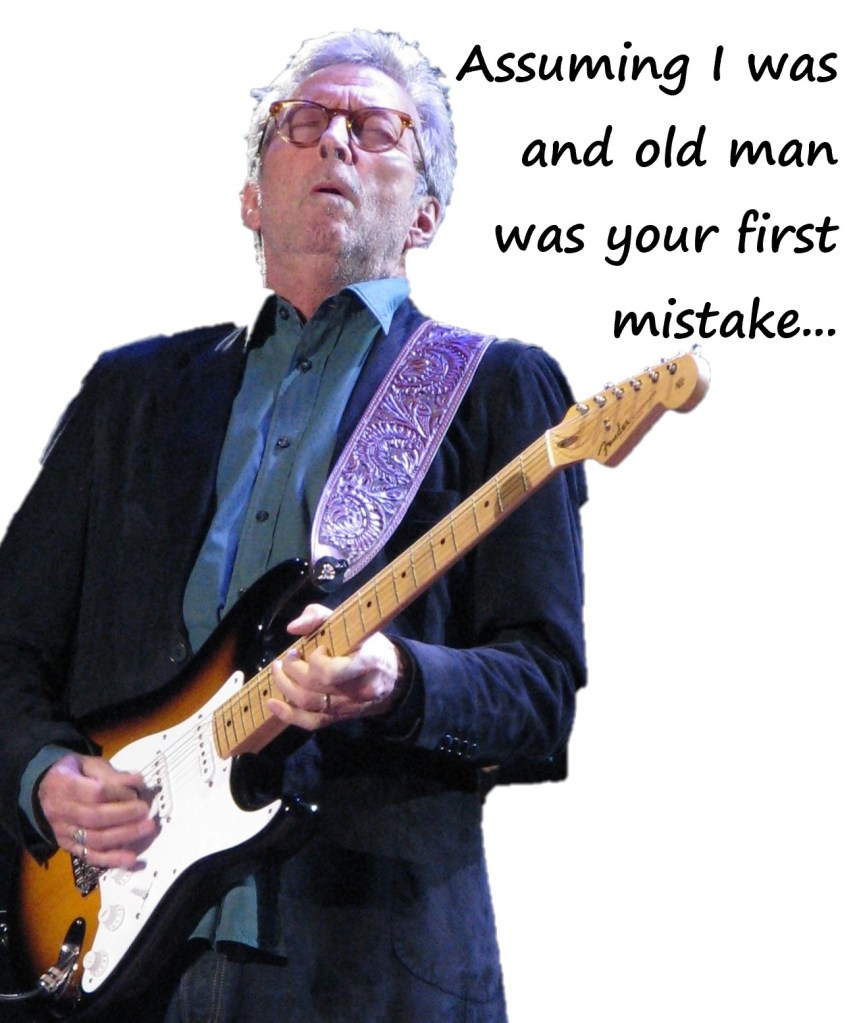
There’s a popular T-shirt with an old Samurai warrior on it that bears the saying to the right. I eventually want to make my own T-shirt with that saying but put a guitar player on it; not necessarily Clapton, but maybe some line art or something.

While that’s all amusing, as I get closer to 60, I’ve noticed how people – and not just young people – assume that because I’m a certain age that all I must play are the old classics; especially when I talk about playing at church, many people think I’m a freakin’ organist!

The looks they get on their faces when I tell them I have a rock band, well, I can’t help but laugh!

So here the thing: You’re only as old as YOU believe you are. And at least for me, I’m gonna rock until the day I die!

Read Full Post »

The choice between the two is not as easy as you might think.

Tweaker – Someone who dives deep into the minutiae of the gear they have and learn every feature and nuance. The more features, the better.

Player – Someone who learns just enough about their gear to play it effectively. Learning nuances is through osmosis over time. Typically, they don’t like too many features in a product.

Let me say this: Neither is better than the other. In fact, over time, both types of people will arrive at roughly the same knowledge of their gear, though admittedly, for straight-up players, that may take years.

And there are no absolutes, no one is absolutely a Player or absolutely a Tweaker. And yes, most people have traits of both simultaneously, but I’ve found in my interactions with thousands of folks over the years that most folks are predominantly one over the other.

In any case, what inspired me to write this post is that I’m in a bit of a quandary right now: Do I get a Strymon Iridium or a Line 6 HX Stomp?

Though I’m probably much more of a Player rather than a Tweaker, one would think that with the limited features of the Iridium, I’d lean heavily towards that unit. But if you’ve read this blog with any regularity, versatility is a key component to many of my buying decisions.

The HX Stomp has so much versatility that there are very few amps and cab combinations – not to mention effect chains – that I couldn’t assemble, however virtually. This is definitely something worth considering because depending on the style of music I’m playing or recording, I could get the exact amp/cab combo that I need with the HX Stomp. It’s a tweaker’s wet dream!

On the other hand, the Iridium has just three amp models and three cab IRs per amp. Far less tweaking (though you can load your own IRs), BUT the amps represent the archetypes on which almost all amps are based. It doesn’t have effects, so if you want effects, you put existing effects in front of it, so no having to learn to tweak virtual effects as in the HX Stomp. For a straight-up Player, it’s very much like just setting up an amp; very plug and play and away we go!

As far as the physical footprint is concerned, with the HX Stomp, once I’ve got it set up, it’s all I’d really need to bring with me or plug into my audio interface as opposed to the Iridium where I’d have to hook up my pedalboard (the Iridium would sit on the board), which takes up real estate – and in a gigging situation, is a MUCH heavier option.

So you see how this could be conflicting?

For a Tweaker, you’d think that they’d immediately jump on the HX Stomp; most probably would, but I’ve also spoken with some guys whom I know who just love twiddling knobs and such who’d rather have the Iridium. And it’s vice-versa with some Players I’ve met and spoken with who look at the HX stomp as a BIG collection of amps and cabs.

So what does it boil down to? To be completely honest, I just don’t know at this point. At least for me, I’m going to have to audition these units. While I really dig all the features in the HX Stomp – including the looper – how much I gravitate towards it will be highly dependent on how easy it is to configure without a computer.

As for the Iridium, since it has a very limited set of features, that means that its sound quality and dynamics have to be absolutely stellar. And from what I’ve been able to surmise, it’s sound quality is pretty spot on. For me, I’m not so much interested in the AC30 sound, but I really like the Deluxe Reverb sounds I’ve heard.

Why Even Consider a Modeler?

I have a bunch of amps, mostly tube amps. I still gig with them, but in my home “studio,” I’ve got limited space. Not only that, even if I record in my man-cave (read: garage) where I don’t have an isolation booth or box, I pick up ambient noises, be they mechanical sounds or just the general activity of my family; not to mention that with the exception of my Katana Artist, I can’t record any other of my amps silently. So a modeler is a great solution to be able to not only eliminate ambient noises, it allows me to record in complete silence. A clean signal is a good signal.

Modeling technology has gotten so good over the years that frankly, it’s just hard to ignore. I’ve never been a purist, preferring instead to look at various types of gear merely as tools. If they get the job done – and especially if they do it well – then that’s pretty much all that matters to me. And with modelers like the Line 6 or Kemper or AxeFX gear and now the Iridium, I love what they bring to the table!

Read Full Post »

Going Back to the Source

As a performer, I’ve always viewed myself as a singer who played guitar or piano to provide accompaniment for my voice. My voice has gotten me lots of gigs from my longtime, local solo act to singing in an international choir and even some narration. And I’ve been performing with my voice since I was a young boy – almost 50 years now.

About 20 years ago, I kind of came to an impasse with singing. I was starting to sing a lot more musical theater and even some select opera pieces. And though I could kind of fake it, I knew that I was straining my vocal chords. I’d get done singing an aria or big theatrical piece and my voice would be hoarse!

I have to admit that it scared me a bit. So I asked a close friend of mine if she knew of anyone local to me that was a voice coach/teacher that specialized in operatic and musical theater styles and she directed me to a close friend of hers named Kay.

One of the first things I established with Kay was that I actually wasn’t interested in being an opera or Broadway singer. What I wanted to learn was to sing correctly so I could sing the occasional opera piece with the proper mechanical technique. Kay was a little perplexed by my request because all of her students had aspirations to be opera or Broadway singers.

I explained to her that to me at least, learning how to sing opera would bring me back to the source of all singing technique; especially with respect to breathing and projecting. I figured if I could effectively sing an opera tune, I could sing anything. Long story short, I took about half a dozen classes from Kay – we treated our sessions like a master class – and I learned valuable lessons in vocal mechanics. As a result, I could literally do 6-hour gigs (with breaks, of course) and still have more in the tank to sing.


So you might be wondering: What does this have to do with guitar?

I spent all that time above talking about how I’m a singer first. That remains true to this day, but as you know from this blog, I have a passion for playing guitar. And in the last 20 years, I’ve taken on more and more lead guitar duties. I never sought to do this. I kind of fell into it.

But lately, I’ve been feeling as if I’m just playing a variation of the same thing for all my solos, and it’s frustrating. So I’ve decided to go back to the source and take some lessons; specifically, take jazz guitar lessons, and not just any kind of jazz, but a study of old jazz standards.

I realize that a lot of that is going to be a review of chord theory, which is actually pretty exciting to me. But more important than that, I want to learn chord comping and instead of just playing note scales, actually play chord scales. It requires a bit different way of thinking, but that appeals to me because long ago when I was taking piano lessons, rather than teach me standard scale theory, my teacher focused on chord theory.

The teacher whom I am hoping still gives lessons is Carol Kaye. She’s a legendary bassist, but she’s also an accomplished guitarist. Ms. Kaye has a resume of touring and session work that most people can only dream of. Most notably, she was the sole female member of the famed “Wrecking Crew,” responsible for creating HUGE hits of the ’50s, ’60s, and ’70s. (And by the way, that whole “Wrecking Crew” name, according to Carol Kaye, was made up by Hal Blaine) The bass line for the Beach Boys’ Good Vibrations, well, that was all her. Freakin’ amazing!

What inspired me to seek her out was this video of an interview she gave in 2013 (it’s over an hour long, but SO worth it):

The way she talked about her approach to music completely jibed with what I’ve been aspiring to achieve for years. I’m hoping she will accept me as a student!

Read Full Post »