Feeds:
Posts
Comments

Archive for June, 2020

If you record at home like me, you’ve probably devised different ways to get good quality sound in your recordings; all without breaking the bank. Make no bones about it, to record good-sounding songs is going to take a small investment but it shouldn’t make you spend your life savings. I’ve been recording in my garage for decades and I’ve learned some neat tricks; in fact, I’m still learning!

Now one thing that has always been a challenge to record for me is acoustic guitar. I’ve pored over article after article from pros on how they do it. But they also use great and expensive mics. But it’s not that I dismissed the great information in these articles. I just had to adjust it to the equipment and environment that I had to work with, and I’ll share some of the things I’ve learned here.

Use two decent mics. Okay, I know that’s a bit of money. But believe me, it’s worth it. And while I have a dedicated instrument mic – a Sennheiser e609 – I only use it to mic my amp cabinet. I actually use vocal mics to record acoustic guitar because I feel they’re designed for natural sounds. The mics I use are a Heil PR22 and a Shure Beta 58a. The Heil costs $119 while the Beta 58a costs $159. Yes, it’s a bit of an investment but to me, these are simply great mics for the money. The Heil has more presence than the 58, but the 58 has a nice, round, bottom-end.

How you place your mics is important. I’ve read about all sorts of different mic-placement methods, but many of those were using condenser mics and recorded at a far distance. The PR22 and Beta 58a are dynamic mics, and work best closer to the sound source. What I discovered in my last couple of recordings is a placement that works with all my acoustic guitars (I have three). Here’s a quick sketch of where I place them:
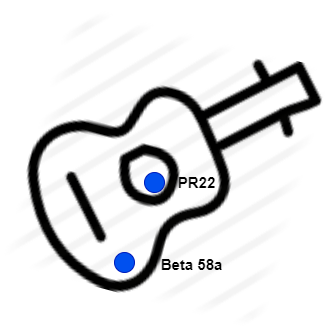
As far as distance is concerned, the PR22 is about 6″ from sound hole, while the Beta 58a is about 2″. Both are pointed directly at the guitar.

You’ll notice that the PR22 points more towards the high strings above the sound hole. This avoids the boominess from lower strings. The Beta 58 picks up the body resonance. Once I have the mics placed, I set their input levels on my interface so they’re roughly equal, and I arm both inputs for recording.

When I finally get to mixing them, I pick a side I want to pan the two tracks. Whatever side I choose, I pan the PR22 10-15 degrees to that side, then pan the Beta 58a about 25 degrees. This provides a really rich sound.

Here’s an example of how my J45 sounds in a song recorded this way.

Note that the ONLY things I did with either of these tracks was to filter out some of the bass and I added a bit of reverb to the PR22 track to get a kind of wet/dry sound. I also rolled off some of the highs from the PR22 track because that mike has a natural presence boost that can make the guitar sound a little too shimmery. The result is a really rich sound!

Note that this is my setup. But it’s a good starting point as I’ve used different mics in the same configuration and gotten pretty good results.

Don’t assume you can EQ bad stuff out.

I used to be of the mind that I’d just get a take, then EQ to “fix” the sound. But to be honest, that only works for real minor things, such as how I rolled off the highs a bit on my PR22 track above. But anything more than a slight adjustment will never sound good.

I say this immediately after the mic placement section because though I gave a good starting point, ultimately, depending on your guitar(s) or mics, you’ll have to play around with placement. I found that even if you just have inexpensive mics, getting good placement will give you a good starting point from which you can EQ if necessary.

You need a quite place to record, but you don’t need a silent place. I’d love to have a completely sound-proofed recording space, but as long as I don’t have a lot of background noise (like kids screaming), it’s quite possible to get good takes where it would be really difficult to tell if there was ambient noise. Plus, one of the things that I love about the PR22 mic is that, like all Heil mics, it has unparalleled rear sound cancellation, so that helps keep tame any background noises.

Don’t be afraid of your input gain knob. The more sonic content you can capture, the better, so make sure you have your input gain up. You just have to be careful when you play that you don’t move or make other sounds that’ll get picked up by the mic. It’s not easy to do at times, especially if you’re capturing a strummed guitar, but it’s not not doable.

Yeah, this is the poor man’s approach to approaching acoustic guitar recording, but it’s effective and produces great results if you work at it!

Read Full Post »

If you didn’t hear about this, here’s a good article about what transpired on Guitar.com.

In essence, Mike Fuller vented online about the looters and how they were ruining businesses. People somehow conflated that with him making racist statements which, from what I’ve read at least, he didn’t make. Or that Mike cared more about business than people. Irrespective, it touched off a HUGE backlash on social media that forced Mike to eat a huge portion of humble pie and make a public apology.

And along with the social media backlash, Guitar Center decided to pull Fulltone products from its shelves in response to Mike’s rant. Yikes!

But this is a perfect example of why words matter. Frankly, part of me agrees with Mike condemning the looting – he even stated that it was the work of bad actors and NOT the protesters. But the way in which he communicated his perspective could have been done so much more diplomatically.

One thing I’ve learned about having an online presence is to carefully weigh my words and do the best I can to not write when I’m angry. You tend to miss details and worse yet, especially with someone like me who wears their heart on their sleeve, overdo the emotion. People react to emotion – especially anger – and in an environment where all it takes is a spark to ignite a wildfire, it can get out of hand quickly.

So all that said, this is a good lesson. To be clear, I’m not saying don’t express your viewpoint. But there are ways to do it that people will hear and others that will, well, have a big box retailer remove your products from their shelves. Definitely food for thought.

Read Full Post »

Much love has been given out to the BOSS Katana amp line since it was released and over time, it has gained many devotees; myself included. Still, there are those folks out there who will argue that it’s still just a solid-state amp and could never be as good as a real tube amp.

I get that. I have eight tube amps ranging in wattage from 5 watts to 50 watts. They’re all set up differently and each has its own distinctive characteristics. With my Plexi-style amps, there really is nothing like the high-end sizzle when the amp is cranked. My Fender Hot Rod Deluxe has a hauntingly rich and beautiful clean tone. And let’s face it: There’s really nothing like the power sag of a tube rectifier.

But despite all those great things about tube amps, my Katana Artist (v1) is my #1 amp for both stage and studio. Why? For one, simply because it has a sound and feel that speaks to me and I’m inspired every time I play it. But perhaps more importantly, it has a sound and feel that’s all its own. I don’t look at it as a digital, solid-state amp. I look at it as a great amp that gives me the tone and dynamics that I expect out of any amp that I call my own.

That said, historically, there is a justifiable reason for the stigma around solid-state amps not being as good tube amps. Twenty-five or so years ago, with just a couple of exceptions, solid-state amps were definitely the cheap alternatives – at least the ones built for electric guitar.

Acoustic guitar amps, on the other hand, tended – and still tend – to be all solid-state. To me, SR and Genz-Benz have been my go-to standards, and I still play through my SR California Blonde. It’s a 75-lb. behemoth with a 15″ speaker. Even as old as it is, I’ll pit it against any other acoustic amp. Sorry, I digress. Back to electric guitar solid state amps…

Back in the day, solid-state amps sounded horrible and felt even worse with little to no dynamics, and don’t get me started with their “overdrive” sound. They totally sucked! They were bad enough that they left a lasting impression and a stigma built up against them that lingers even to today.

And it’s really unfortunate because there are amps like the Katana and the recent Fender Tone Master amps whose sound quality and dynamics are just simply stellar. But where the Tone Master amps are copping the Deluxe and Twin, the amps in the Katana line, at least to me, have their own sounds, and not trying to copy specific amps. And that’s the thing that sold me with my original Katana 50 and now with my Katana Artist. They both have their own sounds. But because of that historical stigma with solid-state amps, lots of people still frown upon them.

To be clear though, amps like the BOSS Katana and the Fender Tone Master are digital amps, which are a far cry from just a collection of chips. These amps are run by powerful digital signal processors that model the behavior of tube amps. Sure, they use solid-state components, but the DSPs set them apart from traditional solid-state amps.

But as with any amp, you have to take the time to dial it in with your playing style and equipment. When I got my Katana 50, I had to spend lots of time getting the gain, volume, and EQ dialed in for my guitars. Playing a Les Paul, I had to bump the mids and highs. With my Godin, I had to roll off the highs and bump up the bass. That’s not even taking into account the fact that I had to break in the speaker, which makes EQ adjustments a moving target!

The same went for my Katana Artist. But I spent even more time playing to break it in because that Waza speaker has just gotten better with time. I recently did a recording session with the Artist and at first, I was using the DI. But I noticed that the speaker sounded SO good that I ended up miking the amp.

The point to this is that no amp, whether digital or valve is going to sound great right out of the box with everything set in the middle. You have to invest time into getting it dialed in and broken in before you get a truly great sound out of it.

Now I realize there will still be detractors. That’s unavoidable. All I can say is this: You do you. But I’m willing to bet that if a detractor kept an open mind and really spent some time dialing in a Katana, while they may not take the plunge and buy one, they may at least get over the notion that all digital amps are bad.

Read Full Post »