Feeds:
Posts
Comments

Archive for the ‘guitarists’ Category

Not many people know of Elliot Smith, and will never know more than what’s already known because he sadly passed away from an apparent suicide in 2003. I actually didn’t know about him until a couple of years ago when my eldest son, who’s into indie music, was playing one of Elliot’s songs on the computer. I knew of his music though because two of his songs were in two movies that I love: “Good Will Hunting” and “Keeping the Faith.” Elliot’s song “Miss Misery” was featured in “Good Will Hunting,” and that’s the song I wanted to share with you.

Through his life, Elliot Smith suffered from depression and drug abuse. His music both musically and lyrically reflect an inner turmoil that spoke volumes of the depth of his personal horror. In interviews, he’s withdrawn and quiet, and he looks as if he’s about to burst. It’s tragic that such a talent had to go through so much personal struggle. Anyway, back to the song…

I was listening to the “Good Will Hunting” version of “Miss Misery” on my iPod the other day, and I thought that it would be a good idea to learn the song. So I did a search for Miss Misery chords and lyrics and found some. Being on a new computer that didn’t have my iPod library, I decided to do a search on iTunes to download the song so I’d have it handy while I plunked out the chords on my guitar. I only found one version of the song and it was an early version that was purely acoustic guitar with no backing instruments. Since I would be performing the song on my acoustic, I downloaded the song to my computer.

Once the download completed, I was surprised that the key was completely different than what was recorded for the movie, and the lyrics were some of the darkest lyrics I had ever heard. Where the “Good Will Hunting” version’s lyrics leaned towards a guy trying to figure out his relationship, the early version, which I suspect was the original version bordered on suicidal. But they were so much more powerful than the movie version, and revealed a very dark side of Elliot Smith. Here are the lyrics to the movie version first:

Ill fake it through the day
With some help from johnny walker red
Send the poison rain down the drain
To put bad thoughts in my head
Two tickets torn in half
And a lot of nothing to do
Do you miss me, miss misery
Like you say you do?

A man in the park
Read the lines in my hand
Told me Im strong
Hardly ever wrong I said man you mean

You had plans for both of us
That involved a trip out of town
To a place Ive seen in a magazine
That you left lying around
I dont have you with me but
I keep a good attitude
Do you miss me, miss misery
Like you say you do?

I know youd rather see me gone
Than to see me the way that I am
But I am in the life anyway

Next door the tvs flashing
Blue frames on the wall
Its a comedy of errors, you see
Its about taking a fall
To vanish into oblivion
Is easy to do
And I try to be but you know me
I come back when you want me to
Do you miss me miss misery
Like you say you do?

Now here are the lyrics to the original version of the song:

I’ll fake it through the day
with some help from Johnny Walker Red
and the cold pain behind my eyes that shoots
that through my head
(note: He might be saying “death” instead of “that”, it was a bit garbled)
Two tickets torn in half
and a lot of nothin’ to do
but it’s all right
some enchanted night
I’ll be with you

Tarot cards and the lines in my hand
tell me I’m wrong but they’re untrue

I got plans for both of us
that involve a trip out of town
to a place I’d seen in a magazine
that you left lyin’ around
I can’t hold my hold my liquor
but I keep a good attitude
’cause it’s all right
some enchanted night
I’ll be with you

I know you’d rather see me gone
than to see the, come the day I’ll be waiting for you anyway

Next door the TV’s flashing
blue frames on the wall
It’s a comedy from the seventies
with a lead no one recalls
To vanish into oblivion
it’s easy to do
and cry to sleep when you talked to me
the day you said we were through
but it’s all right
some enchanted night
I’ll be with you
As I mentioned, these lyrics are so much darker and raw than the movie version.  I was so moved by these lyrics that I wept. This is the version I’ll be performing as a tribute to a guy who couldn’t take life but had so much to offer. Here’s a real good memorial video that features “Miss Misery.”
Read Full Post »

…that makes you sound good. It helps to have great gear, but it’s the player that counts. Don’t believe me? Check this out…

I saw this street musician playing in San Francisco a couple of weeks ago playing a crappy Fender Squire Telecaster, and a beat up amp that also doubled as his vocal PA. Guess what? He sounded amazing! The tiny amp was really tinny sounding, and his voice wasn’t always on key, but his guitar technique was nothing short of incredible. How could I tell this? Not just by watching, but by listening to how he squeezed out every bit of sustain from each note he played; how he transferred his passion from his heart into his guitar. The raw emotion in his playing was almost palpable. That got me thinking about my own playing…

Several months ago, I wrote an article called, “I’ve got GAS and I’ve got it bad!” At the time, I was on a buying binge, getting a new guitar, some effect pedals… just gearing up in general. Then a couple of months ago, I just up and stopped using more than half the pedals I bought. I attributed a lot of this to my Hot Rod Deluxe finally breaking in, but when I saw that guy playing on the street, it got me to thinking that it might’ve been something more; something inside of me that stopped me from buying more gear, and hooking up a bunch of pedals to my rig.

Now, I think that what happened was that I returned to a place that I forgot about: My heart. When I first made the move from primarily acoustic to primarily electric guitar, I was a bit uncomfortable playing. There was a lot more to think about in shaping my tone than before, and I was admittedly self-conscious about my technique. But I eventually reached a level of comfort. That’s when the seas parted, the skies opened, and a voice from Heaven burst forth proclaiming, “Now go forth and PLAY your guitar!”

There’s a big difference between just playing chords and notes, and playing with your heart. It’s not just how you approach your instrument, it’s how you FEEL your instrument and adjust to the subtle nuances within a song. It’s the difference between simply being musically mechanical and being truly musical. I forgot that, or rather, I was distracted from that for awhile, and the thing is, to be truly musical, you don’t need effects or great gear. Yes, that stuff provides added enhancement, but no one or no thing can give you musicality. That comes from you.

I’ve returned to that place where I can really feel what I’m playing, and I’m really loving what I’m hearing – and a bit surprised that I’m actually pleased with how I’m sounding now. And though I’ll most probably buy more gear in the future, it will be with the intent of enhancing my music. I’ll take a much more utilitarian approach and not get trapped into having a piece of equipment because it’s considered by others to be top-of-the-line. I fell into that trap once. I won’t do it again.

So you don’t have to spend a lot of money to sound good. Just look at that guy on the street. He knocked my socks off. But to bring even more legitimacy to this argument, let’s look at some great players who took average or less than average gear and did incredible things with them:

There are two guys I think about immediately: Willie Nelson and Eric Clapton. Willie played this old classical guitar that had an “extra hole” in it that his “Daddy bought me.” Clapton bought three second-hand Strats for $100 each, mixed and matched necks and bodies and produced “Blackie,” his signature guitar that sold for over $1 Million at auction. In each case, these guys took marginal equipment and built careers on them. So tell me it’s not the player… 🙂

I’d love to hear your thoughts…

Read Full Post »

A Great Quote…

On the recommendation of a friend, I checked out this great guitarist named Andy McKee. After I watched a couple of his videos, I wanted to find out more about him. So I went to his official web site, and at the bottom of his bio was a quote that I just had to share.

Most of all, I hope my music communicates something to the listener. I don’t want to just play music with a lot of skill. I hope listening to my music is an emotional experience!

Man, talk about getting it! In any case, here’s the video I saw:

Read Full Post »

After reading my friend Ig’s latest entry, “Innovation: Coated or plain guitar strings,” I thought about funny things I’ve heard myself and other guitarists say in the past, or things that a guitarist should never say in mixed company. Here’s the list:

10. My G-string keeps coming loose…
9. You shoulda seen his axe cut through the crowd…
8. I’ve got a small f-hole…
7. Looks like I have to give that head a good lube job…
6. That guy’s got great licks…
5. That G-string gets gross with grime pretty quickly…
4. I rub it down with a towel after I’m done playing with it…
3. Yeah, he really jerks that thing around…
2. He lowers his G-string to C…
1. When I don’t have anyone to play with, I play with myself…

Most of these are real… bonus points if you can guess which ones aren’t. 🙂

Read Full Post »

I have been a youth minister and occasional inspirational speaker for several years. A few years ago, I did a series of talks and workshops based upon Q.U.E.S.T., an acronym that I came up with to help people focus in their learning processes. This morning on the way to work, it dawned on me that I could easily apply it to learning guitar, and that I have been unwittingly using the QUEST process the past few years to become a better guitarist/musician. So here’s QUEST in a nutshell.

Background

First, life is a process and to go through life, whether you buy into it or not, you are the central figure in the process of your life. Many people spend their entire lives letting outside influences rule the direction they take, instead of taking the reins and taking charge of their destinies. QUEST is a way to focus on your process. The very word lends itself to seeking out and discovering; something no one can do for you. But unlike the quests of old, there’s no prize, and really there’s no end, as this QUEST is a continuous process itself. So let’s go over the QUEST process:

Q – Question
The first step to growth – of any kind – is to question the foundations of your beliefs. This doesn’t equate to doubt; rather, it pertains more to examining where you’re at, what you’re doing, then posing questions like: Am I doing enough? Have I considered other directions? With respect to playing guitar, a lot of times we become fixed on certain styles or methods of playing. By questioning the things on which we are fixed, we open ourselves to new and different possibilities.
U – Understand
This really means “understand yourself.” Another “U” word that could be used in its place is “Uncover.” Growth demands an innate understanding of what our motivations are. Especially with musicianship, learning or doing something “just because” is not good enough. If you want to get better, you need to uncover and understand your motivations to become better; in other words, understand yourself.
E – Explore
This is really the active phase of the QUEST process, where you actively seek out possibilities and break new ground. It’s also the funnest part of the process because you come across all sorts of new things or new ways of playing. While the other steps in the process are much more subtle and cerebral in nature, this step is where you actually experiment with the things you discover. It’s the really exciting part of the process.
S – Surrender
I can’t stress enough of the importance of surrendering. Surrendering simply means to not get in your own way. During any growth process, it’s inevitable that our old, established patterns of thinking come creaping up, and can possibly sabotage the growth we’ve recently experienced. Surrendering to your growth process maintains your open state of mind. As an example, I recently wanted to understand what appeals to my older kids’ love of hard-core rock. So I sat down at their computer, opened up iTunes and started listening. Being a musician whose foundation in music has been built on a more melodic approach, I found that my instinctive negativity towards this style of music kept surfacing while I listened. So I had to check myself and essentially surrender to what I was listening, so I could give myself a chance to “get it.” The net result is that I learned alot about that style of music: Super-fast guitar licks, trip-hammer-double-bass-drums; in other words, high-powered energy. I still don’t like the music, but I now understand the appeal.
T – Trust
Sometimes, change is very subtle, so you have to trust in your process of learning; trust that your going in a direction that will ultimately improve your abilities down the line. Like surrender, this another checks and balances step that’s important in the process because by trusting, you won’t give up your quest to become better.

I realize that this isn’t a specific technique to become a better player. It’s more background. But to me, it’s important background. Personally, if I had not gone through this process, I wouldn’t have evolved as a musician. I literally spent 30 years playing nothing but acoustic guitar, and I’d gone about as far as I could go. Then a few years ago, I “pulled the rug from under” myself and incorporated electric guitar into my playing. I still play acoustic guitar – and a lot of it, I might say – but I now have a much broader musical canvas with which to work – and learn.

Read Full Post »

5735-13-photo.jpgLike many guitarists, I have fantasies of playing guitar with a big name, like Sting for instance. I also have dreams of having technique like Hendrix, Satch, SRV, Eric Johnson, or Vai. But the reality is that I’ll probably never achieve their level of technique. So short of that, the best I can do is learn as much technique as possible, but incorporate that technique into my overall sound.

Notice the word “my” in the sentence above. That’s something that I stress to a lot of young guitarists, especially my own son. In a recent conversation, where we were discussing chords and intervals, I stopped and said, “Son, while it’s important to learn all this music and guitar theory, remember that your ultimate goal is to create your own sound. You say you want to play as fast as Henry Li or Yngwie Malmstein. That’s great – but just remember one thing: Learn the technique to play as fast as those guys, but make the sound your own. If you want to be a more than just a ‘good’ guitarist, you’ll want to sound like yourself, and not like somebody else.” The glazed expression the he returned prompted me to say, “I know you don’t get what I’m saying right now, but give it a few years, and you’ll know what I’m talking about.”

I can’t stress enough how important getting your own sound is. And I’ll say this: For some, like myself, it has taken a lifetime to achieve, and I’m still tweaking my sound! But keep at it, and eventually you’ll get to a space where your sound is distinctly you.

Read Full Post »

Back in the late 70’s and early 80’s, I got introduced to fusion by one of my childhood friends. One  of the most memorable fusion artist was Jean-Luc Ponty, the famed jazz violinist. I bought all his albums at the time, and would play them one after the other for hours, studying the phrasing, which was unlike anything I had ever heard up to that point. But being a guitar player, I was especially interested in Jean-Luc Ponty’s guitarist, Joaquin Lievano who, in my opinion, is one of the most underrated guitarists of our time, and an unsung innovator of the guitar. Most notably, Joaquin’s speed picking technique paved the way for countless glam-rock guitarists. But not only that, his complex, but musical phrasing up and down the fretboard were like nothing I’ve seen before – and very seldom have I seen anyone since who possesses this. Actually, only Eric Johnson comes to mind. That’s how incredible this guy is!

Here’s a video of him playing. Mind you, the song starts out pretty slow, with him not doing much of anything. But about 2/3 through the song, you’ll start seeing him totally rip it up – and the most amazing thing is that he’s completely clean!

Read Full Post »

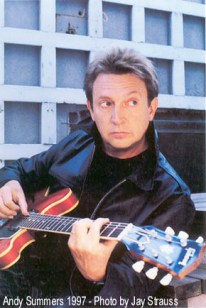
Andy SummersIn my life, “The Police” have been one of my most favorite bands. I’ve got every album they produced – including the really early punk stuff. But until recently, I really didn’t count Andy Summers as one of my guitar heroes. Sure, he was solid, he created some lasting licks (think: Message in a Bottle), but I never thought of him as someone whom I’d look to as a “Guitar God.” All that changed when I saw The Police in concert this past Wednesday, June 13, 2007.

When the announcement was made that The Police were coming to SF Bay Area a few months ago I was ecstatic! I immediately called my best friend Dave (another big Police fan) to see if he’d like to go to the concert. No way would our wives accompany us – it would be a guys’ night out; two guys who had missed the chance to see them over 20 years ago, and we were going, come hell or high water!

I anxiously waited for the day when the tickets were put on sale, and once they were, I snagged a couple of incredible seats though while a bit distant from the stage, were situated dead-center of the stage. On top of that, there would be a walkway in front of us, so we’d have a perfect, unimpeded view of the band. In fact, our seats were level with the stage! As I said, perfect, save for the distance. But in today’s multimedia world, we didn’t miss much with the big screens projecting constant, live video from the stage.

All right… I’ve talked about the seats. Let’s move on to the gist of this entry, shall we?

Never having seen Andy Summers perform, I had no idea just how incredible of a guitarist he is! As the night wore on, I became increasingly transfixed by his technique and utter mastery of the guitar. It’s really hard to describe, but the best description I can give of his guitar playing is that it’s a perfect economy in notes and timing. He plays nothing more or less than what is EXACTLY needed for a particular phrase. If he needs to play fill in with a lot of notes, he does it. If the phrase calls for long, bended notes, he does it, and his execution is PERFECT!

There’s no trickery, no flashiness in Andy Summers’ playing. Most of the time he stands on stage with a dour expression on his face – but as a musician myself, I know that he’s completely immersed in the music he plays. He doesn’t need to shred (though he demonstrated that he has the chops to do so), nor he does he feel a pressing need to jump around on stage. He just does his thing and he’s a complete wizard with his Strat. He makes that friggin’ thing sing!

Add to the fact that all three members of the band are dynamically comping against each other, and what you’ve got is an incredible sound. Some three-piece bands sound just like three-piece bands. The Police sound like there are a lot more instruments than a three-piece band, and Andy Summers is hugely responsible for that.

As I have about an hour to commute into work, still on a high from the concert, I set my iPod to play my Police collection this morning. The thing that really hit me as I listened, is that the recordings really didn’t do justice to how good of a guitar player Andy Summers is. Granted, he’s really tight in the studio, but after seeing him finally play live, I now know what kind of sound he’s capable of producing. And that’s the gist of this whole entry: Because he just quietly goes about doing his own thing, I think he’s totally overlooked as a master of the guitar. This author now believes he’s experienced true greatness.

Props to you, Andy Summers! You’ll always be on my list of “Guitar Gods!”

Read Full Post »

« Newer Posts