Feeds:
Posts
Comments

Archive for the ‘Guitars’ Category

The Amazing Charo

Last Friday evening (1/31/2025), I went to see Charo at Villa Montalvo in Saratoga, CA. Admittedly, it wouldn’t have been a concert that I’d actively seek to attend, but my wife got some tickets from a donor from an organization with which she volunteers, so we went.

I didn’t have many expectations. I knew she was a character having seen her over the decades on various TV shows while I was growing up, so I figured that with her big personality, the show would at least be entertaining. But nothing prepared me for the sheer amount of energy she had! After all, she’s seventy-four years old!

But when she walked on stage, all my preconceptions were completely obliterated! She looked great and had an energy and verve that belied her physical age. No, she didn’t do her trademark “coochie-coo” shtick, but she was dynamic nonetheless.

After doing several singing numbers, she told the audience that she was going to play her guitar. I knew she played flamenco, though I didn’t remember ever seeing her play. But when she said she was trained by the late, great Andrés Segovia, my mind was blown. I had no idea. And nothing could prepare me for her incredible technique. Here’s a clip:

That was a clip of the first song she played, and the only thing I could say when she finished was, “Oh. My. F-ing. GAWD!” The speed and precision with which she played those scales was amazing! Look, I’m not a fanboy, but I admire her talent and skill. And to still be able to play like that is inspiring to me.

Read Full Post »

I had a gig last night with my old farts classic rock band. Normally I use either my Squier Classic Vibe Tele or my Taylor T5z or my Gibson R8 Les Paul. But while I was prepping my gear for the gig, I realized that I hadn’t played “Katie May,” my Slash L Guitars Apache in a while; to be honest, I hadn’t played her in years.

She had been sitting in her case since I messed up the neck pickup mount and I never got around to fixing it. And by the time I’d remember to fix her, I didn’t have enough time. But yesterday I said to myself, “Screw it. I’ve got a few hours and I’ll fix the damn mount and do a quick setup.” So, I pulled her out of her case and got to work.

“F$%k!” I grunted when I fixed the mount because it took all of ten minutes to fix it. Setup took a little longer, but not much longer because the neck was perfectly straight, so I didn’t have to adjust for any bow or relief. I didn’t even have to adjust the intonation because it was perfect. In the end, I just cleaned her up and she was ready to go. And no, I didn’t change out the strings because they were in great shape; no corrosion or dings. I figured that if I broke a string during the gig, I’d just switch over to my T5z then do a full string change later.

Arriving at the venue, I set up my rig and did a quick sound check. That was when I realized that I forgot to adjust my pickup heights! But that’s why I carry a Swiss Army Knife. A few turns of the screws and voila! I was ready for the show!

Katie May has always been an absolute dream to play. She has super-low action which makes moving around the neck incredibly easy. But it also means using a much lighter touch. And since I hadn’t played her in a few years, I used our sound check to get used to her. But muscle memory is a good thing because I got the feel of her within a few minutes of playing. And man, did she sing! That gave me a lot of confidence going into the gig.

As far as her sound was concerned, I was inspired last night. There was something about playing her through my Wampler Tumnus overdrive (klone) that just brought out the best in her Lollar Imperials. And yeah, those pups kick some serious ass. They’re incredibly articulate without being at all harsh. Then running the signal through the Tumnus just gets me more of that sound. It was inspirational!

I’m no longer the lead guitarist in the band as our lead guitarist is far better than me and has all the solos memorized for many of our songs. But I do still get to play some solos when it’s just pure improv, which is what I love. When we play our version of John Prine’s “Angel from Montgomery,” I do the solo work on that song.

Our version is much like the Bonnie Raite version, but a little slower and much more haunting. This allows me to use my Mad Professor Deep Blue Delay with just a bit of grit from the Tumnus. In my solos, I do a lot of double stops taking a sad Hawaiian pedal steel approach, then I break those up with mixolydian and harmonic minor runs that reflect the juxtaposition of the hopefulness of the chord progressions and the melancholy of the lyrics; not that I’m thinking of the mode or scale at the time I’m playing. I’m looking back and analyzing my playing tendencies after the fact.

And last night, I was so inspired by how Katie May cried during that song. She has so much built-in sustain from the neck-through design and the Gotoh 510 bridge. She just holds notes incredibly well. Then combine that with the Deep Blue Delay and OMG! It was a recipe for total inspiration!

But for our rockin’ songs, damn! She was so easy to play that I was all over the fretboard last night! I was kind of beside myself while I was playing. But a huge thing about Katie May was that she has as switch to coil tap the pups. So, I could change up her sound by going single coil for some songs which just added to her palate of sounds. After the gig, I remarked to my bandmates that I had forgotten how much I loved playing that guitar. I think she’s going to be my #1 going forward.

Read Full Post »

…At least for regular gigging.

I’m an old guy now, so I do maybe 60-75 gigs a year, if that. But in my heyday, I was busy, with up to 250 gigs a year. I did my regular, weekly church gig. Played two to three nights a week at a restaurant, had several weekend gigs with the different bands I played with, and did lots of weddings and funerals. It was awesome.

And at the time, I was a gear freak! Though I was gigging a lot, I was still searching for my sound, so I went through a lot of gear, especially pedals. I started this blog as a diary of all the stuff I’d pick up, and if you’ve read this blog for a while, you’d be familiar with my journey.

And this journey has included many boutique pedals. For the ones I’ve connected with, I’ve loved them. But here’s what I found with boutique pedals. Most of them couldn’t withstand the rigors of gigging or could only be used in specific configurations. Take for instance, one of my favorite overdrive pedals by the Geek Driver by the Original Geek. That pedal, based on the ColorSound Overdriver popularized by Jeff Beck was a wonderful pedal. The sound it produced was incredible with my Les Paul and Plexi-style amps. BUT, it lasted a total of two months before it completely crapped out. Since Geek lived close to me, I was able to get it repaired, but after it failed a second time, I gave up on it as Geek had moved out of the area.

Another pedal that blew me away was the ToneCandy Spring Fever spring reverb pedal. When I reviewed it, I hadn’t purchased it, but I eventually did buy it because I loved its sound. But I could only use it under certain circumstances because the fuckin’ thing made so much noise, and I returned it after only a few gigs.

The point to all this is that though boutique pedals are great, I’ve found they’re best for light use and under circumstances like recording where I’m after a specific sound that I can’t get with mainstream, high-production pedals. But for regular gigging, I now only trust mainstream pedals. They may not have the most unique sound, but they’re reliable; so much so that I don’t ever have to worry about them failing in the middle of a gig. As such, my board has Wampler and BOSS pedals, with a Pigtronix Booster. My lone “boutique” pedal is an original hand-wired Mad Professor Deep Blue Delay that has withstood the test of time. But I switch that with a BOSS DM-2W Waza Craft delay, depending on the type of gig I’m doing.

I’m not alone in this thinking. The great John 5 has a pedal board filled with BOSS pedals and a lone Tube Screamer. Other guys I know use a mix of mainstream pedals from BOSS to EHX to TC Electronics.

And now that I’ve found my sound, I’m a lot less compelled to get more gear, let alone boutique pedals. Sure, I still play around with them when I go to a shop, but even with my limited gigging schedule, the high-production pedals I use are just fine for me.

Read Full Post »

Any graphic EQ will have a dramatic effect on your tone. I chose the GE-7 because I trust BOSS quality. Though I don’t gig nearly as much as I used to, a lot of my equipment choices over the years have been driven by durability. I know BOSS pedals will stand the test of time and the rigors of gigging.

As to the subject at hand, I’ve now had the pedal for several weeks and have gigged with it a bunch of times. As I said in my original review of the pedal, I don’t know why I hadn’t had one in my chain until now! As Phil McKnight said in a conversation with Tim Pierce on YouTube, “A graphic EQ fixes problems.” Truer words could not have been spoken!

Though it certainly can be used as a clean boost because of the Level slider, the GE-7’s core competency is boosting or cutting frequency ranges. With the last gig with my old farts classic rock band, I played my Squier CV Tele, plugging into my ToneMaster Deluxe. When I had everything set up with the GE-7 completely neutral, I noticed a bit of sharpness in the midrange. After fiddling a bit, I realized that it was in the 1.0k region, so I cut that frequency a couple of dB. My tone also felt a little flat after that, so I boosted the 100 and 200 ranges and upped the 3.0k and 6.4k a little to get a more scooped tone. Holy shit! It was the best I’ve heard it sound – ever!

Then when I engaged my OD pedal which provided a little midrange boost, my tone was balanced. And it struck me that I didn’t make major changes on the GE-7, but it fixed all sorts of issues in my tone; issues that I frankly just lived with until now.

Since that gig, I’ve been testing the GE-7 with several of my other amps in combination with my CV Tele, Les Paul R8, Taylor T5z, and even my Gibson J45. Later today, I’m going to test it with my Godin Artisan ST V. This is a guitar that I love but has been a bit problematic tonally for me since I got it. It’s a very bright-sounding guitar, and I’ve never been able to dial in its tone just using EQ knobs on my amp. I’m banking on the GE-7 to fix it!

A little update… I started writing this post a while ago and since then I’ve gigged with my Godin Artisan ST. The GE-7 saved my ass with that guitar which has been difficult to dial in with any of my equipment. With that guitar, playing it is like butter, but the pickups have been weird. It’s too bright in the upper midrange and too boomy in the low range. I was able to cut out the problem areas and got a smooth and creamy sound that was just bright enough to cut through the mix. It’s going to be great to be using that guitar in my regular rotation! LIke I said, game-changer!

Read Full Post »

I’m pretty late to the game with the Tumnus, but I wanted a new overdrive. As if I needed more. I’ve got a milk crate full of old overdrives that I don’t use. And we’re talking about some pedals that cost me a couple of hundred bucks twenty years ago. But for some reason or other, I just never bonded with them, so it was off to the next one. And truth be told, I was buying gear left and right and many times, sight unseen. As a result, I have a pile of ’em collecting dust.

Now that I’m technically a senior citizen – shit how time has flown by – I’ve learned to be much more discerning about my gear and gear purchases. I don’t have GAS attacks. I now only replace old gear, or when I think I need to fill a hole in my sound.

After my last gig in which I first used my new BOSS GE-7 EQ, I was totally jazzed by the effect that simple pedal had on my sound. Even still, I left the gig feeling as if there was something missing in my overdrive sound. I’ve been loving playing my Wampler Belle, but the addition of the GE-7 exposed a hole that wasn’t apparent until I put it in my chain, and that is as great as the Belle sounds, it lacks oomph. Enter the Tumnus.

Being a “klone,” I’m familiar with the circuit, having gone through three EHX Soul Food ODs (great pedal, but it doesn’t stand up to the rigors of gigging). What I’ve always loved about that circuit is that when it’s engaged, it gives you more of your sound. The effect is rather uncanny. You still sound the same, but there’s just more of it without a volume change. It’s hard to explain.

What that translates to is a sound that’s more in-your-face. When I compare it to the Belle, if the Belle is like wearing a nice button-down with jeans and a tweed blazer (which looks great), the Tumnus is like wearing a fully tailored bespoke suit, replete with custom fitted Oxfords. They both look great, but there’s just something more to the bespoke suit. And with bespoke suit, one inherently knows it looks sharp, but it’s hard to pinpoint why. And that’s the Tumnus.

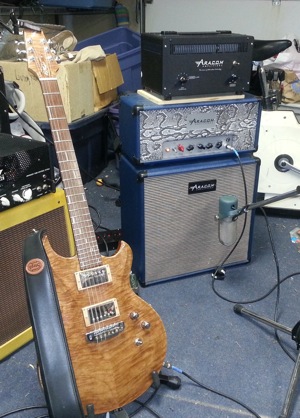
I haven’t gigged with it yet, as I just got it a few days ago. But I’ve tested it with my DV Mark Little 40 set up with EL34s, my Fender ToneMaster Deluxe, and my Aracom VRX22 and VRX18 (Plexi clones). It sounds great with all of them, though I’m leaning towards the Plexi tone. But it sounds killer with all of them.

All in all, I’m loving the pedal thus far. As for setup, the pedal has oodles of volume. I’ve been keeping the volume around 9 am and fiddling with the gain. There’s a lot of inherent sustain with the Tumnus, so I don’t feel the need to up the gain much. And it’s so sensitive to the volume knob and attack that I can get my amp into breakup with ease.

What about the Belle? That’s the cool thing. It has a different sound and feel, so I will be switching between the Belle and Tumnus depending on the song, and for solos, these two pedals stack nicely with each other. I haven’t decided which will go first in the chain. Right now, I’ve got the Tumnus before the Belle. I will have to do more tests to determine the order I like.

But no matter what order I decide on, the Bell and Tumnus stack together really well! For stacking, I was using my trusty Timmy, but it just didn’t sound right with the Belle. And before I bought the Tumnus, I went through that old milk crate and tried a bunch to see how they stacked with the Belle. On their own, they sounded great, but not so good stacked.

But the Tumnus? When I first auditioned it, I knew right away that it would stack well. Unlike my other ODs that had a pronounced midrange hump, the Tumnus was smoother. I knew that it would complement the Belle rather than compete with it. Of course, I was a shop, and I didn’t have a Belle on hand to test, but something told me it would work out. And what I found was that not only did it work out, the stacked sound was about the best I’ve ever heard!

The next test will be at a live gig with my band. I’m SO looking forward to using it then!

Read Full Post »

I got an original hand-wired Mad Professor Deep Blue Delay back in May of 2010. It was a huge expense for me at the time, costing $325.00. It was one of those pedals that, once I played it, I just had to have it. I remember that queasy feeling I had when I bought it, practically draining the money I had available in my checking account. But it sounded so good that there was no way I was going to leave the store (Gelb Music in Redwood City, CA) without it.

I didn’t use it much during the pandemic lockdown as there were no gigs to play. But leading up to that, I was doing a minimum of one-hundred gigs a year between 2010 and 2020, and the Deep Blue Delay was on my board the whole time.

That’s a picture I took of it this evening after I cleaned and tightened the pots. It was pretty beat up. It’s scratched, the lettering and line art were pretty dinged up. And although I hadn’t used it since before the lockdown, it needed some TLC. The pots were scratchy when I turned them, and I also noticed they were loose as all get-out! But once I was done, it was back to sounding like its old self!

Opening the enclosure was a little nerve-wracking. This is a hand-wired pedal, and the enclosure was filled with wires attached to the pots and a small PCB board. I am not electrically inclined, so I was worried about breaking any solder joints. But it went well, and I closed the bottom and tested it.

The sound was beautiful! And to think that after all these years and all the gigs I’ve played with it, it’s still working like the first day I bought it! It’s amazing!

There’s nothing like the Deep Blue Delay. Not only is the sound totally smooth, the pedal is incredibly responsive to pick dynamics. When it first came out, it was known as one of the most well-behaved analog delays to play with drive pedals. So many other pedals turned the sound to mush when played with overdrive and distortion pedals, but not the Deep Blue Delay. You could play fast runs and your notes would still be articulate. Only when you paused was the delay apparent.

Out of all the pedals I’ve owned, this one has been my hands-down favorite over the years. I’ve used it with both my electric and acoustic rigs. I’ve especially loved it when playing with my acoustic guitar. It gives my sound a haunting, dreamy feel.

As of late, I’ve been using my BOSS Waza Craft DM-2w, but that’s going to take a back seat to the DBD yet again. I’m excited to be putting it back into action!

Read Full Post »

Every few years, I write about things I’ve learned. I’m an eternal student of guitars and music and performing and I never stop trying to learn because there is always something to learn. So, here’s another chapter in my learning experience.

The sound is all that matters

One might think that after all these years running a gear site that I’m obsessive about my gear. I’m not. What I am obsessive about is my sound and at least from a gear standpoint, what it will take to achieve the sound I’m after. That could come from a cheap guitar or pedal, or it could come from my Les Paul worth thousands of dollars. If I can get the sound I’m expecting, I’m golden.

I no longer obsess over minute details like what kind of chip or circuit a particular pedal may use. I don’t really give a shit about whether an amp has tubes or not. All I need to know is if some gear helps me deliver my sound. The result of that is that I use a lot less gear now, especially pedals. My pedal chain is incredibly simple: Vox Big Bad Wah (if I’m the solo guitar player) -> Peterson StroboStomp Tuner -> BOSS GE-7 EQ -> Wampler Belle (ODR-1 clone) -> Timmy for stacking -> BOSS CE-2 Chorus (just because) -> BOSS DM-2w Analog Delay -> Pigtronix Class A Boost. That’s it. Depending on my mood, I’ll use either my Fender Tone Master Deluxe Reverb or DV Mark Little 40. When I’m in a Plexi mood, I’ll use my Aracom VRX22 (6V6) or VRX18 (EL84). My number one guitar is a Taylor T5z, though I will often switch with my Squier CV Tele.

Test, Test, TEST Your Gear

Before I leave for any gig, I spend an hour or two practicing and testing my gear to make sure all the connections are good, all the knobs are tight, and there are no shorts or anything crackling when I play. If I’m obsessive about anything, it’s making sure my entire signal chain is in good working order. I do this to ensure that once I get to a venue, what I set up on stage matches what I set up at home. Even with my signal chain being so simple, I still do this because I can’t tell you how many times I’ve found issues with my gear before leaving for a gig.

I also test my levels, so there are no surprises when I hook up to the PA. Depending on the venue, I know where my levels need to be, and I adjust them, accordingly, sometimes even going as far as testing through my DAW to ensure my levels are in the right place. When I talk about levels, it means dialing in my stage volume AND checking to make sure that what I’m sending to the PA isn’t too much or too little. I can’t tell you how many times I’ve played with folks who don’t test their gear or check their levels, especially their output levels, only to set up their rig at a gig and monopolize our setup time or eat into our sound check while they dial their shit in at the gig.

Have Two of EVERYTHING

I’ve written about this before, but I bring spares for everything to a gig, though admittedly, I usually only bring a single amp to a gig, but that’s because I’ve tested thoroughly. But I always have a spare guitar. I have two or three extra XLR, 1/4″ cords, patch cables, batteries, mics (vocal and amp). I also carry no less than three packs of strings.

Other important items I bring: A multitool just in case I need some pliers or cutters. For instance, at my last gig, I had to do a quick repair on my mic stand. I was so glad I had the multitool. Another thing I also bring is a high-power tactical flashlight. That has come in handy many times, especially at the end of a gig and we’re striking the stage. That flashlight mitigates leaving stuff at the venue. Finally, I always have a supply of Hall’s Mentholyptus cough drops. As a singer, they’ve been a lifesaver. But even if I’m not singing, at least for me, there’s something about the freshness that helps get my head straight.

Never Ever Wear Beer Goggles

I once played a gig where I was totally fucked up on bourbon. I thought I was playing great, and that the gig went well. But when I heard the recording, I was embarrassed to hear just how much I SUCKED! There were times where I was even singing completely off key! The moral of the story is that when you’re inebriated, you don’t sound as good as you think you do.

Listen to the Bass

I know that sounds counterintuitive since most people tend to think the drums provide the rhythm, but in every band I’ve played in over the years, it’s the bass that holds down the core rhythm. That’s why Peter Frampton refers to his bassist as the “Balls of the Band.” While the drums provide basic beat and tempo, from a musical standpoint the bass provides rhythmic “mood.” This is what I play off. For instance, in my church band, my bassist is not only skilled, but he’s a rock-solid musician who has great command over his fretboard. We’ve been playing together for years and we mix well as we play off each other. It’s a great mix. So while we’re performing a piece, I’m actively listening to what he’s playing and will adjust my playing to match the mood he’s presenting.

Ambient Reverb Is Only Good for the Studio

When the Christian group Hillsong broke through with their hits like “Oceans” and “What a Beautiful Name,” it seemed that every other Contemporary Christian band started using ambient, long-tail reverb like the Strymon Big Sky. The sound that pedals like that can produce is pretty awesome, but that sound only works in the studio or in a controlled environment.

I saw Hillsong live a few years back at the Oakland Coloseum arena. The guitars sounded like shit! They used all that ambient reverb and the guitars were completely washed out and muddy-sounding. The FOH guys compensated by boosting their levels, but that was a mistake. It just created an amorphous wall of mushy guitar sound. It was a shame because their guitarists are excellent musicians.

As Doug Doppler put it, “I add just a touch of reverb to give my tone a little grease. More than that and it turns mushy.” I totally agree. A little bit of reverb is fine. But as you add more reverb, you lose articulation as notes start overlapping each other. And in a live situation, that can be disastrous to your sound. It may sound great to you up close, but once the sound projects out to the audience along with all the other instrumentation and vocals, it will get completely lost in the mix. So as much as you might like that “big sky” sound, it’s probably a good idea to dial it down.

Using Less Gain

There’s nothing like the sound of a sweet, creamy distortion. But over the years, I’ve learned to use a lot less gain, especially with my overdrive pedals because too much gain causes your signal to compress. What then happens is your sound becomes completely muddy. For example, several years ago I went to the Experience Hendrix Tour with Joe Satriani. It was a great show, but when Joe first came on stage, he had way too much gain in either his pedals or amp and his tone was completely muddy. It was difficult to make out the notes he was playing. The FOH guys compensated by turning up his volume in the PA, but all that did was make his shitty, muddy sound louder – excrutiatingly so. Fortunately, after his opening number, he realized how bad he sounded, made some adjustments on his board, then all was well.

Personally, playing mostly classic rock, I’ve rarely gone into high-gain territory with my sound. But I’ve learned that like reverb to add enough gain to add some grease to my sound and get a great distorted tone without ever getting muddy.

And as far as overdrive is concerned, it boils down to setup. Whatever amp I use, I set it to the edge of breakup, so that if I attack harder or turn up the volume knob on my guitar, I’ll get go into overdrive. I normally use two overdrive pedals with a booster at the end of my chain. With the overdrive pedals, I add just enough gain to color my sound, but I make sure that the levels are at unity. If I stack, I expect only a modest jump in volume. With my overdrive pedals I want to make sure I have lots of control over my levels from my guitar. I kick in the boost for solos, which will slam the front-end of my amp, so I get a bigger jump in volume. That will also increase the amount of distortion, but I still fall short of fully saturating my front-end, which would cause compression and muddy my tone.

Get a Graphic EQ

It’s hard for me to believe that for as long as I’ve been playing, up until recently, I didn’t even consider using a Graphic EQ in my chain. But since I’ve added one to my chain, there’s no way that I will ever be without one on any of my boards. As Phil McKnight puts it, “A Graphic EQ solves problems.” Truer words could not be spoken. And the thing is that you don’t need much adjustment to affect dramatic change to your sound! When I use it on my acoustic board, because my piezo pickup is a bit midrangy, I setup my EQ in a slightly scooped pattern. We’re talking just a couple of dB on the low end and upper frequencies. But the affect that has had on my tone is insane! On my electric board, when I’m playing my Tele (which is most of the time), I slightly cut the lowest frequencies, and boost up the upper mids and slightly cut the highest frequencies. Talk about a rich tone!

You don’t have to spend a ton on one either. I purchased the BOSS GE-7 simply because I know that a BOSS pedal will withstand hundreds of gigs. But Behringer makes a good pedal for a quarter of the price. But no matter what you end of getting, you’ll be amazed at what it will do for your sound!

Read Full Post »

I just pulled the trigger on a BOSS GE-7 EQ pedal last week. It was a game-changer for me. And while I looked at a bunch of different graphic EQ pedals such as the Behringer EQ700, the MXR Six- and Ten-Band EQ, and even the very cool Source Audio EQ2, in the end I went with the standard GE-7. Why? Simply because I know it’ll just work right out the box with minimal fuss, and even more importantly, I’m confident it will continue working for years, even with lots of use.

While BOSS pedals are considered by many guitarists to be utilitarian, and their looks are pedestrian at best, one thing no one can fault them for is reliability. For instance, I have an original MIJ CE-2 Black Label from 1980 that I still use today. It has withstood thousands of gigs over that course of time; though truth be told, because it has so much sentimental value to me, I’m going to retire it soon and replace it with a new CE-2w. But regardless of me retiring it, imagine me lugging it to gigs and using it for over 40 years!

A lot of that reliability has to do with how rugged it is, and that is also an earmark of BOSS pedals. Their all-metal enclosures are thick. You can ding the paint (my CE-2 paint is nicked and chipped), but you will never bend the body of a BOSS pedal! Unless, of course, you take a hammer to it…

So what about sound? Well, that’s totally subjective. Guitarists like John 5 use mostly BOSS pedals. For others, they may be a bit too pedestrian. But one thing is for sure: BOSS has a TON of pedals to choose from, and the fact that they have been around for as along as they have means that they have a sound that’s appealing to lots of guitarists. And even after several decades in the business, they still find ways to innovate. They’ve never sat on their laurels. Even with their Waza Craft pedals, they’re bringing back their classics but upgraded with newer and even more reliable electronics. I have several delays, but the one that’s on my board is my BOSS DM-2w.

BOSS pedals aren’t the cheapest, but also aren’t as expensive as handmade boutique pedals. Cost-wise, they sit right in the middle. But as I mentioned above, they’re reliable. And while some boutique pedals may have more bells and whistles than a comparable BOSS pedal, lots of them do not have the same level of quality control. I’ve had several boutique pedals that didn’t last more than a year, with a couple failing after just a few months! But my BOSS pedals just keep on working.

And though it might not seem like much of a big deal, BOSS pedals are stocked in pretty much every guitar store, which means it’s easy to replace a BOSS pedal should it ever fail, in pretty much any city you go to. Very few gear stores don’t carry some BOSS pedals. I’ve never had to do this even though I have traveled hundreds of miles from home for gigs. But I do know of some guitarists who’ve had one of their pedals fail and they just ran to the nearest guitar store and got a replacement.

And here’s another great thing about BOSS pedals. Their footswitches are unmatched in the industry! I’m not sure if their design is patented – it probably is – but there’s no footswitch like a BOSS footswitch, especially if you play on a dark stage. I’m mainly a singer and rhythm guitarist, and I often play at a venue where the second set is pretty dark. I always have to look down to activate my dirt pedals that all use a latched, circular switch. But the BOSS footswitch is basically a hinged flap over a latched switch. It’s hard to miss!

On a more personal, qualitative note, at least for me, BOSS pedals are my benchmark for pedals. When I review a pedal, it has to be at least as good as a comparable BOSS pedal if it exists. And I’m not talking about price, though that may factor into my decision, especially with boutique pedals. For instance, if a boutique pedal costs three or four times as much as a comparable BOSS pedal but offers little extra, then I probably would pass on it.

But if it does something way beyond the comparable BOSS pedal then I’ll probably get it. Such was the case with my Mad Professor Deep Blue Delay. When I got it, it costed $325. But after comparing it to the DM-2 and MXR Carbon Copy, it was the hands-down winner. It eventually failed, so I now use a DM-2w, but in the back of my mind, I still kind of crave for a Deep Blue Delay.

There are lots of other things I can say about BOSS pedals, but I think you get the idea. Yes, they’re middle-of-the-road. But their longevity is a testament to the quality and reliability that has kept them around for so long.

Read Full Post »

Duke Ellington once said, “If it sounds good, it IS good.” I’ve used that saying when talking about gear for years. And it still rings true today. When my rig sounds good to me, I’m inspired to play. I become more creative and expressive. I do more to eek out more from what I’m playing. My response to a great sound is visceral. That great sound can come from super-expensive or super-cheap gear. As it stands, half of the pedals I own are in the $150+ range, with some in the $300 range.

But when I’m playing a gig with one of my bands, the audience doesn’t know the value of any of my gear. And frankly, they don’t give a shit, as long as they’re entertained.

And that’s the crux of this post. Over the years, I’ve heard lots of people scoff at others for buying incredibly expensive gear. Hell! A couple of my buddies gave me a little shit when I bought my R8, saying, “Dude, the audience doesn’t care about your guitar. You could get a similar tone with a PRS SE that costs a quarter of what you paid.” My reply to them was, “But I care.”

You’ll never hear me say something like that, and though it’s true that the audience can’t tell the difference between a $50 or $500 pedal or a $500 vs. a $2500 guitar, what counts is what inspires you. Whether you’re playing cheap gear or expensive gear, the important thing is that the sound that your gear produces inspires you.

And when you’re inspired, the audience can see it. They can feel the energy. That’s what they care about. They may not be able to hear if you’re playing a Bad Monkey or an original TS-808, but if you’re rocking what you’re playing, they will respond to that.

Read Full Post »

tldr;

Yeah, yeah, I’ve heard it all before. There’s no way a solid-state amp could sound as good as a tube amp. Tell that to Joe Satriani who used a Roland Chorus on “Surfing with the Alien” or George Benson who used one for years. The point is that if sounds good, it is good. And to me, the Fender TM Deluxe sounds killer and has the dynamics I’d expect out of any amp, regardless of it being tube-based or solid-state. Moreover, the audience doesn’t really give a shit.

Having now gigged with the TM Deluxe regularly for over a year-and-a-half, the amp has been a game-changer for me. At 23 pounds, it is light and easily luggable, even when I play in urban venues. It projects such a smooth, pleasant sound that works well with my guitars and board.

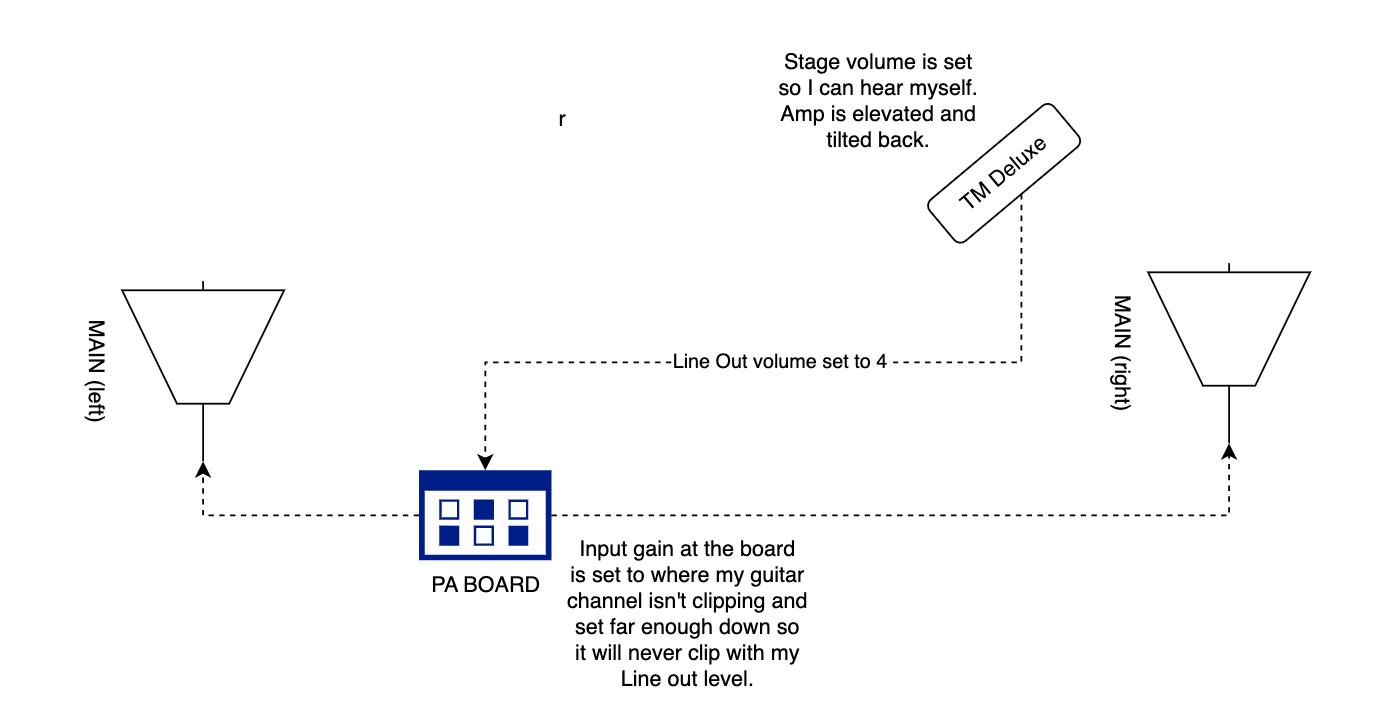
But the Line Out has been its greatest feature, allowing me to set my stage volume to a level where I’m not blowing out my eardrums, send the signal out to the PA for sound reinforcement and projection out to the audience. It took a few gigs to dial in the balance between output and local volume, but it has paid off in spades.

Here’s how I currently have it set up:

Here’s my signal chain:

Guitars (in order of use): Taylor T5z, Squier Classic Vibe Telecaster, Gibson R8 Les Paul

Effects: Wampler Belle > Paul Cochrane Timmy > BOSS CE-2 Chorus > BOSS DM-2w > Pigtronix Class A Boost

On the amp, I have the Master set at 4-5, then adjust the Volume knob based on the guitar so that I’m at the edge of breakup when I’m just past the middle on the guitar’s volume knob. My overdrive pedals are set just beyond unity gain when active, so they’ll push the amp into distortion while adding their own dirt. I use the boost for leads to give me 5-8 dB bump.

It’s a pretty simple and straight-forward setup that doesn’t require me to worry about settings once I’ve got everything set. This is important because even though I do some leads, I’m not the lead guitarist as I do a lot of the singing.

This is such a great amp. Great sound, so very versatile in a band setting. There’s not much more I could ask for!

Read Full Post »

Older Posts »