Overdrive Creates Distortion
Overdrive is the process of overloading a device and the end result – what you hear – is distortion. Here are the fundamental ways distortion is created.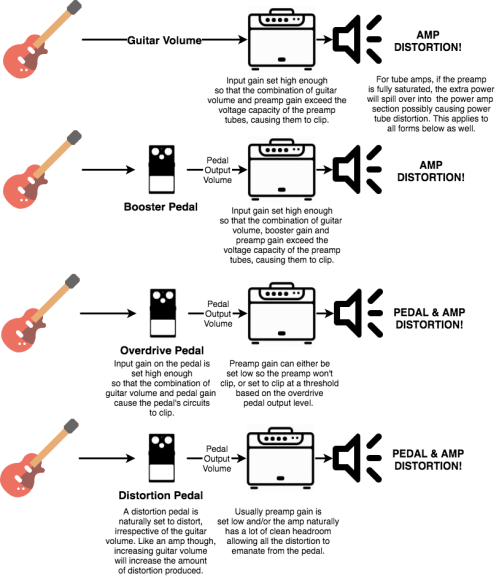
Posted in Guitars, tagged distortion, overdrive, overdrive vs distortion on October 6, 2018| 3 Comments »
Posted in Guitars on October 6, 2018| Leave a Comment »
I was talking to a sales guy in a shop and got into that age-old debate about overdrive vs. distortion and what they sound like. I’m not a mean person, so before he started flailing wildly, opining on how each sounds and the differences between soft clipping and square-wave distortion, I had to stop him, and just said, “Listen, I get it.”
I guess he felt a need to push his point, and my only reply was a question: “Do you understand that overdrive is a verb and distortion is a noun?” I just let the question hang in the air and waited for the expected response, “What do you mean?” which he finally asked after a bit of a stunned silence. My answer was simply, “Distortion is the end-product of the process of overdriving a device like a pedal or an amp, which is why I call overdrive a verb and distortion a noun.”
That led into a discussion on pedals. I explained that in the end, the goal of all “drive” pedals is to produce a form of distortion as the result of overdriving the input of a device to cause it to clip. The higher the gain, the higher the clipping. And different devices produce different kinds of gain. He nodded in agreement and then I went on to explain the following:
We went on to discuss how each sounds, but I won’t bore you with that. Instead, I’ll break down what we discussed.
Do different types of distortion sound different?
Of course, they do. A pure amp distortion is a distortion produced in the amp itself. That has a sound all its own, and different amps sound differently overdriven. Booster pedals are designed to create amp distortion.
The soft-clipping of an overdrive pedal is considered kind of an “open” and “airy” type of distortion, more gritty than smooth with lots of room for dynamics depending on the instrument’s gain and player attack; that is, the amount of distortion produced varies based on gain and attack.
A hard-clipping device like a distortion pedal produces a more compressed, consistent, low dynamic sound; that is, irrespective of a note being played or its volume, the internal gain of the device is set so high that whatever is played will be amplified into clipping beyond the device’s saturation point. Distortion is not as affected by gain or attack as it is with an overdrive or booster pedal. As an aside, fuzz pedals are ultra-high-gain. These produce that square wave distortion: super-compressed, with lots of sustain (think “American Woman” by the Guess Who).
Circling back to amp distortion, in general, vintage and vintage-style amps distort with soft-clipping as they have few gain stages and in a lot of cases, at least for vintage tube amps, by default, their tubes are biased on the cooler side. Modern, high-gain amps have more gain stages which can produce hard-clipping distortion.
I know I’m covering ground I’ve crossed in the past. But even today, the debate continues, so I think it’s worth it to dust off the discussion now and then.
Here’s a quick reference to help understand how overdrive creates distortion:

Posted in Guitars on October 5, 2018| 1 Comment »
 Summary: The BeatBuddy revolutionized practice and even solo performance by providing great backing beats with its default set of beats. But with the Premium Library SD Card 2019, entire songs and even more beats extend the usability of this already incredible drum machine in a box.
Pros: Lots of beats – probably more than you’ll ever need! Contains beats of full-length songs from a bunch of artists and genres. For songwriters like myself, all the extra beats provide a great canvas for song ideas. I LOVE the new, extra drum kits included in this set! The defaults are fine, but some kits like the Phil Collins-inspired sets provide a nice change to the original sets.
Cons: My only nit is also what’s so great about this library: There are A LOT of beats. 🙂 But as with all libraries, you’re going to cherry-pick what you’ll use. The challenge with this will be in a live setting having to go through the menus. Before I use this live, I will have to create a cheat sheet so I can get to the beats I need quickly.
 Tone Bone Score: 4.75 This library makes the BeatBuddy incredibly useful to me now for both practice and finally, for my solo gigs. With the full-length cover songs in the Premium Library, which luckily for me include many songs I do in my solo gigs, I’m looking forward to using this regularly on my board!
Street Price: $199.00
When David Packouz, the inventor of the BeatBuddy, first approached me with his idea for the BeatBuddy, I jumped at the chance to review the unit upon its release. For years, I had to use my recording software like Logic or GarageBand to provide backing drum beats for practice and writing. And for practice, it was a pain in the ass.
So when I got the BeatBuddy, I literally was overcome with joy, as I could take one of my amps, lock myself in a room… well… my man-cave, and practice and write, free from a computer. It was great! But I felt that while incredibly useful, the default loops were a bit basic. Though fairly high quality in sound, there was only so much I could do. So to be completely honest, while I had plans to gig with the BeatBuddy, it remained a trusty companion in my home studio.
But I that’s changed now with the Premium Library because, as I mentioned, many of the full-length songs included on the card are songs I play in my solo gigs. I practiced with a few of them like Sting’s “It’s Probably Me,” which is done according to his version that he recorded with Eric Clapton. This is the version I play in my gigs, though I add some of the major-7th and flat-5 chords he uses on his album (sorry forgot which one). In that version, it starts out with a simple beat with a soft rim shot. Perfect lead-in to the next section (there are 7). I also explored the Elton John and Billy Joel banks and the Popular Cover songs (though I’ve only gotten through the 3rd volume – there are 11 volumes included with 10 songs each).
Not everything I do is covered, but let me tell you why I’m so excited about having all these full-length songs: I’m too freakin’ lazy to use the BeatBuddy Manager to construct full song sets on my own! 🙂 I have a day job, and I gig on the weekends and some nights during the week. I’ve tried using the software a few times to construct songs, but I just don’t have enough time to sit and edit for hours at a time. But if someone did it for me, damn! So yeah, I’m REALLY diggin’ having these full-length songs at my disposal!
But on top of that – and I haven’t even explored all the different beats – the extended set beats are much more complex than the default sets. Myself, I like complex rhythms; and no, not weird time signatures, but rhythms that have lots to offer because it allows me to attack my guitar in different ways and inspires me to explore. But when the beats are basic, it’s difficult to get inspired. It’s a whole new ball game with this the Premium Library!
Some might balk at what might appear to be a steep price to pay for the library. But having gone through the process of constructing songs with the BeatBuddy Manager software, for someone like me who doesn’t have a lot of time to tweak, this library is a godsend. And sure, you might be thinking that it’s just an SD Card, but how much have we gear sluts spent on little items? If you’re like me, you’ll get a lot of mileage from this particular “little” item!
Prior to writing this review, I spent the previous 3 hours exploring the library. I didn’t expect to spend much time with it, but I kept on discovering new things. And when I looked up, I couldn’t believe how much time had passed! So like I said, I’m going to enjoy using my BeatBuddy at gigs, and the Premium Library has now made that possible!
Posted in Guitars on October 4, 2018| 2 Comments »
 Back in the mid-70’s (gawd, I’m dating myself), Eddie Van Halen redefined how players approached playing the guitar. His tapping techniques and blindingly-fast fingerwork, not to mention his natural showmanship combined with a dynamic frontman, and a HUGE sound completely transformed rock and roll.
But with EVH, at least for me, it wasn’t necessarily his technique and style that specifically appealed to me. Sure, I was completely awed by what he could do with his guitar. But even at the young age of 14 when I first heard Van Halen, what I felt truly set him apart was what was behind what he played. I always felt that with each solo, EVH had something to say; that there was some underlying message he was trying to communicate at the time.
Contrast that to the hair metal players that followed in his footsteps. I can’t name a single one except for Mick Mars from Motley Crue, and Brad Gillis and Jeff Watson of Night Ranger. Okay, I admit it: I wasn’t a fan of glam rock – at all. It sounded all the same to me. I figured if I heard one, I’d heard them all.
I wasn’t particularly a fan of the Crue back in the day either, and frankly, most of their songs just didn’t appeal to me. But Mick Mars wasn’t a pattern player, and I always felt he played stuff outside the very limiting box of glam rock. As for the other two, I dug Night Ranger as a band, and though they toed the glam rock line, their music was beyond it; but despite that, Brad and Tom’s playing just blew me away. They took all that flashy technique and said something with it. And even though Jeff Watson’s two-handed arpeggio technique could technically be called just a trick, what he could actually do with that was simply amazing; and again, I felt he had something to say.
Then there’s Glen Campbell. I don’t think anyone will argue with me that Mr. Campbell was perhaps one of the most influential guitarists – ever. I know, big claim. But as part of LA’s Wrecking Crew session group, Glen Campbell literally helped define the rock and roll sound. Back in the early days of the recording industry, groups weren’t writing their own songs, and god forbid they played on their own albums. It was up to musicians like Glen Campbell. And he was special… Check this out:
Every bit of phrasing in that solo just fits. And tell me Mark Knopfler wasn’t influenced by that. Whether directly or indirectly, some of that phrasing could easily translate to the great Mark Knopfler, also one of my all-time favorites.
I could keep going on about great guitarists, but they all have one thing in common. They all have something to say when they play. For me, I’ve always admitted that I’m not a fast player. Never have been, and I probably never will be. But I learned early on when learning how to solo that what’s behind what I’m playing is almost more important than what I’m playing.
Frank Zappa said this back in 1984 in an interview on MTV with respect to improvising: “I have a basic mechanical knowledge of [the] operation of the instrument, and I got an imagination. And when the time comes up in the song to play a solo, it’s me against the laws of nature. I don’t know what I’m gonna play, I don’t know what I’m gonna do. I know roughly how long I have to do it and it’s a game where you have a piece of time and you get to decorate it. And depending on how intuitive the rhythm section is that’s backing you up, you can do things that are literally impossible to imagine sitting here.”
I heard that many years ago, and it has stuck with me since. I’m a “mood” player. My moods affect my solos. I don’t know if I have a particular message in mind when I’m playing, but what I try to do is communicate the mood I’m in at the time I play. I never know what my solo is going to be but I do know that I want to say something about how I’m feeling. Although I will admit that if I’m pissed, my solos are shit. 🙂
I think it was an interview with Freddie King who said, “Playing guitar is like having a conversation with someone. You gotta ask yourself, ‘What are you trying to say?'” And I think that’s root of my problem with all the glam rock shit back in the day is the same problem I have with so much of the pop music out there now. It’s an exercise of “Look at me and all the tricks I can do!” or in the case of pop, just meaningless filler. I didn’t feel a connection with the music. It wasn’t talking to me.
And speaking of talking to me, though I’m not really a big jazz aficionado (I know what I like), I’ve always been in total awe of Miles Davis and his minimalistic approach. That man could say so many things in one or two notes that might take someone else 100 notes to accomplish. Check this out (I’ve set the video position to my favorite song on the album “Blue in Green” – it’s at about 19:00 if the video doesn’t start there):
That song is mesmerizing to me. Miles plays it with a muted trumpet. And he doesn’t play much at all. But what he does play speaks a thousand things to me. He totally proves the point that you don’t need to say much to say a lot. 🙂
And as far as gear is concerned, no amount of gear is going to overcome an empty message. You might sound good, but if you don’t have anything to say (I’ll let you draw your own conclusions)…
What’s YOUR message?
Posted in Guitars on October 3, 2018| Leave a Comment »
This is not a rant, though the beginning may seem like it…
Nothing is easy. In fact, mastery of anything requires work. Hard work. But most people don’t want to do it. They want to take shortcuts. They want to reach stardom instantly.
Why do you think shows like American Idol and The Four and <insert country>’s Got Talent are so popular? They’re mostly comprised of people who want to take the shortest path to stardom. Sure, there have been some exceptions where people have become super-successful entertainers, but for the most part, the actual “success” stories are very few.
Unfortunately, most people are more focused on the trappings of success rather than the process. They see their stars like Tay-tay living in huge mansions and wearing the latest garb and attending the glitz and glamor galas and they think, “Hey! I want that!”
But as Eric Rachmany from Rebelution said in “Lay My Claim” you’ve got to do the work.
You have to develop your talent and skill. Even the late Kurt Cobain who was considered in some circles a great guitarist wasn’t very good when Nirvana first hit popularity. But his “handlers” made the band practice – a lot.
For new guitarists, there’s only one way to reach those rarified heights: Practice. Want to play like SRV, Vai, Satriani, Johnson, Mayer et al? You have to put in the time. I’m nowhere near as good as any of those players, but I’ve developed my own style over the years. I practice/play at least a half-hour or more EVERY DAY. I’m still learning even after almost 50 years of playing guitar!
Nothing happens overnight.
Nothing is easy.
Posted in Guitars on October 3, 2018| Leave a Comment »
Posted in Guitars on October 3, 2018| 2 Comments »
I’ve been playing guitar for over 46 years, and no matter what might be in my signal chain, the difference-maker between sounding good and sounding great has ultimately lain with the guitar. To me, when you play a great guitar, it can bring the best out of any signal chain; though I need to qualify that if a signal chain sounds like crap in the first place, while a great guitar could make the sound passable, there’s no complete cure to a bad-sounding rig.
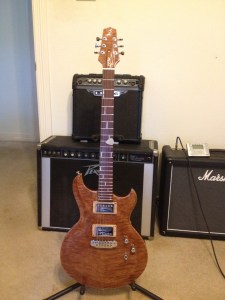 Mind you, the price has nothing to do with making a guitar great. Hell! I’ve had a few guitars over the years that cost a tenth of some guitars and they kick the shit out of them with respect tone and playability. When I say a guitar is “great,” it has everything to do with the guitar’s character. And when I feel a guitar has a special character, it speaks me to in such a way that I can be maximally creative. It will make me explore what tones I can get out of it.
Such is the case with my beloved “Katie May,” my custom Slash L guitar built by my friend good friend Perry Riggs. This guitar is what I consider to be a truly great guitar. I can put her in front of any of my various rig combinations, and she will sing. Absolutely sing.
But I can also say the same for my humble Squier CV Telecaster. It is literally worth a tenth of Katie May, but I love playing that guitar, even with its little quirks like a super-thin neck and low frets.
The point to all this is that we gear sluts have a tendency to fixate on bells and whistles and little minute details. We spend incredible amounts of time perusing forums and trying out gear in a quest to find that tone unicorn. As for me, that quest led me to build up a hoard of instruments and accessories; 90% of which I have either sold or just sit in my garage collecting dust.
In America, we have a saying: Hindsight is 20/20. That means when you look back, you can always see more clearly, and looking back almost invariably leads to saying things like, “If I only did this…” or “Hmm… I could’ve done that…” We all do it. And this article is doing a bit of that. But I also believe in this saying: “It’s water under the bridge,” which means that all the stuff I’ve done is just flowing past. I made my choices and am moving on. But that doesn’t mean I can’t share some tidbits of what I’ve learned along the way.
Besides, let’s face it: It was VERY fun acquiring all that gear! 🙂
On a more serious note though, as I stated in the title, a great guitar really can make all the difference. And at the risk of sounding cliché, our quest for the unicorn starts with the guitar. Everything else is peripheral; even the amp we choose. After all, if a guitar doesn’t feel good, or doesn’t sound good with the gear you’re using to produce sound, what does it matter?
Such is the case with Gibson ES-335 guitars I’ve had over the years. I love these guitars! I’ve purchased three of them in the last 15 years but have sold every single one of them. They’re fantastic guitars, but for some reason, I’m very fickle when it comes to the ES-335. So I tend to stay away from them.
The only exception to this was my very first one, which was a bare-bones ES-330. I sold it because I needed the cash (it was a difficult time for me then), and have regretted the decision since. I was still getting into electric guitar at the time and knew that there were still a lot of territories to cover and discover with that guitar (read: I also needed to get better at playing) that when I look back, I didn’t really get to spend the time with it. But my rig was also in a lot of flux at the time. So I sold off the stuff that wasn’t jibing well. Perhaps now that I’ve found my sound and my rig is fairly established, I’ll explore an ES-x in the future. But I digress…
I know you’re probably thinking: So what makes a guitar great? Hopefully, you’ve gleaned from this discussion thus far that “greatness” is entirely subjective; that is, as the saying goes, beauty is in the eye of the beholder. YOU have to decide if a guitar is great for YOU.
Especially if you frequent online gear forums, there’s always the risk that you fall into the trap of getting bamboozled by all the chatter, relying on people’s opinions who come off as knowledgeable about this and that. But remember this: Opinions are like assholes. Everyone has one. NO ONE can tell you what sounds good and what does not.
The important thing to bear in mind is that it doesn’t matter WHAT you play. If it inspires you to create music and sounds good to YOUR ears and feels good in YOUR hands, then you’re good to go.
Posted in Guitars on October 2, 2018| Leave a Comment »
Amazing. I’ve posted more in the last two days than in past several months… Oh well, being sick and at home allows me to do some catching up… 🙂
As you know, I just purchased the BOSS Katana 50 amp, and yes, I’m very excited about it. Despite feeling like crap, I played the amp late into the night. And no, I wasn’t tweaking it. I was just playing whatever came into my head for the pure enjoyment of playing and hearing – to me, at least – great sound. And for those of you who lurk the online forums, no, I actually didn’t read the forums for others’ opinions before I went and made my purchase. In fact, it didn’t even occur to me to look there.
But I did peruse the forums this morning and ran across several threads about the Katana. As expected, opinions on the amp were a split-decision. But one comment made me think:
Unlike this guy, I won’t be moving out my tube amps. They’ve become trusted, lifelong friends whom I’ll keep around till I die. But the salient point that he made was the phrase “finally crossed my threshold of acceptance.” To me, in other words, he was saying the amp worked for his needs.
And that’s the point with getting ANY gear. A for me, after literally spending tens of thousands of dollars on gear and selling off a bunch of stuff, I’ve learned one important lesson about gear purchases: Whatever I consider buying has to work for ME.
I used to get all hyped up about this or that new thing that people were buzzing about. I’d get so excited that I’d place an order, get the gear, only to find out when I played it that it just didn’t work for me. And that could be – and actually was – a fairly expensive endeavor.
Now with my much more limited budget, I’ve had to control those urges and first form a very good picture in my mind of how I’d use the gear in question; and be completely honest with myself and take the time to evaluate just how I’d use it, and perhaps more importantly, just HOW MUCH I would use it.
Take, for example, a flanger pedal. I love that sound. I even have an old BOSS flanger. But it has never had a permanent, much less a regular slot on my board. I’ve run across some very nice boutique flangers, but I won’t get one any time soon because for what I play on a regular basis, it would never get used.
Back to the Katana 50, I could’ve easily walked away without the amp if the sound and dynamics didn’t fit my tastes. And no, I didn’t really get into the higher gain modes of the amp because what I’ve been looking for specifically is a clean headroom platform in a combo for my pedals. So I made my decision to buy it based on what I could achieve clean. So the eval was quick. When I got home, I plugged my pedal board into the amp, tweaked the EQ and voila! It worked perfectly for my intended application!
So cheap or not, this was a great purchase for me and I couldn’t be happier. But I also have several drawers full of pedals that serve as a reminder of what doesn’t work. 🙂
Posted in Guitars on October 1, 2018| 6 Comments »

Summary: The littlest brother of the BOSS Katana line of amps, this amp packs heaps of tone and dynamics comparable to a valve amp. But instead of trying to cop the sound and feel of a tube amp platform, the Katana has a sound all its own, providing the characteristics one would expect from a tube amp.
Pros: Lots of praise to pile on. Use it as a clean platform – it takes pedals incredibly well. There’s access to over 50 built-in BOSS effects. The EQ is super-usable as well. Though listed as a 2-channel amp, with a second bank on each channel to set sounds, it’s effectively a 4-channel amp. The built-in acoustic preamp is not just usable, it sounds killer. Finally, with power attenuation of 50W, 25W, and all the way down to 0.5W, this amp will perform in any kind of venue. And though the smallest of the Katana line, this comes equipped with a more than capable 1 X 12.
Cons: The ONLY disappointment I have with the amp is that it doesn’t have a line out which is included with the 100 Watt models. But this is simply my nitpicking. I figured that BOSS included some really cool stuff, why not a line out? But no matter, this is still a great amp.

Tone Bone Score: 5
Maybe it’s my initial infatuation talking with this amp, but I’m loving it! Yes, I just got it, but I’ve played countless combinations of gear over the years, and I know what I like, and I absolutely love this amp!
Street Price: $219.99 ~ Yes, you read that correctly…
If you’ve been reading this blog for awhile, you know that I am of the mind that if it sounds good, it is good. But when it has come to amps, I have – up until recently – been of the mind that no solid state amp could even come close to the sound and performance of a tube amp. Even when I reviewed the Fender Ultra Chorus, while I loved the absolutely inspirational clean tones that amp produced, it was still fairly one-dimensional in what it could offer. But all that has changed with the Katana 50.
I’m still scratching my head, thinking how could a literally inexpensive, solid state amplifier perform on par with a tube amp with similar tonal charm and dynamic response. It’s uncanny, but it’s true. Of course, I realize that this is my own truth speaking. Someone else might think it’s crap. But I’ve spent the last 5 or so hours playing a variety of guitars through the amp – both electric and acoustic – and after dialing in the EQ for each guitar, I just haven’t found a bad sound yet.
And get this: I haven’t even begun to use the onboard effects to any extent other than just experimenting because I wanted to use this as a clean platform for my pedals. The only effect I’ve used with any regularity thus far is the very nice reverb, of which you can use three different kinds. But admittedly, I’ve only used this sparingly because for some reason, the reverb is tied into the delay, so you always get a bit of delay. It’s actually not that bad, but if you just want pure reverb, by default you won’t get it. You’ll have to go into the software to program it out. Not a big deal.
This is a real pride-swallower for me. When I got the amp, I did something that I never do when I evaluate gear. I actually tried to make it suck. Granted, you can make anything sound like crap by adjusting to the extremes. I’m more fair than that. But I threw every guitar in my usable arsenal at it, threw several kinds of pedals in front of it, but with only a few simple tweaks of the EQ, I not only got usable tones from the amp, but most were also damn good!
Not to mention the dynamics of the amp. BOSS somehow figured out how to effectively cop a voltage sag in the amp, so there’s lots of sustain which is very apparent when playing clean. With the acoustic preamp channel, this “sag” has a very nice overtone effect. My acoustic sounds gorgeous through the amp. So… hat in hand, I just can’t find anything bad about the performance of this amp.
Did I also say it’s LOUD? Typically when you’re talking tube amps, 50 Watts is searingly hot. Traditionally with solid state amps, those wattage numbers mean practically nothing. But this amp is capable of being very, very, very loud. Luckily though, the amp has built-in ouput power attenuation. You can set it to 50W for maximum clean headroom – and volume – switch it down to 25W to get some great gain at a lower volume, or 0.5W to use for bedroom practice.
Now some have commented that the attenuator is a little redundant and doesn’t make much sense since the amp has a Master volume. It’s a solid state/digital amp after all. But the Master volume acts as a variable regulator relative to the power setting, so you can’t exceed the output at that setting. This makes it very useful, at least to me.
My first exposure to the amp was in a local Guitar Center the other day. I was checking out a Roland JC-40 and another guy was playing a Katana 100. The dude was freaking incredible, having set up the amp tone to sound like Eric Johnson. It was amazing, and the dude could play! As a test, I started playing some riffs and chord progressions to give the guy a canvas to play over, and we did an impromptu jam session. I have to say that I was quite impressed with the Katana. And to be perfectly honest, up until I played it in the shop, I knew very little about it, having dismissed it as a simple practice amp. Boy, was I wrong!
Some people have complained about the black on black color scheme. Me? I actually kind of dig it. It’s very understated. The amp also has a little kickstand underneath to tilt it back. Very nice touch. The cabinet is made of MDM board, not solid wood, but it’s thick and sturdy. But the kicker is that the amp only weighs 25 lbs. Very luggable.
I’ve heaped on the praise of how the amp sounds, and I will provide a sound test entry in the next few days. But the notable thing that really stands out for me is the voicing of the amp. The open back really helps the lows resonate without dampening the tone into mush. My past experience with solid state amps is that the lows are flabby and if you turn them up to any degree, it’s like throwing a blanket over the cabinet. Not so with this amp.
And speaking of EQ, this is yet another impressive feature of the amp. The EQ is highly responsive with what seems like a very wide range for each of the three sections. Want a scooped tone? No problem! Want a midrange hump? Very easy to dial in, which makes it super-easy to get a great tone for whatever guitar you place in front of it.
And make no mistake. This amp isn’t trying to be a Fender or Marshall, and this is what endears it to me so much. It sings in its own voice, and that voice is very pleasing to me. Like I said, others may find that it’s crap, but I’m never going to be one of those people. This is a solid amp that I will be using with regularity going forward.
When I finally had a chance to play this amp where it generated lots of SPL, I was BLOWN AWAY! I played this amp on a weekend youth retreat with a full band consisting of two guitars, a keyboard, bass and drums. And I have to say that when this amp is putting out sound, it’s big and three-dimensional. Hey! It sounds fantastic at low volume, but I think it shines best when it’s pushed hard!
This is definitely where I fell in love with the Katana. The dynamics are absolutely incredible, responding to attack and volume changes with ease. And as far as the dirt that the amp produces. Damn! I didn’t think solid-state breakup could sound this good. But then again, dirt pedals are solid-state and they achieve their clipping with chips. BOSS definitely got it right with this!
Several reviews out there have called the Katana a modeling amp, probably because of the built-in effects and gain settings which seem to mimic a modeler. But even with my limited experience with this amp, those gain settings seem more like voicing rather than models trying to copy an amp. Unfortunately, they call their highest gain setting “Brown Sound.” But to me, it mimics the amp and power settings EVH used rather than a model of his original Marshall. Like I said, the amp has a sound all its own, so at least to me, it’s more an amp with different voicings rather than a modeling amp.
Yes, the amp uses COS-M models that – if you ever played a Roland Cube – have been at the heart of Roland’s amps for years. But it seems that these have been done in such a way that they’re not trying to mimic a particular platform. But then the question really is: Does it really matter if it’s a modeling amp or not if it sounds and performs this well? I’m convinced it doesn’t matter, but I’d encourage you to check it out for yourself.
I normally save this discussion for a Gig Report article, but I thought it would be helpful since this review gets a lot of traffic. I’ve now been playing the Katana regularly for the past 4 months. The speaker is nicely broken in, and as with any new speaker, the brittleness of the speaker cone has been completely smoothed out.
My regular usage has been at weekly church services, and it has performed remarkably well in that venue. The great thing about playing at church is that the musical styles vary – a lot. My particular band doesn’t just stick to the country-infused Contemporary Christian stuff. We play reggae-inspired music as well as guitar-centric classic rock style music and, of course, soft, inspirational music thrown into the mix. No matter what style I’ve played through the Katana, I’ve not yet been left thinking that this amp isn’t enough.
I’ve also played a few larger (as in louder) venues as well, and I do have to say that when the Katana’s speaker is pushing some serious SPL, the sound is absolutely magical. I played a weekend retreat a month ago where I was able to set the amp to its full 50 Watts. At that venue, I was all about maximum clean headroom. I hit the front-end of the amp hard with an overdrive pedal (specifically, the Tone Freak Abunai 2) and the amp just SCREAMED! The cabinet is extremely resonant, and the sound that issued from the amp was lush and rich. At several points over the weekend, I just closed my eyes and let my fingers do the talking through the amp!
What more is there to say? I love this amp! And no, it’s not because it was cheap. That’s definitely something to giggle about. But even if it wasn’t this cheap, the tone and dynamics alone make this an incredible amp irrespective of the price.
Posted in Guitars, tagged capo, g7th on October 1, 2018| Leave a Comment »
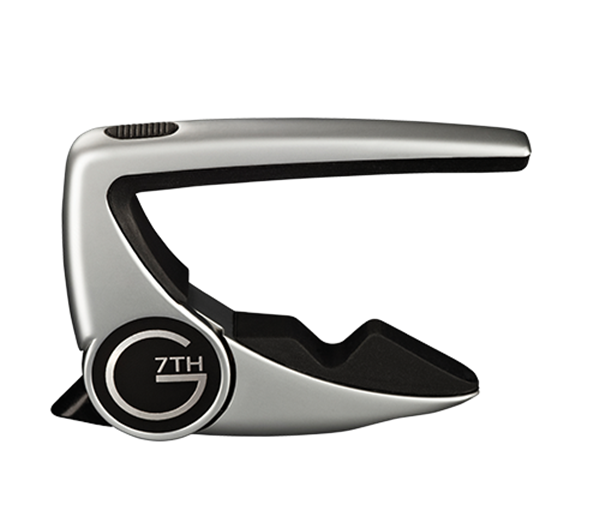 Conceivably, all capos operate pretty much the same way: Place the capo at a fret position and go. I’ve played with many capos over the years, starting out with the traditional folk guitar, elastic strap capo, then moving to Shubb then most recently, Kyser capos, of which I have several.
But recently, and especially since I got my Simon and Patrick acoustic, I’ve been less than enthusiastic with the Kyser, especially when using the capo above the 5th fret. I’d have to spend some time positioning it so it wouldn’t put my strings out of tune and, more importantly, wouldn’t buzz if I hit the strings too hard.
So I went on a quest to find a new one. I could go back to Shubb, but I didn’t really like the lever action, and though adjustable, I’d get frustrated when moving the capo up and down the neck and having to readjust the tension. There are other spring-loaded types, but having tried those, and especially the ones with the levers on the back of the neck, meh, they got in the way. So I wanted a low-profile design that wouldn’t get in the way of my fretting hand.
The two that I considered were the Thalia and the G7th. They both seemed to operate similarly, though I was really leaning towards the ratchet design of the G7th. As for the Thalia, while it seemed to have the characteristics that I liked, the extra “form” with the inlays – which are totally cool, by the way – kind of red-flagged it as a fashion statement for me, though no doubt based on the reviews I read it was probably more than functional.
But in the end, I decided to go with the G7th. This is a great capo! Squeezing it on was a little unsettling at first because I didn’t know whether or not it would work. But it works great! I’ve thus far put it on all my electric guitars and my acoustic and it works pretty much flawlessly with no string buzz or bending my strings out of tune on all of them.
For my acoustic, I had to find just the right place to get the best performance, but I was expecting that because the action on my acoustic is just a tad high. But once I found the spot, it has worked great.
Now the question is: Do I have buyer’s remorse for spending $50 on it? And for those who are considering getting one of these, a good question would be: Do I think it’s worth it?
That’s complicated. No, I don’t have buyer’s remorse because it just works incredibly well and it’s obvious a lot of time and effort has gone into designing this capo. But on the other hand, it is rather expensive for such a utilitarian, pedestrian accessory. At least for me, it solved the string buzz issue I was having with my Kysers, so from that perspective, yes, for me, it was a good purchase. But for those considering getting one, the question you have to ask yourself is are you getting this because it’s cool, or does it really solve a problem?
“Cool” is certainly a reason to go get something like this. For us gear sluts, that’s a given. But I also have a very practical side so I tend to ignore the cool factor and try to focus on function. As I mentioned above, this capo has solved a real problem for me, so I’m happy with the purchase. And yes, I’d recommend getting it. The design is great and really unobtrusive.
But I will say this: If you’re happy with what you’re using now and it works for you, this isn’t something I’d rush to the store to get. It’s certainly a nice-to-have, that’s for sure.
 Guitar Gear