Feeds:
Posts
Comments

Archive for the ‘Guitars’ Category

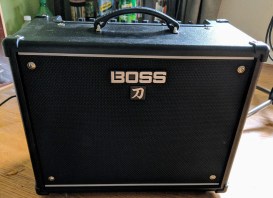
IMG_20181001_112403Or… this could be called Confessions of a Tube Amp Snob…

For the past decade or so, I’ve been a complete devotee of the tube amp. I’ve literally got 10 of them, and believe it or not, I still use most of them. In my mind, there has really been nothing like the feel and dynamics of a tube amp. And solid state amps? No way could that feel be duplicated.

Ten years ago, that might have been true – though admittedly, it was probably also drinking quite a bit of Koolaid – now though, that line between what separates tube amps and solid state amps is so narrow as to be almost imperceptible. WTF? Part of me is beside myself scratching my head and asking, “How could this be?”

Technology, of course, progresses. And luckily, amp manufacturers – specifically, solid state amp manufacturers – have listened to their customers over the years to create amps that have similar dynamics to valve amps.

I just bought a BOSS Katana 50 and I can describe it in two words: IT ROCKS! I can’t even begin to tell you how good it is. It not only sounds great with the deep, 3-dimensional sound I’ve come to love about tube amps, but the feel and dynamics of the amp are right on par with my tube amps. And I only paid $219.99 for the freakin’ thing!

Most solid state amps of old were fairly flat sounding and uninspiring hunks of junk (though I need to leave the Roland JC series out of that). But today? It’s a completely different story. Within the first few notes of playing with the Katana in the shop, I knew I was playing something special. I was expecting kind of a “toy” sound out of it. But what issued from the amp was simply magic. #blownaway

Even when I played the amp completely dry, the deep quality of the sound still remained. It didn’t become flat and lifeless. The sound still resonated and I was playing in a carpeted room with a low f-in’ ceiling! Look, I’ve been around gear for years and have literally reviewed thousands of guitars, amps, effects, and accessories in all sorts of different combinations. I’m not easily blown away because frankly, I’ve become quite jaded. But this amp completely changes my mind about solid state amps being inferior in both sound and dynamics compared to tube amps.

Am I going to scrap my tube amps? Absolutely not. Each amp has a particular voice that I may need when I record. So they will still be set up and still be used. I’ll even still gig with them.

But as far as voicing is concerned, what I like about the Katana is that at least to me, it seems that it isn’t an amp that was designed to emulate a tube amp platform like a Marshall or Fender. It has a sound all its own. What’s most important to me is that it possesses the tonal and dynamic characteristics I’ve come to expect out of a “good” amp. And I will just say it: This amp isn’t just “good enough;” it’s not a compromise. It’s just plain good.

Over the years, I’ve mellowed my perspective about gear. In my mind, if it sounds good and feels good, it is good, and the Katana fits that perfectly.

Here’s a Chappers demo of the amp:

I will be gigging with the amp in the coming week, and will follow this up with a full review!

Read Full Post »

James Taylor: Unsung Hero?

I’ve tended to focus on electric guitar in this blog over the years as it started out as a diary for my move into tube amps. But truth be told, I play acoustic guitar at least 75% of the gigs I play. And through the years, James Taylor has been a major influence on how I approach acoustic guitar playing.

I’ve written about JT in the past, but last night, I watched an episode of Austin City Limits with JT as the guest artist and I was reminded of why he has been such an influence over my playing. For instance, if you watch the video above, listen closely to the guitar playing. There’s A LOT going on!

Which brings me to the title of this article. I think many people – even my contemporaries – view JT as a great songwriter. And I believe that his incredible songwriting has always overshadowed his guitar playing. But his technique is absolutely incredible. Last night, as I watched Austin City Limits, I was literally transfixed by how JT played and approached his instrument. It wasn’t just what he played, but what he didn’t play that I found so amazing. And that’s mark of a true master; that is, a master is one who can express their message in a just a few notes that others may take many more to accomplish.

There’s an economy to JT’s playing that I think very few have mastered. I’ve seen it with jazz musicians like Miles Davis, but very few guitarists. To me, JT is that rare guitarist that can say so much with just a minimum amount of notes. 

Could be I’m way off with respect to JT being an unsung hero, but to me, he’s once of the best guitarists in the history of the instrument.

Read Full Post »

A friend of mine forwarded me an article published in the Wall Street Journal this morning, stating that “Gibson Brands” filed for Chapter 11 as it’s Gibson Innovations division, which operates under the Philips moniker, seeks protection to reorganize “in the face of $500 Million in debt.” The company at large is set to default on some of its debt as soon as July and is actively liquidating its consumer electronics businesses. Sheesh!

According to the article, KKR, a private equity company, will take over Gibson. Hopefully KKR will install leadership that will continue to build up the musical instrument business. Amazingly, it was that side of the house that was cashflow positive, with sales up 11% over the same time last year.

We guitarists have seen the improvement over the last few years; especially since the failed attempt at the robot guitar. Gibson learned from that and went back to its classic, roots styling and configurations, and also created a mid-range level line to fill in sales for people who didn’t want the cheap-o stuff but didn’t want to shell out for the high-end guitars. It was a smart move, and they realized good financial results. Hopefully, by shedding the consumer electronics arm and re-focusing their energies on their core competency, they’ll realize success again.

But all that said, the article did state that all these proceedings shouldn’t affect consumers. That’s a good thing. And it makes sense as the musical instrument business is profitable. So don’t expect them to close their doors. 🙂

Personally, following the saga of Gibson over the years has been amusing at best and head-scratching at worse. I’m a Les Paul guy, so I surely don’t want to see them struggle. But I have to say they’ve made some pretty stupid moves in the past that have hurt the company and affected their customers. The acquisition by CBS was a huge stumble, but luckily Slash came to the rescue – even though he played a custom copy, but it looked like a Les Paul. The whole advanced materials and robot tuners were a joke (IMO). And for a while, build quality suffered immensely. But what I’ve been seen over the last few years is a seeming return to much higher build quality standards.

Hopefully, KKR can get it right this time…

Read Full Post »

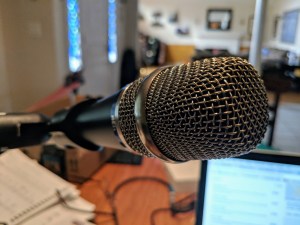
I’ve now been gigging and recording with this mic for a couple of weeks straight and I just couldn’t be happier. I have to admit that it has taken me a little while to work out positioning in front of the capsule, as I’ve spent years practically swallowing other mics just to get a good sound. But with this mic, it requires a bit of space; about an inch for regular singing, and if I need to really lay into a vocal, I’ve got to be about eight to twelve inches away.

Also, while the mic is great for lower volume singing, where I find it really shines is when I’m in a band situation where I’m singing with a full voice. And in a band situation, the rear noise rejection is second to none, and this helps quite a bit with mitigating feedback, as I can position my mic near monitors and not worry about feedback.

As far as how it sounds, the tone is just a tad scooped, and the midrange mid-point seems to be on the higher side. But I love that because it picks up higher frequency characteristics. It also means that with this mic, I can punch through a mix. I have to admit that it was a little unsettling at first because that little higher frequency bump makes my vocals sound so clear. That’s not to say the lows aren’t there. They absolutely are. But compared to an SM-58 or even an e835, the richness of the sound is so much better.

Other than how good it sounds, the mic is very well-built. I see no problem with it enduring the rigors of regular gigging. As far as recording is concerned, it works fantastic! But I think I’m still going to save my pennies to get the PR-35 for recording. I’ve gigged with that mic in the past, and the sound quality is even better than the PR-22. However, it is not nearly as durable as it is coated with a silicon layer, and according to the sound guy who provided me with the mic, with a lot of use, the silicon wears off.

Circling back to the PR-22, this to me is the perfect all-around stage mic.

Read Full Post »

I just read this excellent article on SonicScoop on the importance pre-production work and how many artists/bands haven’t done their homework prior to going into the studio or finding a producer. Then the author finishes up with two approaches to cutting an album: The “insane” way and the “smart” way. Of course, he advocates for the smart way, but more importantly, the underlying message of the post is simply this: Before you even think about going into the studio, know what you want to accomplish and also rehearse, play shows, rehearse, play shows, and repeat.

The point is to hone your skills at playing your music. Especially if you’re in a band, make sure the parts that each member plays are completely worked out. What you don’t want to do is spend studio time (read: MONEY) figuring stuff out. You want to know what you’re going to do going in; know how you’re going to sound. If you have any doubts, just don’t do it.

I’ve been wanting to cut another album after having done it myself over a decade ago. Friends have encouraged me to do this. But I’ve actually been reluctant because this time, I want to use different musicians other than myself. In order for me to do this, I need to get the musicians I ask to learn my music, and before we all head into the studio, I want everyone to practice together – a lot. Make sure the bass is playing where I want them. Make sure the drums are funky enough, etc.

And even before I go into the studio, I’ve got to find a studio and engineer that I can work with and who “gets” my music. I went back into the studio a few years ago and worked with an engineer who kept on making “suggestions” that were almost always contrary to the vision I had for my songs. That got annoying pretty quickly, and I had to shut him down pretty hard by telling him I knew what I wanted and I didn’t want his suggestions unless they had to do with the mix and production.

Then, as a drummer, he would “volunteer” his drumming on my songs as I recorded the drums in my demos with MIDI hits and loops.  Moreover, he just didn’t get the style I was after. Luckily, I didn’t have to pay for his work unless I used his drum tracks, and his drumming was just not that inspiring, so I never used them except for clicks.

But it just wasn’t the engineer. I also wasn’t fully prepared. I hadn’t done all the pre-production work. For instance, my songs were brand new, and I hadn’t performed them enough to really figure out how I wanted them recorded. I also didn’t go into the studio with enough material. That’s a huge mistake. You need to have enough to throw away. Even if you’re just doing an EP, which was what I was intending to do, you should have more material than what would fit on the album. Oh well… live and learn…

The point to all this is that before you go into the studio, there’s so much that you have to do to be prepared. Your performance needs to be a foregone conclusion long before you get into a sound booth, and you need to have lots of material. Nothing beats preparations. It’ll save you time and money in the long run. For those of us on a budget, that’s critical.

Here’s the link to the article again. I highly recommend you read it!

Read Full Post »

Nothing’s Ever Perfect…

When we find gear the works and get us totally inspired, it’s so easy to overlook the little quirks in our gear that, in other circumstances, might be a bit annoying. Such is the case with my magnificent Seymour Duncan SA-6 Mag Mic. I’ve raved and raved about how it sounds,  and though I knew that there would be a potential annoyance regarding the battery, I ignored it because it sounds so damn good.

What’s the issue? Actually a couple of things. First, the instructions say to mount the velcro strip at the base of the neck. That’s actually not too big of a deal, BUT if you put don’t make sure that the entire strip on the battery pack is making contact with the mounting strip, a simple jostle will make the battery pack come loose… which is a perfect segue into the more serious annoyance.

Even if you mount the battery pack squarely on the mounting velcro strip, a quick jarring of the guitar could potentially make the battery pop out of its holder. I had a gig last night, and my guitar case was inadvertently knocked over. Mind you, it wasn’t a full fall to the floor. The case tipped over from where I leaned it on a railing, and landed in a corner of the railing. All told, it was about a foot that it slid, then came to rest. I didn’t think too much about it because my guitar was in the case and I knew it would be safe.

But when I picked it up and plugged it into my rig, I got no sound out of it. At first, I thought it was my rig, but when I moved around, I heard the battery sliding around the inside of my guitar. So I removed the pickup, loosened my strings, reached inside, removed the battery holster, re-inserted the battery, re-mounted the holster, tuned up, plugged in and voila! I was in business.

But what concerned me at the time was looking forward, because when I’m performing on-stage or at church, the battery might pop out in the middle of a performance. I’m the kind of musician that gets kind of carried away when playing, and I jump around.

To mitigate this, and since I have another gig tonight, I wrapped a small piece of duct tape around the holster to hold the battery in place. I wouldn’t have had to do this if the holster’s edges wrapped around the battery a bit more. Plus, if the bottom edge of the holster that holds the battery in place was just a millimeter higher, it shouldn’t pop out so easily. Mind you, this isn’t enough to make me reconsider using the pickup. The sound just kicks ass.

But this is an example of how we gear sluts can easily overlook obvious design flaws…

Read Full Post »

Since I haven’t written on this blog very often for the last couple of years, I haven’t shared much about where I’ve been playing. Well, after about a 2 1/2 year hiatus from playing music in church, I decided to go back to doing a weekly church gig again. But this time, it’s at another church, and I’m happier than ever. It’s like making a fresh start, and that’s a GREAT thing.

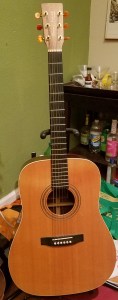
So it was with a bit of nervous anticipation bringing my new acoustic-electric setup to church yesterday. It sounded fine at my restaurant gig, plugged into a board. But the real test was going be using it in the church where I’d plug it into my SWR Calfornia Blonde, then out to the board. With this setup, I run it through a small board that has Chorus, Delay, and Reverb, then into the amp, then out to the board. My big concern was maintaining the natural character of the guitar. Some guitars when plugged into an amp, sound a bit funky.

But all my concerns were laid to rest from the very first strum. I had the same visceral reaction I had on Friday, but it was even more intense this time because I was right next to the amp. The sound was absolutely sweet! Even my bandmates just smiled and said how good the guitar sounded, and one commented that he could tell how well-seasoned the wood was as the guitar just resonated. I have to say that with the guitar being almost 30 years old, it has a very special character due to its age. It reminds me of how my very first Yamaha FG-335’s wood aged so nicely. Before it had its accident and its neck snapped off the body, it had developed a gorgeous, woody tone.

The tone of my S&P PRO is deep, but with shimmery highs. But that wood not only projects the sound incredibly, it resonates. I can actually feel the vibration in the body – even with finger-picked notes. It’s pretty incredible.

Then to have it amplified with a great pickup like the MagMic, well, it’s a match made in and for Heaven. I’m the type of musician that needs to feel what I’m playing. It’s the emotion that comes from my guitar that inspires me. When I don’t feel I sound that good, it’s hard to get inspired. But when I’m playing something whose sound shoots to the core of my being, I become one with the sound. It’s hard to explain… And that was exactly what happened yesterday. I was completely lost in the sound of my guitar. 🙂

Read Full Post »

Wow… That’s usually first – and only – thing I can say when having a visceral reaction to an experience. And a visceral experience was exactly what happened when I finally got my guitar set up for last night’s gig. After I played the first song, I had to pause for several seconds soaking in the tones that the combination of my Simon & Patrick PRO guitar and the Duncan MagMic produced. I already had a good idea of the dynamics of the pickup and how well it worked with my guitar, having had a few days before my gig to record with it. But until I actually gigged with it, I really didn’t know how it would perform in a live situation; especially in a room with a 25-30-foot vaulted ceiling.

It was not without its challenges. The sound system at the restaurant I work with is total shit. The board is going on the fritz and I wasn’t sure I was even going to be able to play last night! But the gig gods were smiling upon me and just when I was about to pack it in and go home, I tweaked something on the board and it started working. Whew!

When I got my nerves settled with a few deep breaths and a long drink of water, I started my first song: “You’ve Got a Friend.” I felt that it would be a good song to start with because with any JT song (I know, it was written by Carole King), the fingerpicking patterns are sophisticated as JT plays a bass line in addition to a hybrid claw-hammer technique. I’m not nearly as adept at it as he is, but I tend to do the same. So with that song, I knew that I’d get the full presentation what the guitar/pickup combination had on offer.

Having moved to a dreadnought from an OM, I was concerned that the bass would be a bit boomy. It was not. It was certainly deep as I expected from a big-body guitar, but not at all over-powering. Another thing I was concerned about was not losing the shimmery highs my guitar naturally produces. But here’s where the MagMic really performs. The condenser mic is tuned to focus on mid-highs to highs. In fact, I had to roll off the condenser level a bit to subdue the highs. The sweet spot that I discovered leading up to the gig was setting the condenser level about 90%. This setting translated incredibly well to a live situation.

Another thing that had me wondering about the MagMic was the lack of an EQ. I’ve had the luxury of an onboard EQ in all my acoustic-electric guitars up to this point. But I found that with the higher-end, third-party pickups that none of them have that feature, as they’re designed to pick up the natural tone of your guitar; which kind of says you better have a good-sounding guitar in the first place before you install one of these babies… But as I mentioned above about the condenser mic’s focus on the high-mids and highs, adjusting its level is much like adjusting a treble knob. But it’s no problem in any case, as instead of setting EQ on my guitar, I can just set it on the amp.

With respect to the guitar itself, besides the larger size, I’ve had to contend with the absence of a cutaway, which makes playing notes above the 12th fret a little challenging. But it’s not undoable. I just make adjustments and play on a different part of the neck. The neck width is also much wider than my Yamaha, but this is also not a bad thing as it forces me to put my left hand and arm in the proper playing position. I certainly can’t be lazy with my posture with this guitar. 🙂

The other thing about the guitar is that it is naturally loud. It was built to project volume from the soundboard. So I definitely had to find the right balance between volume level and attack. Plus, the MagMic picks up pretty much everything with the guitar. In contrast, my Yamaha APX900 and its electronics are very mid-range focused. But with my S&P PRO, the audio content is so much more complex and robust. Combined with the MagMic’s sensitivity, it forced me to be very aware of how I was playing to the point where I felt some of the songs I played were a bit mechanical, or I was concentrating so much on the guitar that I’d mess up some words. 🙂 I’m confident that once I get everything dialed in I’ll be able to relax a lot more.

I do have to say that I love playing a dreadnought. My very first “real” acoustic guitar was an old Yamaha FG-335 dreadnought. When I moved to smaller body guitars, I missed the full sound. And now that I back to a big body guitar, I’m loving it! But the S&P PRO takes the sound to a completely new level. To think that it sat in a shed for 15 years prior to me getting it – and to sound this good still – is incredible to me.

I did a minor setup on the guitar when I got it to straighten out a slight bow in the neck. But after last night’s gig, I’m probably going to have the action lowered a couple of millimeters. It’s not that it’s super high, but it’s higher than I like and playing a 4-hour gig, it takes a toll on the fingers. I suppose I could go with lighter gauge strings (I’m playing 12-54), but I’m not sure I want to sacrifice the resonance I get with the thicker strings just to make it easier to play. Oh well, there’s always a tradeoff somewhere. 🙂

Okay… so very first gig complete, and it was a total success! I absolutely LOVE the MagMic.

Read Full Post »

It has been months since I purchased some new gear, and as I wait for it to arrive, I’m squirming in anticipation! 🙂 I love that feeling! It reminds me of the early days of this site when I was buying all sorts of stuff. It was like I won the lottery! I had a garage full of gear. Now… not so much, and the frequency of my purchases has slowed to a crawl. Also, for me now, finally purchasing the item was the result of months of research. Unlike those early days where I’d read a review or two or peruse some forums. I took some time with this purchase. So I have to qualify that the “anticipation” is different from when I was going on buying sprees to discover new tones. It’s still an incredible feeling because I’m looking forward to using it as it solves a real problem for me.

So how is the anticipation different? As I mentioned above, this purchase was the result of months of research before I finally pulled the trigger. So the anticipation I’m feeling is one in which I’m looking forward to validating that research. This is different from previous purchases where I was seeing if some gear would actually fit the way I play or help me define my sound. This one is more akin to a scientist coming up with a theory, performing tests to prove the theory, then waiting for the tests to complete; reasonably confident that the tests will bear out their original ideas. Contrast this to what it was like for me before and that was more like a kid who just discovered a new candy, trying it out for the first time.

Both situations deal somewhat with the unknown. But the former is a proof, the latter is pure discovery. Both are valid, but I’ll go with the former every time now. Is it maturity? Partially. It’s actually more economics, to be honest. It should’ve been that way in the first place when I was going on my buying sprees. But hindsight is 20/20 as they say, and frankly, I don’t regret a bit of it. With a limited budget to spend on gear, I’m VERY careful about what I buy. I’m doubly careful now because I don’t like to return gear. It’s not that I won’t do it, but it’s a hassle. So I take a lot of time now to make sure I’ve covered all the bases.

You must be wondering what I’m getting… 🙂 I’m getting a Seymour Duncan SA6 Mag Mic, which is a combination magnetic pickup and condenser mic for my acoustic guitar. I thought long and hard and did a lot of research on choosing a pickup after I received my beautiful Simon and Patrick acoustic from a friend who was passing it on from her uncle who died 15 years ago.

I evaluated several pickups from LR Baggs, K&K, Seymour Duncan, iSolo, and IK Multimedia. A prevailing factor – after looking at the iSolo and IK Multimedia solutions was that I didn’t want a permanent solution right away, something that I really couldn’t do with the LR Baggs and K&K.

The iSolo, which is a wireless pickup is incredible. The recordings I heard were magnificent. But the problem with that is that even though they claim a battery life of 5 hours, actual usage was more in the two-hour range. Not good. The IK Multimedia solution was also good, but it looked kind of cheap. I do a lot of gigs per year, and I need my gear to be pretty durable.

The LR Baggs and K&K pickups were also incredible. I think a prohibitive factor for me was the cost. The K&K actually was not expensive by itself, but as a simple transducer setup, I would need to purchase an external preamp. That said, a friend of mine has this setup and plugs directly into his amp. He has to crank the sound, and it sounds fine, but a preamp would be better – especially a tube pre to warm up the signal.

What I dug about the Mag Mic was that it hit all the marks for me with respect to price and performance, and I could choose to make it a permanent installation. I will probably do that in the long run in any case, but for now, I have an “out.” But on top of that, I love the fact that I get the best of both worlds: a magnetic pickup and a condenser mic that I can combine. EQ is not an issue, as I do that at either the board or my amp. I think a major factor for me was that I didn’t want to wait to use it. 🙂 I know a little impatient on my part. But as I said, economics is a factor. I have to wait another month to have the money to get it installed, and I want to gig and record with it right away. I’ll just have to make sure I take good care of it in the interim.

Read Full Post »

What I Look For in an Amp


Image from gearrank.com

I’ve got amps. Ten of them, in fact. Truth be told, I only play three with any regularity – though I’d play the fourth had I not burned out the transformer – but I still want another amp; specifically, I’m eyeing the new Fender Hot Rod V4 with its updated overdrive and tighter reverb. Frankly, I never really had too much of a problem with the original reverb, but when Fender mentioned that they made it a bit tighter, it made sense to me because I rarely set it past 2 or 3 because my sound would get “mushy.”


In any case, on thinking about evaluating the new Hot Rod, I asked myself the very question that I used to entitle this article: What do I really need from an amp, and what do look for with an amp that deems it “buyable?”

For me, the tone of an amp is not really an issue. After 48 years of playing guitar (shit – am I really that old?), my tone is my tone. With different amps, effects, guitars, etc., sure, I’m going to get different textures, but how I ultimately sound will sound like me. So I’m no longer chasing after gear that will help define my sound.

Given that, especially with amps, there are specific things I look for when evaluating one for purchase – or for plain review, for that matter. I’d thought I’d share these factors because they might be useful for anyone who is evaluating an amp. Granted, these are subjective evaluation points – I freely admit that – but as I’ve evaluated literally hundreds of amps over the years, I’ve found them to be useful and these features inform my decision to either buy or give an amp high ratings.

And note: I realize we all view the world through the lens of our own experience, so what I find valuable may not be at all what you look for, but I’ll share my thoughts just the same.

These aren’t in any particular order, but here goes:

Cleans

Of particular interest to me is an amp’s clean tone. I was actually going to talk about clean headroom, but I realized that I have different amps set up for varying degrees of headroom. For my classic rock and church gigs, I use amps that are biased hot to break up relatively early. For my classic rock band, I always play a little dirty and for playing in church, I need the early breakup so I can get amp distortion at a lower volume since I have to play a lot lower in volume in that venue.

But one thing all my amps (at least the ones I gig with) have in common is this: The clean tone is thick; that is, the full EQ range, from low to high, is represented in the sound.

EQ Adjustability

Though I prefer a much thicker, richer clean tone, sometimes I want to roll off or boost the highs or cut out some of the lows. So an amp’s EQ responsiveness is important to me. With some amps, the EQ adjustments are so subtle as to be useless. But other than using EQ as an effect, it is important to me that I’m able to adjust an amp’s EQ so that the guitar I use it with sings properly. For instance, if use a Strat in front of one my Aracom amps, which are Plexi-style amps, they’re voiced high. So I always roll off the highs a bit with a Strat. On the other hand, with a Les Paul, I crank up the highs to compensate for the deep voicing of my Les Paul.

Dynamic Response

This is probably the most subjective area and probably means different things to different people. But to me, the dynamic response has to do with how the amp responds with varying levels of input gain; either from my guitar’s volume knob or with an overdrive or booster pedal and attack on the strings. When I set up an amp for performance, I always set it on the clean side of the edge of breakup, with my guitar’s volume knob(s) set at dead-center. This way, if I roll on the gain, the amp will break up. If I crank my gain, I should get some nice, smooth overdrive from my pre-amps. If I roll it all back or pick lighter, I expect the amp to settle down. But bear in mind, this is all relative. For me, I don’t like to play with oodles of distortion, but what I do want to be able to do is control my amp from my guitar. Of course, there are circumstances where I may have to make adjustments at the amp, but those should be few and far between.

Sustain/Decay

Again, this is a subjective thing, but another thing I look for is how long an amp will “hold” a note before it tapers off. Some amps just die a quick death with this particular test. Pluck a note with no vibrato and see how long the note lasts. What I look for in this particular test is the nature of the tapering off. If it’s relatively long and smooth, that will appeal to me. But if I pluck a note and it stays at a certain level then suddenly drops off, that’s problematic for me. I’m not a fast player, so what I tend to do is try to squeeze as much sound out the notes I play. It helps if the sound doesn’t trail off quickly.

NOTE with this test – and to be fair – I crank the volume on the guitar to make sure as much signal gets to the amp as possible. It’s also best to do this test at a moderate volume as high volumes tend to blow your ears out. 🙂 At a lower volume, you’ll see just how fast the decay is.

Cabinet Construction

To me, the construction of a cabinet – its build quality as well as the materials – plays an important role in how it sounds. Granted, this is a minor factor relative to the other things I look at, but given the choice of two equally good-sounding amps, I will go with the amp that I feel has the better cabinet. Also, this really doesn’t apply to independent heads – I couldn’t care less what they’re housed in. First, I will look at the thickness of the walls. I prefer cabinet walls that are no more than 3/4″ thick; better if they’re 1/2″. Why? Thinner walls resonate better, which is also why I prefer solid pine or birch cabinets because you can get that thin with the wood without making too big a sacrifice with structural integrity. But irrespective of thickness, I still prefer solid wood over MDF. But let me say that while this is a consideration, I typically use it as “icing on the cake” rather than it being an absolute determining factor. If an amp sounds killer and hits all the marks on the other factors, I’ll get the amp or give it a high rating.

What About Tubes?

I don’t care. A great-sound and responsive amp is a great-sounding and responsive amp. Period. I know, tube amps have been all the rage for years. I went to tube amps exclusively for quite a long time. I can’t deny it: Twiddling with tubes and bias settings and all that hand-wired, point-to-point shit is cool. BUT I’ve always loved amps like the Roland JC-120, a foundation in both the blues and rock world (don’t forget that Satch recorded “Surfin’ with the Alien” with a JC-120). But now, there are some FANTASTIC amps made of solid-state components that simple rock the house. The Roland JC-40, Quilter amps, and hybrids like the DV Mark amps. These all sound incredible! I have a DV Mark Little 40. This is my go-to gigging amp with my classic rock band because of its versatility. I can shape the sound with this to make it sound like a Marshall or a Fender. It’s not the SAME sound, but close enough.

Usability Features

These are more “icing on the cake” things, but they can be important; especially if I’m evaluating an amp for a specific usage. But in general, I look for obvious usability items. These include easy-to-read labels. easily accessible auxiliary inputs/switches, usable knobs. For instance, when I’m playing acoustic guitar, I invariably use my SWR California Blonde. Great amp. I usually run the direct out from the amp into a board for sound reinforcement so I can keep my stage volume down. But the jack is positioned in such a way that I have to use a key or a knife to unlock the XLR when I’m done. All they had to do with turn the jack upside down and this wouldn’t be a problem. Something like this is not a deal-breaker, but a collection of these things can be so annoying as to make me feel as if the amp is unusable to the point that I wouldn’t buy it.

I know that these factors aren’t necessarily standard, but they’ve served me well over the years. I think the reason I went this route is that it’s easy to fall into the marketing crap and look at charts and graphs. They can certainly inform you of an amp’s capabilities, but in the end, you have to use an amp, and for me, the things I look at just can’t be measured by numbers. They have to be felt or heard.

Read Full Post »
« Newer Posts - Older Posts »