Feeds:
Posts
Comments

Archive for the ‘Guitars’ Category

I was listening to a radio show yesterday on NPR called “The Science of Wine” in which a panel discussion took place on wine and the wine industry featuring two long-time wine industry veterans, Kermit Lynch and Randall Grahm, and hosted by Karen MacNeil, author of the “The Wine Bible,” and a wine expert herself. In one section of the discussion, the Karen asked Kermit Lynch about the “boldness” of many wines today, and how consumers, especially American wine consumers seem to be bent on bold wine, relating that to the apparent loudness of today’s music. Kermit’s answer intrigued me in that he said something to the effect of “there’s a lot to be said about exquisiteness in wine,” and “listening to the ‘music’ of the wine.” That one phrase hit a nerve with me with respect to how I’ve chosen gear over the years. With gear – at least to me – there really is a lot to be said about exquisiteness.

By “exquisite,” I’m talking about a certain delicacy and dynamic range in which a certain thing – be it music or wine or whatever – communicates a fundamental “message;” but is also accompanied by subtleties and nuances that provide layers of sophistication and complexity, which we in turn perceive as “depth.”

When I heard that phrase above, I immediately thought about all the gear I’ve purchased over the years, and though I’ve spoken a lot about choosing gear based upon its versatility, overlaying that has been this sense that the tone that gear produces has to have complexity and dynamics, not just produce a “wall of sound.” A wall of sound – at least to me – is extremely boring at best, and an assault to my senses at worst.

To me, truly great gear evokes a visceral response which in turn compels me to describe it metaphorically and qualitatively as opposed to purely quantitative. The sound of truly great gear reaches into the depths of my emotions, beyond the reach of mere language. This is the exquisiteness of a great sound; and it’s probably a huge reason I don’t get into really high-gain, high-compression types of gear or music for that matter. On top of that, when it’s so loud and super-compressed you lose dynamic range, and lose a valuable tool that can help you take your listeners on a the musical journey with you. For thrash and high-gain metal, that might not make a big difference, but for the music that I love to both play and listen, namely classic rock and blues, dynamic range is ultra-important to getting a message across.

In 2010, I went to see the “Experience Hendrix” tour featuring Joe Satriani. What a show! But I have to admit that I thought that Satch’s tone kind of sucked; especially when he first hit the stage. His tone was SO compressed and his volume so loud that it was almost intolerable; plus the compression just made everything muddy. The front-of-house guys fixed it a bit, and Joe made some adjustments, but it still wasn’t very good. On the other hand, Kenny Wayne Shepard’s tone was freakin’ amazing! Sure, his volume was loud – hell! it was a concert – but his tone was sweet. For me, he stole the show.

Circling back to gear, I realized that even more important than versatility in my decision-making process has been the gear’s exquisiteness in tone; be it a guitar, an amp, or a pedal. Truth be told, versatility is a close second, and if the gear’s not all that versatile, I probably wouldn’t buy it. But as I said before, there is a lot to be said about exquisiteness in tone because that’s what gets me waxing philosophically. 🙂 When something has the effect of inspiring me, I have to have it; and I’ll pay for it. That happened with my Mad Professor Deep Blue Delay. I had heard lots of people talking about it, but I was naturally skeptical because that pedal cost close to $300. But once I got to audition one, I had to have it. Not only did its sound completely blow me away, but I pictured using it in all sorts of settings. I actually use it more than my chorus pedal, which is something I use a lot!

The wine discussion panel also touched upon things such as much of the public’s focus on specific varietals of grapes used in wines. I think it was again Kermit Lynch who talked about not really paying attention to that, but how many of his customers ask what varieties were used for a particular wine, which in and of itself is innocuous. But he did mention that that particular question was asked within the context of inferring that a blend might be of less quality, which he did say was rather irrelevant. That made me smile because I take a similar approach in my wine tasting. My thought is that if it’s good, it just doesn’t matter if it’s a single varietal or a blend. It’s just good wine.

That part of the discussion led me to thinking about how so many people focus on the components that go into different kinds of gear, and how that somehow makes the gear better. But let me tell you that a DigiTech Bad Monkey sounds a hell of a lot better than some pedals I’ve tried that are five times the price using NOS this and that, and high-end jacks and such! It’s a $35 pedal constructed with overseas parts, for goodness’ sake! This component craziness is also akin to those who claim they can hear the difference between one of those high-end, $200 power cords (yes, power cord), and a standard power cord. I myself prefer to use medical grade power cords only because of their reliability, but not because I believe them to create a better sound. Same thing goes with speaker cables. I just use good ol’ 12-gauge copper-core cables. I’ve tried those high-end $100-per-foot cables, and perhaps they might make a bit of a difference – in your bedroom – but when you’ve got your amp cranked up during a gig, the tonal impact is not going to be all that significant. Hey, for the believers, they probably have way better ears than I do.

The point of all this is that we can draw a lot of parallels between wine and guitar gear and music. And as the only way to determine if a wine is any good to you, you have to taste it; so it goes with gear as I’ve said many times before: The only way to see if something’s good is if you play it.

Read Full Post »

Is It a Sign?

I recently watched “The Lord of the Rings” trilogy and thought that my ’59 Replica Les Paul was much like Sauron’s ring; always finding a way back to its master. 🙂 The reason I was thinking this is because ever since I started making a concerted effort to sell it, the sales have either fallen through or in one case I actually got a buyer, but he returned the guitar for some stupid reason I can’t recall. In any case, the guitar seems to gravitate back to me. I recently got another buyer lined up, but he ran into some money issues and had to back out.

All this led me to think: Is this a sign? Am I meant to keep this guitar?

Then yesterday, on a whim, I decided to use it for my church gig, so I put it in my gig bag and packed it up. Now I hadn’t played “Ox” for a couple of months – and not plugged in – so I was actually a bit excited to play him after all this time. I got my rig all set up, then slung the guitar on my shoulder to tune it. To my amazement, the Ox was still in tune! I had to make a couple of minor adjustments to the tuning, but I couldn’t believe that the tuning didn’t drift all that much. That really made me grin and think to myself, “You know, it’s the mark of a great instrument…” Whether that’s actually true or not, I don’t know, but that was my perception…

Then I switched on my remote unit and started playing. I had forgotten just how sweet the sound is that this guitar produces. The old-growth mahogany and Brazilian rosewood fretboard, combined with the Wolftone “Dr. Vintage” pickups create this dreamy, sustaining tone. On top of that, the asymmetrical neck makes playing this guitar scarily easy!

After warming up a bit, I stopped, looked at my band and said, “I’m crazy to sell this guitar. The way it sounds and how it feels makes me think we were made for each other. Nah, I’m taking this guitar off the market. I’m glad the last sale fell through” My band mates just chuckled. They knew how much I loved playing this guitar.

I think one of the things that compelled me to sell it in the first place was how bright the guitar was through my low-wattage amps, plus the speakers I was using, that had a bit more upper-midrange emphasis. But with an amp like my DV Mark Little 40 that has a nice, tight bottom end, combined with the fat Jensen Jet Falcon 1 X 12, they counteract the guitar’s natural brightness to produce a rich and luscious tone that’s still sits in the upper-midrange, but is bolstered by a great low-end. Needless to say, I was absolutely loving this amp.

So it looks like I’m keeping this guitar for now. I may again consider selling it in the future, but right now, I’m keeping it. What about my R8? Well, “Amber” will never be sold. She’s my all-around guitar and has a much warmer and deeper tone than Ox. I’m going to try gigging with both, using a different guitar depending upon the song.

Read Full Post »

Back in my younger years, about 35 years ago, I was an avid skier. I lived for the sport and spent every red cent I had for equipment and lift tickets. To me, there was nothing like carving perfect turns down a slope; and as I got better, taking on challenging pitches that few would even think to attempt. I even did a bit of racing, as I had a competitive streak. In all those years that I skied, and even up to now, in my book, there was no better ski racer than Ingemar Stenmark, the Swedish legend, whose total World Cup wins has never been beaten and most likely will never be beaten. Here’s a compilation video of him:

The thing about Stenmark was that he was so good that for many years in the Giant Slalom and Slalom events, no one talked about who would be first, but rather, who would be second. And he was also so good that the Federacion Internacional du Ski (FIS), the governing body for all international amateur skiing, changed the rules such that he could not win the overall World Cup beyond the two titles he had won by requiring that to win the combined a skier also had to race the downhill event, which he did not; even though with his wins in both slalom and giant slalom he amassed more points than the winner of the combined!

For those of us who followed him, it was an injustice. But despite that, he will forever live on as the greatest skier of all time. So what does this have to do with playing guitar?

Think about how different groups or players completely changed the game in music history. When Dave Davies of the Kinks used a razor blade to cut up his speaker cone to create a distorted sound for “You Really Got Me,” that completely changed the game of rock and roll. I realize that that wasn’t necessarily borne out of skill, but it was a game-changer.

If you want to look to pure skill, then there are two guitarists in recent history that completely changed the game – at least in my mind. The first was Michael Hedges, the acoustic guitar god who sprouted a cadre of alternate-tuning, body-slapping, both-hands-players such as Kaki King and Andy McGhee. Watching him play was a transformative experience. Of all the players who had an influence on how I play, Michael Hedges is probably the biggest, as I learned to use percussive rhythm techniques in my playing that I carried over to electric guitar. They’re subtle, but they’re definitely derived from hours of watching Michael live and listening to his albums.

The other game-changer – and I think most will agree with me – was none other than Eddie Van Halen. When he hit the scene, he scared the living shit out of his contemporaries. Sure, it could be argued that Satch legitimized shred, but EVH showed the world what was possible with rock guitar, and rock guitar playing has not been the same since.

You may or may not agree with me with my choices of game-changers; it’s subjective, after all. But the point to all this is that those who are that good at what they do really change the game, and make everyone step up theirs to keep up. Thank God I’ve been able to witness masters in my lifetime!

Read Full Post »

I guess this pedal has been around for awhile, and like the EHX wah, doesn’t use an accelerometer, so you don’t tilt the wah itself. Instead, this pedal uses a motion or proximity sensor, and that FREAKIN’ ROCKS!!! Here’s a video demo (sorry, it’s in Italian, but who cares?):

Now THIS pedal I have to try out. Source Audio has been doing this stuff for awhile, but they require the user to wear a ring. This doesn’t require anything of the sort. Just move your foot up and down over the pedal. I DIG it!

Read Full Post »

I dig what Electro-Harmonix has been doing the last couple of years. They’ve really thought outside of the box to either introduce completely new innovations or re-invented some established norms. With these two new pedals: The Superego Synth and the Crying Tone Wah, they’ve done both, respectively. But rather than talk about them, let’s first view a video from our friends at PremierGuitar:

The synth is cool, though I’m not sure I’d ever want one. The wah on the other hand is VERY cool, and I definitely will want to try one out once it gets released to the market in May. Imagine a wah with no moving parts! They’ve probably got some sort of accelerometer inside, but it’s pretty responsive, based upon the demo. My only concern with it is that I can’t attach it to my pedal board, as it was made to just sit on a surface. But once I test it out, I’ll see how I could make it work.

Read Full Post »

Before I go any further, watch the following video of Tupac Shakur:
This footage was taken from the 2012 Coachella Hip-Hop Festival. WTF? 2012? Yup, they somehow found a way to resurrect Tupac. For sure, the technology used to do this is nothing short of amazing. The digital wizards even had Tupac saying stuff he’d never said before! So it’s entirely possible for them to resurrect any artist, like Jimi Hendrix. It wouldn’t be too hard for a great axe-slinger who can cop Jimi Hendrix to lay down tracks.

But there is a darker side to this: Can you see record labels and music execs salivating over the potential revenue this could generate if they used it for other artists? This article seems to think that’s so…

Hate to rain on people’s parades, but I’m not sure how I feel about this technology. It would be cool to see Jimi once again, but… <loss for words> But no question, with today’s technology, an artist need never die.

Read Full Post »

Just read this interview that Esquire did with Eddie Van Halen. What an eye-opener! It’s a great interview, and guess what? He finally reveals the secret behind the “brown sound,” and it’s nothing like all the speculation that has circulated through the guitar world for years. It actually had me laughing at what he did. 🙂 Once you’re done with the interview, there are two more articles following. I haven’t gotten through them yet, but I’ll probably read them tonight.

Read Full Post »

Wow! A pickup that does it all!

That’s one of the more humorous ads I’ve seen for guitar gear. 🙂

Read Full Post »

Peter Frampton.

Like a great wine, Peter Frampton has just gotten better with age. He was my favorite guitarist as a kid and he remains my favorite guitarist today. Frampton proves that making great rock and roll isn’t about speed. It’s about feel and conveying a message. I had never seen the following video until today, and the solo at 3:46 literally made me weep. Among dredging up fond memories from 1976, Lines On My Face is my absolute favorite Frampton tune. Yeah, he’s best known for being the first to really rock the talk box, but Lines On My Face always showed to me the depth of his passion, and even 40 years later, his playing still moves me.

Read Full Post »

Overcoming Stage Fright

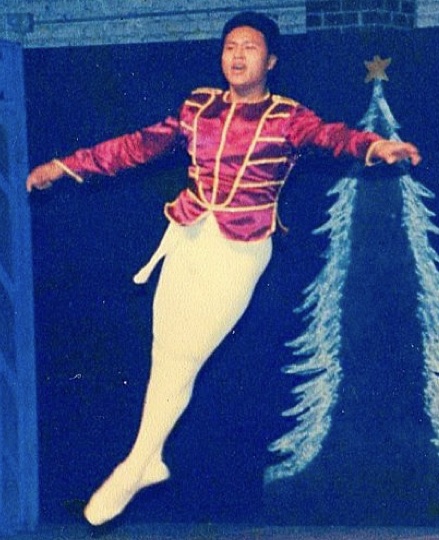
That is moi about 27 years ago, flying through the air as the Nutcracker Prince. Yes, the fat man was actually in great shape once upon a time. 🙂 But that’s not what this article is about; at least entirely…

That picture was taken from my very first public performance – actually the second performance of the day, but on the first day of my first public performance. As a dancer, especially a male dancer, you have to get over your stage fright and self-consciousness and fast. Look, you’re prancing around on stage in tights with the shape of your genitals clearly visible to the world. Once on stage, it’s too late to be thinking about your balls hanging out…

Admittedly though, I had a serious case of stage fright the first show of the day; so much so that I forgot the final steps to my solo, something that I had practiced for 3 months leading up to the show! I recovered by doing a standard sequence of steps that made it look as if I knew what I was doing. But I was PISSED after that show for losing it!

So during the few hours between the matinee and grand opening night show, I practiced for about an hour and a half before the show, and went over and over my blocking and steps till I could literally do the solo with my eyes closed (which I also practiced). I had it down so well, that I even worked out more complicated maneuvers that I added into the solo (without the artistic director’s knowledge 🙂 ), so confident was I with what I had worked out.

When it came time for my solo in the grand opening, though I was a tad nervous at the start, I was confident and focused enough to nail the solo. I mean nail it. I know the picture is a little grainy, but if you can see my face, what I was doing was playing to the audience; not self-absorbed at all, not giving any thought to how I looked. I was running on pure instinct, trusting in my memory of the steps I needed to execute, which allowed me to interact with my audience, or as my beloved dance teacher and mentor put it, “Make love to my audience.” And I got a standing ovation and yells of “bravo” at the end of my solo. And I in turn walked to the front of the stage, bowed to the audience and applauded them for going on the journey with me.

So how did I get over the stage fright?

People talk about using your nervousness or fear or turning it into some other feeling like anger. Still others say to imagine the audience in their underwear or some other visualization, and there are professional coaches who make tons of money teaching people how to get over their stage fright. The coaches probably work, but why pay when you can teach yourself?

So circling back to how I overcame my stage fright, there are a few things I’ve learned in all my years of performance that I’ll share here:

  1. First, be mechanically prepared; that is, know your shit. This doesn’t necessarily get you over the stage fright in the moment, but it certainly helps to give you confidence.
  2. Be mentally prepared. The best way to describe this is that before you perform, visualize yourself doing it so that once on stage, it’s not a surprise. Racers such as ski, bobsled, and even race car drivers do a lot of visualization to make sure they’ve visualized the right line to take through their course.
  3. Once you hit the stage, JUST DO IT! You know your stuff, you’ve visualized it, so execute. You might feel nervousness, you might feel anxiety, that’s okay. After almost 40 years of performing in public, I still get nervous before all my performances. But I don’t try to compensate for it. I simply execute. My performance may not be sexy; it may not be sophisticated. But I’m just doing it. Once I get comfortable, I get confident, and once confident, I can truly put on a performance.

Another thing that really helps me is simply being in the moment and realizing that “it is what it is.” There’s nothing I can do about it – even if I make a mistake. Can’t stop a song if I mess up, so I just have go on. Being in the moment is simply being present. Not dredging up the past and not looking into the future, but purely focusing on where you are and what you’re doing (gawd that sounds like Yoda). After all, where you’re at is no accident. You chose to be there; likewise, your audience chose to be where they’re at – where you are. Nothing can change that, so be in the moment and show up.

Notice that I haven’t once mentioned anything about analyzing your situation. I think analyzing and trying to figure out why you have stage fright just makes you have it more. Instead, I offer suggestions that put you in action, for to me, it’s action, not thought that breaks the stage fright.

Read Full Post »

« Newer Posts - Older Posts »