Feeds:
Posts
Comments

Archive for the ‘Guitars’ Category

If you look on my rig page, you’ll see that for my solo gigs, I use the very wonderful Fishman SoloAmp. This is a great, integrated PA that I’ve been using to great success for the past year or so. Very easy to set up, and it has a nice on-board mixer with decent reverb effects (which I never use, since I always use my vocalizer’s reverb). But the other day, I demoed the HK Audio Elements system while I was browsing “The Music Tree” in Morgan Hill, CA. This is an audio system that is similar to the Bose L1, but unlike the Bose L1, the Elements system allows you to expand by adding more “elements” as your audience size grows. Super-cool!!!

Sound-wise, I plugged an acoustic guitar directly into the system, and was absolutely blown away by the sound! While I love my Fishman, and it has served me well, compared to something like the Elements system, a subwoofer really makes a difference, despite the fact that the SoloAmp’s speakers have good bass response.

But honestly, this entry isn’t about the Elements system. 🙂 While trying to get more information online about the Elements system, I ran across another, just-released, integrated PA system from HK Audio called the Sound Caddy One, that is based upon the same audio technology as the Elements system. But with the Sound Caddy One, there are NO parts to put together! The line array is housed within the PA’s body (which also serves as the housing for the subwoofers), and to set up the system, you release the line array, that pops up out of the housing, secure it, plug in, turn on and you’re ready to go! Damn!

Check out this demo video from Musikmesse 2011:

Here are the Sound Caddy’s technical features:

Model SOUNDCADDY ONE
Max SPL calculated 125 dB
Max SPL peak 125 dB
Max SPL 120 dB @10% THD
Output power system 600W Class D
Frequency response +/- 3 dB 49 Hz – 18 kHz
Frequency response -10 dB 42 Hz – 18 kHz
Connections integrated 4-channel-mixer
LF Speaker 3x 6″
Mid/High Speaker 6x 3,5″
Directivity 70° x 15°
Crossover frequency 150 Hz, 12 dB/oct.
Enclosure 15 mm (5/8“), 13-ply (plywood)
Dimensions (WxHxD) 27 x 102 x 34 cm 10-5/8“ x 40-5/32 x 13-25/64
Weight 29 kg / 63,9lbs

Delivering a max 125dB at 600 Watts, this unit can move some air. Some people have said it isn’t powerful enough for their uses, but for a solo musician, this is more than enough power! Also, I have to question the negative feedback because systems like this are all about sound dispersal, getting an even volume anywhere within the sound dispersal cone which, for this system, is 70 degrees. When I first started using a line array system, it took me awhile to get used to the volume seemingly not being as loud. But it’s deceptive with a line array because the sound actually reaches fairly extreme angles, and what you’re trying to do is get your sound dispersed, and not necessarily through volume.

I dig that unlike the Elements system which is pure sound reinforcement, this has an integrated 4-channel mixer, which is an absolute MUST for me. But the only thing that I’d be wary of is the stability of the system. The base seems rather narrow, and I’m wondering how it would fair in windy conditions. In any case, here’s another demo video that demonstrates the sound. The singer aside, even through the camcorder’s microphone, it’s clear that the Sound Caddy One provides some very clear, clean sound.

As for cost, the video above mentioned a price of “2000.” If that’s in German deutsche marks, then the price would be around $1450 USD. That’s not bad, even as an MSRP, which would make the street price even lower. I’ll have to find out more information.

In any case, for more information on HK Audio products, go to: http://www.hkaudio.com.

Read Full Post »

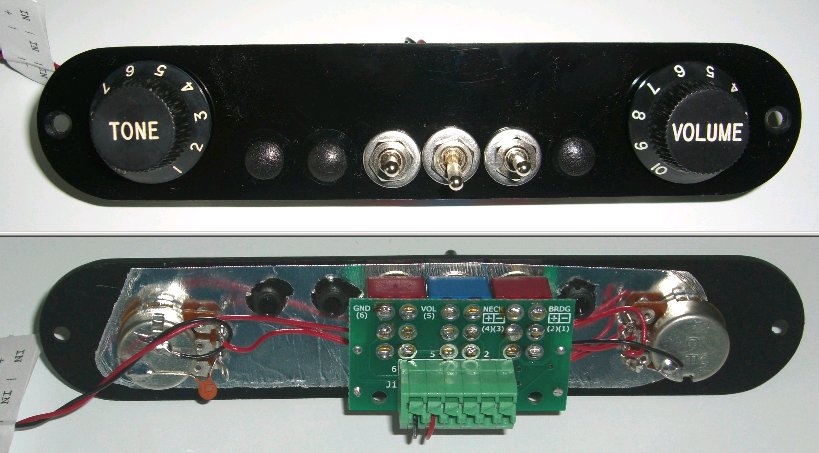
Awesome Guitars TCP-T2 Telecaster Control Plate
Summary: Want to expand the tonal possibilities of your Tele? This solderless control plate assembly will give you six distinct tones.Pros: Undoubtedly, the pros here are that you’re going to get tones that you’ve never heard from your Tele.

Cons: Not quite as easy to install as advertised – but what is? One of the bridge settings created a far too thin and reedy tone for my liking. As there were no instructions to be found as to what switch does what, it took awhile to figure out the different switch settings (though note that the wiring diagrams are all available online).

Features – Check out the link above…

Price: $127.97 direct

Tone Bone Score: 4.5 ~ Though I didn’t like that one setting for the bridge pickup, I do like the fact that I have a couple more very usable tones for my Tele.

I’m pretty wary of hyperbole, especially when it comes from a manufacturer. So when Awesome Guitars contacted me about their products, I was a little dubious, especially since the original email read like an Adam St. James guitar lessons spam. It’s not that I doubted what their Tone MultiplierTM could do, it was the delivery that made me a bit wary. But having an open mind, I replied to see if they’d send me a control panel replacement unit for my CV Tele. I got a very quick reply saying they’d send one right away. That was about six weeks ago. Due to vacation, and leading a busy life in general, I didn’t get the unit installed until recently, but since then, I’ve been messing around with my Tele a lot, and have played it in a couple of gigs.

So what’s the verdict? The manufacturer’s claims of the products being life-changing aside, this is a solid product, and something that I’ve been able to put to use. To be fair though, the unit I tested will only give you 6 different tones. But with dual humbuckers, the other products they offer will give you up to 68 different tones! Pretty amazing stuff.

Ease of Use

Okay… so you lose the sliding 3-position switch, which is replaced by three mini-toggles. On the surface, that might seem to be a burden, but once you’ve played around with the system, it’s fairly easy to get to the tones you want. Even without the instructions, I was able to figure out the functions of the switches relatively easily, and was up and running- and gigging – in a matter of an hour. By the end of the gig, I knew where I wanted the switches. Admittedly, it will take a little more time to switch on the fly during a song, but I was still able to do it pretty easily, if not completely cleanly.

How It Sounds

Sounds like my Tele, but with a couple of more very usable tones. I wish I had the instructions that charted what switch does what, so I could tell if the pickups were in or out of phase or serial or parallel when both are on, but I did manage to figure out the two different sounds for each different pickup combinations. In a way, I’m sort of glad I didn’t have the instructions because it forced me to explore what tones worked for me, which is probably more important than the actual knowledge of each switch configuration. That would probably be a different story if I installed the six-switch model on a dual-humbucker guitar. For that, I’d want to know what each switch is doing.

In any case, here are six versions of the same phrase with each different configuration:

Neck 1

Neck 2

Both 1

Both 2

Bridge 1

Bridge 2

With both pickups on, and switching between parallel and serial configuration (mind you, I still don’t which is serial or parallel), the tonal difference is extremely subtle, and admittedly the recordings didn’t seem to capture that, but suffice it to say that I heard a difference; but also, and more importantly, the dynamics were different. Bridge 1 setting was pretty thin – too thin for my liking, but I my favorite is Bridge 2, which gives me the full power of my bridge pickup, which I love for playing leads.

Overall Impression

At least to me, this upgrade isn’t life-altering, but it does expand the tonal palette of my Tele, and that’s a great thing, and who knows, I may find a use for the thin tone of the Bridge 1 setting. With the Neck 2 setting, I get a similar sound to the neck/middle setting of a Strat, which is jangly. I dig that sound for playing finger-style rhythm. So all in all, I’m pretty satisfied with this unit.

As for the lack of instructions, as I mentioned that’s not a bad thing, necessarily – at least the wiring diagrams were online. The site does mention that two of the switches control the pickups, the other switch controls whether the pickups are in parallel or serial. But which two and which one? 🙂 Doesn’t matter because it was easy to figure out.

Read Full Post »

The other day, I was at my good friend Jeff Aragaki’s (of Aracom Amps fame) home/workshop and noticed his ProLine multi-guitar stand where he always keeps five or six guitars. I was thinking to myself that I could use one of these in my home studio, as I have at least five guitars and a bass out at any time; especially as of late, since I’ve been recording quite a bit. All my guitars are on individual stage stands, and they take up a lot of space. I was thinking that with a multi-guitar rack, I could put out several guitars and not take up too much space on my studio floor.

But one thing that I thought about when considering a multi-guitar stand was it would be great if there was one made of wood. It just looks better to me. And wouldn’t you know it, today I received an email announcing a new company called Rock Solid Guitar Stands that make their stands out of wood. Cool! Check this out!

THAT is exactly what I was looking for in a multi-guitar stand!

Here’s the press release they sent:

———–

NEW MULTI-GUITAR STANDS FROM ROCK SOLID GUITAR STANDS
Two new models coming in October 2011.

Is your studio, family room, or living space crowded with guitar cases or single stands? Rock Solid Guitar Stands will compliment your space, and more importantly, showcase your collection at the same time. Rock Solid Guitar Stands are multi guitar stands that were specifically designed for the home or studio and designed by a collector. Your guitars and basses will truly be at home, and finally given the attention they deserve.

Unlike the typical metal multi-guitar stands out there, which are not very stable or attractive, Rock Solid Guitar Stands flow quite well in any decor in your home or studio. They are also very stable. For more information visit http://www.rocksolidguitarstands.com.

In October of 2011, we will be introducing “The Classic 4,” and “The Show 5.” These two new multi-guitar stand models will offer an alternative for players with guitar collections of various sizes.

The Classic 4 is perfect for someone with limited space. It is only 33” wide x 28” high x 18” deep.

The Show 5 is truly a unique design. Let’s face it, you want to show off your favorite guitar and have it accessible at all times. That’s why The Show 5 has a specially designed fifth slot which let’s your most precious guitar stand out and get some extra loving!
Be sure to visit Rock Solid Guitar Stands on the web in the following places:
Official website: http://www.rocksolidguitarstands.com
Store: http://shop.rocksolidguitarstands.com
Twitter: http://www.twitter.com/rocksolidstands
Facebook: https://www.facebook.com/pages/Rock-Solid-Guitar-Stands/178352512182913

———–

The stands come in three different colors: Honey, Dark Cherry, and Ivory. Personally, I like the Dark Cherry color. Also, they only weight 12 lbs.; not at all heavy, which is cool. The price is $199 direct, which might be a bit steep, but these are solid wood, not press-board. When you order one, assembly is required, but an allen wrench is provided and you’ll just need an adjustable wrench or pliers. From what I gather, the kit takes less than a half-hour to assemble.

Read Full Post »

This week was back-to-school week for my kids, and of course, my wife and I had parental duties to meet our kids’ teachers. Since we have a large family with some in parochial school and others in high school, it was necessary for us to split up. On Thursday, I got the high school, my wife got the elementary school. In any case, one of my daughter’s teachers mentioned a great saying that I’ll share here:

The greatest risk to society is that we have the experience, but miss the meaning – T. S. Eliot

Wow! That quote hit me like a ton of bricks! It reminded me of listening to a clip once that this guy did to demonstrate his Dumble amp. His technique was flawless, but what he was playing was completely nonsensical and perhaps more importantly, absolutely emotionless.

Playing music is like making conversation. Conversation isn’t just words spoken, but emotion  conveyed. It’s the combination of words and emotion that convey meaning. For instance, here’s a quick clip that I put together a few minutes ago. The first part is a scale in C-major played straight, then the same notes are played again, but with feeling. The second part is a chord progression in Am, again played straight, and then adding some emotion.

Same notes and chords in both examples, but with the emotion added, convey a completely different meaning.

To me, adding meaning is what separates the wankers from the players. I don’t care how great someone’s technique is or how blazingly fast they can play. If the playing is all about technique and doesn’t have any emotion, it’s just well… dry. It harkens back to that quote above.

But don’t get me wrong, having no technique isn’t good either. I once dropped into a nightclub to listen to a jazz trio. I walked out after a couple of minutes because the guy playing guitar had no technique whatsoever! Look, I get dissonant, abstract jazz; some of the late Kenny Kirkland’s stuff was way way out there, but I dug it because his technique AND feeling pervaded throughout the songs he played. But what I listened to that night was simply crap that was being passed off as dissonant jazz.

Even with gear, you can have all sorts of equipment, but you still have to play it and make music. My good friend purchased A TON of gear from an estate sale. The guy who died had all sorts of amps, guitars, and effects; so much that it filled my friend’s long-bed pickup AND his race car transport trailer. The guy played at home. More power to him to be passionate about gear. But this was ridiculous!

So here are a few questions that I’ve been asking myself the past couple of days since I read that quote:

  • Where’s the meaning in my life?
  • Is my focus all on experience?
  • Shouldn’t passion count?
  • Musically, what kind of meaning am I trying to convey?

The last question is something I’ve really been pondering, as I recently overcame some serious writer’s block. I had been at an impasse with my music for a couple of years, then recently decided to go in the direction that to where my passion was pointing. Now the music is flowing through my head again. I’ve found my meaning – at least for now…

Read Full Post »

Tuesday Funny…

And now, for something completely unrelated to guitar gear…

Read Full Post »

I’ve written about this with respect to gear before, but that also applies to lots of things in life. For instance, I just put the finishing touches on a new contemporary christian song demo this morning. I was thinking about adding all sorts of percussion, another guitar, perhaps some keys. But in the end, all I did was replace my original click track, and added another guitar. I just found that the simple, straight-forward sound just worked better. Here’s the finished demo:

After I finished the production, I thought to myself that this arrangement can stand on its own. Besides, it’s what I’d have available at Mass, as I’m the only keyboard player and also the lead guitarist – but I default to guitar. 🙂 In any case, we played this song at Mass yesterday, and I was very pleased to see people nodding to the song. We put it in a place in the service where singing is typically optional, though encouraged, and it was great to see people singing a song they never heard before!

But back to the original topic, to me, sometimes the most beautiful things are really simple; no frills, no bling, nothing extra.

Read Full Post »

At last night’s weekly gig at the restaurant I play at, I brought my trusty Roland Cube 60. I was in a rush, and just wanted a lightweight amp that I could easily set up.

To be honest, I hadn’t played that amp for a long time, preferring to use my tube amp combos or my SWR California Blonde. But those amps are also HEAVY. The Blonde weight over 50 pounds! My Cube 60, on the other hand, weighs just 30 pounds, and is roughly half the size of any of my other combos.

But weight aside, the Roland Cube 60 is simply a great-sounding amp. Solid-state or not, it doesn’t matter. If it sounds good, then who cares about its circuitry? I was reminded of that last night. I put the amp in Acoustic/JC Clean mode and was rewarded with a gorgeous clean tone that rivaled the cleans of any of my tube amps. Admittedly, the onboard time mod effects aren’t very good (at least to my ears), so I just used my own.

And that brings me to the point of this entry and my previous entry centering on the title: Let sound guide your decisions in buying gear; not the circuitry. With respect to the Cube 60, its Acoustic/JC Clean is modeled after the venerable JC 120 amp; an amp that has proven itself over the years as a viable tone platform. Players like Joe Satriani and Albert King used this amp. I believe Satch used a JC 120 to record Surfin’ with the Alien. And it’s no small wonder these guitar greats used it: The JC cleans are spectacular. They’re not as basso as Fender cleans, being a bit more mid-rangy, but they’re gorgeous just the same.

One thing that struck me last night as well was the wide sound dispersal from that little amp. I was concerned that the diminutive cabinet would be a bit too directional, but all that worry was laid to rest when I did my sound check. The Cube 60 filled the space incredibly well, and was clear from even extreme angles. Needless to say, I’ll be using the Cube 60 for most of my solo gigs going forward.

So definitely a lesson learned once again, that it’s the sound that matters…

Read Full Post »

My older sons have gotten a lot into Reggae over the past couple of years, and it has sort of rubbed off on me. So while I was jammin’ to a song in the car a few days ago, I got an idea for a praise and worship song with a Reggae theme. Here’s the initial sketch of the song (I have to add the rest of instrumentation, but here it is with just a three-piece combo arrangement):

Read Full Post »

In addition to being a guitar gear freak, I’m also obsessive about fine wines. The other night, I cracked open a bottle of 1985 Beaulieu Vineyard Georges De Latour Private Reserve Cabernet Sauvignon from my collection, and shared it with my best friend. I’ve been wanting to drink this particular wine ever since I won it at auction a few months back, and was just waiting for the right time to drink it. But I was also getting a bit worried about keeping it too long because unlike their French counterparts, California wines aren’t known for their longevity. But there are some exceptions out there, and this bottle was definitely one of the exceptions.

The cork was intact when I opened the bottle, which totally surprise my friend and I. This meant that the wine would have very little sedimentation. There was also perhaps on 4 mm of seepage into the cork, which meant that the cork used was absolutely top quality in this case. We knew we were in for a real treat.

We both took a small tasting pour, swirled the wine, then took our tasting sips. Both of us closed our eyes, then after swallowing that first taste, we both at the same time said, “OH. MY. GAWD!!!!” As wine connoisseurs for over thirty years, we’ve literally tasted thousands of wines, but this wine topped both of our lists as the best cabernet we’ve EVER had! In 1991, Robert Parker rated this wine a 91. Now in 2011, twenty years later, I don’t think this wine is even rateable. To us, it surpassed all of the best wines we’ve tasted.

Over the three hours that it took us to finish the bottle, the wine’s character changed, demonstrating to us just how marvelous, majestic, and magnificent this wine was. It was so complex and sophisticated, that we both, who have a fairly wide and experienced wine vocabulary, had a difficult time describing the wine. In the end, we both agreed that this single bottle of wine bestowed upon us a genuine religious experience.

Religious experiences don’t happen very often, and at least for me, are brought on by things or events that are truly awe-inspiring. For those unfamiliar with the term, a religious experience is one in which it is virtually impossible to articulate the feeling. It’s an experience so profound that words would only diminish it.

With gear, this has happened to lots over the years. Here are some that I’ll share here:

  • The very first time I tried out a BOSS CE-2 Chorus pedal. I have a few chorus pedals now, but when I need a particular chorus sound, this is the only pedal that’ll give it to me.
  • After years of looking for a good delay pedal, playing the Mad Professor Deep Blue Delay sent me off into the nether world. There was simply nothing like it.
  • Getting my very first high-end guitar, a Gibson Dot ES-333. Up until that point, I just had some very cheapo guitars, and getting that ES was like a rite of passage.
  • Unpacking and playing “Amber,” my first Gibson Les Paul. I had wanted one forever it seems, and when I finally had the cash to get one, I can’t even begin to describe the mix of emotions I experienced as I held her in my hands that first time.
  • Playing my Yamaha APX900 acoustic at the guitar shop where I bought it. No Martin or Taylor has ever sounded as good to me plugged in. Yamaha’s ART pickup system is unlike any other.

As I write this entry, I realize now why I and probably so many others are such gear junkies: We thrive on religious experiences. Besides being virtually impossible to describe, religious experiences are the ultimate feel-good. They’re also addictive… So it’s not a small wonder why I’ve got so much gear. 🙂

Read Full Post »

New Song: Given the Body

As many may know, I play at church – a lot. 🙂 And having played at church for over 30 years, writing music for worship just kind of came naturally. Here’s a song I wrote called Given the Body. It features my Strat on the right, and my Les Paul on the left; both played through my Aracom PLX BB 18.

Read Full Post »

« Newer Posts - Older Posts »