Feeds:
Posts
Comments

For over a decade, my main acoustic amp has been an original California Blonde; no, not the v2, but the original. I got it used from a good buddy, and it has been on stage in several hundred gigs to this point. And even though my Katana 50 serves very well as an acoustic guitar amp, there’s just nothing like the depth of sound that comes out of the behemoth that is the California Blonde.

They’re not made any longer, having a final production year of 2006, and SWR got scooped up by Fender to expand its product line offerings. But these were special amps. Inspired by the WorkingPro 12 bass amp, which acoustic guitarists were finding useful to amplify their guitars, the California Blonde was – and still is for me, at least – an amp that could create super-rich tones, and at 120 Watts, pump out the volume.

It’s a heavy-ass amp at 50 lbs. and I use a handcart or small rolling platform to transport it. But the sound, oh the sound, that the amp produces to me, at least, is unparalleled. Yes, there are some great amps out there like the HK Audio Elements and SoundCaddy. But you’re talking 5-6 times the price – at least! Not an easy expenditure. You can get a used Cali Blonde II for under $400 if you look carefully.

The wonderful thing about this amp is the semi-parametric EQ section that allows you to get the perfect EQ balance. In the tone circuit is also a built-in Aural Enhancer that acts much like presence knob. Plus, it has a side-chain effects loop on top of that! It also has an XLR direct out to plug the amp into a board, which is exactly what I do.

To me, this is an archetype acoustic amp. If you look at the picture, it really doesn’t have that many bells and whistles. The bottom row of knobs are for the second channel. I sometimes use this for solo acoustic gigs (though I use my Fishman SA220 SoloAmp for the most part). It is so plug and play!

All that said, despite the fact that it’s almost 20 years old, I don’t see myself getting another acoustic amp for quite a while. The only time I’ll consider one is when this one breaks. And even then, I’ll probably take it to my amp tech and see if it’s unrecoverable. Yeah, the labor may cost more than the amp’s monetary value, but if the repair gets it back to 100%, I don’t have much reason to switch another.

Admittedly though, I think I’m getting close to that point. The reverb no longer works, and it sometimes makes a funny noise when it’s powering on. But I’m still using it. The effects loop still works great, and there are no problems with the DI.

Speaking of which, the DI signal on the Blonde is actually super, super clean. On top of that, unlike other amps’ DI’s I’ve used, it doesn’t hammer the board. I used to use these great Genz-Benz amps and their DI’s were super-hot, and since it was tied into the Master Volume, it was difficult to get a good balance between stage and FOH volume. I had to turn the master down so low that with a full band, I just had to hope and pray that I sounded okay in the mix because I couldn’t hear myself on stage. 🙂

So yeah… My amp ain’t broke just yet. I’m not in any rush to replace it.
There’s a certain mystique about the Les Paul that seems to pervade the market that intimidates people. I look back on the time before I purchased a Les Paul and I was definitely intimidated; having these “I’m-not-worthy” moments when thinking about getting one. But I know I’m not alone in this.

This morning, I was searching the Internet for a Les Paul Supreme. It’s no longer made, but if I’m going to get another Les Paul, that one is going to be it. I played a few back when Gibson was still producing them, and I want that guitar (visions of Wayne’s World…)

I had actually amassed 10 electric guitars before I finally got my Les Paul, so intimidated by the whole Gibson brand. I even got a couple of Les Paul knockoffs and even an ES-335 before I finally got my true-blue 1958 Gibson Les Paul Historic Re-Issue.

And when I finally plugged it in and started playing, the skies opened, a bright light pierced the heavens, and a loud voice proclaimed….

I’ve been trying to tell you all this time… It’s just a guitar…

Well, not just a guitar. For me, the Les Paul represented and still represents the archetype of electric guitar sound. It’s the sound I’ve always heard in my head. Nowadays, if I consider something to be an archetype, I just get it – or at least save up until I can get it. But frankly, it took me getting over my intimidation of the Les Paul to get to that point.

Which brings me to the question I posed in the title…

At least for me, one of the intimidating factors was that everyone whom I considered to be my guitar heroes growing up either currently or at some point in their careers, played a Les Paul. This included artists such as Peter Frampton, Davey Johnstone, Peter Green, Eric Clapton, and Pete Townshend. And being that I hadn’t adopted the electric guitar until later in life, my internal comparison to those guitar greats gave me quite a bit of pause.

Another reason was that the admission price to a Les Paul Standard was pretty steep; and like many, because of that, I spent a lot of time getting other, more affordable guitars. I know… If I had been patient, I could have foregone two or three of those other guitars and gotten my LP. That inability to just be able to buy a Les Paul outright also got me into the camp of “Hey! The LTD Les Paul, Epiphone Les Paul (and others) are just as good as a Gibson Les Paul.”

“Good” is subjective, and while I played some very good (in my opinion) non-Gibson Les Pauls, the plain fact of the matter is there is some inexplicable “mojo” about a real Gibson Les Paul. Maybe it’s me falling for the marketing; who knows? But from my perspective, there’s just nothing like a real Les Paul that gives it a bit of an exclusivity factor. It was admittedly a bit intimidating.

Finally, at the time I was really contemplating getting a Les Paul, there was this craze in the collector’s market for ’59 Les Pauls, with some

But once I got my Les Paul and played it for several hours, I called my good buddy and amp builder Jeff Aragaki of Aracom Amps who is a Les Paul aficionado and collector, and said, “Damn! Why did I wait so long to get a Les Paul?!! All that time being intimidated by this guitar and now, finally playing it, this is the sound I’ve been wanting! Shit!”

Jeff just laughed. He knew then as I know now that despite all the hype that the Les Paul is still just a guitar.

So… if you want a Les Paul, and it has a sound that you like, just get it. Don’t be intimidated; don’t think that you have to be at a certain level to play it. In the end, it’s a guitar.

Back in the late 80’s and early 90’s there was a little memory chip design firm called Micron located in downtown Los Altos, CA. At the time, I don’t think they had a foundry of their own – they just created memory designs and sold them to manufacturers. Not a bad business model; kind of like Levi-Strauss during the gold rush of 1849.

But what was notable about them was that I remember reading an annual financial report from Micron that reported earnings in the hundreds of millions. Well, guess where the bulk of that came from? That right, litigation.

What was really irritating about them at the time was that Micron was suing people left and right, and it made them look like the focus of their business was litigation. Oh, they had some smart people coming up with memory chip designs. But as soon as they were patented, BOOM! Sue everyone on the planet for patent infringement. The trade rags would have frequent stories of “Micron sues X over patent infringement…” Talk about frequent eye-rolling!

By now, many of you have probably heard of the Gibson vs. Armadillo lawsuit. In the lawsuit, Gibson is claiming trademark infringement over the Explorer, Flying V, ES body shapes, and the Hummingbird and Moderne trademarks. I won’t go into a deep-dive, but if you want to familiarize yourself with the main points, here’s an excellent article.

The response to this lawsuit on the forums is that it is ruining the brand. And lots of people are starting threads asking things like, “What should Gibson do to rebuild its brand in light of the lawsuit?” My reaction: All the chatter and bloviating is just a waste of time. Wah-wah-wah. I can’t believe all the “analysis” I saw on the boards.

But in spite of that, it does make me raise my eyebrows questioning the logic behind pursuing the lawsuit which, by the way, was initiated by the previous CEO last year, then renewed by the new one. This can only mean that it was driven by the board of directors. Hmmm….

In any case, think about this: A couple of months ago, Gibson spent a lot of effort re-aligning its product lines and making it very clear what each product line represented; a move that was applauded across the industry – and me included – as something that was much-needed to reduce buyer confusion.

Gibson came out with lines such as the “Avant Garde” (now “Moderne”) to represent alternative materials in their acoustic guitar lineup. I have a J-45 Avant Garde, and what appealed to me was the construction with alternative materials. They also placed the various Les Pauls into specific swim lanes; something that really helped and something I had wished for for a long time.

So when I heard about the lawsuit, it made me wonder:

Gibson, you just spent so much time and effort re-aligning your product lines and gaining a lot of good will capital. I realize you have your reasons, but considering the struggles you’ve had in recent years, why would you subject yourself to negativity so early in the game of rebuilding the brand?

At best, this is laughable. At worst, it’s damaging, at least image-wise.

Look, I have been and I am still a Gibson fan and I’ll be a Gibson fan for the rest of my life. But I seem to do a lot of head-shaking about their business antics. Time for the board to get its head out of its collective ass.

I’m like many of my guitar compatriots and hang out on gear forums. I’m not nearly as active as I used to be, but I still enjoy reading and occasionally responding to forum posts.

One thing that I’ve seen a lot in the forums of goes something like this:

Please help me choose a guitar. I have a $500 budget.

Now look, I’m not one to ever put anyone down. That’s for cretins who have nothing better to do. But I will say this: Replying to requests like this is a time sink. Why? Simply because if you answer with your own suggestion, someone else will invariably debate you.

Then another person will swoop in with, “If you spend a couple of hundred dollars more, you could get this.”

By the time all the discussion simmers down, the original poster’s head will probably have fallen off from all the twisting!

Okay, I have to admit that I made the mistake of making a similar request a long time ago. I have since learned my lesson. And if you’re tempted to do the same, all I can say is: Don’t do it! 🙂

A better solution is to get your ass down to a local guitar shop like Guitar Center and play a shitload of guitars in your price range. Don’t worry, they’ll have many. You should be able to make the decision on your own!

The problem with making a request like this on the forums is that no one knows what style you play. No one knows a whit about your experience, and no one knows what your ideal sound is no matter how much you try to qualify what you’re after.

Also, beware of those who offer advice on gear selections. For all you know, they could just be some wanker who’s giving you advice based on advice they’re passing on from someone else. I’ve seen a lot of that shit, especially when people hype gear like the Klon pedal or Dumble amp clones.

So really, you don’t need help buying a guitar. No one is more knowledgeable about what you need than you. Just take the time to familiarize yourself and you’ll be golden! And as a reader said, get what inspires you!

Mindfulness

Back in 2013, I wrote an article based on this idea of being mindful and in the “NOW.” And while I still practice quieting down before a gig and getting centered, I’ve moved beyond the whole living-in-the-now stuff. Or perhaps after all these years, my idea of “NOW” is more refined.

I think the problem with my original argument was that it centered around simply being open and aware of what I’m doing and where I am. Those are certainly important things. But I’ve learned that true mindfulness is nowhere near as passive as simple awareness. True mindfulness is awareness of the connections around me in the process of doing something and being cognizant of the interactions that take place because of my actions or my reactions to actions taken outside of me. In that, mindfulness is dynamic.

In the recent past, I’ve been writing articles that have orbited this subject like using your mix knob. These have covered different aspects of being mindful when you’re playing. Everything that you play and how you play it and what you put in your signal has effect on whom you play with and even your audience.

If we accept that Newton’s Third Law – for every action, there is an equal and opposite reaction – then mindfulness is our direct observation of Newton’s Third Law in action!

When we’re mindful, not only are we aware of our environment, we are also aware of – and take responsibility – for our interactions within that environment. In a band setting, that can make or break the sound of the band.

I’ve seen – and even played in – bands that weren’t very tight. In other words, one or two or maybe even the whole band was doing their own thing. And while they may be right on tempo, everything put together just sounded like mush. And perhaps more importantly, you could easily detect how at odds they were with each other as their energy was kind of “dark.”

On the flip side, I’ve been in bands where everyone just clicks. In particular, in my previous church band, my former bassist Derek was a model of mindfulness when we played. I’ve always contended that it’s the bassist that holds down the tempo, not the drummer, and Derek had a way of being that glue for the band that affected how each of us played. In particular, we could always just play off each other and the result was always amazing (it did help that he was – and still is – a kick-ass bassist).

I think one of the reasons I’ve trimmed down my rig so much in the past few years is because for the stuff I’ve been playing, I’ve been particularly mindful of my sound in relation to whom I play with and what we’re playing. I’ve gone from slathering on effects fairly thick to being as subtle as possible, so as not to disturb the fragile balance of the band’s sound. I’ll pour on a sound when needed, but only if it won’t upset the balance.

And who knows, maybe in the future I’ll be in another band that requires heavy use of effects, but for now, my mindfulness informs me that less is definitely more.

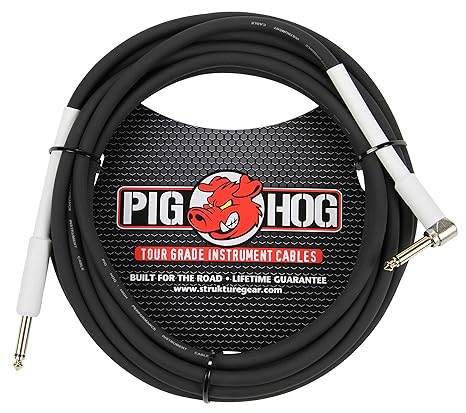
Summary: This is a heavy-duty cable that looks like it’s meant to last. And for someone like me who gigs a lot, durability is the key.

Pros: Uses 8mm wire and a thick shielding. Right out of the box, I felt that this cable is totally road-worthy. And did I mention PigHog cables have a no questions asked lifetime warranty?

Cons: None

Features:

  • High performance instrument cable
  • 8mm high quality rubber outer covering
  • 1/4″-1/4″ connector
  • Lifetime guarantee

Street Price: $19.95

Right before my gig started a couple of weeks ago, I completely lost the signal to my amp. I didn’t panic because as they say, shit happens. We were literally a few minutes from the start, so I unplugged from my pedal board, and plugged directly into my amp and did the gig with no effects. It wasn’t a big deal.

But what was a big deal was the loss of signal. After the gig, I check out my board to see if I had knocked a power connector. Everything was fine. All my patch cables were in place. I finally narrowed it down to the cable connecting my board to my amp. I guess it was its time… But it served me well for almost 20 years through literally thousands of gigs (I take care of my cables).

But it got me to thinking that I hadn’t replaced my cables in a LONG TIME. And lo and behold, I just happened to check my email and saw an ad from American Musical Supply that they were having a flash sale and what would you know, they had these PigHog 10-foot cables on sale. I immediately ordered two of them.

I knew nothing about PigHog cables. I didn’t even know they were considered one of the more expensive brands. But they were only $14.95 apiece, so what the hell! I went for it.

It was later when I received the cables that I got impressed. These are THICK and have a solid feel. The connector jack bodies are wrapped, so no worries about the circuit covers ever twisting off.

But the kicker for me is the lifetime, no-questions-asked guarantee. A company that provides that obviously stands by their product; so much so that they wouldn’t offer this if they knew their cables wouldn’t last!

As far as capacitance and sound are concerned for those who are curious, I have no numbers. I really don’t give a shit. The cables work. I plug them into my rig and I get my sound. Then I set the EQ on my amp and play.

But I do get comfort on how well these cables are built. I feel as if I can trust them to withstand the rigors of packing and gigging. For me, durability and reliability completely trump capacitance. Besides if I plug a cable into my rig and my highs are slightly rolled off, what do I do? I go to my amp and add some mids and/or treble… Uh… duh?

Overall Impression

Cables are boring. They’re pedestrian. But I want to have good, durable cables that will last a long time. I understand the whole low-cap thing, but as I said, that’s less important to me than durability. Besides, the only time I’m concerned about low-capacitance is with my mic cables in my home studio. I don’t know if they really make that much of a difference, but I use them just the same.

But as far as these cables are concerned, I’ll probably get some more; especially patch cables.

Newly Shined Shoes

When I was growing up in the 60’s, dress code was important. You always looked groomed and at least as far as my father was concerned, you always shined your shoes. Granted, he came from a military background, so shining your shoes and belt buckles and making your bed so that you could bounce a quarter on it were important things.

But shining shoes was also de rigeur in that era. Shoe shine stands are a thing of the past and pretty rare nowadays, but they were numerous when I was growing up. If you didn’t shine your own shoes, you went to a stand to have it done.

So what does this have to do with gear? This morning when I was shining my shoes – yup, I still do it with my oxfords and brogues – I thought back to a conversation I had with my dad.

“Dad, why do we have to shine our shoes all the time?” I asked.

“You want to look neat, son,” replied my dad, “And part of looking neat is having nicely shined pair of shoes. People may not know what it is that makes you look neat, but when you wear shined shoes, it just completes the package.”

Wise words. It’s all about subtlety and nuance.

And then I thought about my approach to gear; especially pedals. For the most part, I don’t necessarily want people to know that I’m playing a particular type of pedal, like reverb. You hear it if you look for it, but when you look at the whole presentation, it’s just one piece. Just like a nice shiny pair of shoes.

Of course, there are times when I want something to stand out, like deliberately turning up my digital delay when a song calls for it. But for the most part, I like to deal in subtlety with respect to my tone. I don’t want anything to specifically stand out.

Even with overdrive, my philosophy is that you’d be hard-pressed to tell if it’s coming from my pedal or it’s coming from my amp. In actuality, the way I set up my overdrive pedals, it’s a combination of both. Again, you know it’s there, you just can’t pinpoint what it is that makes the sound.

I realize that this is just my approach and I’ve made a conscious choice to use my effects in this manner. Others are much more overt. But for me, taking this approach has also trained me to trust my fingers and never rely on effects. You never know when you might have to just plug in directly…

But when I have my effects, it’s like a newly shined pair of shoes: You know it’s there, you’re just not sure what it is…

When I first saw the announcement about the BOSS Waza Tube Amp Expander (“TAE”) I got excited because I was just starting to explore the absolutely wonderful world of Impulse Responses. I was working on re-doing the old guitar tracks on a few songs for my new album in and was using IR’s to silently record them.

My setup for using IR’s was pretty basic: Amp into my Aracom DRX attenuator; attenuator line out into a DI; DI into the balanced input on my audio interface. From there, I used an IR plugin in GarageBand (yes, I recorded the entire album in GarageBand) and voila! I had a full, natural guitar sound that I could record silently.

But in the process, I was wondering if there was some magical box where I could house the IR’s I needed. Then I saw the BOSS announcement. But that lead me to another box, the Universal Audio Ox. Then I saw the price for both. It’s doable, but definitely not in the realm of super-affordable.

And then the pragmatic part of me asked, “Well…. what do you really need?”

Both the TAE and the Ox were rife with incredible features. I actually started leaning a bit more towards the Ox because it’s really set up for studio use. The TAE’s convenient knobs make it easy for on-the-fly tweaking, which made it great as a live performance unit. But I’d really only use a unit like this in the studio, so the Ox made a bit more sense.

I was just about to start making it happen when I looked at the Suhr Reactive Load IR. At a little more than half the price of either the TAE and Ox, it didn’t have all the different features those other units offer. But it did have the main thing I was after: The ability to load and save different IR’s! It’s simple. It’s straight forward. It doesn’t have anything more than what I need. Perfect!

I’ve gotten to the point in my gear purchasing where simplicity is the key. In fact, I’m taking this barebones approach even with my musical arrangements. This has been informed and inspired by listening to artists like Bruno Major who gets so much out of trio; or even the Police. If I need more, I add it, but for the most part, I’ve gone the route of less is more.

So I’ll probably start saving my pennies for a Suhr Reactive Load IR unit. And who knows? Maybe I’ll find one used.

I can’t believe it has been just over a month since I got my J-45 Avant Garde. Oh, how time flies! I’ve pretty much played the guitar daily since I got it and the wood is finally starting to break in. It will probably be a few more months till it is finally settled in, but the sound has definitely mellowed.

I did make some changes to the guitar; actually right away. I removed the stock pre-amp (LR Baggs Element) and replaced it with my Seymour Duncan MagMic soundhole pickup. It is SO much better than the under-saddle piezo, combining a magnetic pickup with a microphone. The sound is much more natural.

I haven’t played this in any club gigs yet, but I have played it in church weekly since I got it and also did a few other private gigs. But no matter where I’ve played it, I’ve walked away totally inspired by this guitar.

People ask: Does a great guitar make you better? From a technique point of view possibly, because it’s easier to play. But from an inspiration perspective, absolutely. When I play an instrument that inspires me – and mind you, no matter the cost as I have some “cheap” instruments that kick ass – I tend to be a lot more creative. When the guitar’s as easy to play and sounds as good as this, I just go off.

To be honest, I didn’t quite know what to expect with the walnut body and solid maple neck. I figured it would be a little on the brighter side. And when I first got it, that was definitely the case. But now that it’s breaking in, that brightness has mellowed and given way to that super-rich sound that J-45’s are known for. I’m in tonal heaven.

And no, I haven’t yet come up with a name yet, though I’m really leaning towards calling her Nadine. Don’t know why. There’s no sense in it. And I know it irks some, but hey! You do you! 🙂

As for me, I have a feeling this love affair will last a LONG time!

Many years back, I was jamming with a few guys and I got to the jam a bit late. So when I got there, I hurriedly set up my gear, switched on the power and started playing without doing a check of my pedal settings. In transport or while I was setting up the level knob on my reverb got turned way up. So when I started playing, my sound was awash in this syrupy-soupy reverb.

There was an older, cranky dude who was playing at the time. When he heard my guitar, he stopped and yelled out, “Hey! Use your f-in’ mix knob!”

I laughed, flew him the bird, told him to piss off, looked down and was shocked to see that most of my pedals needed to be set. So I quickly made the adjustments, and went back to playing.

Unfortunately, the guy wouldn’t let it go, and when we took a break, proceeded to lay in on me about my ambient sound. For the life of me, I can’t remember his name, but I again told him to piss off and that I had made the adjustments, and being young and brash and hot-headed at the time, probably added some zingers of my own. But in the end, it all worked out.

What sparked this memory was a demo video I watched this morning of the Walrus Audio Slo Multi-Texture Reverb pedal. It’s a cool pedal if you’re into that ambient sound, but since I don’t play much ambient-style music, it’s not a pedal that I’d consider adding to my rig.

And despite my little conflict all those years ago, the dude had a point: Overdo anything, and you’ll sound like shit. But I need to qualify that.

Set the level of your effect – any effect – relative to everything: the song, the band, the style, etc.. For instance, if you’re playing a funky song, an ambient reverb will not work. The staccato nature and the quick, syncopated patterns of the rhythm guitar just don’t lend themselves to anything with a long decay. That’s not to say don’t use reverb at all, but just don’t slather it on.

But this can be said of any pedal. I pick on reverb a bit because I’ve seen too many players overdo this effect. But to be honest, whenever I’ve seen any player overdo an effect, a lot of that has to do with the player not taking into account the context in which he or she is playing.

For me, I have two pedals that are almost always on: Reverb and Chorus. But I set them such that their contribution to my sound is extremely subtle. If I turn either off, you hardly noticed a difference, but once I switch them on, there’s just a bit “more.”

Now that’s me. The styles I play are mostly classic rock and reggae. And one could argue that reggae uses a lot of reverb. There is a lot of reverb in reggae due to the most popular amp used in reggae is a Fender Twin. But I’m not a big fan of spring reverb either, so I almost always dial it back.

For me at least, I have this thought that I want to hear as much of the natural sound of my guitar as possible. Or if I’m playing electric guitar, the fundamental tone of my rig sans effects. I add on mod effects sparingly so I can get my sound. But also, doing that makes ME work harder.

I’m a firm believer that your tone is in your fingers. Effects can seriously hide flaws in technique. When I’m woodshedding, I almost invariably plug straight into my 1958 Fender Champ. Talk about exposing mistakes! That amp is truly a WYSIWYG amp. You mess up, it’ll let you know.

Circling back, yes, use effects. They add texture and depth to whatever you’re playing. But as that cranky, old dude said: “Use your f-in’ mix knob!”