Feeds:
Posts
Comments

Back in late 2017 when my friend passed on her late uncle’s guitars to me after she and her mom found them in their storage shed, one of the guitars she gave to me is this gorgeous Godin Artisan ST shown to the left. I was so enchanted by the Simon & Patrick PRO acoustic – which has since been with me on well over 100 gigs and is the acoustic I used on all my latest recordings – that I kind of forgot that I had this little beauty.

But while forum-lurking yesterday evening, I got into a discussion thread about Godin guitars and to jog my memory, I pulled the guitar out of its case where it has sat so I could give it a thorough inspection.

As soon as I took it out, I said out loud: Why did I wait so long to give this an inspection?  Things happen in their own time, now ow’s the time for this beauty queen to literally come out of the closet! 🙂 Okay… bad joke…

As I write this, I’m hoping to get information directly from Godin on the exact provenance of the guitar. But what I’ve been able to gather on my own thus far is that this is an Artisan ST-V. There were six versions of this product line. This appears to have a mahogany body and a maple neck with a rosewood fretboard. I’m really not sure what the top is; hopefully, Godin can provide me with that information. But it is a two-piece top.

As for the body style, it is definitely quirky! But I absolutely DIG that huge upper horn! It’s actually a bit ergonomic in that it places the strap peg further left, making it feel much more balanced when I’ve got the guitar strapped over my shoulder.

I don’t know what they call this blue burst finish, but it’s absolutely killer! The photos I took don’t really illustrate the 3-d effect of the finish. Love it!

The pickups are custom pickups designed by Godin and manufactured by Schaller – at least that’s what I found out online (need to verify with Godin). I actually thought they were active pickups at first, but they’re not. Turns out that I had a bad cord, so I wasn’t getting any sound from my amp. Duh! The configuration is like an SH Telecaster with a single coil in the neck and a humbucker in the bridge. The tone knob will coil tap the humbucker to get a single coil sound.
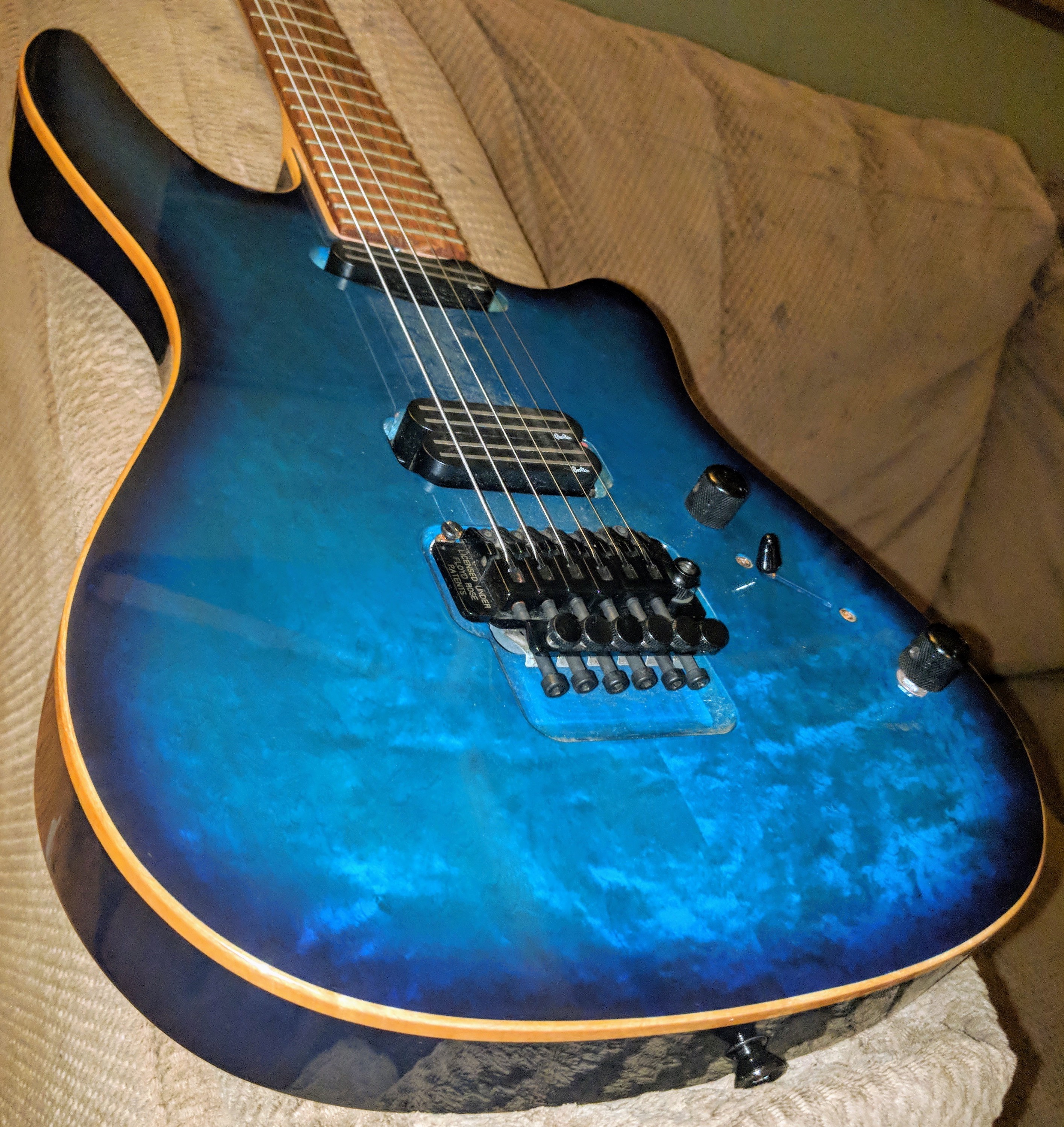
The guitar is also equipped with a Floyd Rose tremolo system. It’s actually pretty cool. It’s missing the whammy bar, so I’m going to have to replace it. I know, you either love or hate a Floyd Rose, but I’m going keep this as-is and not block it off. I blocked off all my Strats’ tremolos, but with this guitar, I’m going to learn how to use the tremolo.

In a quick, initial sound test of the guitar, plugged clean into my Boss Katana 50, the sound is very much like a Telecaster, but a tad deeper. The neck pickup is very reminiscent of a Telecaster lipstick pickup – again a bit deeper and bridge pickup reminds me of a Les Paul humbucker sound with a little more midrange. So tonally, the guitar produces something in the middle between a Tele and an LP.
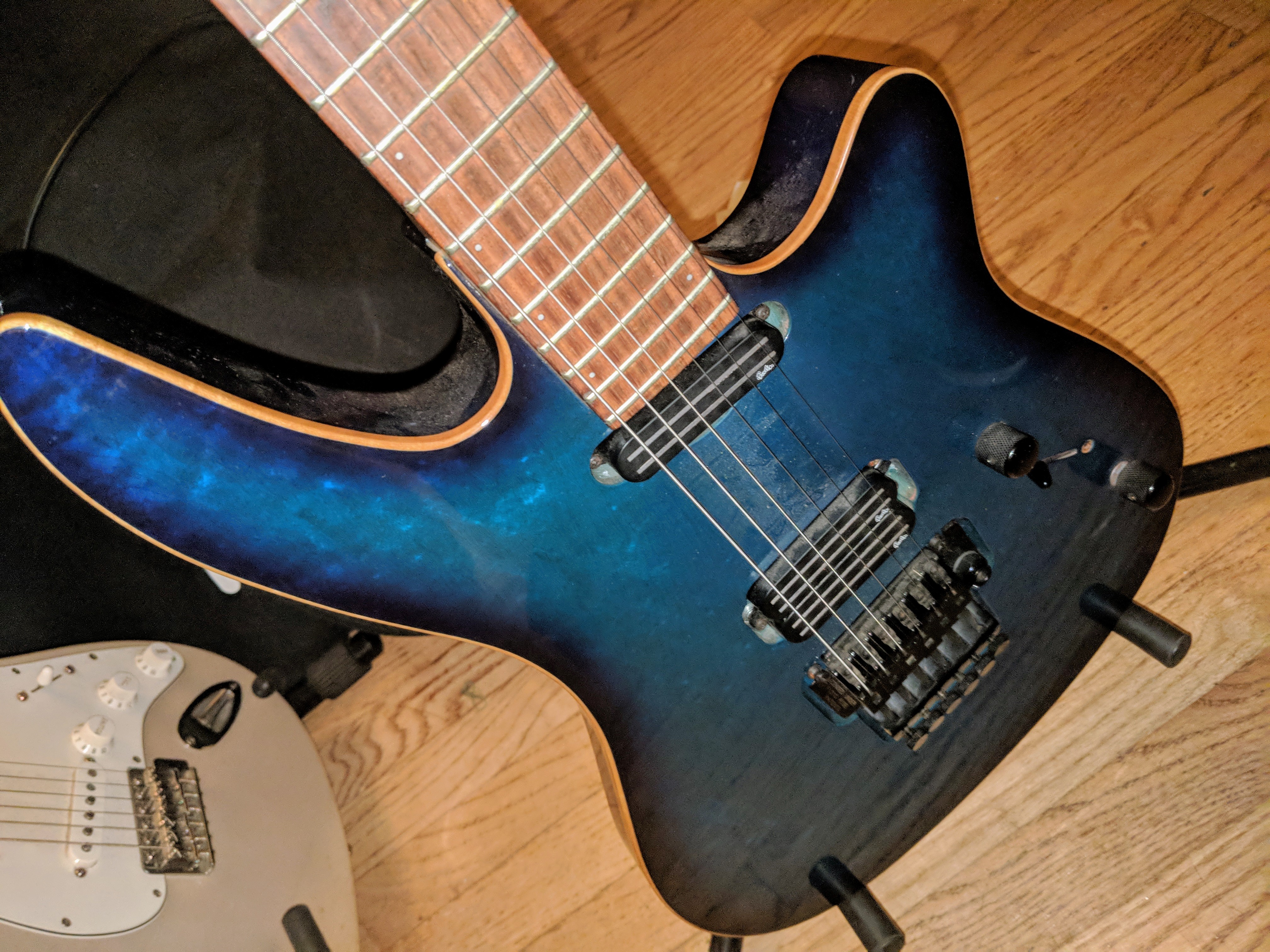
Coil tapping the bridge and playing in the middle switch position, the sound is truly a balanced mix of the two pickups. I was thinking that this would be my preferred setting, but only time will tell.

I’ve been writing this article in spurts – in between conference calls – plus testing out the guitar. I was originally intending to take it to my guitar tech and have him do a setup. But I checked the neck straightness and intonation, during a break, and even after all these years, the neck is ruler-straight. So I will do the initial cleanup and restringing myself. And if I mess it up because I’ve never worked with a Floyd Rose before, I can take it to my tech. But there are great videos that I’ve already watched on working with a Floyd Rose, so it shouldn’t be a problem.

Once I’ve done the setup, I’ll post some sound clips. I’m really impressed with this guitar! It makes me wonder why I haven’t paid more attention to Godin all these years.
Though I’ve been actively writing in the guitar gear space for well over a decade now, I’ve actually never been to NAMM. I get offered passes and interview opportunities galore, but I’ve never taken up the reps on their offers. It’s not that NAMM isn’t interesting to me; it is because it is a time when many manufacturers reveal their latest and greatest stuff.

But I have to admit it: I’m really not into going to conventions. Don’t get me wrong, I’m not the anti-social type. Far from it. A large part of it is that I have very limited free time and the way I like to spend it is in much more quiet surroundings, like driving to my best friend’s place on near the Central Coast of California, hanging out on his six acres in a peaceful, bucolic setting, drinking fine wine (he’s a winemaker) and grilling steaks.

So I don’t really keep up with NAMM. I know it happens roughly around late January. But I know it’s coming because my inbox fills up with new product announcements, offers for interviews, requests for review and of course, convention passes. I read all the product announcements because I love to see what’s coming out.

For instance, this morning I got an announcement of the new Pigtronix Resotron pedal. This is TOTALLY COOL! It’s an envelope filter that gives you the sounds of 70’s-era synthesizers! Check this video out:

I’ve always wanted to provide some synthesizer effects via guitar, but most were fairly big units requiring a mini-DIN jack – In other words, the guitar has to have one as it acts as the controller. This pedal uses 1/4″ jacks, and the pedal follows the pitch of the guitar. Just plug in your guitar and go! Nice! So this is exciting, yes. But I didn’t need to go to NAMM to see this. I just found the demo on YouTube. 🙂

I think the other part of me not going to NAMM is that I’d be like a kid in a candy store, and when it comes to gear, historically, I’ve been a bit compulsive, and I could just see myself coming back from the show and dropping thousands of dollars into new gear. Been there, done that. After the honeymoon is over, I end up selling off swathes of gear. So it’s a bit of a self-control thing for me.

But despite my own reservations – and admittedly, weaknesses – about going to the convention, I love this time of year. And though the past few years have been a bit dry for me with writing, now that I’m back in the game, I’ve got the gear bug back. Luckily, I’m older and hopefully a bit wiser, so I do temper my GAS urges now with my available finances. And at least I can write about the things that I find interesting.

Rock on!

Personally, I dig the stock speaker in my BOSS Katana 50, BUT I also dig Jensen speakers, especially the Jet series speakers, which are installed in all my cabinets. So when I got a press release from Jensen today announcing the new addition to the Jet family specifically designed for digital amps, I had to spread the word. Here’s the press release:

Jensen Jet Full Range Digital “D” Speakers

Jensen Loudspeakers is excited to announce the upcoming release of the new Jensen Digital “D” Series with full range tone for the digital guitarists. The C12D (Ceramic magnet) and the N12D (featuring the Jensen exclusive Neodymium magnet design) are 12” speakers dedicated to amplifying the “quasi-full range” output signal of the digital, modeling, profiling and IR-based guitar systems, and acoustic instruments amplifiers.

Both models retain the core elements of the traditional guitar speakers with lightweight cellulose cone membranes and integrated paper surrounds. Additionally, they feature a specially developed horn-like loading in front of the voice coil that grants a frequency response extended well beyond 12kHz. This ensures a clear, transparent rendition of the reverbs, delays, and all other time-based effects, as well as of the rich harmonic
spread of a high-gain lead sound.

Headroom and dynamics are delivered by the 2” voice coils, for a power handling of 150W AES (300W Continuous Program Power).

The organic, full range tone of the Jensen D Series speakers does not rely on complex, expensive two-way systems and crossovers, but rather on a finely tuned acoustic design and directivity pattern. The Jensen Ds are easy to use and install and as convenient as a traditional guitar speaker. They ensure a familiar feel and response while providing excellent tone for the next generation of players.

The last paragraph of the press release is the salient point, and which is why I have had such a deep appreciation of Jensen as a company for so long. With respect to the new speakers, they relied on their design expertise as opposed to compensating with complex – and expensive – systems. As an engineer – albeit software, but an engineer just the same – applying good design and engineering principles to solve a problem is the way I think, so what Jensen has done with the new speakers totally speaks to me.

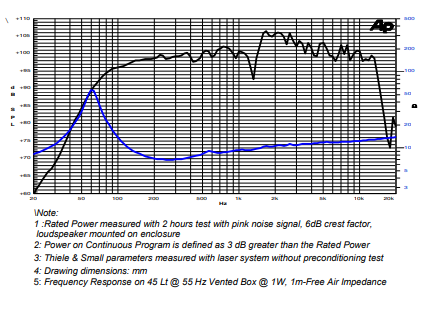
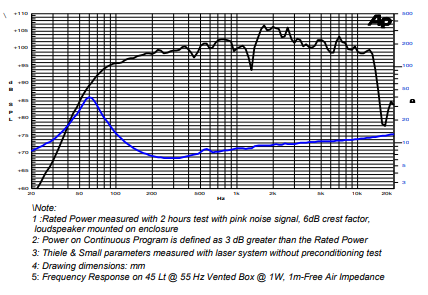
Thought I’d share the frequency response chart for each type of speaker:

C12D Frequency Response Chart

N12D Frequency Response Chart

Fairly similar response shapes with the C12D and N12D speakers, though the N12D have a little more mid- and high- range output and a lower high-end drop-off than the C12D. Based on the graphs, the C12D seems more my cup of tea, but you really never know until you try out the speakers.

Availability

The speakers will not be available until May 2019, so I will just have to wait to do some tests. But if my past experience with Jet series speakers is any indication, these should be great replacement speakers for any digital amp.

…or maybe the more apt title should be:

I finally figured out how to use this pedal.

As I mentioned in my previous Gig Report on the Katana 50, I used the Abunai 2 as my overdrive machine, going for max clean-headroom on the amp. I did this mainly because the way our stage was set up. Our amps were at the back and below the stage, so access wasn’t easy.

In other gigs where I have the amp near me, it’s easy to tweak the amp. This was like playing through a back line, so any control I’d have over my sound had to take place on my board. So prior to the retreat, I did a process of elimination and chose the Abunai 2 as my overdrive platform. I won’t go into the nitty-gritty details, but it was a fairly long process as I had several punch list items. The Abunai 2 checked off all the boxes.

So why am I revisiting this pedal? Simply because I really hadn’t explored the pedal completely in all the years I’ve owned the pedal. For me, setting it to the “traditional” toggle setting was fine when I was using my tube amps. But when I did the retreat a couple of weekends ago, I knew I couldn’t just slam the front-end of my amp. Though it sounded great, the volume jump was pretty massive and I couldn’t use an attenuator with the Katana to tame the output volume. So I used it in a way that I hadn’t before, and I just had to write about it!

The Abunai 2 – Three Overdrives in One

After reading through my original review of the Abunai 2 almost ten years ago, I realized that I had the toggle settings switched: Left is actually Right, Right is Left. Can’t believe I missed that! Even the manufacturer missed that in their preview and proofread! 🙂 With that, let’s get into the pedal’s particulars.

The thing about most overdrives is that they usually do one – or maybe a combination of two – of three things:

  1. Provide a massive amount of gain boost to slam the front end of an amp (think booster pedal).
  2. Provide a combination of gain boost and clipping like a traditional overdrive (TubeScreamer, Soul Food, and others).
  3. Simulate overdrive an amp, letting the pedal produce its own breakup and compression (Caintlinbread DLS, Geek British Ball Breaker, etc.)

The Abunai 2 does all three. Set the toggle to the middle and it acts like a booster. Set it to the right and you get the traditional overdrive response. Then set it to the left and get the amp simulation. So depending on what you’re after given the situation, you can set the pedal where you need it and it will perform. Man! Will it perform!

Toggle Settings in Detail

I call the toggle switch on the Abunai 2 the “magic toggle.” It really is the key to this pedal and what sets it apart from other overdrives. The following table details what each setting does.

Toggle Setting  Description
Left (Symmetrical Clipping)This setting provides the most internal gain and compression of the pedal, and as a result, also provides the lowest amount of output volume. It is also the setting used for getting an amp-like response, responding extremely well to changes in guitar volume and attack. This setting is best used for going into a clean amp.
MiddleThis setting is called the “diode lift” setting. Where the left and right toggles use diodes for providing breakup, this setting does not use diodes and just throws massive amounts of gain at the amp (think clean booster). This is also the loudest setting.
Right (Asymmetrical Clipping)The right toggle is the traditional overdrive that is used in hundreds of pedals. The internal diode provides some clipping and the pedal provides lots of gain. This is best used in front of an amp set just at the edge of breakup. Because this setting has a lot of internal gain to produce clipping, this setting is very much like using a distortion pedal.

For years, I’ve used just the middle position, and sometimes the Asymmetrical Clipping for classic overdrive. In that time, I stayed away from the Symmetrical clipping setting because I liked to rely on the breakup tone of my tube amps. But with my BOSS Katana 50, I purchased it mainly as a clean platform. And while its overdriven tone is pretty killer, for the situation I was in recently, I didn’t have ready access to the amp to twiddle knobs. I’d have to physically step off the stage to make adjustments. Not very easy in the middle of a set.

Fit and Finish

Amazingly enough, the powder coating on the pedal has withstood a couple of hundred gigs over the time I’ve had it, though admittedly, I tend to take great care of my pedals. I like shiny objects. But this is over a ten year period of time so I can attest to the build quality of the pedal. I haven’t had to tighten any knobs or replace any switches.

How It Sounds

Sorry folks, I don’t have any clips. But you can go to the product page where there are several clips available.

The notable thing for me was the with the Symmetrical clipping tone where I felt as if I was playing through a full stack. The sound is huge, with a nice, round, tight bottom-end (yes, I like big butts…). The other two settings are – as the manufacturer puts it – more “open” and transparent. But the Symmetrical clipping produces a big sound. It’s amazing.

Overall Impression

Even after all these years, the Abunai 2 has proven itself to be an invaluable pedal in my collection. And now that the BOSS Katana 50 is my gigging amp, the Abunai 2 will always be on my board.

You can check it out here.

Hmm… Maybe the new management was actually listening. And by the way, these have not been publicly announced as of yet – maybe after NAMM.

At the top of the list are the Les Paul Standard models: ’50’s, ’50’s P-90, and ’60’s models. They must’ve realized from all the feedback that the Standard represents the actual Les Paul tradition, and not confusing things by making the Standard model their platform for experimentation. Notably absent is the “Traditional” model which people who argued in favor of the “HP” model would be the equivalent to the traditional Les Paul Standard because it didn’t have the bells and whistles and modern doodads.

The new, experimental stuff like push-pull pots and DIP switches has now been relegated to the “Modern” model. Now THAT makes a ton of sense. It provides Gibson with a platform to introduce new technologies. From a strategic point of view, it will allow them to gather metrics on responses to their innovations. If the response is high, then they can distribute the really popular stuff to the other models in the product line. Smart.

As for the Standards, I love these designations because they are meaningful to Les Paul aficionados. 50’s necks are completely different from 60’s necks. People have likened them to “baseball bat” necks. 60’s necks, on the other hand, are more tapered and shallower. That Gibson recognized this is pretty killer. The 50’s models had two pickup configurations, either Humbucker or P-90; though most notably, it was the ’57 Goldtop sporting P-90’s that was the cherished model. But no matter. That Gibson chose to make its Standard the standard-bearer of the line is the most important thing to consider.

Thankfully, Gibson has recognized that “Standard” means something very important; not just from a collector’s standpoint, but also from brand-identity perspective. When one thinks of a Les Paul Standard, there is an implicit sense of tradition goes along with it: That this model represents the foundation and provenance from which all Les Pauls derive.

I suppose Gibson tried to transfer that tradition with the Traditional model. But at least to this author, though the guitars were probably very good, Traditional didn’t evoke the same response as Standard had for me. And I know it’s just me, but I found that model to somehow imply a diminished, lower-quality guitar than the Standard, which implied that the Standard was the peak of quality and tradition.

It took bankruptcy to get Gibson to return to its roots. Thank goodness the new management has refocused the brand. I’m looking forward to some good things from Gibson going forward!

As a Les Paul aficionado, and the proud owner of a ’58 Reissue, I like to keep up with the Les Paul product line roll-outs each year. The flagship for 2019 is the Les Paul Standard HP. Just to put it out there, I have mixed emotions about this particular model.

Gibson has again added a bunch of gadgetry to the guitar, and we all know the face-palms that were made with the Robot tuners. Talk about polarizing! My buddy loved his robot tuners, and that Les Paul is his #1. I was on the other end of the spectrum. I freakin’ hated that feature. And though I knew it worked and worked well as I had a chance to test it, I just thought it was a bit gimmicky. To me, a Les Paul just sells itself based on its history and the tradition behind it.

I realize that that’s probably a bit naive of me. But I’m by no means a Luddite. I embrace improvements and enhancements. What I don’t like are gimmicks.

So when I saw all the features of the new product line, they gave me a bit of pause. Four push-pull knobs and a five-position DIP switch in the control cabinet seemed like a bit of overkill. On top of that, Gibson was boasting about the over 500-thousand possible combinations you could have with the settings. So I didn’t think too highly about the product line. But to clarify, not nearly as bad as this fellow in the following video:

I get what he’s saying and while I can see his point, I don’t think it’s all that bad.

First, I love being able to coil tap my humbuckers. I have that feature in “Katie May,” my Slash L guitar, and it’s awesome. Furthermore, unlike the dude in the video, I love the colors. That Seafoam burst is KILLER! And I’m okay with the weight relief. I know what it’s like to lug around an 11- to 12-pound chunk of wood on stage and it’s not comfortable in the slightest; even with a 4″-wide strap.

I think where I draw the line on this model is the DIP switch bank in the control cavity. Putting myself in a buyer’s shoes, would I want it? I’m just not sure.

Here’s a rundown of the operation of the push-pull and DIP switches:

DIP 1: Neck pickup can be split (true single) or tapped (P-90 type tone)
DIP 2: Bridge pickup can be split (true single) or tapped (P-90 type tone)
DIP 3: Neck pickup treble bleed circuit (On or off)
DIP 4: Bridge pickup treble bleed circuit (On or off)
DIP 5: Transient suppression circuit (Spike control) for recording

Neck Volume: Pull for Split or tap (depending on DIP 1)
Bridge Volume: Pull for Split or tap (depending on DIP 2)
Neck tone: Pull for neck pickup phase reversal
Bridge Tone: Pull for Full bypass (Bridge only in humbucking mode with disabled controls) 

When I see this, the geek in me says, “Yowee! Look at all I can do.” But then the more practical side of me says, “Damn! Imagine wanting to set my single coil sound true-single-coil or to P-90 in the middle of a gig. Not going to happen.”

But on the other hand, I absolutely DIG the neck tone push-pull pot! To be able to put my neck pickup in-phase or out-of-phase is LIT (as my 13-year-old likes to say). My own Les Paul has its pickups wired permanently out-of-phase, but it sure would be nice to have the ability to put them in-phase at the pull of a knob.

So this isn’t really a rant against the guitar. If I had one, I’d play it, that’s for sure. I’m just not sure that all this compels me to get one. But to be completely honest, it’ll have to get in line. I’m dead-set on getting a Gretsch Nashville Brian Setzer signature model next. 🙂

I’ve encountered many guitarists over the year who announce that they’ve completed their board or rig or whatever saying things like, “My board’s finished! I can die in peace,” or “Finally completed my rig.”

But experience has shown, both through my own personal experience and through years of observation, that the states of finished and complete are transient. In other words, it just takes a matter of time before things get changed up – again. Generically, people have called this GAS. Yes, it can be that, but GAS also implies a somewhat compulsiveness in varying degrees.

For most people, GAS is picking up a pedal here and a pedal there, or occasionally a guitar. But GAS can get pretty ugly where people go way beyond their means to purchase gear. Admittedly, I was riding a razor’s edge of going beyond my means. It’s not pretty and in the end, I sold off at least 80% of the equipment I bought (yeah, it was a lot).

But from a more reasonable perspective, one of the reasons you’ll never be finished tweaking your rig is simply time. Assuming you’re constantly trying to improve and occasionally branching out to try different genres and styles of music, chances are very good that there will be a concomitant shift in your gear needs.

For instance, when I really started getting into reggae over the last few years, I stopped using a lot of my dirt pedals. I used to have at least three on my board to stack and/or give different overdrive colors. I now only keep one – if that – and many times just have modulation pedals. I also set my amps up differently. It’s now all about maximum clean headroom.

Though I have lots of gear and can swap out a bunch of stuff, who knows? Maybe I’ll make another 90-degree turn in my musical journey and get some more new gear.

The point to this is that as we evolve our skills and interests, what we might think suffices for us now could be totally different in the future.

I was on a forum the other day where someone had just gotten a Katana 50 and were singing its praises. Most comments were supportive, but one person said, “It’s paid shilling is what it is.” It’s easy to see why people might think the praise is over the top or, that the praise this amp line is getting is due to the manufacturer paying people to post positive comments about it. It’s not a stretch to believe that. We’ve all seen that happen in the past with lots of different items other than guitar gear.

I can see how it may look on the outside to those who haven’t played the amp, or even to those who didn’t really like it for some reason or another. This is a US$219.00 amplifier. It’s CHEAP! Something this cheap shouldn’t be this good. In a world where we’ve been lead to believe that more expensive something is it must be better, the Katana is an anomaly and the epitome of antithesis to that belief.

But instead of arguing about how good it is based on my experience, why don’t we look at it from a different perspective:

  • Roland (BOSS’ parent company) has had years developing and perfecting its solid state and digital technology, so research costs that smaller and newer manufacturers would have to incur to get to this level of quality have already been paid.
  • Roland has been making solid state and digital amps a LONG time, so they know how to mass-produces these things at a low cost.
  • Finally, Roland’s production capacity kicks in economies of scale. Materials and labor costs are spread out, again, lowering cost.

The net result is that Roland passes on these savings to consumers, and we get the double benefit of being able to take advantage of their expertise along with not having to pay much for it.

To be clear, even as a big supporter of this product line, I’m not saying that this is the best amp I’ve ever had. But for what I get for the price I paid for it, it certainly has the largest value proposition relative to my other amplifiers and quite frankly, I can use it with a lot more diverse musical styles than my tube amps.

Think of the Katana like the Yamaha studio piano. The Yamaha studio piano is said to be the most-used piano on recordings across several genres of music. Why? Because its sound is considered to be “neutral.” What that means is that the recorded sound can be shaped and equalized to fit just about any recording. The drawback is that – according to several pianists I know – is that the sound isn’t all that lively, nor distinctive. But the advantage is that it sits very well in a mix.

The Katana’s sound is much like that. It doesn’t have that mid-range hump that I love in my Marshall clones, and it doesn’t have the jangly cleans of a Fender. But with pedals an EQ, I can get close – damn close. But I don’t believe the amp was meant to cop a particular style of amp. It really does have a sound all its own that sits somewhere in the middle; and for many people, it’s a sound that pleases them.

I’ve made no secret that I play music at church; specifically a Catholic church. I’ve got a full band and we indeed rock it up; well, within reason because after all, we do have to play within the context of the Mass plus, we just can’t go all-out with the volume and melt people’s ears off.

But a few times a year, I get to go on youth retreats. There, volume is NOT an issue, so I can usually play a much higher volumes than at church, but normally, it’s just me on acoustic guitar with several teen singers. I can only rock so much playing by myself…

But this past weekend, it was different. On this retreat, I had an entire band playing with me: Two guitars (incl. myself), a bass, keys, and drums. So I brought the full rig for the weekend, which included my California Blonde for acoustic, acoustic guitar, my Les Paul with a Strat as a backup, and of course, my BOSS Katana 50.

As luck would have it, I only played acoustic maybe 10% of the time. The rest of the time was on my Les Paul cranking out rockin’ praise and worship music. And truth be told, this was my first full volume test of the Katana 50. And if I had any doubts about how it would perform at concert stage volume, they were completely laid to rest this weekend.

I already knew that the amp was loud. But as experience has shown, playing an amp in a controlled environment (in this case my living room) isn’t the same as playing it on stage where you have to compete with other instruments.

Unlike other venues I’ve played, I didn’t have the amp on stage with me because space was limited. Since the stage was only a foot and a half off the ground, I had everyone put their amps in the walkway at the back of the stage and tilt them against the wall. This would direct the speakers up so we could hear ourselves. That actually turned out to be a great idea because it allowed us to keep our stage volume under control so our sound guy could reinforce us through the mains.

And with the Katana 50, sound projection was not an issue at all. I could hear myself clearly, or if the band was playing all out, I could still isolate my sound. The Katana 50 kicked ass!

I originally purchased the amp as a high clean headroom platform that I could put my own pedals in front of. The built-in effects are incredible and quite honestly, the overdrive sound is pretty spectacular. But I have some great overdrive pedals that I haven’t put to much use lately and for this gig,

I decided to bring my Tone Freak Abunai 2 overdrive. This pedal has always been super-special to me and I have always loved its three different clipping sections. For me, the symmetrical clipping provides a very amp-like response and has the most gain and compression of the different clipping sections. This was the kind of thing I needed to run against a clean platform. The cool thing was that I could just set my amp’s base volume, then do fine adjustments at my guitar or on the Abunai 2 when I was playing dirty.

The Katana 50 took to the Abunai 2 as if they were made for each other. When I first switched it on and started playing a solo, the other guitarist in the band looked over at me and just shook his head laughing, then yelled out, “That sounds SOOOO good!” The thing about the Abunai 2 in the symmetrical clipping setting is that the distortion is pretty high-gain and simulates playing through a full stack. But at the same time, you get incredible note separation. It’s incredibly musical.

And to have an amp that provided that platform well, that was just kick-ass! Being just a 1 X 12 cabinet, it’s amazing how BIG the amp sounds when it’s pushing air. It’s hard to actually describe it in words but the effect is absolutely dramatic.

As far as clean tones are concerned the only thing I can say is, “Wow!” I dialed in just a bit of reverb from my TC Electronic Hall of Fame, then added some light analog delay texture with my Mad Professor Deep Blue Delay. When we were playing songs that demanded clean, clear tones, the Katana 50 delivered that in spades! Again, so very very inspiring.

Once we finished our first set Friday night, I just turned to the band with a shit-eating grin on my face. Not only had these kids done a great job – for which I gave them TONS of kudos – I also said that my tone was just spot-on. I was SO inspired by the sounds that were coming from the Katana 50!

Saturday was filled with several short sets of praise and worship and one really long, two-hour set in the night to cap off the day. Not once on Saturday did the amp let me down. Once I had it dialed in on Friday, I didn’t touch it except to add a bit more Master Volume because once our drummer got his confidence, he also got much louder – which is a good thing because I kept on having to remind him to play louder on Friday (imagine telling a drummer to play louder). 🙂

But the piece de resistance was yesterday morning’s final praise and worship set. For that set, I set the master much higher because we needed to be loud to finish up the retreat; plus with all the kids dancing and jumping, and singing along at the top of their lungs, I knew we’d have to cut through the crowd.

It turned out that even that setting wasn’t loud enough. 🙂 So after the first song of the set, I instructed the other guitarist to up his volume a bit (he was always pretty loud, but even he couldn’t cut through a screaming crowd) and I went back and cranked the Master to about 2pm, which is pretty freakin’ loud.

On the second song, I ripped into a quick intro solo by myself, then counted out the song. OH. MY. GOODNESS! 🙂 Talk about moving some serious air! That just got the band amped up and we finished up the set totally spent!

So no doubt, I LOVE THIS AMP! And imagine that its street price is only US$219.00!!! F-in’ A!

I am very aware of the doubters of this amp. One person on reddit called all the praise people were giving “paid shilling.” With all the buzz about the amp, it’s not a stretch that some might think this. But this amp really is that good! Every time I play it, I find another nuance that makes me love the amp even more!

Get Rid of Gear

Did I just say that? A gear slut saying to get rid of gear?

Okay, I have to admit that the title was mostly meant to be an attention-getter. BUT… There really is a serious side to this, and no, it has nothing to do with evaluating an emotional response to gear. What the subject of this post revolves around is this simple question that I’d like you to ask yourself:

How much am I hiding behind my gear?

To answer that question, try this:

  1. Pick a song or solo that you know very well – the more complicated, the better.
  2. Make sure you’re plugged in and have all the effects you normally use to play it.
  3. Play the piece. It’ll probably be the same, familiar thing you know so well.
  4. Now, turn off all your pedals, set your amp’s reverb to 0, set up the amp for maximum clean headroom such that no matter how hard you attack or turn up the guitar volume, it will not break up.
  5. Replay the song/solo in its entirety.

How did it sound?

Chances are good that you may say something similar to “Ouch! That wasn’t very good.” <or in my case, my reaction was filled with muttered expletives> It can be a humiliating and sobering experience to hear yourself play without effects.

I discovered this “humiliation” when I first got my 1958 Fender Champ, a 5 Watt, single-knob amp with a 6″ speaker. I was all set to do a review and provide sound samples, and when I sat down to record the amp, I sounded like shit! 🙂 I switched guitars and still sounded horrible. It was then that I realized that it wasn’t the guitars that sounded bad, it was me. And it also made me realize that I had been hiding behind my overdrives and reverbs and delays – for a long time.

So I delayed providing sound clips for a long time until I did a little woodshedding to work on my technique. It would be months before I felt comfortable playing that amp.

But there were several positives that came out of that process:

  1. I learned to be so much more expressive with just my fingers. With nothing to hide behind, everything had to come through me, just me.
  2. Using a totally clean amp helped me find my own, authentic sound; that base tone that no matter what guitar or amp I play, I sound like myself.
  3. The few months that I spent on my technique got me into this mode – and this is the crux of the article – where I felt that I just didn’t need certain pedals – especially overdrives. I could rely on the amp for that.
  4. I also came to the realization that what pedals I would use going forward would be accents to my sound as opposed to defining my sound.

At first, I reduced my pedal board to just modulation pedals; specifically, chorus, delay, and reverb. If I needed overdrive, I’d just overdrive my amp. But after awhile, I started back some overdrive pedals, simply because I like the sound of my favorite pedals like my Tone Freak Abunai 2 or EHX Soul Food. I’ll occasionally have a wah in the chain (though now that I’m playing a lot of reggae, it’s more often than not). But for the most part, I went from having a 12-pedal board to usually just using a PedalTrain Nano.

I will say that your mileage may vary. But if you’re like me, you may very well find that you just don’t need a bunch of pedals to get your sound.