Feeds:
Posts
Comments

bren-thumbs-upYesterday, I wrote an article about how my beloved Hardwire RV-7 Reverb had finally gone on the fritz, and I was going to try out the TC Electronic Hall of Fame Reverb, which I’ve had now for a few years, but hadn’t put on my pedal board. This wasn’t because I didn’t think it was good; in fact, I gave it pretty high marks in my original review back in 2013. But that was a studio test.

Testing in a controlled environment is one thing, but for me, gear doesn’t really reveal its true nature until I’ve used it live. The conditions are completely different than in a studio, and oftentimes I’ve found that something might sound great in the studio, but in a live performance situation, just doesn’t perform all that well, no matter how it is adjusted.

But as you can tell by the meme, that is definitely not the case with the Hall of Fame. In fact, it performed so well that it’s not leaving my acoustic board. Ever. Yeah, yeah, I know that there are awesome boutique reverbs out there. But when you dial in a great sound, irrespective of the pedal, you don’t mess with it. It’s like the saying in baseball: You don’t f$%k with a streak. If it works, you go with it.

Truth be told, I found a “magic” setting for the pedal, and not only did it meet the capability I expected it to have – that is, at least equivalent to my old RV-7 – it far exceeded my expectations. That setting didn’t make a lot of sense to me at first because I normally like to run a reverb at about 50-50 wet/dry with a short decay, and that’s how I initially set it up. And as opposed to using a spring setting, I’ve turned to using a Hall reverb. I had gotten used the natural subtlety of the RV-7, but the Hall of Fame Hall reverb is much wetter at the 50-50 level setting than the RV-7. It’s also slightly brighter in tone.

So here’s how I set it for my acoustic rig, which goes directly into the board: Hall effect; Tone at 11 am; FX Level at 10 am; Decay at 2:30-3 pm, which is about 70-75% of the sweep; and Pre-Delay set to short. That setting is a little unintuitive to me because of the long decay. But with the level kicked back, what it does is provide a nice tail in between notes, but with the lower FX Level, I retain my note clarity. The result is a subtle, expansive, and deep and rich tone. And though set to Hall, which you would expect to be super ambient, again, the lower FX Level ensures that I can hear all my notes up front, while the tails due to the Decay provide the lingering of the notes. It’s beautiful.

What was an even more pleasant surprise was how well it played with my other modulation pedals. I expected it to play nice with my Corona Chorus as that is another TC Electronic product. But I didn’t quite know how well it would play with my Mad Professor Deep Blue Delay. It played nice. Very nice. For some reason, my old RV-7 sat better in my chain in front of my delay (I know), but the Hall of Fame definitely belonged at the back, as the last pedal before my looper.

That I’ve had this pedal for almost four years and haven’t gigged with it is an absolute shame. I was so blown away by how it performed last night, and I even got several comments from both staff and patrons commenting on how good my guitar sounded. The Hall of Fame has definitely found a home!

That feeling is a mixture of sadness and sickness. After many years, and literally, thousands of gigs, my trusty Hardwire RV-7 Reverb finally stopped working. I remember that before I got this pedal, I went through several reverbs before I finally found one that inspired me, and that was the RV-7. Built in partnership with Lexicon, the seven reverb models the pedal offered were unparalleled in my opinion.

What I loved about that particular reverb, which turned me off with so many others was its subtlety. Most other reverbs at the time were really in your face, even at low settings and with long pre-delays, and they sounded processed. But the RV-7 was completely different from all of them. I could get rich, deep tones out of it, but even at high settings, the reverb was “just there,” as if it was a natural component of my signal.

Subtlety in a reverb is very important to me because it can easily overpower the rest of the effects on a board. But the RV-7 played so well with the rest of my pedals. I’m going to miss it.

That said, I’m going to finally put the TC Electronic Hall of Fame reverb on my board tonight. I’ve had it for a couple of years, and I actually like this pedal quite a bit, but never got around to using it on a regular basis as I was happy with my RV-7. While I thought it was great, it wasn’t great enough to compel me to make a switch. I have high hopes. But if I can’t get it dialed in at tonight’s gig, I’m probably going to get the Digitech Polara Reverb, which is the next evolution of the RV-7.

I know, there are other alternatives out there, such as the Strymon Blue Sky. That’s a great reverb, and capable of incredible subtlety, but if memory serves, I just wasn’t all that inspired by its sound. As with anything, you go with what sounds and feels good to you, and you go with that which you are familiar; and as I’ve mentioned in the past, I had Lexicon reverb inserts on my PA board at my former church gig, and I loved them.

We’ll see how it goes with the Hall of Fame tonight. You can’t go wrong with TC equipment, but then it all depends on the sound…

You know what the best thing about guitar gear is? There’s lots of it! You know what’s the worst thing about guitar gear? There’s lots of it! So much so, that it makes it difficult to make a decision on just what to get. Let’s talk about amps! There are so many to choose from that it’s difficult to make a decision. For me, I’m looking for a new amp with lots of clean headroom and a shimmery top-end to play reggae and be a pedal platform for the classic rock cover band I’m in.

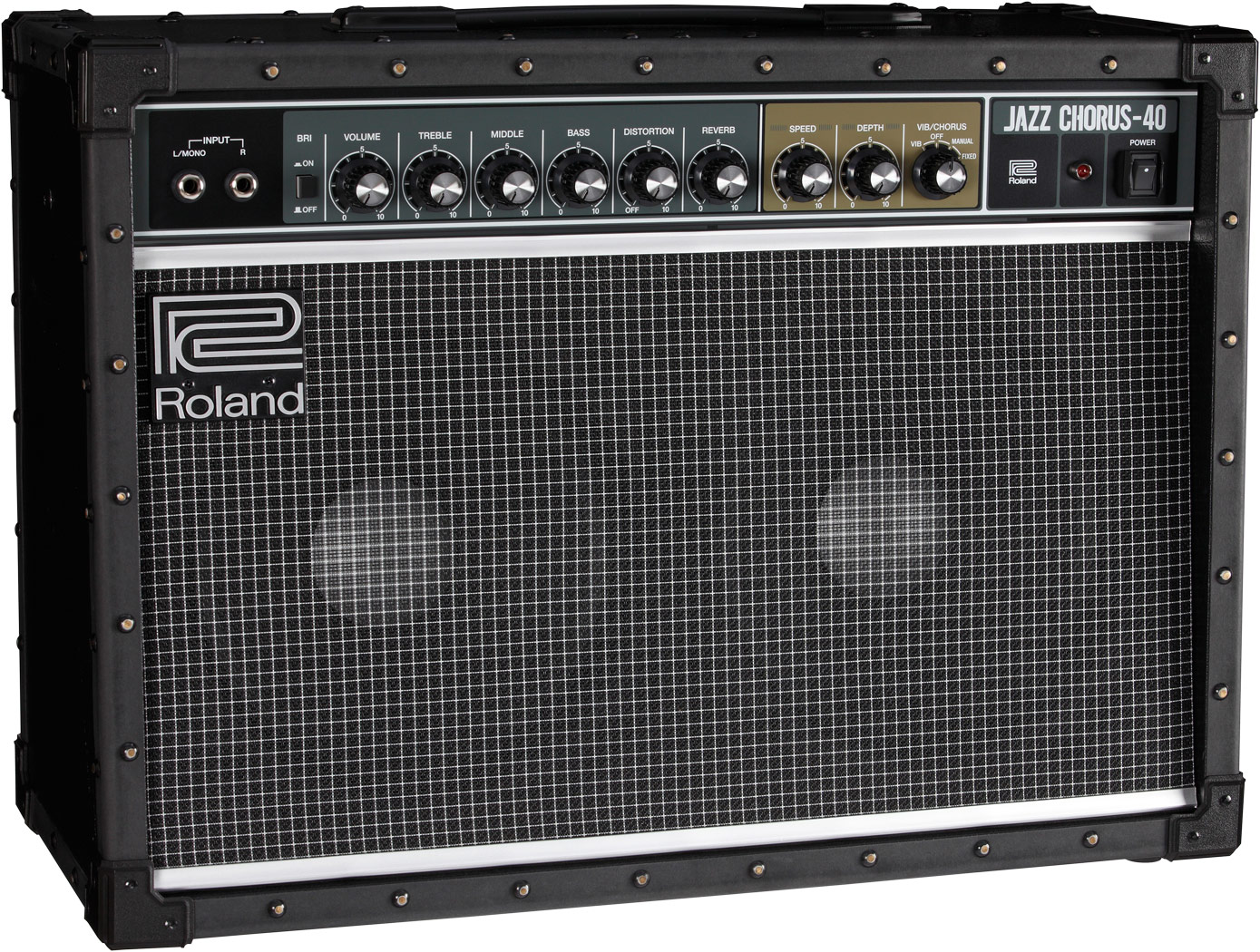
For those in the know, they’ll automatically think Fender for that kind of clean tone. There is something absolutely magical about that Fender clean tone. It’s truly unique. And, in fact, I’ve been thinking heavily about investing in a Fender Twin Reverb. But truth be told, I have to face it: The barrier to entry for me, at least financially, is pretty thick at the moment, so I have to look to less expensive alternatives. And that’s where the problem lays. Whereas I love that Fender clean tone, I completely forgot how much I loved the original Roland JC 120 clean tone. It’s completely different from a Fender clean, but it’s still an incredible and unique tone that stands on its own.

Recently, I played one of my band mates’ Fender Ultra Chorus and absolutely loved the delicious and lush cleans that amp produced. I wrote an article about the experience because I was so blown away by how great the amp sounded. I was actually ready to pull the trigger on a used Ultra Chorus last week, but then I ran across the Roland JC 40. Oy-vay!!!

Talk about having the tonal mojo of its bigger brother, but only weighing in at 34 lbs.! Plus, there’s absolutely NOTHING like a JC-Chorus tone live. Sure, there are GREAT chorus pedals out there, and I own a few of them. But once you hear how a chorus sounds out of a two-speaker setup with one dry and one wet speaker, then your whole perspective changes on chorus. The thing about the JC 120 was that with the chorus engaged, the sound was extraordinarily three-dimensional. It’s hard to explain. And now apparently, the JC 40 offers the same “JC Clean” mojo but in a smaller, lighter form factor.

Now I know that there will be those that eschew amps like this because they’re solid state. But for me, an amp like this serves one purpose: Give me a clean platform with TONS of headroom to which I can add pedals to shape my sound. I don’t need a tube amp for this. Besides, I’ve set up all my tube amps to break up early, and since they’re pretty low wattage/low gain, I don’t have much clean headroom. That said, my DV Mark Little 40 and Aracom VRX22 definitely have enough volume to play clean, but these cleans are “Marshallesque,” which are gorgeous, but are much more smooth and don’t have the “shimmer” of a Fender or JC clean tone. And for the reggae that I’m starting to play, I need a bit more of an edgier clean tone.

So, enter the two amps above. They’re purely clean, though they have a distortion effect built in, but I doubt I’d ever use that feature. Both have a chorus effect, of course, and while I prefer the Roland chorus, the chorus effect on the Fender Ultra Chorus is pretty nice, though a bit warmer sounding than the Roland chorus.

It’s a tough decision. Fender no longer makes the Ultra Chorus, but I could get one for under $300. The JC 40 runs from $549 to $599, but it’s a modern amp with truly modern solid state components. To be honest, I’m leaning towards the JC 40. It’s twice the price, but it sure does look cool.

Here’s a great 2-part demo of the JC 40 done by Music Bliss Malaysia. To me, this is just about the best demo I’ve seen of this amp, and one of the best demos I’ve seen of gear period. This dude rocks it!

I don’t know the guy’s name who demos for Music Bliss Malaysia – and I can’t seem to find his identity at all – but I love the fact that he demos a myriad of styles in his demos, and this particular set of demos shows off the amp’s capabilities quite nicely. It’s nice to see a demo which isn’t just blues chords and licks. Not that I have anything against blues, but when demos are only done with only a single style, it feels a bit one-dimensional.

In any case, the more I write this article, the more I’m leaning towards the JC 40. While I love the Ultra Chorus, I have a history with the “JC Clean” sound, and I love it.

For those of you who’ve been reading this blog for the last 10 years, you know that my amps are now all valve amps. I’m never going to get rid of them, and I will continue to gig with them. But my music-writing has taken a HUGE turn towards reggae, and that means playing clean. Yes, I can get great clean tones out of my tube amps, but I’m looking for a certain type of clean that my current set of amps won’t give me. I could get that with my Fender Hot Rod, but that finally went kaput, so I figured instead of investing up to $300 to get everything fixed, I could invest in another amp. Great reasoning, right? 🙂

And to address even considering a solid state amp, for me, I’m a disciple of the Duke Ellington school of thought: If it sounds good, it is good. It doesn’t matter to me what materials go into a piece of gear, just so long as it gives me the sound I want, and can also stand being transported and work in my studio.

The challenge, of course, is that I’ve chosen my pedals -especially my overdrive pedals – specifically because they sound great and interact well with the front-end of my tube amps. With these solid state amps, that’s not an option. Though the distortionLuckily I’ve never gotten rid of the pedals I’ve purchased that don’t work. Hopefully, I’ll be able to take those out of mothballs and find one or two that work well.

I was looking for user reviews of the DigiTech Trio+ so I could get a feel for what I’ll need to adjust in my rig to accommodate this pedal once I get it. To me, as a songwriter, playing a riff then “teaching” a pedal the riff, then having both drums and bass “automagically” layered on top of it is awesome! For me, once I come up with a riff, I want to create a rhythmic context so I can continue with a song. The way I would do this is search through loops to find the right “feel” for my song, then place it on a track, then record my riff over it. But oftentimes, I’d get so frustrated just trying to find a damn drum loop that I lose the inspiration to go further than just recording the riff. But based on the all I’ve read and the demos I’ve watched the last couple of days, I think the Trio+ will be an invaluable tool for my songwriting, and even using it in a live performance.

But in the interest of being thorough, I wanted to see user reviews on the Trio+ because professional reviews, while incredibly useful are created by people whose jobs are to do great demos, and oftentimes they tend to gloss over idiosyncracies of the gear they review. So I did a search and ran across this thread on the GearSlutz forum. The guy who started the thread griped about his perceived shortcomings of the unit. I suppose they could be valid from his perspective. But others chimed in and talked about how to address those issues. Others piled on with some negativity; you know, the typical, “hate that crap” and they’ve never even used the gear. But despite others offering solutions, the guy doubled down on his complaints thinking that there should be more features added to the unit to make it easier. When I read his suggestions, I thought that those made a bit of sense, but it’s unclear to me if they would fix his issues, especially if the problems were because of his playing.

And that formed the gist of this particular entry. Over the years, with all gear that I’ve evaluated and played, there’s one constant I’ve come to find about gear: Nothing is perfect. Nothing falls neatly into what we perceive to be how gear should operate.

And I suppose that this could be applied to life in general. I think we all fall into the trap of struggling between our perception and reality. To overcome that struggle, I truly believe that if we open up our minds and hearts and take the time see something for what it truly represents as opposed to how we think it “should” be, we’ll be a lot happier.

Food for thought…

Gear I Want To Get

I’ve been writing a couple of articles in parallel and one was kind of negative, and a bit of a rant, and I didn’t want to start the new year out on a negative note. And what better way to start the new year out but to talk about gear! And in this case, gear that I would love to get…

I spent the last couple of years trimming back on my gear collection. I went from 20 guitars and am now down to 6, though I only play 3. I still have 6 amps, but that’s the bare minimum for me as they provide different sonic presentations that I like, though admittedly, that’s only meaningful in my home studio. I just gig with 2 amps.

It’s still a lot of gear, at least for me, and probably not much relative to many gear freaks out there, and in general, I’m pretty happy with what I’ve got. BUT, there’s still some gear out there that I want. So here’s my current wish list:

Guitars

Gretsch Brian Setzer Nashville Hollowbody Electric ~ Every time I play this guitar in a shop, I just get transported to another dimension. I sold my previous Gretsch. It was a good guitar, but my affinity for it ran its course. But if I ever get this one, it’ll be a keeper along with my Les Paul and custom Slash L “Katie May.”

Preston Thompson OM Acoustic (Cutaway) ~ This one would be a real stretch for me as the starting price for one of these is $15,000, and it would have to be a pure custom guitar as the OM’s don’t normally come in a cutaway, but I asked Mr. Thompson if that could be done and he said he could. In any case, I was up in Sisters, OR this past summer and happened to stumble into his guitar shop/factory while walking around the town. I played an OM made of “shipwreck” Brazilian rosewood, which was literally recovered from a shipwreck in 1937 off the coast of Brazil. It had an Adirondack Spruce top. I’ve never heard an acoustic guitar sound like that – ever. The challenge with that guitar will be finding a preamp/pickup system that will do it justice. I like the LR Baggs and Fishman pickups. Maybe Thompson has a recommendation.

Amps

Fender ’65 Twin Reverb ~ As I’ve gotten into playing reggae, there’s a clean amp sound that I’ve been absolutely craving, and that is the Twin Reverb sound. No, I’m not trying to sound like anyone else but myself, but the traditional sound of a reggae guitar has come from a Fender Twin. Having played both real and modeled versions, there’s a certain vibe about the Twin sound. It’s hard to explain, but that vibe is something I’m after.

VHT Special 6 Ultra Head ~ I bought the original VHT Special Combo pretty much the week it came out. At the time, I knew nothing about the amp. I happened to be passing through Beaverton, OR and poked my head into a guitar shop where I saw that little amp. The owner said that he had just put it out on the shelf, and at $179 at the time, I immediately sprung for it!

Well… I sold that amp a couple of years ago, then recently saw that VHT had come up with a variable-power Ultra version. I wasn’t interested in a combo because I like to mix and match heads and cabinets, and this amp fit what I’ve been looking for lately to add to my classic rock band rig.

Roland JC 40 ~ I almost forgot about this (and am actually adding this as a late addition after I posted this article). In any case, a few months ago, I was looking to get an old JC 120, then saw that Roland had come up with the JC 40 that apparently had all the vibe of the original 120, but was smaller in stature.

I have to say that the first clean tone that I fell in love with is that JC 120 clean tone. I used to use a JC 120 back in the ’80’s and loved that amp. But it was such a beast to lug around that I stopped using it.

And make no mistake, though this amp is solid state, its cleans are simply magnificent. This is an amp totally worth considering if what you want is an amp that is all about clean headroom.

Pedals

DigiTech Trio+ ~ I recently went to the DigiTech website to look for a new version of the Hardwire RV-7 Reverb, as my RV-7 is starting to really act up (more on that below), and on the home page, I saw the Trio+; a pedal I hadn’t heard of up to that point. I admit, I haven’t had my ear to the ground these last couple of years with respect to gear, so it came as a real pleasant surprise to see a new pedal. At first, I thought the pedal was simply one of those multi-function pedals that gave you the ability to have something like chorus, reverb and delay all in one.

But then I saw a demo video on the pedal’s product page featuring Andy from ProGuitarShop.com. Over the years, I’ve found that Andy doesn’t do demos on just anything. He does demos on the either the best or most interesting stuff out there, and for him to have done a demo on this pedal immediately told me that it was a special pedal. So I watched the video and was immediately like #mindblown!

I thought the BeatBuddy was cool  – a programmable drum machine in a pedal. But this was something entirely different and so much more: An instant band creator! Unlike other rhythm machines that essentially dictate the beat, this box LISTENS TO WHAT YOU PLAY, then comes up with a beat and bass line! On top of that, it includes a looper, and you can program a sequence of up to 5 song parts and store them!

To say I’m excited about this pedal is kind of an understatement. I could definitely see myself using it for live performance, but more importantly, this will be a great tool for practice and songwriting; especially songwriting. One of the biggest challenges I have with songwriting, and something that makes me lose my inspiration, is finding a beat to lay down an idea. I get frustrated because all I want to find is something close to what I want, then I have to find the right tempo. A lot of times I get so frustrated with that process that I just give up laying down the track altogether.

But with something like the Trio+, I can come up with a riff, loop it, layer on more riffs, add parts, then save the whole damn song! It may not be what I eventually record, but it’ll allow me to capture my idea. Plus, the fact that I can save more than the default 12 songs to an SD card makes this pedal an incredibly invaluable tool! I’m getting it, and soon!

DigiTech Polara Reverb ~ As I mentioned above, my RV-7 is finally seeing its last days. After several years and literally a couple of thousand gigs, it’s finally going on the fritz. Thank goodness it’s a true bypass pedal because it just stopped working last weekend. I can’t complain. That pedal has been absolutely good to me.

A couple of weeks ago, I noticed that it was starting to act up, so I did a search on the RV-7 and sadly discovered that it was out of production. But in my search results, I saw a link to the DigiTech Polara, so I followed the link. After reading through the literature, it was clear that the Polara is the new version of the RV-7, replete with Lexicon reverb models. To me, Lexicon models are the best. I used them for years at my church gig as an insert module on our board, and that’s what originally sold me on the RV-7. The Polara sports the same reverb models – though I suppose they’re probably updated from my 10-year-old ones – and that pleases me.

On top of that, what finally sold me was yet another demo from Andy at ProGuitarShops.com. The “Halo” reverb mode of the pedal that Andy started with just struck me to the core! This is a new reverb model, and it provides tons of ambiance but also a top-end shimmer that will go absolutely well with my acoustic guitar. Can’t wait to get it!

Okay… that’s this year’s lineup. Realistically, I’ll probably only get the pedals, and maybe the VHT head. But I can dream…

 

I Like Shiny Things…

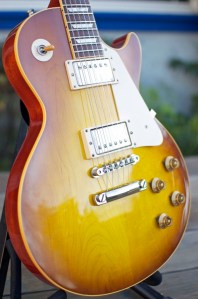
AmberTo the left is my beloved “Amber,” a 1958 Les Paul Standard Historic Reissue. She’s my #1 guitar. That picture was taken six years ago and despite a couple of hundred gigs since then, she still looks pretty much the same. She might have some super-minor dings, but they’re small enough where they’re not even noticeable.

You see, I like a nice, shiny guitar. I like things that look new. I don’t do anything special. I wipe her down with a soft, microfiber cloth after a rehearsal or gig. But I don’t oil the fretboard or any of that kind of stuff. But I do take care of her. It’s like a car. I have an old 2002 Subaru Outback Wagon. It is definitely showing its age, but I take care of it. I get it washed once or twice a month, but I keep the interior clean.

Same thing with all my guitars; actually, all my gear. I’m not one to abuse it, but if I do get dings, it’s not going to be the end of the world. But at least I’ll know that it happened while I was using it.

My Yamaha APX900 has a lot of road wear. I play about over 200 gigs with that guitar a year, and it has some dings, and I’ve had to duct tape a spot where the top got banged and started delaminating. But I did that damage, and that’s just a consequence of it being used so much.

The point to all this is that I’ve never really gotten into the “road worn” or artificially relicked gear. I’ve played the Road Worn Strats and Teles and one fine Nash Telecaster, and they play and feel and sound great. But my problem with them is that I didn’t cause the wear. To me, it’s cheating. To me, scars and dings are battle marks. They’re signs that my gear has been and is being played.

Mind you, I’m not putting anyone down for wanting that kind of gear. All I’m saying is that it’s not for me. Never will be.


I love all sorts of genres of music, but as of the last few years, my go-to genre has been reggae, and one of my favorite reggae bands is Rebelution. This is a band out of Isla Vista, CA and was formed in 2004 by a group of guys who went to UC Santa Barbara. Their lead guitarist is Eric Rachmany, and he’s an incredible guitar player. While he may not play screaming licks or do any shredding, he’s solid in every way, and so expressive. To me, guitar playing isn’t about the tricks or complexity of what you play, it’s about your expressiveness and ability to get your message out.

Eric’s playing, especially on his acoustic guitar speaks to me. He doesn’t do anything sophisticated, but his approach to the acoustic is simply amazing. Check out this video of my favorite Rebelution song, “Feeling Alright.”

As far as playing electric, who couldn’t like a guy who plays a Les Paul? 🙂 But even with electric, Eric is such a solid guitarist, and incredibly expressive. Check out “Sky Is the Limit,” and especially pay attention to his lead at around 2:50

At least to me, Eric doesn’t play what doesn’t belong. His leads and fills just “fit.” I first noticed this when I saw Rebelution play this past summer. I was transfixed by his guitar playing and gave me a real appreciation of just how good this guy is.

Personally, from a music-writing perspective, I’ve started exploring writing music with a reggae feel or straight-up reggae. And while most who are unfamiliar with reggae may think that it’s mostly just an “um-chuck” type of deal, Eric Rachmany has shown me there is so much you can add, and I’ve incorporated similar embellishments to my own rhythm lines.


…and a few others to consider

I know, I know… A lot of people wouldn’t ever think about doing this, but I’ve used them for years, and actually got the inspiration from one of the greatest acoustic guitarists – in my humble opinion – who ever walked planet Earth: Michael Hedges. While he mainly used a chorus pedal, it gave me the idea that I could take advantage of the interesting sonic layers I could add to my sound. Note that these aren’t hard and fast rules, but for me, I don’t go to a gig without them. And also note that this assumes you’re plugging your guitar into a board or an amp of sorts.

Reverb

A lot of acoustic amps have onboard reverb, but I’ve found that they’re not quite as good as a dedicated pedal that I can tweak. My favorite reverb pedals that I use are the DigiTech Hardwire RV-7 Reverb and the TC Electronics Hall of Fame Reverb. The RV-7 is no longer in production and I’ve had it for several years, but it’s awesome. Apparently, the DigiTech Polara builds on DigiTech’s use of Lexicon reverb models. Lexicon reverbs are the tops, and I’ve used them on pedals and sound boards for years. As far as the Hall of Fame reverb, it’s an absolutely solid reverb pedal, though admittedly, it sits on my electric board. This pedal is cool because it has TC Electronic’s TonePrint capability that allows you to download saved tweaks from their site. I’ve used it, but I tend to like where I set my reverb, so I don’t use it too much.

Chorus

Frankly, I couldn’t live without this in my live gigs. I never use it really heavy – even for electric guitar – but it can add depth and shimmer to your plugged-in tone. Frankly, you have to play a lot of these to find the right kind of sound for you. But my go-to chorus pedals are as follows (in order of use): TC Electronic Corona Chorus, BOSS CE-2 Chorus (vintage MIJ black-label – and I only use it in my home studio now because it’s so rare), Homebrew Electronics THC (discontinued, but the warmest, most liquid chorus I’ve ever heard). The Corona is my workhorse chorus pedal that I use for both acoustic and electric. There’s really something about this particular pedal that I just dig. It’s actually a very subtle chorus, and that suits me just fine because I don’t ever want a pedal to dominate my sound. I usually just set it in the standard setting. I keep it at about 10 o’clock for level; I set “speed” at about the same, and depth about 2pm. Then depending on where I’m plugged in, I’ll adjust the tone to where I perceive it to be balanced with the rest of my signal chain.

I actually also have a BOSS  CE-5, but that sits in my spares drawer just in case one goes down. It’s decent, but it’s not a CE-2, which is a pretty special sound. You can still get CE-2’s used. But you’ll want to get one in excellent to mint condition.

Analog Delay

I’m making an important distinction here mainly because I’ve never been able to get a satisfactory sound with a digital delay with my acoustic. And to tell the truth, while I’ve had several digital delays in the past, I now only use my Vox Time Machine for digital delay. But even that doesn’t get used much. Instead, I have two mainstays that I use pretty regularly. First is my Mad Professor Deep Blue Delay (hand-wired). Whew! I paid a pretty penny for that (USD $325 new) but there’s a less-expensive PCB board version that sounds incredibly good as well. In any case, I use this pedal mainly for acoustic. To me, it has this other-worldly sound that I just can’t get enough of when I’m playing my acoustic through it. It works great with my electric rig as well, but I tend to prefer my MXR Carbon Copy for that. For some reason, the Carbon Copy has an awesome mojo in my electric signal chain. I just love it. It doesn’t have the depth of the Deep Blue, but that’s not really what I’m after when I’m playing electric guitar. I just like to add some ambiance to my solos. Got that from Tommy Shaw of Stix.

Other Pedals To Consider

I use the following pedals depending upon the venue I’m playing.

Compressor/Sustainer – My go-to is the Maxon CP101 Compressor. I usually use this if the venue I’m playing doesn’t have an onboard compressor and/or the venue has really high ceilings, and I need my band to be pretty narrow to cut through the ambient noise.

Acoustic Enhancer – I use the BBE Sonic Stomp, and again, I use it mainly for wide-open areas. This is particularly useful for when I’m playing with other acoustic guitars and am doing a lot of solos. I typically use it to add some high-end shimmer – but sparingly, otherwise I risk sounding “tinny.”

Vibe – I know what you might be saying, “Really?!!!” For me, this is a “mood” type of pedal. I don’t use it much, but when I want to get a pulsating, modulated tone, there’s nothing but vibe that’ll do. And for me, my vibe of choice is the Voodoo Labs MicroVibe.

Of course, you don’t really “need” any of these. And if I were to choose just one, I’d probably go with a good reverb pedal first. There’s nothing like adding a little “grease” to your sound than with some subtle reverb. The next would be delay, then chorus. But I should say that in my solo acoustic gigs, my chorus pedal is always on. I have a very subtle setting that I use that really pleases me, so I just keep it on all the time. But in its absence, I’d choose a delay over that.

And as I mentioned above, there are no hard and fast rules, but having literally played thousands of gigs over the last 35 years, I’m banking on my experience to at least get you started.

Quality Gear Matters

I’ve gotten the recording bug again. But it’s different this time because I’ve had to do a necessary upgrade to my recording equipment, as my old audio interface just doesn’t work with my new computer. So I recently purchased an M-Audio M-Track 2X2M and I love it! It has the features that I need for my simple uses, and the best thing is that it’s relatively compact compared to my old MBox2.

But more importantly, the sound quality of this unit versus the MBox2 is worlds apart better! I first noticed it in my studio headphones, the venerable AKG K240. I couldn’t believe that they could sound this good. Then tonight, since it is Halloween, and my son had a bunch of friends over, I went into my man cave to do some mastering.

I hooked up my trusty Roland DS-5 reference monitors, and just couldn’t believe my ears! The bass response was absolutely crisp and clear. With my old MBox2, the bass response was really muddy. But I could actually make out the note separation for the first time since I go those speakers over ten years ago!

The point to all this is that as the title says, quality gear matters. Sometimes it’s more expensive, but a lot of times, it’s affordable. If I had to do it all over again, I probably would’ve invested in a slightly more expensive audio interface instead of my MBox2. But I was just starting out back then and didn’t know any better. Sure, hindsight is 20/20 but I do believe a slightly larger investment back then would’ve yielded me MUCH higher quality recordings.

And frankly, in the case of the M-Track, though I could’ve gotten a nice Focusrite 6i6, it was more than I needed. Plus, I saw a GREAT video demo of the M-Track and that convinced me that it would give me the sound quality that I needed. And hey! At $149, if it breaks, I can just get another (I did spend the $23 for a 2-year replacement warranty, so I’m good for a couple of years).

I’m at my happiest when I’m making music; either gigging or writing and recording songs. And for recording music, I’ve been using some pretty antiquated software and hardware that has served me well these past 10 years. But I knew these past few months that I would have to eventually upgrade as the Macbook that I was using was dying a slow death and rather than get it repaired, which would cost more than what the machine is now worth, I decided to move over to my newer Macbook that I keep up to date with the latest stuff. But moving also meant that I could no longer use my trusty MBox 2 which was made for a much older version of OSX was going to be unusable.

As fate would have it, my old Macbook finally died, and to make matters worse, I had come up with a new song for which I wanted to lay down tracks so I wouldn’t forget it.

I sort of solved the problem, at least musically, by recording my guitars into GarageBand on my new Macbook using an IK Multimedia StealthPlug. And though I knew my sound quality would suffer, I knew it would have to serve while I searched out different audio interface solutions.

After spending the next few days reading reviews and coming to terms with my allowable budget for a new unit, I narrowed it down to three units: Native Instruments Komplete Audio 6, Focusrite Scarlett 6i6 (2nd Gen), and the M-Audio M-Track 2X2M. I REALLY liked the Focusrite, but it was just at the very edge of my comfort zone with respect to price and I have learned to be disciplined in that department after having wasted thousands on gear in the past. I then set my sights on the Komplete Audio 6, and that was a very cool machine. It was close to the price of the Focusrite – about 30 bucks less expensive – but far enough below my threshold that I was okay with the price, and I was all set to get it. Then I saw a video review on the M-Track 2X2M and was very impressed with its features and its price of only $149.

My needs for recording are actually pretty simple: I’m not in the business of creating production-quality recordings; I just want good enough quality to achieve reasonably-sounding demos. I need two inputs so I can record acoustic and vocal simultaneously if I want, but I also need MIDI. As long as a unit had those things, and had reasonable sound quality, I’d be fine. And after seeing that review, going for the M-Track was a pretty easy decision. It had everything that I needed plus I’ve got some M-Audio gear, and have always been satisfied with their quality. On top of that, M-Audio gear is notoriously compatible with Macs; you never need a special driver. I didn’t know if the other units required a special driver, but I knew that the M-Track would work with my Mac right out of the box. So I got the unit.

Once I hooked it up, which involved nothing more than connecting the included USB cable, I was up and running. When I opened up GarageBand, it automatically detected that I had hooked up a new audio interface and asked me if I wanted to use it. Simple as that!

As far as the unit itself, I DIG IT! It is a lesson in simplicity. There are gain control knobs for the inputs, a USB/Direct mix level knob to adjust how much you hear from your DAW and how much from your instrument and finally, a headphones volume. The big knob in the center is to control your monitor output. I record with headphones when I’m in the house, so I haven’t used that feature yet. But I will when I record amps in my home studio.

As far as sound quality is concerned. I don’t think I have sensitive enough ears to be able to tell the difference between this and a more expensive unit, but I can say that the sound quality of this unit versus my old MBox2 is drastically better. With my MBox 2, I had to do a lot of tweaking in my DAW to get decent sounds, and I always felt my raw recordings of instruments were a little dry. But the M-Track’s clarity is lightyears beyond the MBox 2. Though I couldn’t do a side-by-side comparison, after years of having to deal with the MBox 2 sound quality, just being able to get great recordings and not have to tweak them except for adding effects and adding “normal” dynamics like compression was simply a godsend!

Finally, I couldn’t detect ANY latency with this unit whatsoever. That’s always a concern with audio interfaces. But I have a late-model MacBook so it’s fast all-around. It also helps that I was using a decent DAW. What, you don’t think GarageBand is up to snuff because it comes free with OSX? If it was an older version, I’d tend to agree with you on that. But GarageBand’s audio engine is built from the same core as Logic, so it’s essentially a dummy’s version of Logic. The sound quality from that is pretty good. Here’s the new song I recorded last night that proves it.

Is it production-quality? Probably not because Logic is infinitely more tweakable than GarageBand. But for my purposes, it creates stupendous sound!

A Quick Word on GarageBand

This program has come so far since I began using it, especially in the drum loops department. For years, I pieced together drum loops to create my drum tracks. It was so obvious that I was using loops because there are only so many fills and tweaks you could make on an audio loop, thus it was very limiting. But at least with this version of GarageBand, there’s Smart Drums, and I have to say that I’m completely blown away by this. On the surface, it’s just like dropping in a regular audio loop. But what you can do with that loop is incredible! Smart Drums allows you change the complexity and attack, change the toms and cymbals, and add some background percussion as well. Then on top of that, by twiddling a virtual knob, you can adjust the loop to have fills in the loop itself!

To be honest, I discovered this feature a bit accidentally. But after I started playing with it, I was hooked! I finally could get decent drum tracks and not have to pore over an endless succession of loops to get the right mix. It made the work of getting a decent-sounding drum track incredibly fast. For instance, for “Loved” above, once I finally worked on the drum track, which I always do last because it has been such a pain in the ass, I couldn’t believe that I finished in about 15 minutes! It normally would take me an hour or more.

As far as other stuff is concerned, the one thing GarageBand has for it is incredible simplicity. But all that is relative. Coming from the Logic world, even though Logic is much more complex, GarageBand follows the same UI paradigm, so where I’d expect things to be in Logic are in similar places in GarageBand. If I start using the included Cubase LE that came with the M-Track, it will be a different story.