Feeds:
Posts
Comments

Saturday Inspiration…

This week was back-to-school week for my kids, and of course, my wife and I had parental duties to meet our kids’ teachers. Since we have a large family with some in parochial school and others in high school, it was necessary for us to split up. On Thursday, I got the high school, my wife got the elementary school. In any case, one of my daughter’s teachers mentioned a great saying that I’ll share here:

The greatest risk to society is that we have the experience, but miss the meaning – T. S. Eliot

Wow! That quote hit me like a ton of bricks! It reminded me of listening to a clip once that this guy did to demonstrate his Dumble amp. His technique was flawless, but what he was playing was completely nonsensical and perhaps more importantly, absolutely emotionless.

Playing music is like making conversation. Conversation isn’t just words spoken, but emotionΒ  conveyed. It’s the combination of words and emotion that convey meaning. For instance, here’s a quick clip that I put together a few minutes ago. The first part is a scale in C-major played straight, then the same notes are played again, but with feeling. The second part is a chord progression in Am, again played straight, and then adding some emotion.

Same notes and chords in both examples, but with the emotion added, convey a completely different meaning.

To me, adding meaning is what separates the wankers from the players. I don’t care how great someone’s technique is or how blazingly fast they can play. If the playing is all about technique and doesn’t have any emotion, it’s just well… dry. It harkens back to that quote above.

But don’t get me wrong, having no technique isn’t good either. I once dropped into a nightclub to listen to a jazz trio. I walked out after a couple of minutes because the guy playing guitar had no technique whatsoever! Look, I get dissonant, abstract jazz; some of the late Kenny Kirkland’s stuff was way way out there, but I dug it because his technique AND feeling pervaded throughout the songs he played. But what I listened to that night was simply crap that was being passed off as dissonant jazz.

Even with gear, you can have all sorts of equipment, but you still have to play it and make music. My good friend purchased A TON of gear from an estate sale. The guy who died had all sorts of amps, guitars, and effects; so much that it filled my friend’s long-bed pickup AND his race car transport trailer. The guy played at home. More power to him to be passionate about gear. But this was ridiculous!

So here are a few questions that I’ve been asking myself the past couple of days since I read that quote:

  • Where’s the meaning in my life?
  • Is my focus all on experience?
  • Shouldn’t passion count?
  • Musically, what kind of meaning am I trying to convey?

The last question is something I’ve really been pondering, as I recently overcame some serious writer’s block. I had been at an impasse with my music for a couple of years, then recently decided to go in the direction that to where my passion was pointing. Now the music is flowing through my head again. I’ve found my meaning – at least for now…

Tuesday Funny…

And now, for something completely unrelated to guitar gear…

I’ve written about this with respect to gear before, but that also applies to lots of things in life. For instance, I just put the finishing touches on a new contemporary christian song demo this morning. I was thinking about adding all sorts of percussion, another guitar, perhaps some keys. But in the end, all I did was replace my original click track, and added another guitar. I just found that the simple, straight-forward sound just worked better. Here’s the finished demo:

After I finished the production, I thought to myself that this arrangement can stand on its own. Besides, it’s what I’d have available at Mass, as I’m the only keyboard player and also the lead guitarist – but I default to guitar. πŸ™‚ In any case, we played this song at Mass yesterday, and I was very pleased to see people nodding to the song. We put it in a place in the service where singing is typically optional, though encouraged, and it was great to see people singing a song they never heard before!

But back to the original topic, to me, sometimes the most beautiful things are really simple; no frills, no bling, nothing extra.

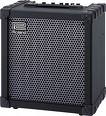
At last night’s weekly gig at the restaurant I play at, I brought my trusty Roland Cube 60. I was in a rush, and just wanted a lightweight amp that I could easily set up.

To be honest, I hadn’t played that amp for a long time, preferring to use my tube amp combos or my SWR California Blonde. But those amps are also HEAVY. The Blonde weight over 50 pounds! My Cube 60, on the other hand, weighs just 30 pounds, and is roughly half the size of any of my other combos.

But weight aside, the Roland Cube 60 is simply a great-sounding amp. Solid-state or not, it doesn’t matter. If it sounds good, then who cares about its circuitry? I was reminded of that last night. I put the amp in Acoustic/JC Clean mode and was rewarded with a gorgeous clean tone that rivaled the cleans of any of my tube amps. Admittedly, the onboard time mod effects aren’t very good (at least to my ears), so I just used my own.

And that brings me to the point of this entry and my previous entry centering on the title: Let sound guide your decisions in buying gear; not the circuitry. With respect to the Cube 60, its Acoustic/JC Clean is modeled after the venerable JC 120 amp; an amp that has proven itself over the years as a viable tone platform. Players like Joe Satriani and Albert King used this amp. I believe Satch used a JC 120 to record Surfin’ with the Alien. And it’s no small wonder these guitar greats used it: The JC cleans are spectacular. They’re not as basso as Fender cleans, being a bit more mid-rangy, but they’re gorgeous just the same.

One thing that struck me last night as well was the wide sound dispersal from that little amp. I was concerned that the diminutive cabinet would be a bit too directional, but all that worry was laid to rest when I did my sound check. The Cube 60 filled the space incredibly well, and was clear from even extreme angles. Needless to say, I’ll be using the Cube 60 for most of my solo gigs going forward.

So definitely a lesson learned once again, that it’s the sound that matters…

My older sons have gotten a lot into Reggae over the past couple of years, and it has sort of rubbed off on me. So while I was jammin’ to a song in the car a few days ago, I got an idea for a praise and worship song with a Reggae theme. Here’s the initial sketch of the song (I have to add the rest of instrumentation, but here it is with just a three-piece combo arrangement):

In addition to being a guitar gear freak, I’m also obsessive about fine wines. The other night, I cracked open a bottle of 1985 Beaulieu Vineyard Georges De Latour Private Reserve Cabernet Sauvignon from my collection, and shared it with my best friend. I’ve been wanting to drink this particular wine ever since I won it at auction a few months back, and was just waiting for the right time to drink it. But I was also getting a bit worried about keeping it too long because unlike their French counterparts, California wines aren’t known for their longevity. But there are some exceptions out there, and this bottle was definitely one of the exceptions.
The cork was intact when I opened the bottle, which totally surprise my friend and I. This meant that the wine would have very little sedimentation. There was also perhaps on 4 mm of seepage into the cork, which meant that the cork used was absolutely top quality in this case. We knew we were in for a real treat.

We both took a small tasting pour, swirled the wine, then took our tasting sips. Both of us closed our eyes, then after swallowing that first taste, we both at the same time said, “OH. MY. GAWD!!!!” As wine connoisseurs for over thirty years, we’ve literally tasted thousands of wines, but this wine topped both of our lists as the best cabernet we’ve EVER had! In 1991, Robert Parker rated this wine a 91. Now in 2011, twenty years later, I don’t think this wine is even rateable. To us, it surpassed all of the best wines we’ve tasted.

Over the three hours that it took us to finish the bottle, the wine’s character changed, demonstrating to us just how marvelous, majestic, and magnificent this wine was. It was so complex and sophisticated, that we both, who have a fairly wide and experienced wine vocabulary, had a difficult time describing the wine. In the end, we both agreed that this single bottle of wine bestowed upon us a genuine religious experience.

Religious experiences don’t happen very often, and at least for me, are brought on by things or events that are truly awe-inspiring. For those unfamiliar with the term, a religious experience is one in which it is virtually impossible to articulate the feeling. It’s an experience so profound that words would only diminish it.

With gear, this has happened to lots over the years. Here are some that I’ll share here:

  • The very first time I tried out a BOSS CE-2 Chorus pedal. I have a few chorus pedals now, but when I need a particular chorus sound, this is the only pedal that’ll give it to me.
  • After years of looking for a good delay pedal, playing the Mad Professor Deep Blue Delay sent me off into the nether world. There was simply nothing like it.
  • Getting my very first high-end guitar, a Gibson Dot ES-333. Up until that point, I just had some very cheapo guitars, and getting that ES was like a rite of passage.
  • Unpacking and playing “Amber,” my first Gibson Les Paul. I had wanted one forever it seems, and when I finally had the cash to get one, I can’t even begin to describe the mix of emotions I experienced as I held her in my hands that first time.
  • Playing my Yamaha APX900 acoustic at the guitar shop where I bought it. No Martin or Taylor has ever sounded as good to me plugged in. Yamaha’s ART pickup system is unlike any other.

As I write this entry, I realize now why I and probably so many others are such gear junkies: We thrive on religious experiences. Besides being virtually impossible to describe, religious experiences are the ultimate feel-good. They’re also addictive… So it’s not a small wonder why I’ve got so much gear. πŸ™‚

As many may know, I play at church – a lot. πŸ™‚ And having played at church for over 30 years, writing music for worship just kind of came naturally. Here’s a song I wrote called Given the Body. It features my Strat on the right, and my Les Paul on the left; both played through my Aracom PLX BB 18.

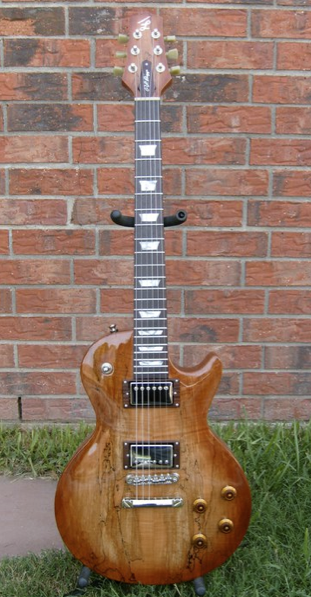
As I’ve said in the past, there’s always room for people who are good. I said it about Barron Wesley Guitars, and I’m saying it for Slash L guitars made by Perry Riggs. Look at the guitar to the left. Notice anything familiar? It’s patterned after a ’59 Les Paul with a mahogany body and neck, but with a neck-through construction. I have to tell you, Perry’s neck-through design works really well. As I mentioned in a previous article about “Lana”, his guitars sustain for days owing to the that neck-through design. Not only that, if this guitar is similar to Lana, it’ll be less than 8 lbs. (Lana weighed 6.5 lbs).

But as to the overall design of this guitar, it’s gorgeous! Of course, being a Les Paul guy, I love that shape, and that spalted maple top and the translucent tea burst finish is killer! The guitar comes equipped with Lollar Imperials (coil tapped), and has a rosewood neck. Love those trapezoidal fret inlays!

By the way, Perry doesn’t have a site, but he’s got a Facebook page (https://www.facebook.com/perry5610). Friend him. He’s uploading pictures of his build process. Very cool stuff.

I was watching a two-part video series a couple of weeks ago where Premier Guitar was interviewing Keith Urban’s guitar tech about Keith’s rig (Part I is here). During part two of the series, the guitar tech said something that struck me as he and the interviewer were talking about Keith’s compressor pedals. Keith uses four different compressors, and the tech was in the middle of describing how Keith sometimes uses them in combination. In the middle of his explanation, he sort of stumbled, then said, “…like they say, there’s really no wrong way to do this. If it sounds cool, then it’s right.”

I always say a corollary to that to myself: If it moves you, then go with it. But I think I’m going to use “If it sounds cool, then it’s right” from now on. And really, that’s the point about any gear we buy. There’s no right or wrong when it comes to gear and gear combinations. If it pleases you, then it’s right… for you. Of course, listen to constructive input from other people, but in the end, it’s on you to find the tone that fits you. No one else can do that for you, which reminds me of another saying that I used when working with teenagers years ago and giving a talk on peer pressure:

The only real freedom we have is our freedom to choose; unfortunately, we often choose to give up that freedom in exchange for acceptance.

I know I’m getting philosophical, but to me, conviction, personal power, feeling strong, what have you, come from our freedom of choice. We lose our personal power when we give up our freedom to choose. For instance, how many times have we all fallen prey to hero-worship and get gear that our idols use, only to find that it just doesn’t work for us? How many of us have been on the forums and have blindly purchased gear based upon the hype built around it? There’s a reason why there’s so much practically brand-new stuff up on The Gear Page’s Emporium on a constant basis: People have fallen for the hype, then get the gear and realize it’s not for them. I’ve committed this error enough times myself to always qualify my recommendations with something akin to “try before you buy.”

Freedom of choice is crux of this article and what the saying, “If it sounds cool, then it’s right” is all about – at least to me. Where we are in life is the result of the choices we make; congruently, our tone is the result of the choices we’ve made in gear. Some choices are not as positively productive as others, but that’s life. And that’s how we learn.

A friend of mine shared with me a Top 50 list that was published by Guitar Player mag back in 2004. I vaguely remembered reading that list back then, and when my buddy shared the list with me again a couple of days ago, it reminded me of the Rolling Stone Top 100 guitarists list from a few years back.

I understand why a mag would publish a list, but you have to understand that those lists aren’t supposed to be definitive. It’s just one person or a group of people’s view of what they think is “best.” As with gear, the “top” whatever is a pretty subjective thing. One person’s top will most likely be different from someone else’s because we all have different tastes.

This leads me to the title of this entry. I think the mags publish these lists to piss people off. πŸ™‚ To put it more kindly, I believe they post these lists simply to stir the pot and create a buzz. If you think about it, the thing that the lists ultimately do is attract visitors. Someone might see a list, then go to a forum and post, “Did you see this list? I can’t freakin’ believe what they say the top 100 is! What a crock!” Look at the Rolling Stone Top 100 list. Talk about flame bait! When that came out a few years ago, it caused a huge stir on the forums! Most people hated that list, and certainly didn’t agree with the rankings.

To tell the truth, I don’t really have a problem with “top” lists. But I know now not to get all worked up about them. They’re there simply to create a buzz. But go ahead: Get pissed off if you want. πŸ™‚