Feeds:
Posts
Comments

Posts Tagged ‘guitar gear reviews’

A couple of weeks ago, I did a gear find announcement about the new EH Freeze pedal that essentially takes what you’re playing such as a chord or note and freezes it. The video demonstration was particularly awesome, and very intriguing. Intriguing enough to where I needed to check it out. So I did, and…

I’d rather use a looper. 🙂 The premise is great: Strum a chord, or pick a note, press and hold the button, and what you just strummed is held in place.

When I first saw the video, I was thinking that it would be great for my solo acoustic gigs where I could solo over the frozen chord. But after playing around with the pedal, I realized that I like soloing over live loops than just a single chord. No doubt, the pedal offers some interesting possibilities.

One thing that I found was really cool was using the latch mode while playing chord progressions. In latch, freeze is always on, and each time you press the button the pedal freezes what you’re playing at the time. With chord progressions, it’s cool because it really helps fill the space, but the problem for me – and probably  most players – is that I don’t do just a straight strum. I palm mute, I tap the strings, I pick out bass lines and such, and this is where it’s really tough to use this pedal.

Interestingly enough, lots of bass players have picked up this pedal. For bass, it makes lots of sense because you’re mostly playing single notes at a time. But if you slap or play two- or three- note chords like my bassist does, I think the pedal would get limited usage.

I suppose you could use it to get infinite sustain, but for that, I’d rather use something like the Pigtronix compressor/sustainer. While it won’t give me infinite sustain, it’ll give me enough for my needs. 🙂

So the verdict? I like the pedal, but not enough to actually put it in my chain. Quality-wise, it’s built solidly and that’s not an issue. I think for me, it would get very limited usage, and while I can get it for around $100, there are other things I’d rather use $100 for…

Read Full Post »

Slash Appetite for Destruction Limited Edition Les PaulI subscribe to Gibson tweets and Facebook postings, and yesterday I got an update about three new Gibson Custom Shop Les Pauls that Gibson is releasing. One of these is yet another Slash Appetite for Destruction. Gibson came out with one of these earlier this year that retails for around $4000. It’s a nice guitar in honey finish. This latest addition comes in two flavors – VOS and Aged – and is signed by Slash, with only 100 being made by the Custom Shop. Here’s Gibson’s blurb:

Slash Appetite For Destruction
Working hard to record Guns N’ Roses’ 1987 debut, Appetite for Destruction, Slash was experiencing nothing but frustration trying to achieve the tones he was seeking with a range of contemporary electric guitars he was using. Then someone handed him a reissue-style Les Paul Standard, and that was all she wrote. With this legendary rock machine in hand, Slash laid down the deadliest rock riffs of the decade—propelling songs like “Paradise City”, “Sweet Child O’ Mine”, and “Welcome to the Jungle”—and fired up the biggest-selling debut album of all time in the process.

Slash has been a devoted Les Paul player ever since, throughout his years with Guns N’ Roses and later with Slash’s Snakepit and Velvet Revolver. He has taken a number of Gibson Signature models on the road, and owned and recorded with near-priceless vintage late ’50s ’Bursts. To honor his achievements on the instrument, Gibson’s Custom Shop introduces the Slash “Appetite for Destruction” Les Paul, a guitar made in the image of the axe that launched a thousand riffs.

This one has an MSRP of $9,174 for the VOS and $12,468 for the Aged edition. You can read the details here, in the article entitled “The Guitar That Saved Rock N’ Roll;” hence the title of this article.

I’m sure collectors will get excited by this, and having a couple of Custom Shop guitars myself, I don’t doubt the quality of workmanship that went into producing the guitar. But I am scratching my chin about any of the Appetite for Destruction guitars, and also mildly chuckling. Why? The AFD guitar is a replica of a replica!!! Again, that is not to say that the guitar is bad; in fact, it apparently most closely matches the specs and more importantly the tone of the original guitar as Slash remembers it. Plus, if people are big enough fans to buy the guitar, I say definitely go for it!

By the way, for a more detailed article describing that original replica, you can read it at Premier Guitar! It’s definitely worth the read.

I don’t see these guitars as a real negative against Gibson. I think the fact that Slash played a replica on the album (and subsequent tours), is the ultimate compliment to Gibson. Be that as it may, I still find it amusing that it’s a replica of a replica, and that it took a replica to drive Gibson produce a guitar of this caliber.

As for the AFD guitar “saving rock n’ roll,” let’s be honest: That original replica probably saved Gibson’s ass, as the company’s sales at the time were apparently languishing with all the hair metal and glam rockers turning to Strats, Charvels and Jacksons. Plus, it is well-noted that Les Pauls of the era had some huge quality issues; all serving to draw players away. That Slash found his tone in a Les Paul, and in turn drew in a huge fan base not just to the music, but to Les Paul guitars was a major coup for Gibson.

It’s great that Gibson recognized the importance of that guitar by creating its own replica of it. It’s the implied gratitude of “Thank you for saving our asses!”

Read Full Post »

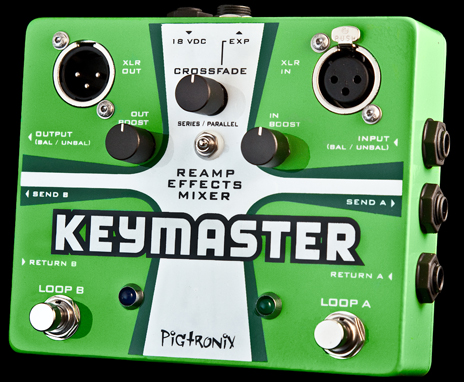
I’m not too sure how to actually describe this “pedal.” It’s a dual looper, but could be used as a switch box, or a DI box. You could use it to direct your signal to two different effects loops and with the crossfade knob, mix in just the right amount of signal from each loop. As an impedance matching DI box, you can use it to go directly into a board or DAW. Or you could keep things very simple and use the box to go from one guitar to two amps, or two guitars to one amp. The possibilities for using this box are immense! Very interesting.

Here’s a copy of the press release I got from Pigtronix:

Pigtronix introduces the Keymaster – Impedance Matching Effects DI

Pigtronix Keymaster is an impedance matching, effects mixing direct box that allows musicians to do more with the gear they already own. Without loss of tone, the Keymaster routes any sound source (XLR mic, line level or instruments) into effects via two, true-bypass loops and then optimizes the mixed effects signal for your instrument amplifier, mixing console or DAW.

The Keymaster’s unique and intuitive arrangement provides musicians of all types with an elegant solution for routing their sound through effects in a creative fashion and then out into any device without losing signal integrity. The two loops can be switched between series and parallel, with a CROSSFADE function for on-board or expression pedal controlled blending of different effects. Input and Output boost controls add up to 10db of gain both before and after the loops.

The Keymaster lets musicians easily blend their instrument’s natural tone with a floor processor or even cell phone and laptop computer based effects using a standard expression pedal. Vocalists and horn players can use the Keymaster to control their effects mix from the stage. Guitar players can now mix pedals like a DJ does two turntables.

Already in use by some of the world’s top producers and FOH mix engineer’s, the Keymaster elegantly answers the unmet needs of musicians at every level, opening up endless realms of possibility for combining the effects you already own.

“I use the Keymaster to run the Piano mic through my Leslie Cabinet, drum mics into spring reverb and to get vocals into guitar amps. This pedal kills. You need it, I can’t live without it.”
Hector Castillo – Producer / Engineer for David Bowie, Bjork, Roger Waters, Brazilian Girls

I get lots of press releases, and there are just a few that I’ll forward to my readers. The gear simply has to be interesting enough for me to publish. This is definitely something I could put to use in the studio – or even on stage. It’s definitely worth a look! In any case, check out this video describing the pedal:

Read Full Post »

Before I go into the specific company in question, my thought is if it plays and sounds great, and more importantly, it moves me enough to want it, then I’d probably let its questionable ancestry go and just buy the item.

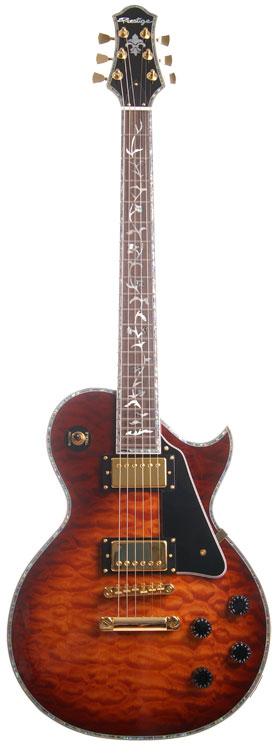
Prestige Heritage Elite - Lite Sunburst

I did just that with my Prestige Guitars Heritage Elite. I bought my Heritage Elite, which is a fantastic guitar, actually before I knew of the controversy – so too late for me. These guitars are Les Paul-style guitars that the company say are cut and shaped in Korea, then accessorized in Vancouver, BC, Canada. Prestige also provides the woods. All that sounds well and good as Gibson does this with the Epiphone line, and PRS does it with its SE line.

But here’s where the controversy starts. These guitars are EXACTLY like this: http://www.unsung.co.kr/html/products/ulp523.html, which is a made by Un-Sung Musical Instrument Company, and this one: http://translate.google.com/translate?js=n&prev=_t&hl=en&ie=UTF-8&layout=2&eotf=1&sl=ru&tl=en&u=http%3A%2F%2Fjetguitars.ru%2Fshow_9104259 by Jet Guitars in Russia. The latter two share the same model number so the Jet is obviously a re-label of the Un-Sung. Plus, the Samick company in Korea makes something that is eerily similar to the Heritage Standard.

All that said, Prestige says they use two different manufacturers in Korea – the same foundries that produce Epiphones and another popular brand, and that Un-Sung makes copies of these, which are actually constructed in China.

Who knows what to believe? I do know that the tops of the Prestige guitars are full caps, not laminates (you can see the sandwich layers from the pot cavity). My Elite sounds and plays great, and though I don’t use it nearly as much as I used to as I now have real a Les Paul and a ’59 replica, it still gets play time because the Duncan ’59 and JB pickups sound absolutely sweet!

So, knowing what I know now, however uncorroborated, would I still have bought the guitar? Yes. I would have bought the guitar because all things being equal, this is just a great guitar, and you can still get them for a GREAT price on EBay from “acemate,” who sells lots of gear from Canadian manufacturers.

Mind you, it doesn’t have the sound of a Les Paul, but it does have a sound all its own, and that sound is actually quite aggressive. If I had to do it all over again, I’d probably buy the Heritage Standard, as the Elite is a bit too pretty, and I’m always concerned of getting it dinged up.

Would I recommend it? Absolutely. If you’re looking for a LP-style guitar but don’t want to pay the price, and don’t want an Epiphone, Prestige Guitars are a great lower-cost alternative!

For more information, go to the Prestige Guitars website!

Read Full Post »

My good buddy Jeff Aragaki of Aracom Amps (http://www.aracom-amps.com) is in a bit of a quandry. His attenuators have been incredibly successful and very well-received by both amateur and pro guitarists. He actually built the attenuator in the hopes that it would raise awareness of his wonderful amps, of which I own three with a fourth on the way. Unfortunately, it sort of backfired because his attenuators are so great that they’ve completely overshadowed his amps. That’s too bad, because they’re great amps, and they’re all I gig and record with.

So to try to raise more awareness of his products, Jeff compiled a few videos that feature moi, Clint Morrison – who’s a pro player out of Austin, TX – and Doug Doppler. Check ’em out. Clint’s and my videos feature both the PRX-150 Pro or DAG, and Aracom amps.

Yours Truly:

Clint Morrison:

Doug Doppler:

For more information on Aracom Amps products, go to the Aracom website!

Read Full Post »

When I first heard about this pedal, which EH calls a “sound retainer,” I have to admit, I was rather incredulous. I asked, “What the hell would I use THAT for?” But after seeing a demonstration of it, I seeing some real possibilities; especially for my solo acoustic gigs. But rather than bore you with a bunch of features, take a look at this video:

That dude is a great guitar player! Don’t know who he is, but I do know he’s from Mexico as that demo comes from guitargear.com.mx. No affiliation to this site, but it’s a cool name just the same! And of course, at least for me, I have to appreciate his choice of guitar. 🙂 Nice Tea Burst Les Paul!

In any case, that demo sparked off an idea in me for when I play my solo acoustic gigs. I could strum a chord, then play a short lead over it. But I can also see how it could actually be used to introduce a whole new way of approaching music. It’s wild! I’m seeing all sorts of possibilities now with this pedal, once I saw a demo. And at under $120, it’s not expensive at all.

For more information, check out the EH FREEZE site!

Read Full Post »

Yeah, I mention it a lot, but I thought I talk about it once again, because it truly has had a HUGE impact on how I approach amps. To me, there’s simply no attenuator on the market that can touch the quality of its sound; well, it doesn’t produce sound of course, but it lets all your tone come through, but more importantly, no matter where you set it, you will always have your dynamics. In any case, I recorded a couple of videos this afternoon, talking about this wonderful device by Aracom Amplifiers.

Part I: Discussion

Part II: Demo

BTW, recorded these clips with an Alesis VideoTrack. Nice little unit. Not sure how long I’ll actually use it because I actually do want a better picture. But for now, it’s great to have an all-in-one solution to get some video out!

For more information on this great attenuator, go to the Aracom PRX150 product page!

Read Full Post »

People have asked me to do more videos, especially after I did the Doppler on the Dumble series. But the problem with doing video reviews is that I needed to set up a separate sound source to replace the video’s sound track, as it’s not all that good. So I’ve been looking at alternatives that had decent built-in sound, and a really inexpensive alternative I found was the Alesis VideoTrack. Mind you, I wouldn’t buy this one at full price. I got it for $80 today at Guitar Center during their Black Friday sale.

On the positive, it had great audio quality, which I’d expect from an audio company like Alesis. On the negative, the video quality is poor. But for gear reviews, it’s more important to have great sound than great video. That said, this will work for the time being until I get the Zoom Q3HD which has great audio and HD video. But it’s also almost four times what I paid for the Alesis, so I probably won’t be getting one anytime soon.

In any case, I did a test video. Check it out:

Not bad. Not bad at all. The sound quality is amazingly good, so I think we have a winner here!

Read Full Post »


MXR Carbon Copy Delay Summary: Fantastic-sounding analog delay at an affordable price.

Pros: Out of the box, this baby oozes great tone, and creates warm, silky-smooth repeats as you’d expect from an analog and importantly it doesn’t turn your tone overly dark as analog delays are apt to do. The Mod button adds a cool and super-subtle modulation similar to chorus, to smooth out the tone even more.

Cons: The only nit I have with it is if I hit it hard with a lot of input gain. There’s almost a bit too much “flutter.” However, this is a small nit because this pedal sits on my acoustic board, and the input gain is low, so that flutter will never happen.

Features:

  • Bucket-brigade technology
  • 600ms delay time
  • Modulation switch to add subtle chorus-like modulation
  • Regen (repeats), Mix, and Delay knobs
  • Two internal trim pots to adjust width and rate (doubt that I’ll ever open up the box to adjust these. Factory settings are just fine)
  • True hardwire bypass

Price: $105 -149 Street

Tone Bone Score: 5.0 ~I was really blown away by this delay. I was seriously considering getting another Mad Professor Deep Blue Delay – well, the PCB version, at least – to put on my acoustic board. But a friend showed me his Carbon Copy, and I was immediately sold. I’ll admit that if I’d gotten the Carbon Copy first, I probably wouldn’t have even considered the Deep Blue Delay, which is over double the price.

No, I’m not kicking myself… And yes, I paid over $300 for my hand-wired Mad Professor Deep Blue Delay. But that particular delay is seriously in a class all by itself. In my mind, there’s the Deep Blue Delay then all the rest of the analog delays. But near the top of that “other” list sits the MXR Carbon Copy. It never crossed my mind to even evaluate this pedal after I got my Deep Blue Delay, but when I wanted to get another analog delay for my acoustic rig, fortune had it that a good friend happened to get the Carbon Copy. I originally turned him on to the Deep Blue Delay, and instead of that (he couldn’t justify the price), he got the Carbon Copy for use on his acoustic board. Of course, I had to try it out, and fell in love with it immediately! Plus, at less than $150, this pedal would be a steal! So I got it a couple of Fridays ago to use at my weekly solo acoustic gig, and have been a happy camper.

Built like a tank

I still have an 80’s MXR Distortion pedal that I used for many years. One of the reasons I dug it was that it was super-durable. I gigged with a lot, and it got knocked around and stepped on, but I never had to change a knob or switch in all the time I’ve had it. Though MXR is now owned by Jim Dunlop, I have to give kudos to the new ownership for maintaining the solid feel of the MXR line.

It ain’t cheap…

Make no mistake, though MXR has been traditionally known for affordable pedals, don’t equate that with them being “cheap.” They’re affordable, yes, but they’ve also made their mark on Rock and Roll (can you say Phase 90?). The Carbon Copy is yet another example of an affordable pedal that produces killer tone.

How it sounds…

I was very surprised by the quality of the sound that this pedal produces, and the range of delay tones you can get. For instance, here’s a clip that cops a bit of “Edge” delay:

In this next clip, I combine two modulation effects – heavy chorus and delay. The Carbon Copy is set to a long delay time with Regen set to noon. To keep the delay effect subtle and ambient, Mix is at about 10am.

Finally, here’s a video from Guitar World that really demonstrates the Carbon Copy’s capabilities:

Overall impression

I totally dig this pedal! Once I got it dialed in for my acoustic gig a couple of Fridays ago, it stayed on almost the entire gig! I only switched it off when I needed a more “in your face” tone. This is just a super pedal, and I highly recommend it!

Read Full Post »

Click on each picture to see larger views

Pedaltrain NANO Pedal Board

Summary: Super-convenient and super-portable, the NANO is a great board for those that only need to use a few pedals.

Pros: Included gig bag has straps that make it easy to attach to a guitar gig bag or case. Includes enough fuzz to cover both rails. Nice.

Cons: None.

Features:

  • Durable metal frame with rubber feet on bottom
  • Light weight at 2lbs including gig bag

Price: $49.95 Street

Tone Bone Score: 5.0 ~I recently decided to just use time-based effects (chorus, delay, and reverb) for my acoustic rig, and wanted a mini board that I could easily lug. The NANO totally comes through in this regard!

I’ve got lots of pedals. Truthfully, I’ve got a LOT of gear. 🙂 And for a long time, I used just a single board and swapped out pedals depending upon the type of gig I was performing. But then there were times when I played both electric AND acoustic during the same gig, and so I’d have to compromise on what pedals to put on my board. Then I got one of those Wicked Woody pedal boards which supplanted my old Gator board, and that meant I could put my acoustic pedals on the Gator board.

That Gator board has served me well for years, but I found myself using only three time-based effects for my acoustic rig, and that board, which can fit 8 full-size pedals, was way too big, and actually kind of heavy. But it’s what I used this past summer during my outdoor gigs, mainly because by the time I’d think about replacing it with something smaller, I was setting up for my gig. 🙂

So last week when I purchased my Homebrew Electronics THC chorus pedal, I asked my trusty sales rep, Jordan, over at Gelb Music in Redwood City, CA if he had a small board in stock. He first directed me to the Pedaltrain Mini. That was a cool board, but I remarked that I didn’t need all that space. Then he remembered that he had just gotten a NANO in stock. I picked up the box, looked at the picture and said, “Sold. This is EXACTLY what I’ve been looking for since I’m only using three pedals for my acoustic rig.” So that’s how I ended up with the NANO.

After having taken it to couple of gigs, I have to say that I just dig the convenience of this board! As you can see in the picture above, you can attach it to your guitar gig bag. The straps are actually long enough to wrap around the entire bag. This makes it so easy to lug around!

Now for some particulars…

  • There’s plenty of space underneath the board to run wires and do a neat job of it, as you can see in the picture I took of my board this morning.
  • The rubber feet are a god-send! This board will not slip, which is yet another convenient feature.
  • With the board itself weighing only 1 lb. it’s easy to lug.
  • I recommend using a 1-spot with this board – this is what I use, and it keeps things neat while giving you plenty of cord to run to an outlet.

Overall Impression

At $49.95, you just can’t go wrong with this board. I love it! Now a real cool thing would be to have a powered version of this, but I’m not complaining at all. Besides that would just add some weight, and it’s great that this is nice, lean board. So if you only use a few pedals at most, this is definitely a board you should consider!

Read Full Post »

« Newer Posts - Older Posts »