Feeds:
Posts
Comments

Posts Tagged ‘Guitars’

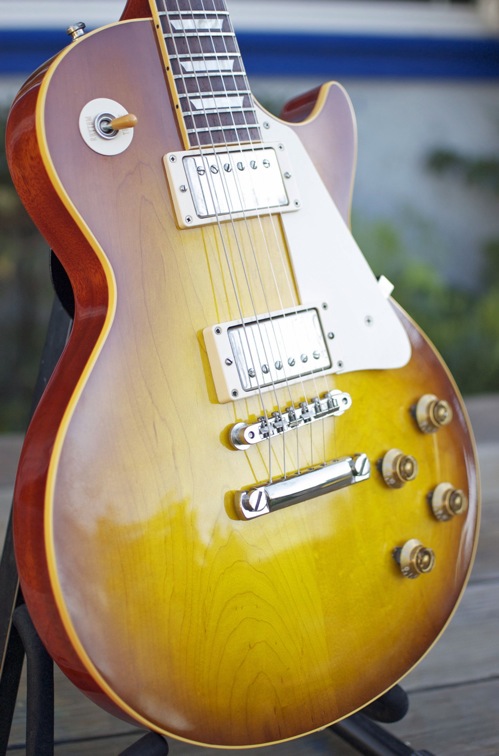
My buddy, Jeff Aragaki is totally into the relic thing. and has several guitars that have been aged. He even went so far as to take a brand new R9 (’59 Les Paul Reissue) and rough out the gloss finish! Mind you, he’s a very close friend, and I don’t begrudge what he did to an absolutely fine-working guitar! And I know, I’ve brought up this subject before, asking the question: Do you get the relic thing?

I don’t get it, but there are many people who do, and there are many people who would pay top-dollar for a relic job. For instance, this morning, Jeff sent me this eBay link to a Bill Nash aged Les Paul Standard. The seller is asking $4200 for the guitar. I personally wouldn’t pay that but I’m sure that people who are into aged guitars woudn’t balk at the price, considering the work Bill Nash puts into the process of aging; and there are many who would send their guitars out to Nash or RS Guitar Works to have their guitars aged.

For me, based upon the process description that was provided by the seller, I’d send Bill one of my Les Pauls to have the pickups matched and the frets dressed. I especially like what he does with the neck tone pot, providing a coil tapping pot. After 8, the pot will tap the neck pickup coil. Very cool. But this is the extent of the work that I’d have done. Don’t mess with my finish; don’t apply acid to my hardware. Give me my nice, shiny, guitar!

Read Full Post »

I was answering a comment on one of my videos this morning on YouTube, when I came across a great series on understanding tube amps posted by Old Tone Zone (http://www.oldtonezone.com). It’s a 7-part series, and goes through various features of tube amps. Here’s the first video in the series. If you want to view it with the playlist, go here: http://www.youtube.com/watch?v=Yc-78AKIo5A&feature=BF&list=PL2D0A1CC3FC96F1CA&index=1.

Read Full Post »

I finally got some time to post my very first full video review (the Dumble series doesn’t really count because it wasn’t really a review, but more of a demo). So here, I present to you the Sebago Sound Double Trouble 100, an 100 Watt amplifier from a newcomer to the amp business and another entry in the very popular Dumble-style amp genre.

Intro and Feature Walkthrough

Dirty Tone (Master Volume)

Clean Tone and Wrapup

Overall Impression

As I mentioned in the last video segment, I’m giving the amp a 4.5. Tone-wise, it’s a fantastic amp, but personally, I’m just not in pre-amp-only distortion, and like to have the power amp side working in conjunction with the pre-amp side. It’s just a lot beefier and dramatic to me. Cranked up like this, the amp performs wonderfully; and I especially dig using the boost as it seems to add even more clarity and note separation.

For more information on these great amps, check out the Sebago Sound website!

Read Full Post »

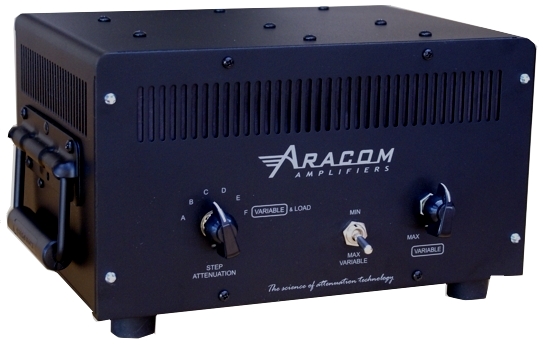
I swear by my Aracom attenuator as do many others, and it’s great to see people demonstrating it. This demo comes from a guy in Italy who can cop Angus Young like no other. This dude rocks the house and has several vintage amps and guitars. He’s not just a collector, he’s a bonafide player!

Read Full Post »

My church bandmates were a bit tired of this bluegrass-style “Joy to the World” that we’ve done for the past few years at Christmas Mass, and they asked if we could do a new song. Well… in keeping with our much more straight-ahead rock style, I came up with an 80’s punk version of Angels We Have Heard On High. 🙂 That’ll wake everyone up!

By the way, the guitar (my R8 Les Paul) was recorded in the bridge position through the AWESOME VHT Special 6. I used a 1 X 12 external speaker cab loaded with a Jensen Jet Falcon. The amp was cranked, in the high input, high output, with the booster engaged! HA! It has a much bigger sound than its 6 Watts! It was actually pretty loud in my studio!

Also, MERRY CHRISTMAS!!!!

Read Full Post »

A couple of weeks ago, I did a gear find announcement about the new EH Freeze pedal that essentially takes what you’re playing such as a chord or note and freezes it. The video demonstration was particularly awesome, and very intriguing. Intriguing enough to where I needed to check it out. So I did, and…

I’d rather use a looper. 🙂 The premise is great: Strum a chord, or pick a note, press and hold the button, and what you just strummed is held in place.

When I first saw the video, I was thinking that it would be great for my solo acoustic gigs where I could solo over the frozen chord. But after playing around with the pedal, I realized that I like soloing over live loops than just a single chord. No doubt, the pedal offers some interesting possibilities.

One thing that I found was really cool was using the latch mode while playing chord progressions. In latch, freeze is always on, and each time you press the button the pedal freezes what you’re playing at the time. With chord progressions, it’s cool because it really helps fill the space, but the problem for me – and probably  most players – is that I don’t do just a straight strum. I palm mute, I tap the strings, I pick out bass lines and such, and this is where it’s really tough to use this pedal.

Interestingly enough, lots of bass players have picked up this pedal. For bass, it makes lots of sense because you’re mostly playing single notes at a time. But if you slap or play two- or three- note chords like my bassist does, I think the pedal would get limited usage.

I suppose you could use it to get infinite sustain, but for that, I’d rather use something like the Pigtronix compressor/sustainer. While it won’t give me infinite sustain, it’ll give me enough for my needs. 🙂

So the verdict? I like the pedal, but not enough to actually put it in my chain. Quality-wise, it’s built solidly and that’s not an issue. I think for me, it would get very limited usage, and while I can get it for around $100, there are other things I’d rather use $100 for…

Read Full Post »

Slash Appetite for Destruction Limited Edition Les PaulI subscribe to Gibson tweets and Facebook postings, and yesterday I got an update about three new Gibson Custom Shop Les Pauls that Gibson is releasing. One of these is yet another Slash Appetite for Destruction. Gibson came out with one of these earlier this year that retails for around $4000. It’s a nice guitar in honey finish. This latest addition comes in two flavors – VOS and Aged – and is signed by Slash, with only 100 being made by the Custom Shop. Here’s Gibson’s blurb:

Slash Appetite For Destruction
Working hard to record Guns N’ Roses’ 1987 debut, Appetite for Destruction, Slash was experiencing nothing but frustration trying to achieve the tones he was seeking with a range of contemporary electric guitars he was using. Then someone handed him a reissue-style Les Paul Standard, and that was all she wrote. With this legendary rock machine in hand, Slash laid down the deadliest rock riffs of the decade—propelling songs like “Paradise City”, “Sweet Child O’ Mine”, and “Welcome to the Jungle”—and fired up the biggest-selling debut album of all time in the process.

Slash has been a devoted Les Paul player ever since, throughout his years with Guns N’ Roses and later with Slash’s Snakepit and Velvet Revolver. He has taken a number of Gibson Signature models on the road, and owned and recorded with near-priceless vintage late ’50s ’Bursts. To honor his achievements on the instrument, Gibson’s Custom Shop introduces the Slash “Appetite for Destruction” Les Paul, a guitar made in the image of the axe that launched a thousand riffs.

This one has an MSRP of $9,174 for the VOS and $12,468 for the Aged edition. You can read the details here, in the article entitled “The Guitar That Saved Rock N’ Roll;” hence the title of this article.

I’m sure collectors will get excited by this, and having a couple of Custom Shop guitars myself, I don’t doubt the quality of workmanship that went into producing the guitar. But I am scratching my chin about any of the Appetite for Destruction guitars, and also mildly chuckling. Why? The AFD guitar is a replica of a replica!!! Again, that is not to say that the guitar is bad; in fact, it apparently most closely matches the specs and more importantly the tone of the original guitar as Slash remembers it. Plus, if people are big enough fans to buy the guitar, I say definitely go for it!

By the way, for a more detailed article describing that original replica, you can read it at Premier Guitar! It’s definitely worth the read.

I don’t see these guitars as a real negative against Gibson. I think the fact that Slash played a replica on the album (and subsequent tours), is the ultimate compliment to Gibson. Be that as it may, I still find it amusing that it’s a replica of a replica, and that it took a replica to drive Gibson produce a guitar of this caliber.

As for the AFD guitar “saving rock n’ roll,” let’s be honest: That original replica probably saved Gibson’s ass, as the company’s sales at the time were apparently languishing with all the hair metal and glam rockers turning to Strats, Charvels and Jacksons. Plus, it is well-noted that Les Pauls of the era had some huge quality issues; all serving to draw players away. That Slash found his tone in a Les Paul, and in turn drew in a huge fan base not just to the music, but to Les Paul guitars was a major coup for Gibson.

It’s great that Gibson recognized the importance of that guitar by creating its own replica of it. It’s the implied gratitude of “Thank you for saving our asses!”

Read Full Post »

No, I’m not taking a poll. But I do have to say that people are passionate about Les Pauls on either side of the fence. The haters REALLY hate them, and the lovers REALLY love them. I’m one of the lovers; always have been. But it wasn’t until recently that I could actually afford one. Yeah, I know, I could’ve gotten a Les Paul Studio for a great price, but for me, a REAL Les Paul is a Standard or Custom, and they don’t come cheap.

Most haters’ problems that I’ve read about have to do with the high price Gibson charges for these guitars; and they all point to the fact that the LP requires a high price to pay when there have been known quality issues. I’ll give them that. There were indeed quality issues back in the 90’s, but I think those issues are less of a problem now. I’ve personally examined a good many in the last few years, and haven’t seen any quality problems with the ones I’ve played.

The lovers on the other hand, love the Les Paul for a variety of reasons. For me, there’s a certain magic in the tone and feel of a Les Paul that I just can’t describe. And since I got my R8 (’58 Standard Reissue) and ’59 Replica, those are pretty much all I’ve been playing, with the exception of my Yamaha acoustic when I do my solo acoustic gigs. But in the studio or when I’m playing with my band, I go to my Les Pauls. Just can’t get enough of ’em.

Admittedly though, I was a hater, and it was an unreasonable hate. I couldn’t believe how much those guitar were! The prices were on par with boutique guitars. I just couldn’t understand it! I paid less than that for Goldie, my custom Saint Guitar Goldtop! But then I met Jeff Aragaki who is a Les Paul collector, and that completely turned my world upside-down. As they say, information is power, and Jeff was loaded with information about Les Pauls, especially how to get them for much more reasonable prices than retail. And armed with that information, I was able to procure my R8 and ’59 Replica for under $2000 each.

But besides price, I was also a bit intimidated by Les Pauls. After all, at least to me, those are the guitars that defined the sound of rock and roll for me. Part of me didn’t feel “worthy” to play a Les Paul, so I told myself I hated them. But Aragaki came to the rescue again, and had me play several of his LP’s, including a ’53 that he had upgraded to ’57 specs. Needless to say, I fell in love, and now I’m hooked on Les Pauls.

Read Full Post »

I love playing through a 2 X 12. I have an Avatar G212 Premier made of 3/4″, 13-ply baltic birch. It’s a bright cab, and has a big resonating chamber, which really gives a nice 3-D effect to my sound. I originally had it loaded with Celestion Blue and Gold speakers, and they sounded great, but I just felt the Blue didn’t have enough bottom end for my preferences. So I recently swapped the Blue out with a Jensen Jet Falcon. Yeah, that’s right. I now have one of the most expensive Celestion speakers and just about the most inexpensive Jensen speaker in my cab. And you know what? It totally works.

The one thing I like about ceramic speakers is that they have a nice, tight bottom end. The Falcon has a great bottom end that provides a real nice “oomph” to my sound. Alnico speakers – at least in my experience – are much more mid-rangy, with an emphasis on the upper-mids. The Gold has a fantastic, bright tone. It’s rich, and has a super-smooth breakup. So mixing the ballsy ceramic Falcon with the alnico Gold seemed like a good idea, as I postulated that I’d get a nice balanced sound.

I did the swap this afternoon, right before my church gig. I was a little nervous because my soldering skills are highly suspect. But I took my time, and the swap was done without incident. Then I went to test it out. The cleans were deep and lush, and the big space that the Avatar cab provides gave my tone real depth! Loved it.

Then I cranked my amp to hear the breakup. Yikes! It was pretty harsh and stiff, but I was kind of expecting that, considering I installed the Falcon right out of the box. It wasn’t too bad, but I could feel the stiffness.  But I was determined to bring it to my gig, so an hour later, I loaded it up in my car and away we went.

Luckily, the songs I chose for Mass were mostly clean, so I didn’t have to drive the speaker too hard, but I played it straight for three hours (two hours of rehearsal, then an hour for service), and by the end of the service, I could really feel the Falcon loosening up. Our last song was a rocker, and I cranked my amp. I was greeted by a fantastic, ballsy tone that had a real complex tone; exactly how I envisioned it! So now I’m a believer in mixing ceramic and alnico. It’s a great combination!

So what am I going to do with the Blue? I honestly haven’t made up my mind. That’s not a cheap speaker by any stretch of the imagination. But it is only 15 watts, so I can really only use it with a lower wattage amp. That’s maybe not a bad idea. I could use it with my ’58 Fender Champ, or as an extension cab for my VHT Special 6. We’ll see…

Read Full Post »

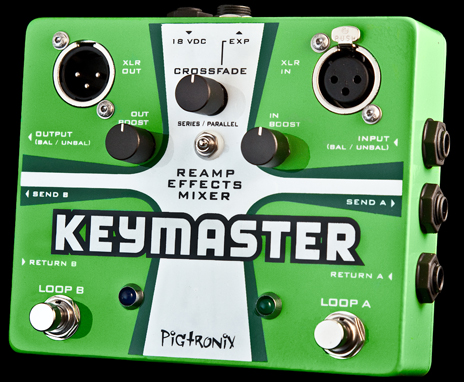
I’m not too sure how to actually describe this “pedal.” It’s a dual looper, but could be used as a switch box, or a DI box. You could use it to direct your signal to two different effects loops and with the crossfade knob, mix in just the right amount of signal from each loop. As an impedance matching DI box, you can use it to go directly into a board or DAW. Or you could keep things very simple and use the box to go from one guitar to two amps, or two guitars to one amp. The possibilities for using this box are immense! Very interesting.

Here’s a copy of the press release I got from Pigtronix:

Pigtronix introduces the Keymaster – Impedance Matching Effects DI

Pigtronix Keymaster is an impedance matching, effects mixing direct box that allows musicians to do more with the gear they already own. Without loss of tone, the Keymaster routes any sound source (XLR mic, line level or instruments) into effects via two, true-bypass loops and then optimizes the mixed effects signal for your instrument amplifier, mixing console or DAW.

The Keymaster’s unique and intuitive arrangement provides musicians of all types with an elegant solution for routing their sound through effects in a creative fashion and then out into any device without losing signal integrity. The two loops can be switched between series and parallel, with a CROSSFADE function for on-board or expression pedal controlled blending of different effects. Input and Output boost controls add up to 10db of gain both before and after the loops.

The Keymaster lets musicians easily blend their instrument’s natural tone with a floor processor or even cell phone and laptop computer based effects using a standard expression pedal. Vocalists and horn players can use the Keymaster to control their effects mix from the stage. Guitar players can now mix pedals like a DJ does two turntables.

Already in use by some of the world’s top producers and FOH mix engineer’s, the Keymaster elegantly answers the unmet needs of musicians at every level, opening up endless realms of possibility for combining the effects you already own.

“I use the Keymaster to run the Piano mic through my Leslie Cabinet, drum mics into spring reverb and to get vocals into guitar amps. This pedal kills. You need it, I can’t live without it.”
Hector Castillo – Producer / Engineer for David Bowie, Bjork, Roger Waters, Brazilian Girls

I get lots of press releases, and there are just a few that I’ll forward to my readers. The gear simply has to be interesting enough for me to publish. This is definitely something I could put to use in the studio – or even on stage. It’s definitely worth a look! In any case, check out this video describing the pedal:

Read Full Post »

« Newer Posts - Older Posts »