Feeds:
Posts
Comments

Posts Tagged ‘Guitars’

Before I go into the specific company in question, my thought is if it plays and sounds great, and more importantly, it moves me enough to want it, then I’d probably let its questionable ancestry go and just buy the item.
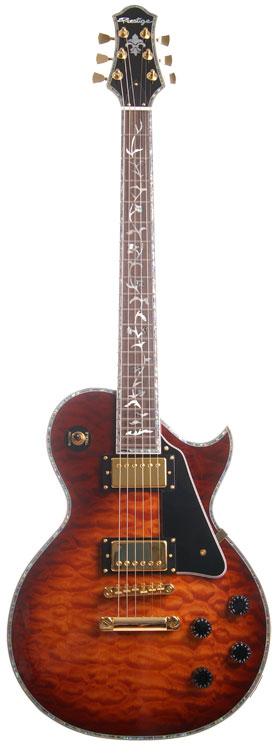
Prestige Heritage Elite - Lite Sunburst

I did just that with my Prestige Guitars Heritage Elite. I bought my Heritage Elite, which is a fantastic guitar, actually before I knew of the controversy – so too late for me. These guitars are Les Paul-style guitars that the company say are cut and shaped in Korea, then accessorized in Vancouver, BC, Canada. Prestige also provides the woods. All that sounds well and good as Gibson does this with the Epiphone line, and PRS does it with its SE line.

But here’s where the controversy starts. These guitars are EXACTLY like this: http://www.unsung.co.kr/html/products/ulp523.html, which is a made by Un-Sung Musical Instrument Company, and this one: http://translate.google.com/translate?js=n&prev=_t&hl=en&ie=UTF-8&layout=2&eotf=1&sl=ru&tl=en&u=http%3A%2F%2Fjetguitars.ru%2Fshow_9104259 by Jet Guitars in Russia. The latter two share the same model number so the Jet is obviously a re-label of the Un-Sung. Plus, the Samick company in Korea makes something that is eerily similar to the Heritage Standard.

All that said, Prestige says they use two different manufacturers in Korea – the same foundries that produce Epiphones and another popular brand, and that Un-Sung makes copies of these, which are actually constructed in China.

Who knows what to believe? I do know that the tops of the Prestige guitars are full caps, not laminates (you can see the sandwich layers from the pot cavity). My Elite sounds and plays great, and though I don’t use it nearly as much as I used to as I now have real a Les Paul and a ’59 replica, it still gets play time because the Duncan ’59 and JB pickups sound absolutely sweet!

So, knowing what I know now, however uncorroborated, would I still have bought the guitar? Yes. I would have bought the guitar because all things being equal, this is just a great guitar, and you can still get them for a GREAT price on EBay from “acemate,” who sells lots of gear from Canadian manufacturers.

Mind you, it doesn’t have the sound of a Les Paul, but it does have a sound all its own, and that sound is actually quite aggressive. If I had to do it all over again, I’d probably buy the Heritage Standard, as the Elite is a bit too pretty, and I’m always concerned of getting it dinged up.

Would I recommend it? Absolutely. If you’re looking for a LP-style guitar but don’t want to pay the price, and don’t want an Epiphone, Prestige Guitars are a great lower-cost alternative!


For more information, go to the Prestige Guitars website!

Read Full Post »

My good buddy Jeff Aragaki of Aracom Amps (http://www.aracom-amps.com) is in a bit of a quandry. His attenuators have been incredibly successful and very well-received by both amateur and pro guitarists. He actually built the attenuator in the hopes that it would raise awareness of his wonderful amps, of which I own three with a fourth on the way. Unfortunately, it sort of backfired because his attenuators are so great that they’ve completely overshadowed his amps. That’s too bad, because they’re great amps, and they’re all I gig and record with.

So to try to raise more awareness of his products, Jeff compiled a few videos that feature moi, Clint Morrison – who’s a pro player out of Austin, TX – and Doug Doppler. Check ’em out. Clint’s and my videos feature both the PRX-150 Pro or DAG, and Aracom amps.

Yours Truly:

Clint Morrison:

Doug Doppler:

For more information on Aracom Amps products, go to the Aracom website!

Read Full Post »

I don’t hide from the fact that I play in a worship band. In fact, that has been one of my primary musical outlets for most of my life, and the Mass (I’m Catholic) has been a source of inspiration as I’ve written many songs over the years for worship. For those who are in a worship music group, they “get” that inspiration. It’s not about performance, and it’s not just about the praise. To me, it’s about creating a connection with the congregation, and inviting them to join us on the journey that is the service.

In the past, I’ve come across some visitors here and people on forums who scoff at worship players, with some going so far as saying, “Why don’t you play a REAL gig?” What idiots like that don’t realize is that playing in a worship setting is actually one of the hardest gigs to play, because you can’t just go out and rip it up like you would in a club. You’re constrained by the service, and this means that you have to be able to play different styles of music, from rock to even classical, and if you have a group like mine that consists of entirely volunteers that have day job (I’m the only paid worship leader, but I also have a regular job), then you have to also deal with changing instrumentation and arrangements from week to week.

Then on top of all that, volume is always an issue in a church building. So you also have to take that into account. As I play mostly vintage-style amps, they have to be cranked to get some grit, so I’ve had to resort to all sorts of solutions from drive and distortion pedals to attenuators to introduce some dirt into songs.

The stuff I’ve mentioned above are just mechanics, but there’s another side of doing a worship gig that’s even more important than all that, and that is you can’t suck. To me, nothing takes away from a service more than music played poorly. The higher the quality of the presentation, the more connected the assembly becomes, and that means that the worship experience is that much more meaningful to the people. We, as worship musicians, have to always keep in mind that we are there as facilitators of the worship experience, and thus we have to have a command over that for which we are responsible: our music.

Lots of people over the years have tried to join our group – singers and musicians alike – and only a few have stuck with it. Those who don’t – especially experienced gigging musicians – almost invariably say that playing in a worship service is A LOT harder than they thought it would be because there’s just so much to think about. So for you worship players out there, take heart in what you provide because you’re playing in a venue that is incredibly difficult to play in. For the opinionated and ignorant who say us worship musicians aren’t doing a “real” gig, I challenge you to try it yourself. I doubt you’d be able to stick with it.

Read Full Post »

The worst thing about hype, especially when it comes to guitar gear is that we all fall prey to it. I was thinking about all the hype and myths that surround guitar gear today, and doing a search on “guitar gear hype” yielded this interesting article that talks about marketing hype and how musicians are so tired of marketing hype that most don’t believe ANY of it, even if it’s true. I used to get all “gassed” up with all the hype, but I’m a lot more reasonable now. So when a manufacturer makes claims about something, I’ve become accustomed to ignoring the claims, though I admit that I do my best to prove or disprove claims if the gear in question seems interesting enough.

But it’s not just the manufacturers, it’s also players that push a lot of hype around, and I’ve got a few hype topics that especially annoy me:

  • “Class A amps are better than Class AB”
    This statement is less prevalent now than when I first heard this a few years ago, but it still irks me when I hear it. Class A doesn’t refer to the quality of an amp, but to the type of circuit. I remember hearing that from a dude at GC when I was looking at a used VOX AC30 (and btw, the ACxx amps are really NOT Class A). I thought he was bs-ing me at the time, so I just politely nodded my head, blew him off. Luckily there’s the Internet, and I also know a great amp guy who explained the operating classes to me.
  • “It sounds like a Dumble”
    No it doesn’t. A Dumble sounds like a Dumble, and I know what at least one Dumble sounds like. Dumble tailors each amp to the player, so while as a group the amps may sound similar, they each have an individual character. It’s hard to tell – especially on the forums – who has actually heard and played one, but I’m willing to bet most people’s experience is through sound clips. I remember reading on the forums that this dude claimed he could make his Dr. Z Maz 18 sound like a Dumble (I think because it has a master volume). What a crock of shit! Unfortunately, that dude has thousands of posts and people actually believe him.But despite that, the Dumble is one case where the hype about Dumble amps is something I tend to believe, having heard and played through a Dumble. What annoys me are the comparisons with other amps or players making claims that their amps sound like a Dumble.
  • Cable break-in
    I’ve spoken to electrical engineers, and even the article I mentioned above mentioned this hype item, and all agree that cable break-in is a fantasy. Personally, I’ve never bought into it. Who knows? Maybe my ears are not good enough to tell, but I just get decent cables that are durable and have a reasonably low capacitance. I use Monster cables – but not the super-expensive ones. They work great and they have a lifetime warranty.
  • Transparency
    Lots of builders and players alike bandy this term about quite liberally. The fact of the matter is that anything you add to your chain will affect your tone; some more than others. The most pure tone you’ll get is your guitar plugged straight into your amp. After that, you’ll change your tone. Consider this: If you like to run effects (I usually have at least nine pedals on a board), not only do you have to deal with signal running through the pedals themselves, you have all that cable that ties them together. I think the best you can hope for is retention of your dynamics. Or if you’re like The Edge, the sum total of your effects is your tone.

So how does one get past the hype? Simple: Play it for yourself. Granted, there are some things that you just can’t try out at a shop – especially boutique gear – but most boutique gear builders have a return policy, so if it happens that you don’t like it, you can always return it.

Read Full Post »

When I first heard about this pedal, which EH calls a “sound retainer,” I have to admit, I was rather incredulous. I asked, “What the hell would I use THAT for?” But after seeing a demonstration of it, I seeing some real possibilities; especially for my solo acoustic gigs. But rather than bore you with a bunch of features, take a look at this video:

That dude is a great guitar player! Don’t know who he is, but I do know he’s from Mexico as that demo comes from guitargear.com.mx. No affiliation to this site, but it’s a cool name just the same! And of course, at least for me, I have to appreciate his choice of guitar. 🙂 Nice Tea Burst Les Paul!

In any case, that demo sparked off an idea in me for when I play my solo acoustic gigs. I could strum a chord, then play a short lead over it. But I can also see how it could actually be used to introduce a whole new way of approaching music. It’s wild! I’m seeing all sorts of possibilities now with this pedal, once I saw a demo. And at under $120, it’s not expensive at all.

For more information, check out the EH FREEZE site!

Read Full Post »

People have asked me to do more videos, especially after I did the Doppler on the Dumble series. But the problem with doing video reviews is that I needed to set up a separate sound source to replace the video’s sound track, as it’s not all that good. So I’ve been looking at alternatives that had decent built-in sound, and a really inexpensive alternative I found was the Alesis VideoTrack. Mind you, I wouldn’t buy this one at full price. I got it for $80 today at Guitar Center during their Black Friday sale.

On the positive, it had great audio quality, which I’d expect from an audio company like Alesis. On the negative, the video quality is poor. But for gear reviews, it’s more important to have great sound than great video. That said, this will work for the time being until I get the Zoom Q3HD which has great audio and HD video. But it’s also almost four times what I paid for the Alesis, so I probably won’t be getting one anytime soon.

In any case, I did a test video. Check it out:

Not bad. Not bad at all. The sound quality is amazingly good, so I think we have a winner here!

Read Full Post »

I did a “What is it about…” regarding the tone of a 100-Watt amplifier recently, and while I’m now hooked on higher-wattage amps, and will probably sell off a few of my low wattage amps, I’ve got some other lower-wattage amps – namely, my Aracom amps – that I will never part with because of their insanely fantastic tone and dynamics. While not nearly as beefy-sounding or -feeling as a 100 Watt amp, they just ooze great tone, and when cranked to the hilt, just sustain for days!

For instance, this morning I played a church service at my kids’ school and had two of my fellow church band members to play a power trio. Since we didn’t have a lot of room (the 5th grade class shares our normal band space), I just brought my Aracom PLX18 BB Trem combo with me so I wouldn’t have to hook up a cab. This amp is based upon the popular Marshall 18-Watt Plexi circuit, which is absolutely simple, as all vintage Plexi circuits were. It has a single gain stage that feeds into an EQ (and on the PLX, it’s a single tone knob to bleed off highs), then straight into the power amp. I believe it’s this simplicity that gives the amp and its Marshall ancestors such pure tone.

With their single gain stage, obviously amps of this ilk will not do over-the-top overdrive, and have to be cranked (as in dimed) to deliver any overdrive. But when they do deliver it, it’s smooth as silk and incredibly dynamic and articulate. This has always been my experience with Plexi-style amps, be they 100 Watts or 18 Watts. For my own PLX, as I said, it may not have the beefy tone that a 100 Watt version may offer, but that smooth overdrive and dynamicism is all present.

Anyway, I set up my rig this morning and I warmed up the amp. Then I plugged in my Gibson 2009 Limited Run Nighthawk, and started playing some warm-up scales. I hadn’t played my PLX for awhile, and running through my warm-up, I was reminded about how damn good that amp sounds! As Jeff Aragaki (Aracom’s owner) puts it, “It doesn’t matter what wattage the amp is. You just know a great amp when you play and hear it. And Marshall got that circuit right.” At least to me, Jeff couldn’t be more right. The PLX is pretty much an exact copy of the classic 18 Watt Plexi circuit (with some slight mods that Jeff has made), and that amp was made to be hit hard. When you do that, you’re rewarded with a tone that, at least to me, is other-worldly! If you’re looking a great Plexi-style amp, this is an amp you have to check out!

Here’s a little treat. Gene Baker of B3 Guitars recorded a great clip that demonstrates the PLX18’s wonderful crunch tone. Check it out:

Over the years, I’ve tried and tested a lot of different amps, and several that cop Marshall designs. No doubt, there are some great amps out there, but Jeff at Aracom really “gets it” with respect to vintage Marshall-esque amps. The cool thing is that instead of making an exact replica of the circuits as many amp builders do, Jeff sees where he feels the designs may be weak, makes corrections or improvements, or creates new amps altogether from the base. For instance, my VRX22 started out as a Plexi 18, but Jeff wanted to add more gain with the second channel, so he added another gain stage that acts as a tube overdrive that’s always on, went from EL84’s to 6V6’s, and what he came up with is an absolutely superb amp that has vintage-style Marshall dynamics, but a sound all its own.

For more information, please visit the Aracom Amps site!

Read Full Post »


MXR Carbon Copy Delay Summary: Fantastic-sounding analog delay at an affordable price.

Pros: Out of the box, this baby oozes great tone, and creates warm, silky-smooth repeats as you’d expect from an analog and importantly it doesn’t turn your tone overly dark as analog delays are apt to do. The Mod button adds a cool and super-subtle modulation similar to chorus, to smooth out the tone even more.

Cons: The only nit I have with it is if I hit it hard with a lot of input gain. There’s almost a bit too much “flutter.” However, this is a small nit because this pedal sits on my acoustic board, and the input gain is low, so that flutter will never happen.

Features:

  • Bucket-brigade technology
  • 600ms delay time
  • Modulation switch to add subtle chorus-like modulation
  • Regen (repeats), Mix, and Delay knobs
  • Two internal trim pots to adjust width and rate (doubt that I’ll ever open up the box to adjust these. Factory settings are just fine)
  • True hardwire bypass

Price: $105 -149 Street

Tone Bone Score: 5.0 ~I was really blown away by this delay. I was seriously considering getting another Mad Professor Deep Blue Delay – well, the PCB version, at least – to put on my acoustic board. But a friend showed me his Carbon Copy, and I was immediately sold. I’ll admit that if I’d gotten the Carbon Copy first, I probably wouldn’t have even considered the Deep Blue Delay, which is over double the price.

No, I’m not kicking myself… And yes, I paid over $300 for my hand-wired Mad Professor Deep Blue Delay. But that particular delay is seriously in a class all by itself. In my mind, there’s the Deep Blue Delay then all the rest of the analog delays. But near the top of that “other” list sits the MXR Carbon Copy. It never crossed my mind to even evaluate this pedal after I got my Deep Blue Delay, but when I wanted to get another analog delay for my acoustic rig, fortune had it that a good friend happened to get the Carbon Copy. I originally turned him on to the Deep Blue Delay, and instead of that (he couldn’t justify the price), he got the Carbon Copy for use on his acoustic board. Of course, I had to try it out, and fell in love with it immediately! Plus, at less than $150, this pedal would be a steal! So I got it a couple of Fridays ago to use at my weekly solo acoustic gig, and have been a happy camper.

Built like a tank

I still have an 80’s MXR Distortion pedal that I used for many years. One of the reasons I dug it was that it was super-durable. I gigged with a lot, and it got knocked around and stepped on, but I never had to change a knob or switch in all the time I’ve had it. Though MXR is now owned by Jim Dunlop, I have to give kudos to the new ownership for maintaining the solid feel of the MXR line.

It ain’t cheap…

Make no mistake, though MXR has been traditionally known for affordable pedals, don’t equate that with them being “cheap.” They’re affordable, yes, but they’ve also made their mark on Rock and Roll (can you say Phase 90?). The Carbon Copy is yet another example of an affordable pedal that produces killer tone.

How it sounds…

I was very surprised by the quality of the sound that this pedal produces, and the range of delay tones you can get. For instance, here’s a clip that cops a bit of “Edge” delay:

In this next clip, I combine two modulation effects – heavy chorus and delay. The Carbon Copy is set to a long delay time with Regen set to noon. To keep the delay effect subtle and ambient, Mix is at about 10am.

Finally, here’s a video from Guitar World that really demonstrates the Carbon Copy’s capabilities:

Overall impression

I totally dig this pedal! Once I got it dialed in for my acoustic gig a couple of Fridays ago, it stayed on almost the entire gig! I only switched it off when I needed a more “in your face” tone. This is just a super pedal, and I highly recommend it!

Read Full Post »

Click on each picture to see larger views

Pedaltrain NANO Pedal Board

Summary: Super-convenient and super-portable, the NANO is a great board for those that only need to use a few pedals.

Pros: Included gig bag has straps that make it easy to attach to a guitar gig bag or case. Includes enough fuzz to cover both rails. Nice.

Cons: None.

Features:

  • Durable metal frame with rubber feet on bottom
  • Light weight at 2lbs including gig bag

Price: $49.95 Street

Tone Bone Score: 5.0 ~I recently decided to just use time-based effects (chorus, delay, and reverb) for my acoustic rig, and wanted a mini board that I could easily lug. The NANO totally comes through in this regard!

I’ve got lots of pedals. Truthfully, I’ve got a LOT of gear. 🙂 And for a long time, I used just a single board and swapped out pedals depending upon the type of gig I was performing. But then there were times when I played both electric AND acoustic during the same gig, and so I’d have to compromise on what pedals to put on my board. Then I got one of those Wicked Woody pedal boards which supplanted my old Gator board, and that meant I could put my acoustic pedals on the Gator board.

That Gator board has served me well for years, but I found myself using only three time-based effects for my acoustic rig, and that board, which can fit 8 full-size pedals, was way too big, and actually kind of heavy. But it’s what I used this past summer during my outdoor gigs, mainly because by the time I’d think about replacing it with something smaller, I was setting up for my gig. 🙂

So last week when I purchased my Homebrew Electronics THC chorus pedal, I asked my trusty sales rep, Jordan, over at Gelb Music in Redwood City, CA if he had a small board in stock. He first directed me to the Pedaltrain Mini. That was a cool board, but I remarked that I didn’t need all that space. Then he remembered that he had just gotten a NANO in stock. I picked up the box, looked at the picture and said, “Sold. This is EXACTLY what I’ve been looking for since I’m only using three pedals for my acoustic rig.” So that’s how I ended up with the NANO.

After having taken it to couple of gigs, I have to say that I just dig the convenience of this board! As you can see in the picture above, you can attach it to your guitar gig bag. The straps are actually long enough to wrap around the entire bag. This makes it so easy to lug around!

Now for some particulars…

  • There’s plenty of space underneath the board to run wires and do a neat job of it, as you can see in the picture I took of my board this morning.
  • The rubber feet are a god-send! This board will not slip, which is yet another convenient feature.
  • With the board itself weighing only 1 lb. it’s easy to lug.
  • I recommend using a 1-spot with this board – this is what I use, and it keeps things neat while giving you plenty of cord to run to an outlet.

Overall Impression

At $49.95, you just can’t go wrong with this board. I love it! Now a real cool thing would be to have a powered version of this, but I’m not complaining at all. Besides that would just add some weight, and it’s great that this is nice, lean board. So if you only use a few pedals at most, this is definitely a board you should consider!

Read Full Post »

To me, Mother Father is the quintessential Journey tune that showcases Steve Perry’s voice and Neal Schon’s composition and phrasing. I remember hearing that song when it first came out, and listened to it over and over – probably wearing out the grooves on my LP (ya, I’m dating myself). 🙂 And like him or not, no one can do that vocal like Steve Perry. Dean and Arnel can come close to Steve’s vocal range, but the soul and dynamics of his voice was truly unique.

If you look at later versions of the song with Dean Castronovo singing, you’ll see Neal playing his customized Les Paul Custom with the sustainer toggles. I actually prefer his Les Paul tone to his original “Schon” guitar tone, which is a bit thinner sounding.

So what inspired me to write this entry? I watched Journey Live in Manila on cable last night, and was in pure awe of Neal’s guitar tone – especially in Mother Father. Plus, that chord progression is classic Neal, who is the master of the rhythm riff.

Read Full Post »

« Newer Posts - Older Posts »