Feeds:
Posts
Comments

Posts Tagged ‘new gear’

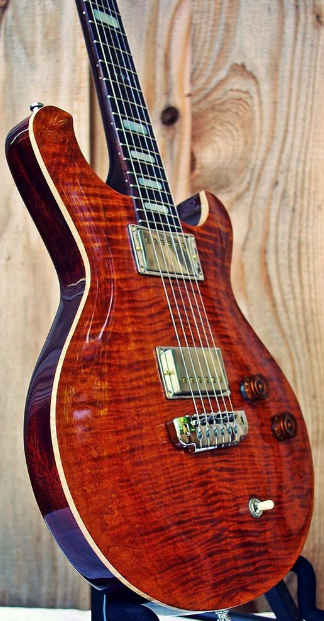
Work – my day job as a software engineering manager – as of late has been quite busy with deadlines to meet and annual reviews to do, though I somehow find time to sniff around for new gear. A few days ago, I was perusing craigslist.org, and ran across this guitar (by the way, that CL guitar weighs a very light 7 lbs. 8 oz.). Intrigued, I contacted the seller who happened to be the luthier and who also happened to be based in Palo Alto, CA, about 15 minutes away from where I live! Russell, owner and luthier of Barron Wesley Guitars, emailed me back and directed me to his brand-new site.

After looking through the pictures he has available and listening to the sound clips, I really dig what Russell is doing!

Now you might ask, “Why go custom?” Well, from personal experience, custom guitars sound unique in addition to being built to order. For instance, Saint Guitars have a certain sensuous ring about them – at least to me – that is absolutely incredible. From the sound clips I heard on Russell’s site, while the tone is VERY similar to a Les Paul vintage re-issue (due to the PAFs Russell uses), there’s definitely a uniqueness about the tone that is very pleasing to me. I love it! Plus, with coil taps on both pickups, we’re talking some serious versatility!

The Barron Wesley guitars also look fantastic. The double-cut to the left is a fine example of Russell’s work (though it has been sold, Russell will hook you up!). What a stunning guitar. Here are general specs of the guitars:

25″ scale Length
-22 or 24 frets (Medium)
-12″ fretboard radius
-1-11/16″ nut width ***
-2-1/4″ width at last fret
-Cocobolo Rosewood fingerboard ***
-Dot fretboard inlays ***
-Block inlays *** + $365
-TonePros AVT2 wraparound bridge with locking studs
-CTS, Dimarzio or Bourns Volume with treble bleed
-Bourns push/pull tone control with tone cap
-Matching wood speed knobs (plastic available also)
-Switchcraft 3 way toggle
-Bone nut
-Gotoh Magnum Locking tuners
-Manlius Modern Vintage PAF+ humbuckers (proven very versatile) ***
-Double action truss-rod
-Carbon fiber neck reinforcements
-1 or 2 piece mahogany back (depending on stock)
-1 piece mahogany neck
-1 or 2 piece book-matched maple or redwood top (natural) (depending on stock)
-Form fit plush lined hard case

Price: ~$3200 (the one on craiglist is only $1445, and only weighs 8.5 lbs – I’m very interested!)

Cool stuff, folks! For more information, go to the Barron Wesley Guitars web site!
Read Full Post »

For years I was on an Overdrive kick. I still kind of am. I love dirt pedals despite the fact that I don’t use them nearly as much as I used to, and am patiently waiting for my Timmy to arrive. 🙂 But ever since I went on my quest to get an original BOSS CE-2 chorus, I’ve kind of gotten on a chorus kick as well; not as bad as my overdrive kick, but every time I see a new chorus, I have to at least listen to it. And if I REALLY  like it, I might just buy it. That’s how it was with my Homebrew THC. It just came along at the right place at the right time.

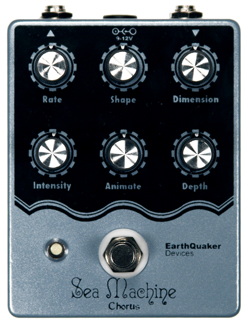
Truth be told though, while I’m not currently in the market for another chorus pedal, the Sea Machine Chorus from Earthquaker devices does give me pause. One thing that always turns me on with respect to gear is versatility, and the Sea Machine certainly cannot be blamed for lack of it. In addition to the tradition, Rate, Depth, and Intensity knobs, the Sea Machine also boasts three other knobs:

  • Animate – adjusts the width of the chorus pitch shift
  • Shape – adjusts the shape of the LFO
  • Dimension – which adds reverb/delay-like ambience to the tone.

This is impressive because from demos I’ve seen, this pedal is capable of producing TONS of different tones from your traditional chorus to leslie to vibe to all-out tweaked!

The pedal retails for $215 online. Here are some demos for your viewing/listening pleasure:

I totally dig Andy at ProGuitarShop.com’s demo as he demonstrates AND explains what the pedal can do, which is a lot. The Dimension feature is absolutely awesome!

If I had to do it over again, and I hadn’t purchased the Homebrew THC, I probably would’ve picked up the Sea Machine. Great chorus!

Read Full Post »

Usually during winter or summer NAMM, I keep close watch on the press releases and trade rags to make announcements about new gear. I’ve received plenty of press releases for this current Winter NAMM 2011, but there really haven’t been any  new sounds lately to get me excited. Maybe it’s because I have the flu, and I’m a bit grumpy, but nothing I’ve seen thus far has really wowed me. The trade rags still tend to play to the major manufacturers, so all you normally get is the expected set of gear from the expected set of manufacturers, though I do have to say that at least Premier Guitar makes an effort to showcase non-mainstream, boutique gear, as they seem to cater a lot to “The Gear Page Forum” crowd.

So the fact that I hadn’t seen anything new and exciting led me to the question: Do we have all the tones we can get? And by that I mean new classes of tones outside the standard amplitude, frequency, and time modulation classes; and let’s not forget envelope filters and the like. Frankly, all that territory has been well-explored. But some genius may come up with some other thing that will add yet another dimension to guitar tone in the future – it’s just not now.

So where does that leave us?

Well luckily we’re no longer in the days when only a few manufacturers existed and the selection of gear was fairly narrow. With all the boutique manufacturers out there now, there’re all sorts of choices at our disposal. We may not have any new classes of tones being developed, but we do have fairly limitless possibilities to combine gear within the existing classes. That’s a great thing!

For me, there’s still undiscovered country in what’s currently out there. I think my next avenue of exploration will be envelope filters. A lot of my latest music has had a real funk feel to it, and an envelope filter or an auto-wah may just add that little funky zest to my rhythm lines.

I did see this one very interesting – maybe weird – “guitar” called the Kitara by Misa Digital Instruments that’s completely digital. No strings. Each “fret” has a button. The right hand (it also can be flipped to be a lefty) uses a touchpad to generate sound. The Kitara is connected to a synth or software. Interesting concept, but I’m not sure if this will be the future of guitar. It does provide some very interesting possibilities, though. Here’s a demo:

Read Full Post »

Slash Appetite for Destruction Limited Edition Les PaulI subscribe to Gibson tweets and Facebook postings, and yesterday I got an update about three new Gibson Custom Shop Les Pauls that Gibson is releasing. One of these is yet another Slash Appetite for Destruction. Gibson came out with one of these earlier this year that retails for around $4000. It’s a nice guitar in honey finish. This latest addition comes in two flavors – VOS and Aged – and is signed by Slash, with only 100 being made by the Custom Shop. Here’s Gibson’s blurb:

Slash Appetite For Destruction
Working hard to record Guns N’ Roses’ 1987 debut, Appetite for Destruction, Slash was experiencing nothing but frustration trying to achieve the tones he was seeking with a range of contemporary electric guitars he was using. Then someone handed him a reissue-style Les Paul Standard, and that was all she wrote. With this legendary rock machine in hand, Slash laid down the deadliest rock riffs of the decade—propelling songs like “Paradise City”, “Sweet Child O’ Mine”, and “Welcome to the Jungle”—and fired up the biggest-selling debut album of all time in the process.

Slash has been a devoted Les Paul player ever since, throughout his years with Guns N’ Roses and later with Slash’s Snakepit and Velvet Revolver. He has taken a number of Gibson Signature models on the road, and owned and recorded with near-priceless vintage late ’50s ’Bursts. To honor his achievements on the instrument, Gibson’s Custom Shop introduces the Slash “Appetite for Destruction” Les Paul, a guitar made in the image of the axe that launched a thousand riffs.

This one has an MSRP of $9,174 for the VOS and $12,468 for the Aged edition. You can read the details here, in the article entitled “The Guitar That Saved Rock N’ Roll;” hence the title of this article.

I’m sure collectors will get excited by this, and having a couple of Custom Shop guitars myself, I don’t doubt the quality of workmanship that went into producing the guitar. But I am scratching my chin about any of the Appetite for Destruction guitars, and also mildly chuckling. Why? The AFD guitar is a replica of a replica!!! Again, that is not to say that the guitar is bad; in fact, it apparently most closely matches the specs and more importantly the tone of the original guitar as Slash remembers it. Plus, if people are big enough fans to buy the guitar, I say definitely go for it!

By the way, for a more detailed article describing that original replica, you can read it at Premier Guitar! It’s definitely worth the read.

I don’t see these guitars as a real negative against Gibson. I think the fact that Slash played a replica on the album (and subsequent tours), is the ultimate compliment to Gibson. Be that as it may, I still find it amusing that it’s a replica of a replica, and that it took a replica to drive Gibson produce a guitar of this caliber.

As for the AFD guitar “saving rock n’ roll,” let’s be honest: That original replica probably saved Gibson’s ass, as the company’s sales at the time were apparently languishing with all the hair metal and glam rockers turning to Strats, Charvels and Jacksons. Plus, it is well-noted that Les Pauls of the era had some huge quality issues; all serving to draw players away. That Slash found his tone in a Les Paul, and in turn drew in a huge fan base not just to the music, but to Les Paul guitars was a major coup for Gibson.

It’s great that Gibson recognized the importance of that guitar by creating its own replica of it. It’s the implied gratitude of “Thank you for saving our asses!”

Read Full Post »

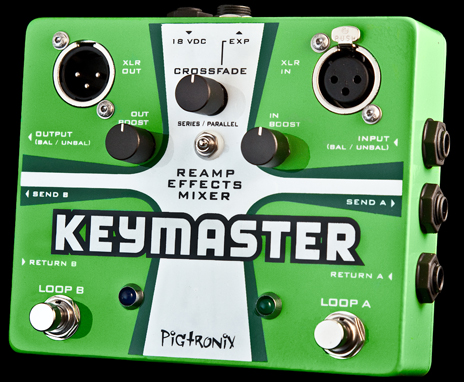
I’m not too sure how to actually describe this “pedal.” It’s a dual looper, but could be used as a switch box, or a DI box. You could use it to direct your signal to two different effects loops and with the crossfade knob, mix in just the right amount of signal from each loop. As an impedance matching DI box, you can use it to go directly into a board or DAW. Or you could keep things very simple and use the box to go from one guitar to two amps, or two guitars to one amp. The possibilities for using this box are immense! Very interesting.

Here’s a copy of the press release I got from Pigtronix:

Pigtronix introduces the Keymaster – Impedance Matching Effects DI

Pigtronix Keymaster is an impedance matching, effects mixing direct box that allows musicians to do more with the gear they already own. Without loss of tone, the Keymaster routes any sound source (XLR mic, line level or instruments) into effects via two, true-bypass loops and then optimizes the mixed effects signal for your instrument amplifier, mixing console or DAW.

The Keymaster’s unique and intuitive arrangement provides musicians of all types with an elegant solution for routing their sound through effects in a creative fashion and then out into any device without losing signal integrity. The two loops can be switched between series and parallel, with a CROSSFADE function for on-board or expression pedal controlled blending of different effects. Input and Output boost controls add up to 10db of gain both before and after the loops.

The Keymaster lets musicians easily blend their instrument’s natural tone with a floor processor or even cell phone and laptop computer based effects using a standard expression pedal. Vocalists and horn players can use the Keymaster to control their effects mix from the stage. Guitar players can now mix pedals like a DJ does two turntables.

Already in use by some of the world’s top producers and FOH mix engineer’s, the Keymaster elegantly answers the unmet needs of musicians at every level, opening up endless realms of possibility for combining the effects you already own.

“I use the Keymaster to run the Piano mic through my Leslie Cabinet, drum mics into spring reverb and to get vocals into guitar amps. This pedal kills. You need it, I can’t live without it.”
Hector Castillo – Producer / Engineer for David Bowie, Bjork, Roger Waters, Brazilian Girls

I get lots of press releases, and there are just a few that I’ll forward to my readers. The gear simply has to be interesting enough for me to publish. This is definitely something I could put to use in the studio – or even on stage. It’s definitely worth a look! In any case, check out this video describing the pedal:

Read Full Post »

When I first heard about this pedal, which EH calls a “sound retainer,” I have to admit, I was rather incredulous. I asked, “What the hell would I use THAT for?” But after seeing a demonstration of it, I seeing some real possibilities; especially for my solo acoustic gigs. But rather than bore you with a bunch of features, take a look at this video:

That dude is a great guitar player! Don’t know who he is, but I do know he’s from Mexico as that demo comes from guitargear.com.mx. No affiliation to this site, but it’s a cool name just the same! And of course, at least for me, I have to appreciate his choice of guitar. 🙂 Nice Tea Burst Les Paul!

In any case, that demo sparked off an idea in me for when I play my solo acoustic gigs. I could strum a chord, then play a short lead over it. But I can also see how it could actually be used to introduce a whole new way of approaching music. It’s wild! I’m seeing all sorts of possibilities now with this pedal, once I saw a demo. And at under $120, it’s not expensive at all.

For more information, check out the EH FREEZE site!

Read Full Post »

People have asked me to do more videos, especially after I did the Doppler on the Dumble series. But the problem with doing video reviews is that I needed to set up a separate sound source to replace the video’s sound track, as it’s not all that good. So I’ve been looking at alternatives that had decent built-in sound, and a really inexpensive alternative I found was the Alesis VideoTrack. Mind you, I wouldn’t buy this one at full price. I got it for $80 today at Guitar Center during their Black Friday sale.

On the positive, it had great audio quality, which I’d expect from an audio company like Alesis. On the negative, the video quality is poor. But for gear reviews, it’s more important to have great sound than great video. That said, this will work for the time being until I get the Zoom Q3HD which has great audio and HD video. But it’s also almost four times what I paid for the Alesis, so I probably won’t be getting one anytime soon.

In any case, I did a test video. Check it out:

Not bad. Not bad at all. The sound quality is amazingly good, so I think we have a winner here!

Read Full Post »


Homebrew Electronics Three Hound Chorus

Summary: All-analog, thick and rich chorus capable of produce subtle to dripping wet chorus to organ-like leslie tones.

Pros: Warm, rich chorus tones – never gets bright, so it might not be for everyone, but I LOVE IT! Width knob is the “secret sauce” of the pedal that physically alters the width between the wave forms.

Cons: None.

Features:

  • Depth – Controls the depth or wetness of the signal
  • Speed – Connected to the LED indicator light which flashes with the rate of the chorus – very helpful.
  • Width – As mentioned above, controls the width between the wave forms. The effect is subtle, but provides another dimension for tweaking.
  • All Homebrew pedals feature true-bypass switching, heavy duty metal enclosures, chassis-mounted switches and pots.
  • All pedals are hand-built. Even the enclosures are drilled by an actual person, not a machine.
  • Lifetime warranty

Price: ~$189 – $200 Street

Tone Bone Score: 5.0 ~ I’m blown away by this chorus! It has such a beautiful tone! I was looking for a chorus to use with my acoustic rig, but this pedal has so much versatility, that I will be using it for a variety of settings (though it’ll mainly be used for my acoustic rig).

I Love Surprises…

Actually, saying I was surprised by the THC is actually an understatement. I needed a chorus pedal to go with my acoustic rig yesterday, because I was tired of using my BOSS CE-2 on both my electric and acoustic boards. Plus, the CE-2, at least for me, has always sounded better with electric because of the gain boost which I dig with my electric rig. But for acoustic, I just want something that turns on, doesn’t give me a jump in volume, and doesn’t add any brightness. So when I auditioned a couple of chorus pedals yesterday – the other was an MXR Micro Chorus – I could not believe how absolutely SWEET the THC sounded!

Mind you, the Micro Chorus sounded killer to me, but it was much closer in character to the CE-2 as it is a fairly bright chorus. For acoustic, I needed a much thicker tone, and I found that in the THC. I will mention that I was going to also audition the Red Witch Empress Chorus, which is hailed as just about the best chorus on the market today. But at $400, there was absolutely no way I was going to get it, so I didn’t bother auditioning it. Also, the Red Witch has 4 knobs and two toggles. I didn’t need that kind of tweak-ability. I know, it’s also a Vibrato, but I just wanted a chorus.

Fit and Finish

All Homebrew Electronics (HBE) pedals are hand-built: And this means all the components, drilling and even the painting are done at the Homebrew shop. But the cool thing is that HBE. My experience with them has been that they’re built like tanks, and the THC is no exception. The pedal feels solid. There’s nothing loose. I also absolutely dig the bright green paint job. Reminds me of a Granny Smith apple! 🙂

Ease of Use (read: How easy is it to dial in great tone)

This is where the THC really shines. What’s very helpful in this regard is the LED, which flashes with the according to how the Rate knob is set. I found myself setting this knob first, then setting the Depth knob for the wetness, then setting the width, which I mentioned is a very subtle feature, but it changes the character of the chorus, which is really cool. Note that it’s not something that I can’t really explain because at least to me, the change is more felt than heard.

How It Sounds

As with all gear that I give 5 Tone Bones, the THC sounds AMAZING! With a high rating like this, the tone really has to move me emotionally. Other gear that gets a lower rating, even gear with a 4.75 sounds great, but there’s something that “bugs” me. Not so with the THC. It’s one of those pedals where I can close my eyes, put a smile on my face, and just let my fingers do the talking. It’s that good!

I recorded a few clips of the pedal to demonstrate how it sounds. All clips were recorded with my trusty Squier CV Tele 50’s (middle pickup position) into my Aracom VRX22 and a 1 X 12 with a Jensen Jet Falcon:

All controls dead-center

Subtle: Depth at about 10am, Rate at 12pm, Width at 10am (added a touch of reverb)

Leslie: Depth at 2pm, Rate cranked, Width about 2pm

Heavy: Depth at 4pm, Rate at 1pm, Width 11am

With this clip I wanted to see how well it played with both delay and reverb, and it plays quite nicely. 🙂

Overall Impression

This is one of those pedals that I actually had never seen before. I’d heard of it, but went into the audition completely cold. If you have a dealer near you that carries these pedals, I encourage you to check it out. You won’t be disappointed.

Read Full Post »

You’ve heard of it happening to other guitarists, and how could it possibly happen to you? That’s right, your guitar gets stolen at a gig. Over the years, I’ve heard of countless stories of players having their axes taken right off the stage during a break; especially at small clubs where the stage can get obscured by the crowd. Bands have devised numerous ways to protect their gear from taking their guitars with them during breaks, to always leaving at least one band member in the stage area to keep watch over gear to even cordoning off parts of the stage area.

Myself, in my solo acoustic gigs where I play outside at a busy outdoor mall, I cordon off the open, rear area – I play in a “patio” at the end of a busy walkway – to prevent people from walking through my “stage.” But I also do this as a mild deterrent from possible theft. In other gigs, the stage is either raised or in an area that’s secure enough so as to offer more reasonable protection from theft. But still, that’s not complete insurance, so when I take a break, I either do it within line-of-sight of my rig, or have the servers and bussers keep watch over the stage when I can’t be within eye-shot. But if in the rare chance that any of them get busy and can’t keep watch, it’s possible for a cunning thief to come along at take my guitar.

Just a couple of weeks ago, this kid wandered over to my stage area and started checking out my rig while I was on a break. He was even audacious enough to twiddle with my pedals – he even lifted my Deep Blue Delay to inspect it! And while I was trying to get through the crowd back to the stage, he picked up my guitar! I finally got out there and asked him what the hell he was doing, and told him to put my guitar down. It turned out that he was just a young, high-school kid who turned out to not have any filters for manners. Some of the stuff he blurted out during our conversation made me open my eyes wide (had to say a brief prayer that I make sure my kids have filters 🙂 ). In any case, he just assumed that since he played he could just go up and mess with another player’s gear. I was friendly enough so as not to make him too uncomfortable, but I was quite firm when he asked me if he could play my guitar while I was on break that no, he couldn’t, and it was just not cool to just pick stuff up.

So what are we gigging musicians to do?

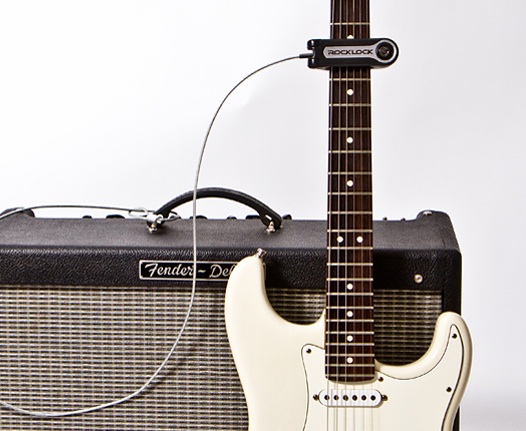
Enter the new Rock Lock from The Rock Lock Company. This is one of those inventions where you say, “Damn! Why didn’t I think of that?” The Rock Lock is much akin to a laptop tether with a loop at one end to attach to a fixed, stationary object (like a guitar handle as shown in the picture to the right), and a locking mechanism that wraps around the neck of your guitar.

Folks, this is the answer to guitar security! Talk about a theft deterrent! I’m totally excited to get one of these as it will certainly set my mind at ease when I go on breaks!

Here’s some information about the Rock Lock from the site:

  • MADE IN USA!!!
  • PATENT PENDING
  • Core Constructed from Cutting Edge Metal Replacement Technology
  • Nitro-Cellulose Safe Over-Mold
  • Heavy-Duty Braided Steel Cable
  • 1 Year Full Warranty with Registration
  • 2 Keys Included, with optional Key Registration
  • Fits almost all standard 6 string Guitars.
    This excludes: 12 String Instuments, Flamenco/Spanish Guitars, and Bass Guitars.

Pricing and Ordering

The Rock Lock will retail at $49.99, and if you’re one of the fortunate first to pre-order, you’ll get free shipping.

Note that the Rock Lock is not widely available just yet, but you can submit your name and email address to be notified when the next shipment is available (apparently, the first short, test-run sold out immediately). I exchanged info with the manufacturer, and he indicated that the first large production batch will be available on December 1, 2010, so get your name in ASAP!

You owe it to yourself to be comfortable to leave your stage knowing that your axe(s) are safe!

Read Full Post »

Click for larger image

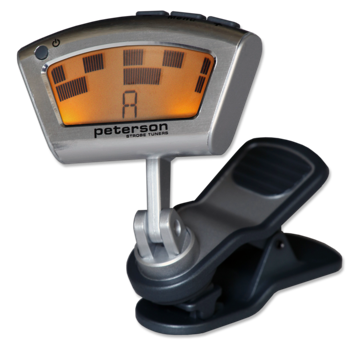
Peterson StroboClipTM Clip-On Tuner

Summary: A high-accuracy (0.1 cent) clip-on tuner! But it’s a Peterson Strobe tuner and that means tuning sweeteners. The StroboClip has several of Peterson’s sweeteners for different instruments, and these sweeteners ensure that your instrument(s) will sound great.

Pros: To me, the Sweeteners are what set apart Peterson tuners from the pack. But as far as the StroboClip is concerned, the clip-on is great for use in both the shop and on stage, and the fact that it is a clip-on makes it versatile enough to use on a variety of instruments. And with a metal enclosure, you can be assured of its durability.

Cons: None.

Features (from the Peterson site):

  • Smallest Multi-Temperament Tuner
  • 1/10 Cent Accurate
  • Smooth, Real-Time Display
  • Alternate Temperament Presets (Including Buzz Feiten Tuning System®)
  • Includes Eastern Temperament Presets
  • Drop/Capo Setting
  • Adjustable Key
  • 28 Exclusive Peterson Sweeteners™/Temperaments
  • Adjustable Concert A Reference: 400Hz to 490Hz
  • Auto Sleep And Power Off For Battery Saving
  • Low Power Consumption
  • Virtual Strobe™ Patented Technology

Price: ~$70 street

Tone Bone Score: 5.0 ~ I received this as a test unit from Peterson the other day, and used it to intonate one of my guitars, which I then used for a recording, and used it on-stage this evening. In all applications, it worked incredibly well. I have absolutely no complaints about this unit! So for studio, shop, or stage, this is a winner!

I dig Peterson tuners, and the fact that this comes in a clip-on makes it super-versatile; add 0.1 cent accuracy, and this is an absolutely fantastic tuner. I’m not really one to use a clip-on on-stage for guitar, even though I used it tonight to test it out, but for the studio, and especially for intonating guitars, I can see how the StroboClip will be an indispensable tool for me! That said, I am getting a ukulele pretty soon, so I’ll probably be using the StroboClip for that.

As I mentioned above, the thing that has always stood out for me about Peterson tuners in general are the sweeteners. I don’t know any of the mathematics behind the technology, but the best explanation I can give is that the Peterson tuners don’t just tune the string to the exact correct pitch. When set to a particular type of sweetener (for guitar and other instruments), certain calculations are made in the tuning algorithm to compensate for the type of instrument. The net result is that once you tune, your chords and note runs sound great!

Many tuners that just tune a string to the exact correct pitch, require some adjustment to get them completely dialed in. But with a Peterson strobe tuner, those minute adjustments are already done for you, so when you tune, you tune to the compensated pitch. That’s about the best explanation I can give without the technical knowledge. Just let it be said that once I’ve tuned with a Peterson tuner, my guitars sound so much better because they’ve been tuned with the guitar in mind. But the StroboClip also includes several other sweeteners for other instruments such as mandolin and ukulele, so it can be used to great effect with different instruments.

With respect to the physical act of tuning, it takes awhile to get used to tuning with a strobe tuner. Unlike other tuners where you either center a needle or LED, all Peterson strobe tuners use a moving checkerboard that speeds up or slows down depending upon how far off your tuning is. Right to left movement means you’re flat, and the converse for sharp. As a strobe tuner is super-sensitive, you have to get used to picking very lightly (I just use my thumb) to tune. But once you’ve gotten the feel for it, it’s very easy.

Tonight, I used it in my weekly solo acoustic gig. Amazingly enough, my Yamaha APX-900 stays in tune so well – never had an acoustic that did that – so the adjustments I made were minute to each string. But I do have to say that after tuning with the StroboClip, unlike other tuners like my venerable TU-2, I didn’t have to do any post-tuning tweaking.

As for the price of $70, it’s not cheap. But believe me, if you want a great tuner for studio or shop use, you could do a lot worse. I found it extremely useful for intonating my guitar last night. I have an old Seiko analog-style tuner that I’ve used for years for that purpose, but it has always required running a cable from my guitar. With the StroboClip, I just clipped it to the headstock. This also meant that I could keep my guitar plugged into my amp so I could hear what I was doing as well as see what the StroboClip was doing. So very cool!

All in all, this is a great little unit that I will most assuredly be keeping around for a long time!

Read Full Post »

« Newer Posts - Older Posts »