Feeds:
Posts
Comments

Posts Tagged ‘thoughts’

…We know it’s good for us, but we don’t enjoy the taste.

That’s a corollary on a saying my cousin shared on Facebook: Truth is a bully we all pretend to like. It got me thinking about some feedback I gave to a young singer/songwriter this weekend on her playing, which was not very good. I first didn’t say it directly and simply said, “That’s a great song you’ve written. If you have a chart, I could accompany you, so you could focus on your singing and not have to think about the accompaniment.”

“I play just fine,” she said.

I replied, “Well… truth be told, some customers last week did mention that while they liked the song, they felt the piano playing was a bit choppy.” (That’s actually the truth; as a few asked me why I didn’t accompany her).

“To you, maybe,” she shortly replied, “I’m not here to be the brilliant musician.”

I said, “Look, you’re reading me completely wrong. I want to make you and your song look absolutely the best, and frankly, your playing is choppy, and you’d have a much better appeal if you had backup that’ll make you shine.”

She wasn’t having any of it. There was a bit more in the exchange that I’d rather not dive into, but I was really taken aback by the arrogance and total lack of humility. I do know one thing, having been performing for over 40 years, she’s in for some serious smack-down. I’ve encountered many performers like that over the years that operate off their own hubris. They get their bubble popped and it’s like their world comes crashing down around them.

Hell! I even operated like that years ago, thinking my own music was something special; only to get feedback from a pro that lyrically, it was cliche, and a lot of my musical phrasing was something that had been done hundreds of time over – in other words, it wasn’t very original. Yikes! I was crushed.

But as Sylvester Stallone said in the movie, Rocky Balboa, “It ain’t about how hard you hit, but about how hard you can get hit and keep moving forward…” And that’s kind of the crux of this entry, dear readers.

We all tout wanting to be honest and receive honesty in return. But honesty is like taking cold medicine. Rarely do we enjoy the taste. But in the end, we actually do feel better. After having experienced that crushing review of my music, I just happened to watch Rocky Balboa and that saying shook me to the core, and I realized that a little humility goes a long, long way. It’s good to believe in ourselves and our abilities, but don’t let that belief turn into hubris. Besides, with humility, we give ourselves room to grow and get better.

After I got that feedback, it actually took me awhile to do some soul-searching – a couple of years, in fact. But I jumped on the horse again, so to say, and started writing again. This time ’round, I went at it with no particular goal in mind; just let the music and lyrics flow. Don’t have expectations of where I think my music should be. It it goes nowhere, that’s okay. But most importantly, really listen to the feedback. So as opposed to parading my music in front of friends and family first, none of my newest songs go out without a professional review from producers in the music industry who critique the songs on their structure, lyrics, and melody. As a result, I think I’ve become a much better writer.

It’s not that I’m following a formula that they prescribe. The reviewer I use the most stresses originality, and absolutely nails me on being cliche. But they are keen on flow and making sure my lyrics make sense. All in all, it has been a great growing experience.

Who knows where my music will go? I’ll be heading into the studio in the next couple of months to start recording and then I’ll get my album out. We’ll see where it goes from there…

Read Full Post »

This actually isn’t an article on Steve Jobs specifically. But after reading a Time Magazine article on Steve this morning, it struck me just how important Apple and especially the Mac have been at least to this author.

For years, I had been doing home recording with a variety of systems; starting with dedicated recording systems such as my hand-me-down Roland 880EX. Frustrated by the unintuitiveness of that and similar units, I turned to the PC since it was a device of which I knew intimately. So I assembled my own PC with the latest hardware, super-fast graphics processor, Dolby 7.1 surround system (I was also into gaming), and got a DigiDesign MBox2 that came with ProTools. That system was incredible! Unlike other Windows-based machines I’d had in the past, this monster booted up in less then 30 seconds; graphics displayed in dizzying high-resolution with – at least to me – 30+ frames per second consistently; sound quality was mesmerizing with my surround-sound system; and even doing complex programming operations were blindingly fast. It was became practically useless to me as a recording system.

The reason for my frustration with the machine as a recording system wasn’t because of the machine itself. It was ProTools. ProTools these days seems to be the standard in professional recording. Even the base configuration with the default plug-ins provides you with a plethora of tools and recording capability. But that’s the problem. I got into PC-based recording because I was tired of sifting through the confusion of menus of a 3 X 2 LCD screen. With ProTools, I now had confusion once again – but on a larger visual scale.

Mind you, this isn’t a knock on ProTools. Almost all recording studios use it, and for good reason: It is amazingly powerful. But you really need to be a sound engineer to take advantage of all the features it has to offer. My frustration lay in that the fact that I was spending more time learning how to properly operate ProTools than doing what I needed to do most: Get my song ideas down. So I gave up home recording for awhile, and went back to writing up lyrics and chord charts and banking on my memory to regurgitate the melodies – fat chance. I knew how to use ProTools at a rudimentary level, but I was so disenchanted with the whole process that I just said, “Screw it.”

Then in 2007, I got an iMac and a Macbook Pro for work and discovered GarageBand. When I first opened it up, I thought GarageBand was just a little toy after my ordeal with ProTools. But I hooked up my MBox 2 and my Mac luckily recognized it, then started playing around. After a couple of hours, I had recorded an entire song, with all the instrumentation I wanted. Granted, the sound quality wasn’t nearly as good as what I could achieve out of ProTools. But I knew then and there that GarageBand would change my life forever!

It wasn’t supposed to be this easy. But it was. I had to practically pinch myself to prove that taking the musical ideas in my head were actually becoming reality. I was cranking out songs like nobody’s business! I finally had a way to not only put my songs down, I could create demos for my church band so they could understand my vision behind how a particular song should be performed. It also helped with this blog that I started about the same time I got my Macbook Pro. I could provide demos of the stuff I was testing.

Circling back to the crux of this entry, that kind of usability is Steve Jobs’ legacy. Call him what you will, but his keen sense of how things should work are undeniable and reflected in the products that Apple has produced during his reign. He wasn’t an inventor. He was a super-innovator. And if you look at Apple products – both hardware and software – there seems to always be this recurring theme: “We need to make people continually exclaim, ‘It’s not supposed to be this easy!'”

But it is, people. It really is…

Read Full Post »

My American Deluxe Strat is the very first Strat that I actually liked. A lot of it has to do with the pickups, which are Kinman Hx noiseless single coils. These have a bit more output than stock Strat pickups and they make a HUGE difference in the tone of the guitar; fattening up the sound significantly.

Traditionally, I have absolutely abhorred the middle pickup of Strats. To me, with the stock set, though it is mid-rangy, which is a tone I like, I always felt the middle pickup was a little lifeless. Even EVH with the Frankenstein removed the middle pickup, and replaced the bridge pickup with a humbucker I suppose to fatten up his tone. With my Kinmans, the tone is not quite ‘bucker-fat, but it is much fatter than the stock pickups. As for the middle pickup, it’s my favorite pickup on the guitar when I’m playing with distortion. It produces tons of mid-range that cuts right through a mix.

Plus, at least to me, it has the best balance of sustain and fatness to simply be an ideal pickup. Take this demo that I recorded this morning called “The Way The Truth The Life:”

I actually recorded this a few years ago, but couldn’t get a groove with the song. So I finally got it put together, and after I recorded the acoustic guitar and piano parts, realized that it needed a driven electric guitar sound; specifically, my Strat through a cranked Marshall. ๐Ÿ™‚ To be honest, I tried recording with the neck pickup which is my usual go-to pickup, but that was way too fat, and the bridge pickup was way too thin. But the middle pickup was just right… (yikes! sounding like Goldilocks and the three bears).

When I spent time with Doug Doppler way back when, he talked about the middle pickup being one of his favorites. I personally didn’t “get it” at the time because up until that point, I hadn’t heard a middle pickup on a Strat that I liked. But after recording this song, I’m sold. When I want a smooth drive with lots of mid-range, the middle pickup is it!

Read Full Post »

I’ve been on the job hunt these past few weeks, which is why I haven’t posted as much as I normally would. And in my search, interviewers have all asked the standard question: “Why did you leave your last position? You were there for three-and-a-half years.” My original “pat” answer was, “It became too political.” But that was really only a minute part of why I left. I only said that because I had a hard time articulating what really was at the core of my leaving; and simply put, it was a gradual reduction in freedom: Freedom to think, freedom to be creative, freedom to be honest.

When I first started at that company, we were pre-IPO. The engineering team was lean – about 50 people to develop for a HUGE enterprise app – and thus, we all wore lots of hats. It was chaos, but the level of teamwork and collaboration was at a level before which I had never experienced. Because of our flat organization, we were all expected to lead in some way, shape, or form at any time. There were no egos.

But all that changed after the IPO as the company transformed into a classic corporate culture where collaboration and courage gave way to internal competition. That change in culture eroded the sense of ownership of employees, as the executive management focused on pleasing Wall Street, and started practicing Wall Street’s executive rewards programs: Paying themselves huge bonuses in stock and cash, while not rewarding the rank and file in kind. They created management layers and stratified the entire organization. The values that the company was built on were only given lip service.

That’s why I left. I could no longer work for a company that was not living up to its values.

So what does this have to do with this blog? ๐Ÿ™‚ I came to that realization above as I was writing some of my latest songs, so bear with me.

As a sanity check, I submit my music to a few different services to be critiqued. I’ve always known that my music while Christian in flavor, really doesn’t fit in the Contemporary Christian music category. But several reviewers have come back with critiques to shape my songs into that genre. My reaction has been, “I guess they don’t get what my music is about…” Mind you, that’s not an ego thing. It’s more of an awareness that it’s completely different from the genre. However, one reviewer whom I have been using for critiques and who is also the most brutally honest with me, has never tried to change my songs to fit in the CCM bucket. Instead, she evaluates my songs completely on their own merit, allowing me to build on my creativity, and working with me on making tweaks that serve the song as opposed to genre.

Frankly, my music could be considered “contemporary sacred,” as it is all worship music, and really meant to be played within the context of some sort of worship ceremony or event. Most songs I write aren’t just for listening: They’re for interaction. They’re meant to be sung.

During a recent conversation with the reviewer I mentioned, I realized that a sense of “freedom” is a critical ingredient to creativity. In the past couple of weeks, I have been churning out new music that will be going on my new sacred songs album. I have been experiencing an incredible burst of creativity. That is largely due to having this sense of freedom: I’m writing what I feel I need to write, free from the consideration of what someone else might think. In essence, I’ve given myself the freedom to be creative and stopped trying to build a box around what I think my music should be, or worrying myself about whether or not it will be liked. It is what it is.

For highly creative people, reduction in freedom to create, whether or not it’s self-inflicted kills their ability to create. For me, once I gave myself permission to write what I needed to write, all sorts of great things happened…

Read Full Post »

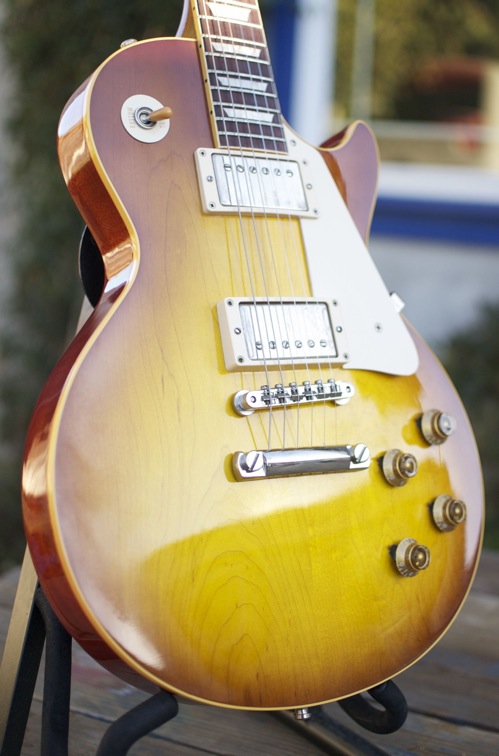
There are “go-to” guitars and there are “go-to” guitars. But do you have one that’s just.. well… perfect? I do. It’s my Gibson Les Paul Standard 1958 Reissue. To me, that tea burst is absolutely sexy, but more importantly, when I play that guitar, I feel that I can do just about anything. The neck is perfect on this guitar. It’s a fat neck, but not anything like a ’57’s baseball bat girth. And every time I play this guitar (her name is “Amber”), I just feel so confident. I can switch from rhythm to lead and back again, and with Amber, I feel as if I can express my creativity freely.

Mind you, this is purely subjective. Everyone will have their own perfect guitar, and their own idea of a perfect guitar. But for me, I’ve found my perfect guitar.

But what about my others? I still play all of them because there are tones that Amber just can’t create. Take, for instance, my Gretsch Electromatic. It has an almost acoustic tone to it; so much so that I use it for my solo acoustic gigs. And because it’s an electric, I can play that guitar for hours, and never get tired. And of course, getting that jangly, Strat single-coil sound just can’t be gotten with a Les Paul.

But luckily for me, most of tunes require a fat, sustaining tone, and there’s nothing like a Les Paul – at least for me – to deliver that.

Read Full Post »

This week was back-to-school week for my kids, and of course, my wife and I had parental duties to meet our kids’ teachers. Since we have a large family with some in parochial school and others in high school, it was necessary for us to split up. On Thursday, I got the high school, my wife got the elementary school. In any case, one of my daughter’s teachers mentioned a great saying that I’ll share here:

The greatest risk to society is that we have the experience, but miss the meaning – T. S. Eliot

Wow! That quote hit me like a ton of bricks! It reminded me of listening to a clip once that this guy did to demonstrate his Dumble amp. His technique was flawless, but what he was playing was completely nonsensical and perhaps more importantly, absolutely emotionless.

Playing music is like making conversation. Conversation isn’t just words spoken, but emotionย  conveyed. It’s the combination of words and emotion that convey meaning. For instance, here’s a quick clip that I put together a few minutes ago. The first part is a scale in C-major played straight, then the same notes are played again, but with feeling. The second part is a chord progression in Am, again played straight, and then adding some emotion.

Same notes and chords in both examples, but with the emotion added, convey a completely different meaning.

To me, adding meaning is what separates the wankers from the players. I don’t care how great someone’s technique is or how blazingly fast they can play. If the playing is all about technique and doesn’t have any emotion, it’s just well… dry. It harkens back to that quote above.

But don’t get me wrong, having no technique isn’t good either. I once dropped into a nightclub to listen to a jazz trio. I walked out after a couple of minutes because the guy playing guitar had no technique whatsoever! Look, I get dissonant, abstract jazz; some of the late Kenny Kirkland’s stuff was way way out there, but I dug it because his technique AND feeling pervaded throughout the songs he played. But what I listened to that night was simply crap that was being passed off as dissonant jazz.

Even with gear, you can have all sorts of equipment, but you still have to play it and make music. My good friend purchased A TON of gear from an estate sale. The guy who died had all sorts of amps, guitars, and effects; so much that it filled my friend’s long-bed pickup AND his race car transport trailer. The guy played at home. More power to him to be passionate about gear. But this was ridiculous!

So here are a few questions that I’ve been asking myself the past couple of days since I read that quote:

  • Where’s the meaning in my life?
  • Is my focus all on experience?
  • Shouldn’t passion count?
  • Musically, what kind of meaning am I trying to convey?

The last question is something I’ve really been pondering, as I recently overcame some serious writer’s block. I had been at an impasse with my music for a couple of years, then recently decided to go in the direction that to where my passion was pointing. Now the music is flowing through my head again. I’ve found my meaning – at least for now…

Read Full Post »

I was watching a two-part video series a couple of weeks ago where Premier Guitar was interviewing Keith Urban’s guitar tech about Keith’s rig (Part I is here). During part two of the series, the guitar tech said something that struck me as he and the interviewer were talking about Keith’s compressor pedals. Keith uses four different compressors, and the tech was in the middle of describing how Keith sometimes uses them in combination. In the middle of his explanation, he sort of stumbled, then said, “…like they say, there’s really no wrong way to do this. If it sounds cool, then it’s right.”

I always say a corollary to that to myself: If it moves you, then go with it. But I think I’m going to use “If it sounds cool, then it’s right” from now on. And really, that’s the point about any gear we buy. There’s no right or wrong when it comes to gear and gear combinations. If it pleases you, then it’s right… for you. Of course, listen to constructive input from other people, but in the end, it’s on you to find the tone that fits you. No one else can do that for you, which reminds me of another saying that I used when working with teenagers years ago and giving a talk on peer pressure:

The only real freedom we have is our freedom to choose; unfortunately, we often choose to give up that freedom in exchange for acceptance.

I know I’m getting philosophical, but to me, conviction, personal power, feeling strong, what have you, come from our freedom of choice. We lose our personal power when we give up our freedom to choose. For instance, how many times have we all fallen prey to hero-worship and get gear that our idols use, only to find that it just doesn’t work for us? How many of us have been on the forums and have blindly purchased gear based upon the hype built around it? There’s a reason why there’s so much practically brand-new stuff up on The Gear Page’s Emporium on a constant basis: People have fallen for the hype, then get the gear and realize it’s not for them. I’ve committed this error enough times myself to always qualify my recommendations with something akin to “try before you buy.”

Freedom of choice is crux of this article and what the saying, “If it sounds cool, then it’s right” is all about – at least to me. Where we are in life is the result of the choices we make; congruently, our tone is the result of the choices we’ve made in gear. Some choices are not as positively productive as others, but that’s life. And that’s how we learn.

Read Full Post »

A friend of mine shared with me a Top 50 list that was published by Guitar Player mag back in 2004. I vaguely remembered reading that list back then, and when my buddy shared the list with me again a couple of days ago, it reminded me of the Rolling Stone Top 100 guitarists list from a few years back.

I understand why a mag would publish a list, but you have to understand that those lists aren’t supposed to be definitive. It’s just one person or a group of people’s view of what they think is “best.” As with gear, the “top” whatever is a pretty subjective thing. One person’s top will most likely be different from someone else’s because we all have different tastes.

This leads me to the title of this entry. I think the mags publish these lists to piss people off. ๐Ÿ™‚ To put it more kindly, I believe they post these lists simply to stir the pot and create a buzz. If you think about it, the thing that the lists ultimately do is attract visitors. Someone might see a list, then go to a forum and post, “Did you see this list? I can’t freakin’ believe what they say the top 100 is! What a crock!” Look at the Rolling Stone Top 100 list. Talk about flame bait! When that came out a few years ago, it caused a huge stir on the forums! Most people hated that list, and certainly didn’t agree with the rankings.

To tell the truth, I don’t really have a problem with “top” lists. But I know now not to get all worked up about them. They’re there simply to create a buzz. But go ahead: Get pissed off if you want. ๐Ÿ™‚

Read Full Post »

…but can you play.

For those of us that remember back in 1985, during the heyday of MTV, Billy Crystal put out a video featuring his Saturday Night Live persona “‘Nando” called “You Look Marvelous.” In the video, he says, “My father told me, ”Nando don’t be a schnook. It’s not how you feel, but HOW YOU LOOK!'” Well, as I mentioned in a previous article, looking good is one thing, but playing good is entirely different matter. ๐Ÿ™‚

I will submit that how you feel is ultra-important to playing well. Again, I’m going to draw a parallel between golf and guitar. Recently, I stepped up to playing with fairly expensive golf balls. Up to that point, I couldn’t really justify playing with “tour” caliber balls because I was just getting back into the game; so I opted with cheap balls that I didn’t mind losing should I hit an errant shot. But I’ve been hitting a lot more consistently as of late, so before my last round, I purchased some balls that cost about $43 per 4-pack. That’s quite expensive. However, the way they felt and in turn made me feel when I hit them compels me to always buy those.

I wrote an article about that on my golf blog. After I wrote it, I saw yet another connection that I could draw from golf to guitar; and that is that how you “feel” when you’re playing totally affects how you play. If you don’t feel comfortable with your gear, you’re going to fidget and f-up. You’re going to be constantly adjusting to find the comfort zone.ย  If you’re stressed out – as I covered in a recent article – you’re going to mess up, and completely limit your creativity.

So the moral of the story is the exact opposite of “You Look Marvelous.” It’s not how you look, it’s how you feel…

BTW, here’s the original video. It’s hilarious:

Read Full Post »

Yesterday, I wrote an entry in my golf blog about staying loose, and how important it is to stay loose, both mentally and physically, to have an effective golf swing. All this came out of a drill I learned in a recent lesson that forced me to loosen up both mentally and physically to allow my swing to simply flow. The result has been much longer distance, much more consistency, and really important for this middle-age, overweight body, a lot lest strain on my back. ๐Ÿ™‚

This morning, I thought about that article and realized that staying loos applies to playing guitar. I gig a lot – at least three times a week – and one thing I’ve learned is that when I’m tight and tense, I just don’t play very well. I don’t have much feeling, and I end up getting more stressed as the set goes on. If I’m stiff, I’m sure it shows up in my performance, and that’s not enjoyable for ANYONE.

When I detect that I’m stressed out – I usually catch it – I simply take an early break. Get a cup of coffee or a glass of wine, then mingle with my audience a bit. As I usually have friends in the audience, I’ll go to their table and chill a bit. The idea is to take my mind off the gig, collect myself, then go back at it. The net result is that I can pick up my guitar, and start being expressive once again.

At my church gig, as the band leader, it is easy to get stressed out, but I’ve learned to just quietly take band mates aside and just tell them directly something like, “Dude, that wasn’t very pretty…” and chuckle a bit. Then I’ll just suggest they try something else. That corrects the behavior, but then to get over my tightness because of the stress, I simply remember why I’m doing what I’m doing, and doing music for church isn’t about me or the group. It’s about the congregation, and helping them have a better worship experience. If I’m tight and stressed, it shows. Period. And especially in a worship setting, people pick up on that fast because they can tell when you’re forcing it.

But the net result of staying loose is that you free your mind, and it allows you to turn on the creativity and expression. You just can’t do that when you’re pissed or stressed out. I’ve seen some great performers in the past whom I could tell were stressed. They seemed to be in their own world. It’s not very enjoyable.

So stay loose, leave your stress for outside the venue, and ROCK ON!!!

Read Full Post »

« Newer Posts - Older Posts »