|
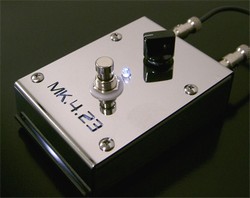 Creation Audio Labs Mk.4.23 Boost |
Creation Audio Labs Mk 4.23 Clean Boost
Summary: Truly flat EQ response, zero coloration, clean boost pedal that takes your tone and gives you more, much more of it. Can be used as a simple clean booster, or can slam the front of your amp with up to 24dB of gain. Pros: Does only one thing: It boosts your signal, giving you more cleans, or slamming your preamp tubes into sweet, singing, sustaining distortion. No bells and whistles, just a single volume knob. Super cool stainless steel finish, with backlit lettering. Cons: None. Price: $149 direct Specs:
|

Want a pure boost pedal? One that just does what it’s supposed to do? Simple to use? Doesn’t add its own “character” and just gives you more of your own tone? Look no further. I don’t say these words lightly either. All those things are true!
When Anthony Bonadio of Reason Amps first told me about the Creation Audio Labs Mk 4.23, I was really taken by the emotion in his voice when he described the pedal, and his claim that it was the best boost pedal he’d ever used. That’s saying a lot coming from a man who rarely uses pedals. And when he offered to send his to me to try with the Reason SM25 amp I recently reviewed, I just couldn’t wait until it arrived. It arrived today, and now I understand why he feels the way he does about the Mk 4.23.
Playing it through the Normal (clean) channel of the SM25, it does what it’s supposed to do: It boosts your clean channel. It was what I expected, so it was a bit boring, though I was impressed by the fact that there was no snap, crackle, pop when I kicked it in, and it just simply gave me more of my clean tone. But where this pedal really shined was when I kicked in the Bright and StackMode channels of the amp.
Talk about a visceral response! I can’t even describe the feelings I experienced as the pedal slammed the preamp tubes, and made the amp produce sweet, singing sustain that lasted for days! I always knew that the amp could produce incredible distorted tones, but with the boost engaged, I could hear additional harmonics and overtones issuing from the amp that up until that point I had never heard! On top of that, I never lost a bit of tonal clarity, even when I had the volume knob dimed and was creating that scooped, snarling dog buzz. That’s certainly a testament to the quality of the amplifier and complex and sophisticated sounds it can produce, but it’s also a huge testament to Mk 4.23 that can push the amp into that organic, high-gain overdrive. OH MY FREAKIN’ GOD!!!
I tested the pedal with humbuckers and single coils, and it was interesting to hear the difference in how the pedal performs with both. With humbuckers, the volume boost is less dramatic, as humbuckers send a lot of gain by default. But the effect was by no means displeasing. Where I didn’t get a significant volume boost, I got a lot more gain, driving the preamp tubes even harder. The sound was absolutely delicious! In fact, it drove the amp into feeding back, even a lower volumes! How cool is that?!! The guitar I used has tons and tons of sustain, but with the amp slammed, the sustain went on and on and on. And with that much gain, the compression from the power tubes just gave the signal balls of steel. But wait! There’s more!
With my Strat, the volume boost effect was dramatic; perfect for pushing your volume into great lead levels to get over the top of a mix. I didn’t get as much drive into the preamp tubes, but I wasn’t expecting that in any case. And yet again, the booster just took my tone, and simply gave me more of it.
So as you can tell, I REALLY like this pedal. I love what it does in a big way. But here’s another thing to love about this pedal: Its price. Creation Audio Labs got tired of using middle men and retailers that would price the pedals out of many players’ budgets, so they decided to only go direct. So what used to be a $260 pedal is now only $149. Buy it direct from Creation Audio labs!
In closing, after I return this pedal to Anthony, I’m going to buy this pedal. After just using it for just a short time, I’m confident in saying that this is a pedal that will always be on my board.

 Guitar Gear