Unfortunately, many guitarists, especially inexperienced guitarists don’t understand tone shaping all that well. They think that just because they get a certain stomp box, they’ll sound just like their favorite guitarist. But getting the right tone involves a lot of different factors, but they boil down to three different areas. And how you balance those areas will affect how you sound. NOTE: This deals more along the lines of equipment as opposed to the guitarist, who of course is the main factor in getting tone; in other words, how you play affects how you sound, so technique is really a huge factor.
The Tone Triangle
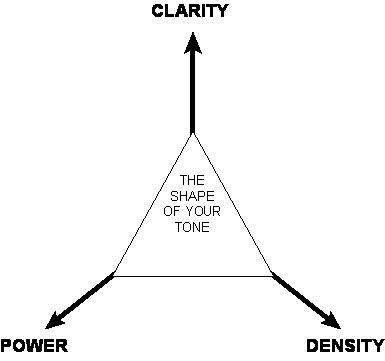
The diagram above is what I call the “Tone Triangle.” It simply is a graphical representation of the three factors that influence your overall tone: Power, Clarity, and Density. Power is a function of your volume, whether set from your guitar, volume pedal, or amp; or by using a booster or overdrive pedal. Clarity is the cleanliness of your tone. I tend to think of clarity or cleanness in terms of the amount of distortion or lack thereof that is present in your tone. Density is the “fatness” or “thinness” of your tone. For instance, a Strat has a fairly thin tone as it doesn’t produce much in bass area. An ES-335 or Les Paul however, have dual humbuckers, so they produce a much wider range of tone; thus the “fatter” tone.
So what’s the point to all this? What you do to tweak your sound will affect the shape of your tone triangle. Note that there’s no bad shape to the triangle. Its shape just changes based upon the tweaks you make. And understanding how that shape is affected will get you a long way towards knowing what kinds of pedals to buy or adjustments you have to make. So armed with that idea, let’s look at the three corners of the tonetriangle.
Things That Affect Power
Power is a pretty easy thing. Pump up the volume, add an overdrive or boost, and the net result is a generally louder sound. But keep in mind that power has an inverse relationship with clarity. The more power you add, the lower your clarity, as your signal will tend to distort at higher power levels.
Specifics: Volume adjustment (guitar, amp, volume pedal); overdrive and boost pedals.
Things That Affect Clarity
As discussed above, gain has a negative effect on clarity; not that this is a bad thing. I myself can appreciate a creamy smooth distorted signal. But distort too much, and what you get is a mess. In fact, with an overly distorted signal, even though you might pump up the volume, your sound will just get lost in the mix. So with clarity, you have to really balance how much distortion is appropriate for what you’re playing and who you’re playing with.
Let’s take a bit of time to discuss distortion. Generally, there are two types of distortion. The first distortion is the result of high input gain, while the other type is the result of signal manipulation. Both are completely valid, but each produces completely different types of sounds. Distortion from gain or overdrive tends to be on the bright and gritty side, while distortion from dedicated distortion pedals tends to be thick and smooth. The combination of both kinds creates a very big sound indeed – sometimes too big for some applications, so be careful how you’re applying distortion. With respect to distortion pedals, my advice is to play a bunch of different kinds. The same goes for overdrive pedals. Again, it’s all about personal preference, but it’s also about the type of music you play. It doesn’t make a lot of sense to play with a lot of overdrive and distortion if you’re playing jazz or pop; on the flip side, playing a really clean tone with death metal is absolutely nuts!
Clarity is also affected by how you EQ your rig. Put too much bottom-end in your sound, and you’ll sound muffled. Dial in a lot of treble, and you’ll sound thin or at higher volume levels, you’ll sound piercing. So you have to be careful about how you balance your EQ.
Specifics: Again, volume or gain; distortion and overdrive pedals. EQ. Modulators such as reverb, chorus, flange, and phasers also affect your clarity.
Things That Affect Density
As mentioned above, density is about the fatness of your tone. This can be affected in a lot of ways, not the least of which is the type of guitar you play and the pickups they employ. In general, single coil pickups produce a thinner tone, while humbuckers have a deeper and richer, thus denser or “fatter” tone. The type of amp you play out of can either thicken or thin out your tone. For instance, Fender amps are clean and bright, while something like a Vox AC30 produces a thicker overall tone.
As far as effect pedals are concerned, the most common pedal used for adjusting signal density is the compressor. I’m tired, and this entry is getting long so for a good discussion of how a compressor works, read this great article. An overdrive pedal can also serve to thicken your tone if used at lower drive levels, but it’s tricky, and you have to do a lot of tweaking depending upon the guitar you use.
Specifics: Type of pickups you employ;compressor, overdrive pedals.
Wrapping It Up
Notice that I didn’t mention specific brands or pedals in this discussion. This is because tone shaping is such a personal thing that to give advice on specific items to purchase would be a disservice. What I wanted to do was give you an idea of the kinds of things that can affect your tone triangle. So go out and shape your tone!
 A few days ago, I got a Fender Hot Rod Deluxe, and as I mentioned, I was just blown away by the sound. As I’ve mentioned before, there’s nothing like the tube sound, and according to articles I read and people that I’ve spoken to about this amp, it’s a great entry-level tube amp that you can a lot of mileage out of. Since I’ve gotten it, I’ve been playing it at least a couple of hours a day – it’s that good!
 Guitar Gear