Feeds:
Posts
Comments

Archive for October, 2010

I wrote an article called “Gear That Has Changed My Life” last year where I talked about various types of gear that have had a huge impact on who I am as a guitarist. But today, I realize that there have been several pedals that completely changed my approach to playing, and I thought that I’d focus on them here.

BOSS CE-2 Chorus – This was the very first pedal I ever purchased, and I also sold it after a few years because I didn’t know any better. Kicked myself frequently until I finally got another one earlier this year. To me, this pedal produces the chorus sound that means “chorus” to me. There are some great ones out there, but this to me is the original and definitive chorus sound. And despite its little quirks, like adding a slight gain boost when activated, I can’t think of a chorus pedal that does it better.

Mad Professor Deep Blue Delay – I’ve had a love/hate relationship with delay pedals over the years. Digital delays always seemed so “processed” and analog delays were always way too dark-sounding to me. I got close to what I wanted with the VOX Time Machine, and I actually still use that pedal for some specific songs. But then I auditioned the Mad Professor Deep Blue Delay, and my prayers to find a delay that I could love all the time were answered! From adding just a touch of ambience to drowning in heavy, pulsating, analog echo, the Deep Blue Delay delivers, all without turning mushy or going dark in character. I got mine before the PCB version came out, so I paid a premium for the hand-wired version at $325. The PCB version is a more reasonable $199 and apparently sounds great (though a touch different according to a well-trusted source). But hand-wired or PCB, there’s nothing like this delay.

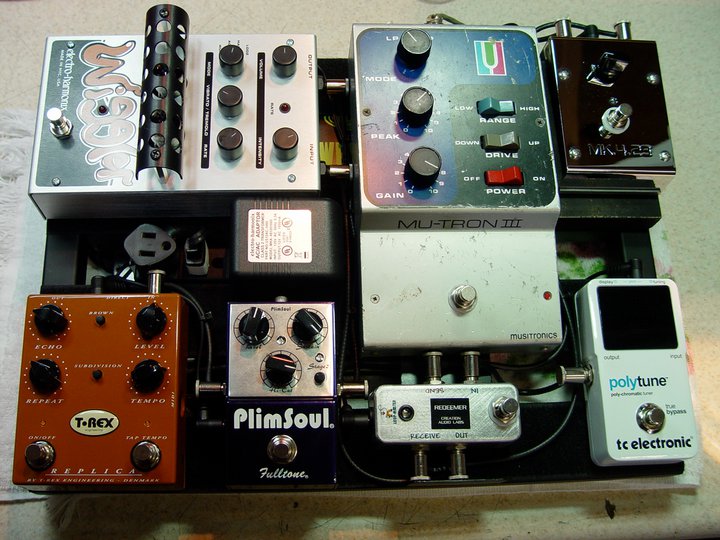
Creation Audio Labs Mk.4.23 – I mentioned this pedal in my previous article, but it truly has had a HUGE impact on me as I use it a lot in place of an overdrive pedal to push my amp into distortion. When I want to retain the natural overdrive tone of my amp, the Mk.4.23 is where it’s at for me.

Fulltone OCD – Though I sold this pedal long ago, it was my first “boutique” pedal. Up to then, I’d stuck with the mainstream. It really demonstrated to me that there were sounds beyond the mainstream. Unfortunately – or fortunately depending upon how you look at it – it also was responsible for me to go on a quest to test out other boutique gear. Now I have a lot of it. 🙂

DigiTech Bad Monkey – This pedal reinforced the notion that great tone can come cheap. A Tube Screamer clone for sure, the one thing that this has got over the the TS is adjustable bass and treble knobs. It sounds great to boot! I no longer have this pedal as I gave it to a kid in my church band, but whenever I get the inking to spend big bucks on gear, I look back to the Bad Monkey and tell myself that there is great gear out there that doesn’t have to come at a premium in price.

Dunlop Original Cry Baby – This was my very first wah pedal, and up to that point, I had NEVER even considered playing wah. But curiosity got the best of me, and I got a second-hand one at a used gear shop. I still love playing with it now and then, though my main wah is a VOX Big Bad Wah. But the Cry Baby opened a whole new realm of expression; and even though I’m not playing it much, I don’t think I’ll ever get rid of it.

I’ve gone through so many pedals in my lifetime, and something tells me I’ve missed something. But these are the pedals that come to mind. Care to share and pedals that have changed your life?
Read Full Post »

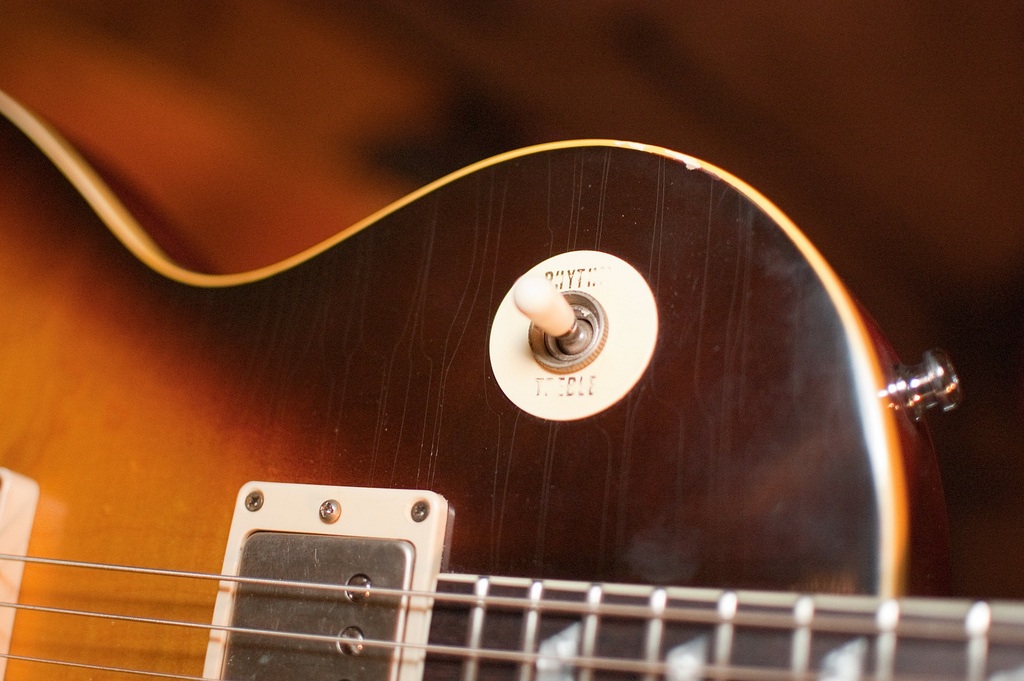
To the left is a shot of my 1959 Les Paul Replica. If you click on the picture you can see the finish checking and the little ding above the pickup selector toggle that was applied by the builder. It’s light, so for me, it’s cool. But truth be told, I don’t really get the relic thing. Give me a nice, bright, shiny guitar, and I’ll be happy. In fact, though many of my guitars have dings on them or their metal is a little tarnished, I’m cool with that because I did the aging through gigging and recording. And I will also add that while I don’t actively try to prevent aging, I do take very good of my guitars and make sure I wipe them down after each gig or session, so even though some of my guitars have dings, they still look fairly new – even the older ones.

On the other hand, my very close friend Jeff Aragaki loves guitars that have been artificially aged. In fact, he once got a gloss ’59 historic, and buffed it down to age it slightly himself. My reaction was, “WTF did you do that for?” He just said that he prefers the well-used look. Of course, I’m totally cool with someone liking that, and will never dis anyone who likes artificially aged gear, but it’s not for me. I’d rather do the aging myself.

Do you get the “relic” thing? 🙂

Read Full Post »

Go to any blog or forum and you’ll see lots of discussions centering around Tone. You’ll also see some heated debates about it that often escalate into name-calling and all-out arguments. With respect to tone, everyone has an opinion. Some are put more eloquently and authoritatively than others, but in the end, they’re still just opinions, no matter how educated or experienced one may sound. For this particular discussion, I’m referring to “Tone” as that unicorn that we all chase that is a combination of what we’re playing as well as how we’re playing.

Admittedly, even with the articles I’ve written regarding tone, my viewpoint is well… my viewpoint. People call me out all the time on that and offer their viewpoint, and that’s all well and good. But it’s still just their viewpoint. I think the challenge of describing tone is that it is incredibly difficult to articulate something that is produced aurally and then evokes an emotional response. The result is that when speaking in reference to something like that, instead of being able to capture the meaning definitively, we have to speak metaphorically, with copious use of “sounds like” or “feels like.”

So with respect to that, to find your Tone, as I’m apt to say quite often here, you simply have to try things out for yourself. Recordings get you into a general area, and they’re quite helpful, which is why I do them in the first place, but keep in mind that they don’t tell the entire story. For instance, here’s an experience I’ve had several times when evaluating amps. Like almost everyone, one of the first things I do is to try to find recordings and videos on the Internet so I can hear how the amp performs. But one thing I’ve learned with evaluating an amp is to take note of what guitar and effects are being used to do the recording. An amp may sound great with a Strat, but may sound absolutely horrid with a Les Paul. I can’t tell you how many times I’ve been disappointed when I finally audition an amp in a shop that I’ve gotten wind of on the Internet. The point to this is that you have to do ALL of your homework…

Salient Question: How do you know when you’ve found your Tone?

Taking into account that different styles of music require different combinations of gear, the way that I’ve found that I’ve hit that sweet spot of finding my tone is that my performance becomes effortless, and I’m going on pure instinct and expression. I’m not thinking about the sounds my gear is making or how the individual components are functioning or if my levels are correct. At least when I hit that sweet spot, I can FEEL it, and I’m left to be truly creative.

For instance, at my church gig last night, I was in the zone tone-wise. I used a fairly simple, low-wattage setup with a VHT Special 6 amp (which I ran into a 1 X 12 speaker cab for better bottom end), my pedal board, and a Les Paul. Clean or dirty, I just felt I could do no wrong. I didn’t do any tweaking, except for turning down the gain on my amp or guitar. I was able to perform on pure instinct, and that just made the set so much more enjoyable. The point to this is that when you don’t have to worry about it, chances are you’ve found your tone.

But I’ve also said this before: Tone is an ever-moving target. What makes you happy and inspires you today may likely change over time. Myself, I was a Strat/Fender Deluxe player for years. But as of the past year or so, I’ve converted over to the Les Paul/Plexi combination. More likely than not, I’ll probably stick with this combination for awhile as I’ve found that I’ve bonded much more closely with this combination than with the Strat/Deluxe combination. But only time will tell…

Read Full Post »

One of early my inspirations for playing guitar was Mark Knopfler of Dire Straits. To this day, I still listen to Sultans of Swing at least once a week. I just love the tone he gets with his fingers! Plus, that guy is one of the coolest cats on the planets. Here’s a video from a few years back. When I saw it yesterday, I must’ve watched it 5 times. What technique and feel!

Read Full Post »

Since I’ve gotten it, I’ve been absolutely digging the VHT Special 6. It’s such a versatile little amp, with bright cleans and capable of creating some gorgeous, sustaining overdrive. And while I do certainly appreciate its clean tone, this amp totally shines when it’s cranked to hilt.

To demonstrate, here’s a clip I recorded this evening with the VHT Special 6:

Now here’s the thing about recording with a low-wattage amp. I’ve found that almost invariably, it’s difficult to get a big sound out of the stock speaker, no matter where I place the microphone. People recommend recording from an angle lined up along the outside of the speaker cone. I’ve never had much success with that, considering I’m not using any high-end mics. So my solution is to use larger speakers to get that bigger sound.

For this clip, I used two different 1 X 12 speaker cabinets: The rhythm track was recorded using a Fane Medusa 150 speaker to get a bigger bottom end. The lead was recorded with a Jensen Jet Falcon – that’s my favorite speaker at the moment. And of course, because even 6 Watts cranked is very loud, I ran the amp through my Aracom PRX150-Pro and recorded each track at about loud conversation level. It’s just loud enough to move the speaker cone a bit, but not so loud that I’d wake up the neighbors. 🙂

For both parts, I used my Les Paul R8. For the rhythm, I recorded in the middle selector switch biased towards the bridge, and for the lead, I recorded with the bridge pickup only. To make the guitar tone sound even bigger, I added just a tiny bit of compression to each track and added a touch of small room reverb to add some dimension. I didn’t EQ the guitar parts at all. That’s the natural sound of the amp through the speakers I used. The compression keeps the sound focused. At least to my ears, the guitar parts sound like they’re coming from a much bigger amp.

As far as the amp setting were concerned, I was plugged into the hi input with the amp set to high-power mode. Tone and volume were at 3pm, and I engaged the Boost. Even at these cranked settings, the amp will clean up very nicely! That’s how responsive this amp is!

Admittedly, if I were to rewind and go back to when I bought the amp, I’d probably go with the head. The stock speaker is great for practicing, but for gigging and recording, it just sounds much better with at least a 1 X 12. But hey! A handwired amp for $199? Geez! I can live with its shortcomings as what it brings to the table tonally is fabulous!

Read Full Post »

Before I got my Aracom PRX150-Pro, to get grind, I used a variety of overdrive pedals. But now that I have a great attenuator that allows me to get my amps in their sweet spots without stepping all over my band, I’ve been making lots of use of clean boost – namely, the Creation Audio Labs Mk.4.23 – to push my amp into overdrive, plus get a bit of a volume boost. I use overdrive pedals far less now, but I do use them when I want a different color to my overdrive tone. But I’m curious – especially after seeing Peter Frampton’s small board – what people prefer. So here’s a poll…

Read Full Post »

I’m not one to buy into hype; especially all the hype that you hear in the forums. There’s A LOT of hype associated with Paul Cochrane’s Tim and Timmy pedals. But after reading tons of posts over the last couple of years on how much people love these, and also after hearing one live in action, I decided to get on the waiting list.

As Paul puts it, the pedal was designed for a Strat played through a Plexi or Vox; in other words, amps with lots of midrange. He says his pedals don’t sound so good with “Black Face” amps. But since I don’t have any amps like that, well, it’s all good.

As for the waiting list, my position doesn’t come up until February. But that’s cool. I’m willing to wait. From what I’ve heard, this is a pedal that should fit right into my style of playing!

BTW, if you’ve got one, I’d love to hear about your experience with it!

Read Full Post »

Peter Frampton's BoardI was perusing The Gear Page this morning, and came across a post about Peter Frampton’s pedal board. Cool stuff on the board! But the pedal that really caught my eye was the pedal in the top-right corner: A Creation Audio Labs Mk.4.23 Clean Boost. Ever since I got one, it has never left my board. In fact, it’s one of the only pedals I have besides my trusty Boss TU-2 that hasn’t been rotated. Here’s my original review of the pedal.

Circling back, of course, this is probably not his touring board. Further in the post he is quoted as saying that this is a board that he could “grab and go jam at your house.” Wouldn’t that be cool to have a buddy like Peter Frampton call up and say, “Hey mate, wanna jam? I’ll come over.”

Read Full Post »

Like any gear freak, I’ve got tons of gear. Just check out the “My Rig” page, and  you’ll see what I mean. I use it all. Now while I rotate my usage of guitars, I use all my amps in the studio. But when playing out, I almost invariably go with a specific type of setup: A humbucker guitar through a vintage-Marshall-style amp; and lately and more specifically, a Les Paul through a Marshall-style amp. That tone simply speaks to me. Clean or dirty, it’s what I almost always go to in a live situation.

At my church gig yesterday, I brought along one of my favorite amps: My Aracom PLX18-BB Trem, which is a “Bluesbreaker” style 18 Watt Plexi clone with two channels and no master volume. With that amp, I usually play in the Bright channel, which is a clone of the Plexi circuitry. This is a simple channel with just one volume and one tone knob. I love this channel! I usually have the volume dimed, with the tone at about 3pm, then control the amount of breakup with my guitar’s volume knob and/or pick attack. That amp just oozes Plexi goodness, and is so incredibly dynamic. The EZ81 rectifier provides just the right amount of sag, where even with the amp dimed to the hilt, it never turns soupy or mushy due to sag. I also loaded it with NOS ’59 GE 12AX7’s in V1 and V2, then have a 60’s JAN Philips 12AT7 in V3. To compensate for the overall brightness of the amp, I loaded a kick-ass Fane Medusa 150 to bring out the bottom end. The net result is that this amp sounds A LOT bigger than its 18 Watts may imply.

Then take all that Plexi goodness and combine it with a Les Paul, and to me, that’s a recipe for rock-and-roll! 🙂

It took me several years to get my “Go-To” tone, which accounts for the gear that I’ve got from my explorations; not that I’d get rid of much of it because in the studio, having lots of gear to get different sounds is important, but for me, when I’m playing out, it’s the Les Paul/Plexi combo all the way. To my ears, there’s simply nothing like the tone that that combination produces!

So what produces your “Go-To” tone?

Read Full Post »


V-Picks Bb Pick
Summary: Nice and thick at 4.10 mm, but this pick glides over the strings!Pros: As with all V-Picks, “smooth” is the key, but with this bevel, you get great note articulation and control! As thick as a Snake, but slightly smaller in diameter, I’m finding I like this pick even better than the Snake!

Cons: None.

Features:

  • Laser Cut
  • 4.10 mm thick
  • About the size of a quarter

Price: $10

Tone Bone Score: 5.0 ~ I’ve been a Snake user for quite some time, and it has served as my “go-to” pick. But the game has changed with the Bb.

Yet another new favorite pick?

I do need to clarify that as I’ve reviewed other picks, they haven’t necessarily become my favorites. For instance, I dig Wegen picks. They play great and they really glide over the strings, and for acoustic they’re a dream to play. But for electric, they just don’t feel entirely comfortable. With my Red Bear Tortis picks, I absolutely love them for their tone on both electric and acoustic, but they wear pretty easily and they’re also kind of expensive.

The Bb isn’t cheap at $10, but it’s half the price of both the Wegens and the Red Bears, and more importantly, I it’s a durable pick that I can use with both acoustic and electric. One thing that I didn’t mention about the other picks is that I have used them with both electric and acoustic, but I’ve found that I’ve had to adjust my attack slightly when moving from acoustic to electric and vice-versa. It wasn’t too much of a problem, but with the Bb, I attack the strings the same way, whether I’m playing acoustic or electric.

More comfortable (to me) than a Snake

The one thing that struck me, the first time I held the Bb was that it was immediately comfortable – more comfortable than the Snake that I had in my pocket (please don’t read anything into that). 🙂 When I first looked at it in the bag at the shop, I was a bit dubious of its smaller size. But all I had to do was hold it, and I was immediately hooked! The shape is perfect to me: Imagine a quarter with three protruding, rounded points, and that is the Bb. You can see what I mean in the picture to the right. Out of all the thick picks I’ve played – even the Snake – this is the absolutely most comfortable pick I’ve ever played.

Another thing that I love about the size of the Bb is that I can easily get pinch harmonics with it. I could achieve them with the Snake, but its overall diameter actually made it quite difficult. Plus, there were a couple of times during gigs where I’d get to a place where I’d like to do a pinch harmonic, and because I had to shift the position of the pick, I’d actually drop it! Not so with the Bb. With its smaller size, I can simply bend my forefinger and thumb a bit more, get to the harmonic, and voila! Pinch harmonic!

Tone

Like the Snake, Vinnie Smith describes the Bb’s tone as producing lots of midrange. But my experience is a bit different. To me, with either pick, the tone you get depends heavily on your attack. With a light attack, the bevel produces a ringing, chimey, tone. Bearing down, the thickness of the pick comes into play, and you can get a super fat tone that has a bright finish due to the bevel. I guess that’s where Vinnie gets the “midrange” from, as the fatness from the thick body and the ring from the bevel balance out. But no matter how you want to describe it, the tone this pick produces is fantastic.

A New Convert

Interestingly enough, the guy who recommended the Bb to me was a guy named Jordan who runs the guitar department at Gelb Music in Redwood City, CA who was a total non-believer. I showed him V-Picks ages ago, and he was pretty skeptical at the time. But Vinnie being such a great salesman got a V-Picks case into the shop, and Jordan then had a chance to play them. He is now a convert.

I was in the shop yesterday to get a One-Spot, and I realized that I was short of picks. Since they were having a big sale, they didn’t have the V-Picks case out because they couldn’t police the picks area. But all I had to do was mention V-Picks, and Jordan said, “By the way, I’m diggin’ the Bb. It just glides over the strings, and the bevel is perfect!”

I just laughed and said, “This coming from the biggest skeptic of all time! Welcome to the thick pick club!”

“Yeah,” Jordan replied, “Once you go to a thick pick, you’ll never go back.”

Read Full Post »

Older Posts »