Fuzz pedal? Me? GoofyDawg? I know, I know… I’m an overdrive and overdrive/distortion pedal kind of guy. I usually prefer soft clipping pedals that throw just a hint of clipping and lot of input gain at an amp to make the amp’s tubes saturate and overdrive. And up until this point, I haven’t even discussed any fuzz pedals. But after hearing some of the sound clips from the new Algal Bloom from FH(fx), I have to say that I’m now rethinking my predeliction for overdrive pedals only. But don’t let me do the talking. Check out the clips on the Fuzzhugger.com site!
This pedal looks awesome! And from what I could tell from the sound clips, it’s capable of producing some gnarly fuzz and, as the guys at Fuzzhugger.com say, “[the Algal Bloom’s] name is inspired by its tone – thick and destructive – but very alive.” From the sound clips, I’d say that’s a pretty accurate description of the Algal Bloom.
It’s weird isn’t it? I’m normally not into that kind of sound, but it’s so ugly, it’s lovable! I had a little dog like that when I was growing up. It was a mix of Chihuahua, Toy Poodle, and Wire-haired Fox Terrier. Ugliest freakin’ dog you ever saw – like a little rat. But I loved that dog! He was smart and playful and so loving! Sorry, reminiscing… not that I could say that about the Algal Bloom, but there’s something about how it sounds that I just dig! Check it out!
I don’t know why I love overdrive pedals so much, despite my recent discovery of the beauty of using a clean boost. I just do. I can’t help myself. So when I hear about new drive pedals appearing on the market, I’m keen to check ’em out and better yet, see if I can play ’em; but that’s besides the point of this entry… 🙂
Anyway, I just found out about a brand-spankin’-new company called Fairfield Circuitry, who’s just come out with a new overdrive pedal called “The Barbershop.” In their own words,
“Have you ever sat in a barber’s chair wishing your tone was as slick as your freshly shaved upper lip? With the Barbershop Overdrive on your pedalboard, you could keep your moustache and sound good doing it.”
That’s pretty amusing! But the sound of this pedal, at least from the samples provided on the product page, is absolutely serious. According to the Fairfield Circuitry spec sheet, this is an original design and completely handmade from JFET’s. It has three controls: Drive for driving the gain, Sag (which I find very cool) to control voltage into the internal amplifiers, and Volume to control output volume without changing the effect. The Volume control is a very cool feature – it’s like a Master Volume on an amp. I dig it!
The Barbershop is the first of three pedals to be produced by Fairfield Circuitry. Two more will be coming out in the near future, but there’s very little information on these right now. In any case, check out the site for yourself!
And by the way, this pedal, though handmade is actually quite affordable: $175 CAN. That converts to $141.68 US! Not bad at all!
Summary: Truly flat EQ response, zero coloration, clean boost pedal that takes your tone and gives you more, much more of it. Can be used as a simple clean booster, or can slam the front of your amp with up to 24dB of gain.
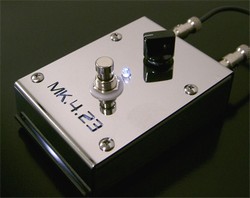
Pros: Does only one thing: It boosts your signal, giving you more cleans, or slamming your preamp tubes into sweet, singing, sustaining distortion. No bells and whistles, just a single volume knob. Super cool stainless steel finish, with backlit lettering.
Cons: None.
Price: $149 direct
Specs:
From zero to +24 dB of transparent boost
No tone coloration
No signal distortion
No phase reversal
True bypass with quiet switching
Ultra quiet 9v power supply included
Want a pure boost pedal? One that just does what it’s supposed to do? Simple to use? Doesn’t add its own “character” and just gives you more of your own tone? Look no further. I don’t say these words lightly either. All those things are true!
When Anthony Bonadio of Reason Amps first told me about the Creation Audio Labs Mk 4.23, I was really taken by the emotion in his voice when he described the pedal, and his claim that it was the best boost pedal he’d ever used. That’s saying a lot coming from a man who rarely uses pedals. And when he offered to send his to me to try with the Reason SM25 amp I recently reviewed, I just couldn’t wait until it arrived. It arrived today, and now I understand why he feels the way he does about the Mk 4.23.
Playing it through the Normal (clean) channel of the SM25, it does what it’s supposed to do: It boosts your clean channel. It was what I expected, so it was a bit boring, though I was impressed by the fact that there was no snap, crackle, pop when I kicked it in, and it just simply gave me more of my clean tone. But where this pedal really shined was when I kicked in the Bright and StackMode channels of the amp.
Talk about a visceral response! I can’t even describe the feelings I experienced as the pedal slammed the preamp tubes, and made the amp produce sweet, singing sustain that lasted for days! I always knew that the amp could produce incredible distorted tones, but with the boost engaged, I could hear additional harmonics and overtones issuing from the amp that up until that point I had never heard! On top of that, I never lost a bit of tonal clarity, even when I had the volume knob dimed and was creating that scooped, snarling dog buzz. That’s certainly a testament to the quality of the amplifier and complex and sophisticated sounds it can produce, but it’s also a huge testament to Mk 4.23 that can push the amp into that organic, high-gain overdrive. OH MY FREAKIN’ GOD!!!
I tested the pedal with humbuckers and single coils, and it was interesting to hear the difference in how the pedal performs with both. With humbuckers, the volume boost is less dramatic, as humbuckers send a lot of gain by default. But the effect was by no means displeasing. Where I didn’t get a significant volume boost, I got a lot more gain, driving the preamp tubes even harder. The sound was absolutely delicious! In fact, it drove the amp into feeding back, even a lower volumes! How cool is that?!! The guitar I used has tons and tons of sustain, but with the amp slammed, the sustain went on and on and on. And with that much gain, the compression from the power tubes just gave the signal balls of steel. But wait! There’s more!
With my Strat, the volume boost effect was dramatic; perfect for pushing your volume into great lead levels to get over the top of a mix. I didn’t get as much drive into the preamp tubes, but I wasn’t expecting that in any case. And yet again, the booster just took my tone, and simply gave me more of it.
So as you can tell, I REALLY like this pedal. I love what it does in a big way. But here’s another thing to love about this pedal: Its price. Creation Audio Labs got tired of using middle men and retailers that would price the pedals out of many players’ budgets, so they decided to only go direct. So what used to be a $260 pedal is now only $149. Buy it direct from Creation Audio labs!
In closing, after I return this pedal to Anthony, I’m going to buy this pedal. After just using it for just a short time, I’m confident in saying that this is a pedal that will always be on my board.
Back in September of this year, DigiTech released a line of high-end pedals under the “Hardwire” brand. These are high-quality, true-bypass pedals, and I have to say that I’m very impressed. Traditionally, DigiTech hasn’t been known for really high-end pedals. They’re typically priced at the mid- to low-end, and have always had reasonable quality. Nothing to complain about, but definitely nothing to write home about either.
But with the new Hardwire line, they’ve completely stepped beyond the norm, and have created pedals that have the potential to compete with other high-end pedals. In addition to being true-bypass, the pedals operate with a higher operating voltage which gives them a lot of headroom, making them a lot less susceptible to clipping. The power conditioning within each unit also ensures a constant voltage; a boon when a battery is being used, so you don’t get performance loss as battery power runs down (though I wonder how that affects battery life…).
I’ve been so focused on off-name brands of pedals for awhile that I’ve essentially ignored what the big production houses have been creating. So I apologize for being a bit behind the curve with the timing of this review. But be that as it may, I’m glad I stumbled upon this particular pedal while I was testing the EH #1 Echo at my local Guitar Center.
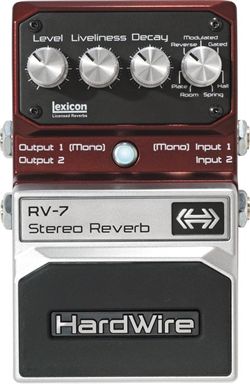
After I was done testing the #1 Echo, which I really liked, by the way, I asked the helpful, and amazingly knowledgeable sales guy if he had any good reverbs in stock. GC doesn’t really carry much in the way of boutique pedals, so I wasn’t expecting much. But very much to my surprise, he pointed me to the new line of Hardwire pedals, with special emphasis on the RV-7 Stereo Reverb, explaining that Hardwire was a new brand from DigiTech. I raised my eyebrows at that…
Sensing that I wasn’t some schmuck, he didn’t try to do a selling job on me, and just simply said, “Dude, I think you’ll really like this pedal. I wasn’t expecting it to be THIS good. You gotta try it out.” So I did, and the first words that came out of my mouth were “Damn! That’s sweet!” The sales guys just grinned and said, “I told you. Surprising to come from DigiTech, huh?” That was putting it mildly, to say the least.
So what makes this pedal special? DigiTech licensed 7 reverb effects from Lexicon. I’ve worked with Lexicon reverbs for years, and they are top-notch. At my Church gig, we use a Lexicon rack for vocals, and I just DIG that unit. To have them in a pedal for my guitar is even better! Granted, it’s digital modeling, but this pedal really KICKS ASS! In all the voicings, the sound is consistent, and you can dial in as much attack and decay as you need. Attack is controlled via the Liveliness knob which is similar to a pre-delay. For those of you who aren’t familiar with pre-delay, it’s essentially a certain amount of time (usu. in milliseconds) that a reverb unit waits before it kicks in the reverb. It’s very useful to have this kind of control, because those units without it often suffer from being really wet and soupy. Pre-delay allows a certain amount of dry signal to go out first, then tail out with reverb. The net result is that you get much better note articulation.
My favorite setting was the Spring Reverb, though they all sounded dynamite! And with the fine-tuning you can dial in with the Liveliness and Decay knobs, you can get just the right reverb effect for your purposes. I had so much fun playing with this little box! I spent more time with it than the #1 Echo.
Let’s look at the RV-7 features (from the DigiTech web site):
Reverb Types
Room – Fast decaying reverb; great for a touch of ambience
Plate – Renowned studio reverb heard on classic recordings
Reverse – Reverb in reverse; gradually crescendos to full volume
Modulated – Lush, modulating, reverb ideal for chords
Gated – Unique reverb with abrupt decay; good for percussive playing
Hall – Large, encompassing reverb with warm decay
Spring – Classic “surf” reverb; great for Rockabilly too!
Tails On/Off Switch – When on, reverb tails are not cut off in bypass
True Bypass circuitry preserves your tone in bypass
Constant high-voltage operation for tonal quality and noise reduction
HardWire Pedals include the following stage accessories
Stomplock™ knob guards lock your tone in place and prevent tampering or accidental knob adjustments onstage
Green gaffer tape helps you locate the pedal in adverse stage lighting
Custom-cut Velcro® pads attach and lock your pedals to your pedalboard
The features in this pedal, plus the standard features included in all the Hardwire pedals are definitely worth a look. And you’ll actually be blown away by the price: $149.00. While higher than their $100 pedals, that’s not a lot more to ask for that much more quality and features! And just for shits and giggles, here’s a video review by ProGuitarShops.com:
Finally, I realize that this review isn’t in the format of my regular reviews, and for that, I’m sorry. I just wanted to get this out. In any case, the DigiTech Hardwire RV-7 Stereo Reverb gets:
Just read a great article on setting up your pedal board on Guitar Jam Daily. It has great information on planning out your board size and layout – something I wish I had done before I got my board, which is now too small for all my pedals, especially since I’ve gotten a wah pedal! Eek! In any case, check it out!
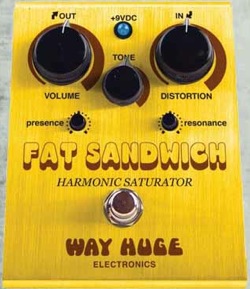
Okay, okay already. Another overdrive pedal. Just when you think you’ve seen ’em all, another pops up. But harken back to the early 90’s, and you’ll find Way Huge pedals gracing the boards of many guitar gods. Way Huge closed their doors in 1999, but a recent partnership with Dunlop has revived Way Huge, and the Fat Sandwich is one of the products of the partnership.
As many know who read this blog regularly, I’m a bit of an overdrive/distortion pedal nut. Just love the things. Silicon, germanium, doesn’t matter. I’ve always dug the tones boxes like the Fulltone OCD and Ibanez TS-808 produce. But then again, I never had good enough tube amps whose natural distortion didn’t require some bolstering.
Then I discovered Reason Amps, and did a review of the Reason SM25, which the guys at Reason graciously sent me to evaluate and to show to some local dealers. For the first time in my playing career, I’ve been playing an amp that has a knock-your-socks-off natural distortion. It’s so pleasing that I just don’t need overdrive or distortion pedals to get that saturated sound. It’s in the amp!
But the one thing that I found that I missed when playing with the amp at a couple of recent gigs was the volume boost I’d set up in my drive pedals to play a lead. It wasn’t that big a deal; I just set up the base volume of the amp a little louder than normal, then use the volume knob on my guitar. And for most situations that has worked out well. But when the band gets really loud, I need some extra oomph, and that’s when I started thinking that a booster pedal would really help.
And wouldn’t you know it, by pure coincidence, Anthony Bonadio at Reason called me last week and asked me if I had tried out the Creation Audio Labs Mk.4.23 Boost pedal. He claimed that it was best boost pedal he’d every played through, and that it was completely transparent. It takes your guitar’s signal and just makes more of it; totally transparent. Then told me he’d send his own out to try with the SM25. Then I got really interested. Check out the video demonstration below:
Flat EQ response, and a single volume knob? What could be easier?
I know there are lots of booster pedals out there. But from my research, it seems that most add some coloration of their own, or have an extra “drive” knob to add overdrive. From my perspective, a booster should just well, boost; that is, take what you have and just give you more of it. And from what Anthony has said, and from the reviews I’ve read, this seems like it does just that.
If this is enough for you to take a bit, you can only get the pedal at Creation Audio Labs directly. But don’t dispair! This pedal is only $149.00!!! Can you believe it?!!! Creation Audio Labs want to reach as many people as possible, so they eliminated the middle man and sell their pedals direct. So what used to be $250+ pedal is over a hundred bucks cheaper!
I think those pedals are definitely worth a look for price alone! Creation Audio Labs has been known as a great boutique pedal maker, and to have them get into the range of more affordable pedals is absolutely awesome! Check ’em out!
The problem with evalutating pedals online is that you can’t really audition them very easily – especially in combination with other pedals. But BOSS has gotten us one step closer with the new BOSS VPB-2 or Virtual Pedal Board. It’s very cool in concept. You go to the VPB site, select a style of music and a combination of pedals appears on the page. A loop in the style you’ve chosen begins playing, and you can then activate/and de-activate pedals to see how they change the recorded signal just by clicking on them. You can also swap some of the pedals out for the current style.
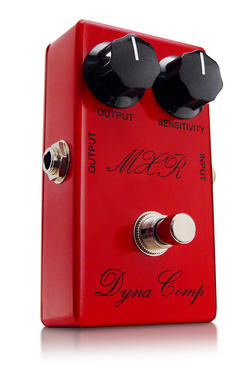
Over a year ago when I was looking for a compression pedal, one of the pedals I reviewed was the MXR Dyna Comp, along with the Boss CS-3. I didn’t like either of them. The CS-3 was way too squishy and I thought it significantly altered my tone. The MXR wasn’t quite as bad, but I still thought it did enough tone alteration to pass on it.
As many might know, I ended up going with the Maxon CP9 Pro+, which I felt didn’t alter my tone, no matter how far I squeezed the signal. I love the pedal, and when I play my Strat, it’s almost always on.
But in my search for a compressor back then, I ran across several discussions on the classic Dyna Comp from the 70’s. People raved about its transparency, and how it was a highly sought-after pedal. In fact, a search on eBay revealed that I couldn’t get a vintage one for under $250. Yikes! For a pedal that brand new goes for under $80, the vintage Dyna Comp must’ve been really special.
Well, the folks at the MXR Custom Shop have produced a limited run of the classic Dyna Comp replete with the script lettering, and more importantly, the EXACT same circuitry as the original. According to the article I read, the IC’s used in the original pedal haven’t been produced since the 80’s. But the Custom Shop folks seemed to have found some – at least enough to produce a limited run.
I looked on the Dunlop site for any information about the new pedal, and there was none to be found. No prices either. Count on this baby to hit collectable status real quick. Also count on it being priced a hell of a lot more than its newer sibling, which you can get at Musician’s Friend for $69.99. Now given that I already have a kickass compression pedal, I’m probably won’t be in the market for one, but I sure would love to get my hands on one just to review it.
For those of you who are a bit dubious of using a compression/sustainer, please don’t scoff. I will admit that for high-volume, high-gain situations, a compression sustainer is not really needed. You’ll get a lot of compression from your saturated power tubes. But for those of us who mostly play in low-volume applications, a compression/sustainer is a total life saver.
The restaurants and church that I play at have high ceilings, and of course, there’s the ambient crowd noise to deal with – especially at the restaurants. To help cut through the crowd noise, and to deal with the expansive acoustic environment without turning up too loud, I couldn’t do without a compression pedal. This is especially true when I kick in distortion, which tends to “spread” out your sound a bit. With a compression pedal, you fatten up your tone and produce a more even volume, albeit a tad less dynamic.
You might think that the loss volume dynamics is a bad thing, but before I got my CP-9, I had to fight my volume all the time – it was frustrating.
Apparently, the newer M-102 version with serial numbers starting with ABxxx are true bypass, and sound really nice. Maybe the one I tried at the time was not one of ’em. Oh well… In any case, if you’re interested, you can check it out at Musician’s Friend:
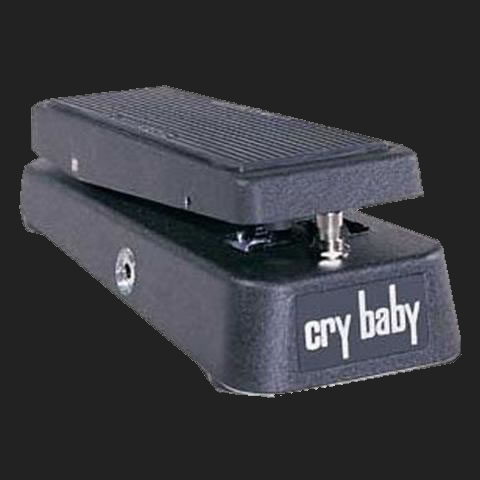
About a week ago, I wrote an article about getting a wah pedal. I had tried out and listened to several, and actually dug on a lot of them, but I just kept on coming back to the original Cry Baby. There has just been something about the classic sound of the Cry Baby that just makes me close my eyes with a smile of complete satisfaction while I’m playing.
For other players, this classic wah sound may not be their cup of tea, but this is the sound I grew up with. Every cop show on TV in the 70’s had a guitar played through a wah, and of course, let’s not forget Jimi who took it to another dimension. And it’s not like I’m going to try to play like Jimi – frankly, no one can – it’s just a sound that I’m used to, and it puts me in a time warp, back to when I was a kid.
Did nostalgia make me pick the GCB-95? It probably had a lot to do with it, but that’s the thing about tone: It’s what you like that matters. I didn’t get that nostalgic feeling of my youth with a lot of the other pedals. Yeah, I do admit there were some really awesome ones out there that I was ready to buy, but I figured that those could actually wait. I just couldn’t justify making a substantial investment into something that was so new to me. But I could get a Cry Baby at a fraction of the price, and I figured that since I was so new to playing with a wah, it would be best to instead make a minor investment to try out the technology before I spent a couple of hundred on a more expensive model. So, I forked out a reasonable $49 bucks at my local used gear shop for Cry Baby in excellent condition and saved even more money to hedge my bet.
So after a day, what’s my take? Well… I should’ve gotten a wah a long time ago! Don’t know what it is about it, but I’ve taken to it like a fish to water! Not to say that I’ve completely mastered it in a day, but it sure does feel natural. And you know what? The Original Cry Baby may be bordering on the vintage with respect to tone, it may only cost $69 used, and may be considered way too low tech for more modern players’ likings, but it totally does the job for me. I’m very satisfied.



 Guitar Gear