 |
Voodoo Lab Micro Vibe
Summary: Looking for that vibey sound? Look no further. The Micro Vibe serves up a range of vibe tone from chimey chorus to thick, soupy psychedelic in nice compact stomp box. Pros: Incredibly versatile vibe that has multiple personalities depending upon where you set the knobs. Cons: A little tricky to set up in your chain, and can be finicky with overdrive pedals, and can make your low-end really boomy (not hard to overcome, though). Price: $149 Street |
 I wrote a comparison review between the Micro Vibe and the Fulltone Mini Deja Vibe, two excellent ‘vibe pedals out on the market, but since I recently purchased the Micro Vibe, I thought I’d do a full review because my original evaluation was done in a more controlled environment A/B’ing the two pedals.
First off, this pedal is extremely easy to use. Two knobs control intensity and speed, and toggle switch turns the unit on and off. This pedal is true-bypass as well, so when it’s off, it’s really off – very nice to find in a relatively affordable pedal. To get that psychedelic sound, you set intensity about 4 or 5 o’clock, and the speed anywhere between 11 and 2 o’clock. For a more chorus-like effect, I set both Intensity at 12 o’clock and speed at about 1 o’clock. I’m still playing with it, but so far, so good!
Like the Fulltone, the Micro Vibe boasts a faithful reproduction of the original UniVibe’s circuitry. I’m not much of an electrical guy, so I’ll take their word for it. However, in the previous comparison review, I mentioned that the Micro Vibe has a slightly darker tone than the Mini Deja. To me, it has a rich tone that really brings out the lows – though I found through my latest experimentation that you really have to be careful about your EQ. Too much low-end, and you’ll get a really muddy sound. I found that with both the Mini Deja and the Micro Vibe, but a bit more so with the Micro Vibe. It wasn’t too hard to overcome with a little EQ adjustment, though, so that was just a minor problem. All in all though, the two pedals sounded very similar, giving off that ‘vibe sound that I just love.
What the Fulltone has over the Micro Vibe is a Vibrato mode, that gives you the pulse from the photoresistor without the phase effect. It also costs almost twice as much. For me, I wanted a dedicated ‘vibe pedal with no other accoutrements, and the Micro Vibe serves that up just fine!
One thing that I found really nice with the Micro Vibe was how the pedal’s intensity responded to the input gain from my guitar. Higher gain produced higher levels of intensity. That’s very cool because it’s possible to dial back the intensity of the effect from your guitar.
In any case, here are a couple of sound clips I recorded to demonstrate a bit of the Micro Vibe’s capabilities:
TS-808 plus Micro Vibe:
Micro Vibe with a bit of reverb:
Both clips were played with my Strat and output through a Fender Champion 600.
I did find it a bit challenging placing the Micro Vibe in my signal chain. Placed before my overdrive pedals, it was pretty tough to control, and the resultant pulsing drive wasn’t too pleasing to the ear – though it was correctable with some minor tweaks to the OD pedals. I found that it worked the best (at least so far) at the end of my chain, right before my BBE Sonic Maximizer. It’ll stay there for awhile, then I’ll switch its position to see how it compares.
Here’s an interesting thing that I found that I forgot to mention: The Micro Vibe sounds absolutely horrid with a Fulltone OCD. I really wasn’t expecting that. It probably could be the chip that’s used in the OCD. Whether I put the Micro Vibe in front of the OCD, or after it didn’t matter. The combination was UGLY! But it sounds awesome with Tube Screamer-type pedals like my TS-808 and Bad Monkey.
In conclusion, if you’re looking for that vibey sound, the Voodoo Lab Micro Vibe delivers that in spades, and at a very affordable price!
 As a guitar player and singer/songwriter, nothing brings me more joy than to see my kids enjoying my music. But what really makes it all worth the effort is a conversation I just had with my son Owen a few minutes ago. I was in my home studio,
 I was conversing with a friend of mine who just received his conditional black belt in Tae Kwon Do this past weekend – very great accomplishment. During the course of our conversation, he said the one missing ingredient in his study of martial arts is developing his “chi.” He believes in chi, but is having a hard time grasping what it is all about. Chi is a Chinese word that describes the natural energy of the universe. For sci-fi folks, it’s the equivalent of the Force in Star Wars. Without going into detail, the development of chi is at the heart of martial arts, though it is downplayed in the US because we live in such an empirical society where everything needs to be explained. In any case, my friend wanted to know more about developing his chi. We’ve had previous conversations about this subject, and I’ve related how I developed my chi over the years, so I showed him some techniques. But that’s really not what this blog entry is about…
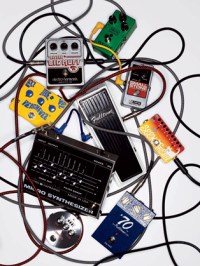 I walked into my garage this morning, which also doubles as my home studio and I looked around and saw several items that I’m not using at all right now. This includes a couple of solid state amps, a few pedals, and a sweet, digital recording workstation that I inherited from my brother that I never use because GarageBand is so much easier. My wife is great about all this, but she recently told me I have to do some spring cleaning. “Look at the big amp,” she said, “You haven’t gigged with that in a couple of years, and I haven’t seen you record with it either. Maybe you ought to get rid of some stuff… Besides, you need to make room for the shelving I want to put in here this spring”
 Guitar Gear