Feeds:
Posts
Comments

Archive for the ‘Guitars’ Category

As in Gear Acquisition Syndrome…

Here’s the backstory… Back in May of 2021, I got an email from the keyboardist of my former old farts classic rock band asking if I’d be willing to fill in for their lead guitarist who was going to be away on a business trip. I agreed and we set up rehearsal dates leading up to the gig. I hadn’t played with them for over six years, so I was excited to get back together with them. Rehearsals went swimmingly well. It was like we have been playing together this whole time. They went so well that at the third rehearsal, our drummer, who’s also one of the band leaders, asked me if I’d like to rejoin the band as a permanent member. I agreed and have been playing with them since.

When I was doing 250+ gigs a year back in the day, I was gobbling up some kind of gear quite often. It was compulsive behavior where I spent tens of thousands of dollars on amps, guitars, effects, sound systems, etc. It was a serious case of GAS that filled up my garage with stuff; most of which got limited use. But getting all that gear helped build this blog so I have no complaints nor regrets for getting all of it. And I have since given away or sold much of the gear I acquired all those years.

The great thing about getting back to playing regularly is that though I sold off or gave away lots of gear, I still had LOTS. So, it was easy to literally “gear up” and play. I had all the effects I needed, so I didn’t need to get any new gear. The exception was my purchase of my Fender Tone Master Deluxe, which replaced my BOSS Katana Artist that went on the fritz at a gig. But other than that, I’ve purchased strings and picks. That’s it.

I still keep up on new gear that’s coming out, but to be honest, I’ve found my sound so I’m not feeling hard-pressed to explore. The only thing I may get is a BOSS CE-2W Chorus so I can retire my 1981 BOSS CE-2. It still works great, but it is pretty beat up from the hundreds of gigs I’ve played with it over the years.

And now that I’m over 60, I’m just not interested in lugging a lot of gear. I want to make one trip from my car to the stage. Here’s my equipment list:

Guitars

  1. Taylor T5z
  2. Squier Classic Vibe Tele
  3. Gibson R8 Les Paul

The T5z is my #1 since it is so versatile. I switch between the CV Tele and the R8 depending on my mood, but lately I’ve been playing the CV Tele a lot more than my R8.

Amps

  1. Fender Tone Master Deluxe Reverb
  2. DV Mark Little 40 L34 / Avatar 1 X 12 with a Celestion Gold
  3. Aracom VRX22 (Plexi clone) / Aracom 1 X 12 with a Jensen Jet Falcon

All my amps are set to the edge of breakup to allow me to push it if I need to but clean it up. The exception is that I will sometimes go for maximum headroom with the Little 40 and let my OD pedals provide the dirt. It’s a mood thing for me.

My main amp is the Deluxe, but lately it has been splitting time with the Little 40. I brought it to my last two gigs and I forgot just how sweet that amp sounds. When I play the Deluxe, I use the Line Out to feed my signal into the PA. For the other amps, I hang a Sennheiser e609 in front of my cabinets, positioned halfway between the center and edge of the cone.

I set my amp volume so I can hear it, and have taken to pointing it inward so my drummer can hear it. I let the PA do all the sound reinforcement. This saves my ears but also gives the band a much more balanced presentation.

Effects

  1. Wampler Belle (Nobels ODR-1 clone)
  2. Paul Cochrane Timmy Overdrive
  3. BOSS CE-2 Chorus
  4. BOSS DM-2w Delay
  5. Pigtronix Class A Boost

Super-simple effects chain. I run everything in front of the amp. The Wampler is my primary overdrive. I prefer the flatter ODR-1 sound over a TS midrange hump. I use the Timmy almost exclusively for stacking. I use both the Chorus and Delay sparingly, though for clean tunes, I love adding that slapback sound. As for the boost, that’s for when I play leads. I don’t need a volume pedal.

Strings

  1. The T5z is strung with Elixir Electric 11-46. This provides the perfect balance between electric and acoustic. And amazingly enough, they bend so well.
  2. For my other guitars, I just use standard Ernie Ball Slinkys 10-42.

Read Full Post »

Since I got this amp, I have gigged with it a bunch of times! The Tolex has a couple of dings, and the faceplate has a couple of minor scratches; about what I’d expect from regular use. Mind you, it’s not that I don’t take care of my stuff, but gigging takes its toll on any gear and dings and scratches are the price you pay.

That the Deluxe has survived those “battle scars” (plus being knocked over a few times) is a testament to its ruggedness. I’ve had lots of other gear that was so delicate that I’d never gig with it. And to be honest, if I can’t gig with it, it’s practically useless to me. But the Deluxe has not only survived the rigors of regular gigging, but it still sounds incredible!

To this day, I have only opened it up to the full twenty-two watts once. The way my band’s sound is set up, I usually only need enough volume to hear myself; that is, unless our lead guitarist decides to crank it, and by that time, everything goes to shit. Though, for the most part, I keep it attenuated to 1 or 5 watts and even 0.5 watt for small venues, then use the line out to run my signal into the board. With the attenuator, I can still get good overdrive through the pre- and power amp stages (I know, it’s simulated rather than being real), and it sounds damn good! When I hit it with a booster or an overdrive pedal, it takes it over the edge, acting so much like a tube amp, I forget that it’s a digital amp!

And I suppose it could be argued that I’m not getting the full range of sonic content from my amp because I’m not pushing SPs. But I’d rather keep the hearing I have left than push the amp to a volume that introduces speaker distortion, something that in the end is merely nuance and frankly, only matters to me. Besides, since my sound reinforcement is coming from the PA, that’s a moot point.

If there is one negative mark I might give to the amp, it does not work well with distortion pedals, especially high gain distortion pedals. I hooked up my trusy EWS Little Brute Drive distortion pedal to my board to try it out, and it was off in 20 minutes! It sounded mushy in the mids and lows and spiky sharp in the highs. I tried to tweak my EQ pedal to compensate and while I could achieve a passable sound, passable wasn’t good. Passable isn’t inspiring.

I did try it out with an old ’80s MXR distortion (the gold one, MX-104) that I still have from way back when, and it was much better, like insanely better. But I think that pedal has a lot lower output than the Little Brute Drive so it worked better with the amp. Even still, the sound wasn’t nearly as good a sound as I get with my Tumnus, Abunai 2, Belle, or Timmy. All my overdrives work great with the amp which leads me to believe it was built for use with overdrives, prefering a mix of gain and soft clipping coming from the pedal. I don’t know this for certain, but based on my personal experience, it seems plausible.

For those who’ve read my blog for a while, you may remember that I was a huge Boss Katana fan. I still am, and still have the amp. In fact, it turns out that the “problem” that I seemed to have with it wasn’t the amp at all, but a bad patch cable. Oh well… But since I’ve had the Deluxe, I totally get what Fender was after with the Tone Master amps: Do one thing really, really, really well. And at least with the Deluxe, they got it in spades!

And there’s a lot to be said for keeping things simple. Though I love the Katana, I had to spend a lot of time dialing in the different channels with the right combination of effects. Once I got the process down, it was easy, but there were still a lot steps. On the other hand, with the Deluxe, I set the volume and amount of reverb I want. That’s it. EQ is all in the middle because I use a graphic EQ on my board. So, setup for my rig is literally a 5-minute affair, if that.

Finally, the Tone Master Deluxe weighs only twenty-three pounds. At my age, gear weight becomes a factor. The Katana weighs almost twice that. Yes, I can still lift it but lugging 23 pounds vs 45 pounds… there’s a substantial difference between the two. I’ll take the lighter option, thank you.

It hasn’t all been just rock and roll. I’ve used the amp several times at church. For that gig, I use my Taylor T5z as I can get a nice acoustic-like tone out of it then switch to an electric tone when needed, and as with my classic rock band, my sound reinforcement comes from the PA. My setup is a little different because I set the amp to clean. Any distortion I need comes from my overdrive pedals. Set up as a clean platform, the amp performs as expected. There’s nothin’ like Fender cleans.

In closing, I have no regrets about buying this amp. It has been a trusty companion for all types of gigs and venues I’ve played. Yes, there may be less expensive options that have more bells and whistles, and I agree with the point that if you buy Fender or Gibson, you pay a premium for the name. But in this case, the gear delivers. You can’t put a price on great sound.

Read Full Post »

I remember the first time I ever laid eyes on this guitar. I was at a relatively intimate venue to see Eric Rachmany and Kyle Hearn of Rebelution play an acoustic concert in San Francisco. When they stepped up on stage, both were wielding these gorgeous Taylor guitars. At first, I thought they were T5s, but they looked too small. So being in the age where information is literally at your fingertips, I looked up the guitar model and found that it was a T5z that they walked onto the stage with; simply gorgeous-looking guitars! Then Eric and Kyle started playing…

The guitars sounded as good or better than almost all the plugged-in acoustics I had ever heard. No midrange honk, and no loss of dynamics. It was a pure, rich, and natural sound that penetrated deep into my very soul! I know, a bit dramatic, but the effect of the guitars’ sound was so incredibly visceral that it shook me to the core. I knew then and there that I would be buying one in the next couple of days. It actually took me three days. The concert was on a Friday and I brought a T5z home the following Monday.

After testing it thoroughly at GuitarCenter my hope was that even though it had a great plugged-in acoustic sound, it was mainly – and as I wrote in a previous post, unabashedly – an electric guitar; one that could amazingly cop a bunch of different styles of electric guitars but amazingly had an excellent acoustic guitar sound. And unlike the original T5 which I thought couldn’t decide what it was, that isn’t the case with the T5z.

Earlier this year, I rejoined my previous old-farts-classic-rock band. Since we were doing predominantly songs that mainly employed an overdriven sound, I didn’t feel the need to use the T5z much, splitting time between my R8 and Tele. But as we have two guitarists, I’ve switched to using the T5z to provide a contrast in guitar sounds, especially when we do Eagles songs where I can use the T5z’s acoustic setting for acoustic-like strumming.

But I have to say that where this guitar really shines is when I use it as a straight-up rock machine. I call it a “machine” because depending on where I set the selector and adjust the EQ, I can get single-coil, humbucker, and even hollow-body guitar sounds. And with the breadth of my band’s repertoire, having a guitar with that kind of versatility allows me to get a sound that fits pretty much any song we play. Plus it’s great to have to rely on a bunch of pedals to get the feel and sound I need.

And this is pretty much everything I was hoping to get out of the T5z as far as sound is concerned. But the sound is nothing if the guitar isn’t comfortable to play and the T5z is an absolute joy to play. And that’s surprising because it’s set up for 11s which at first blush might not seem too bendable. But bending is not at all an issue and the action is so perfect that playing chords and moving around the fretboard are practically effortless.

It’s a little surprising to me just how much I love playing the T5z and just how much it has become an integral part of my rig. I’ve been a Les Paul guy for years and truth be told, I’ve felt a little guilty not playing my R8 that much – let’s be truthful, at all – since I started using the T5z as my main guitar. I still bring my R8 as a backup, but I haven’t even been tempted to pull it out of its bag as the T5z handles everything.

I laugh at my original post on the T5. I was so unimpressed with it mainly because, as I mentioned above, I felt it couldn’t decide what it wanted to be. But the T5z has completely bowled me over. I’m looking forward to many more years playing it!

Read Full Post »

A few weeks ago at band rehearsal, our other guitarist was setting up and I noticed he was using a wireless system. I asked him if it was the BOSS wireless, and he replied that he just couldn’t justify spending $200+ for a wireless system. Instead, he did a lot of research on the various budget systems out there and finally decided on an Xvive system.

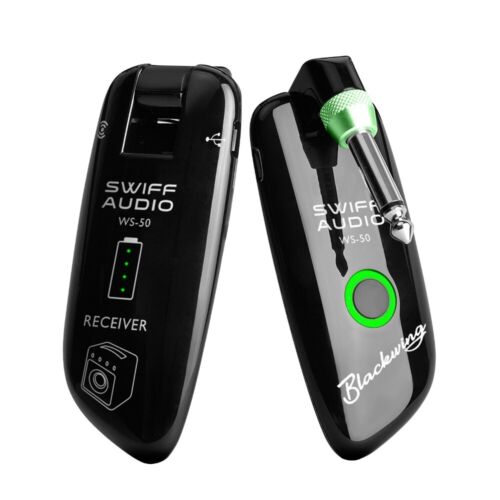
He sent me a link to it because I thought he sounded great with it. But being a gear guy myself, I couldn’t resist doing my own research. And in my research, I stumbled upon the Swiff Audio WS-50 system. I read and watched several reviews and decided to give this system a try. And why not? At $56.00 on Amazon, it was less than half the price of the Xvive.

But what also sold me was that it operated in the UHF frequency range which was intriguing to me because all the rest of the systems either operated in the 2.4GHz or 5.8GHz range. Even before I saw a video that confirmed my concern about that, I wondered that with both WiFi and cellular operating in these frequency ranges if there might be a problem with those ranges being too crowded at times. It wasn’t a really big concern, but I still had it.

Then when I came across the WS-50, I noticed that it operated in the UFH range. When I was growing up in the days before cable TV was ubiquitous, there were two TV bands: VHF, which had all the major networks on it, and UHF where all the good cartoons like Speed Racer, Simba, and Spiderman played; not to mention Ultraman! Well… UHF has pretty much been supplanted with cable – and I supposed VHF as well – so with the WS-50 operating in the UHF range, my concern for frequency conflict was much lower.

So I pulled the trigger and it arrived a few days ago. It came almost fully-charged, so I just plugged the receiver into my amp and plugged the transmitter into my guitar and… It just worked. Almost ’nuff said. I practiced with it for almost an hour and had no signal drop-off or any interference whatsoever. Granted, I was in my house, so the chance of interference was pretty low. But yesterday, I brought it to my church gig to really run it through its paces. But instead of plugging the receiver directly into my amp, I plugged it into my pedal board. Again, it just worked.

I have to admit that I was a bit concerned about the quality of the unit, considering I only paid $56.00 for it. But wireless technology is so mature now that even low-cost units will be fairly high-quality. And the WS-50 rocked it! I haven’t compared how it sounds to a cable connection, but it plain sounds good, so I don’t really see the point in making the comparison.

And how it sounds is really all that matters to me. And it worked right out of the box! Now during my gig yesterday, during a break I turned both units off to save the batteries and when I went to play again, they both came up real quick.

One thing I do love about the WS-50 and frankly, the new wireless units that have come out on the market is that they just plug right into jacks. I had a Sennheiser remote for a long time and no doubt the quality was super-high with that unit. But it was a bit inconvenient in that the remote unit clipped onto either my strap or onto my belt. If I brought multiple guitars to a gig, I had to duct tape the unit to my strap.

But with the WS-50 and its ilk, I can turn off the transmitter, remove it from my current guitar, place it into my new guitar, then switch the unit back on. And it does it completely noiselessly! Super-convenient!

Read Full Post »

If you don’t want to read any further…

Damn! I shouldn’t have loved it, let alone like it, but I absolutely fell in love with this amp! I’m not ready to buy it as I’ve got to try out the Deluxe Reverb, but I probably will get one of them. Now that that’s out of the way, let me give you the back story.

TL;DR

With the pandemic lockdown over, my former old farts classic rock band asked me if I’d like to come back and play with them. At first, it was just to sub at an upcoming gig for their current lead guitarist who had to attend a company retreat. But over the course of a few rehearsals leading up to the gig, they kept on hinting, then finally just outright asked if I’d play with them again during the break at our gig. I had forgotten just how much fun I had playing with them so I readily agreed.

For the gig, I used my BOSS Katana Artist. I love that amp and through the first set, it worked awesome. But a few songs into the second set, its volume started fluctuating. I powered it down then powered up again, and it didn’t happen again during the gig. But my confidence in the amp was shaken. And an amp isn’t something that I normally bring a back up for a gig. So needless to say, that experience put me in the market for a new amp.

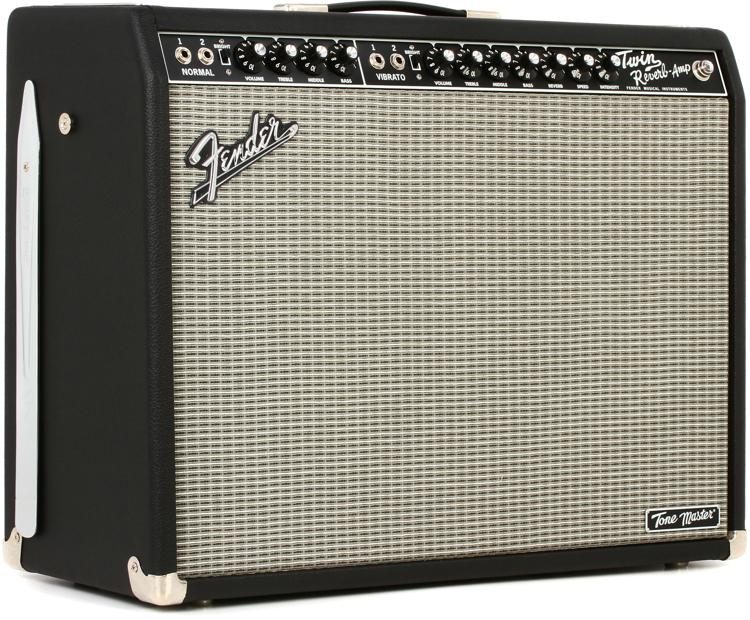
A couple of days ago, I took a bit of time to go down to my local Guitar Center. They didn’t have the Deluxe in stock, but they did have the Twin. So I took it out for a spin.

Like a regular Twin, it’s all about clean headroom. But the totally AWESOME thing about this amp is that it has power scaling, basically a built-in attenuator to reduce the output wattage of the amp so you can crank it. The Deluxe allows you go all they way down to 0.2 Watt and the Twin lets you go down to 1 Watt. That’s still pretty loud, but it does let you crank the amp and not make your ears bleed.

The dirty sound of the Twin is just okay. Truth be told, it doesn’t break up a lot, but that’s not what you get an amp like that for. But for cleans and tons of clean headroom, this is a GREAT platform. And though the sound is a little different from an original Twin (which frankly you should be able to get real close with EQ), the sound is unmistakably Fender, with that luscious three-dimensional quality about it. If the amp didn’t have that quality, I would’ve dismissed it out of hand.

But the sound is good. Real good. And for me, it was so good that I almost bought it on the spot, but I need to try out the Deluxe before I make a decision.

And I almost forgot… The amp only weighs 33 lbs! An original Twin starts at 64lbs and goes up. My buddy’s Twin weighs over 80 lbs! And the Deluxe only weighs 23 lbs! For an older guy like me, that’s totally appealing.

I didn’t get to try the feature out at the shop, but I dig the fact that it has an XLR out with optional cab simulation IRs. This is a total value-add as I can get my sound into the PA and not have to rely on the amp to get my sound out. I can keep it at a reasonable volume near me and let the PA get my sound out to the audience.

An XLR out. Power scaling. Great sound. I’m sold. I’ve always leaned towards the Twin because I just love the Twin’s sound. But I’m a little conflicted because the Deluxe’s dirty sound is damn good, at least from what I’ve heard on demos. It’s the kind of amp you set at the edge of breakup then use a combination of volume knob and pedals to tip it over the edge. It’s the way I’ve set up my amps for years. But lately, I’ve been wanting a lot more clean headroom.

Then there’s the weight of each respective amp. The Deluxe is a total lightweight at 23 lbs. And though the Twin only weighs 33 lbs, that’s still a 10-lb difference. I really need to A/B the two amps.

Circling back to sound, one might ask just how close to the sound of an original Twin does the Tone Master get? I’ve played several Twins over the years, but I didn’t have one to A/B, so I can’t really answer that question. But at least for me, the Twin has always been about the classic scooped, Fender sound. The Tone Master has that down in spades. And though it’s a digital amp, emulating an original black face, that emulation is damn good, both in sound and dynamics; so good to me at least that even if it wasn’t emulating an original Twin, it could easily stand on its own merits as a great amp.

Plus, with the two speakers, the spread of the sound is wonderful. Whereas a single 1 X 12 is pretty directional, the two speakers of the Twin provide a sonic spread that adds depth and breadth to the sound.

As compared to my Katana Artist or other digital amps, the Tone Master might seem to be a one-trick pony. But to me, therein lies its beauty. What Fender has done is to create a digital emulation that is absolutely superb, focusing solely on that as opposed to other amps that include effect emulation and/or emulation of several amps. It’s this focus on a single platform and doing it excellently that to me at least makes it stand out.

Admittedly, it’s not for everyone. For years, I’ve gravitated towards the Marshall Plexi sound. I’ve always had a Fender amp of some sort in my studio, but for playing live, I’ve mostly used Marshall style amps. That changed when I got my Katana that I got specifically for its clean headroom to be a pedal platform.

That amp has a sound all its own, and I was actually thinking about getting another one. But what I think influenced my research into the Tone Master line was the old Fender Ultra Chorus I use at band practice. That amp just oozes Fender clean goodness. It’s a great clean platform that emulates my live sound.

If I had any negative marks about the Tone Master line it’s the same negative marks I give to other Fender products. That is the price. At $1049 for the Twin, it’s a bit of a steep barrier to entry. The Deluxe is $949.

With only a few features, you might think that the prices Fender’s charging exceed the value of the amps. But if the sounds differ from the originals much like the difference in sound due to different tubes or speakers, then perhaps the value lies in the emulation software and computing power of the amps. The Deluxe uses dual processors, while the Twin uses quad processors.

That said, you can occasionally get these on sale for slightly less. I may wait for a sale. Or maybe I won’t. I do know that I will end up with one of these amps.

Read Full Post »

The other day, my cousin Willie texted me to let me know that he was in town for a few weeks. In his text, he mentioned that he was thinking about selling his dad’s baritone ukulele and got it appraised at Gryphon Stringed Instruments in Palo Alto. I’ve known this uke for many many years. My uncle Roy – Willie’s father – used to play it with the Hawaiian music group he was with and I remember many family gatherings where my ohana would sit and play and this uke was one of the instruments.

So when Willie told me he wanted to sell it, all those memories came in a flood and I knew I had to have it. On the one hand, I knew he probably needed the money, but on the other hand, it was a family heirloom and it would be a total shame for it to leave our family, especially considering its history. So I told him that I’d like to check it out and I would buy it for what Gryphon would offer.

Willie brought it over to the house yesterday and as soon as I took it out of its case, even though I hadn’t even played it, I could feel my beloved uncle’s spirit in it, and I had a Wayne’s World moment… Oh yes! It will be mine!

Of course I had to play it. But once I picked it up, I got lost in its sound, and I immediately hit upon a riff and just went from there to where I went right to my office and laid down what I was playing (recording below).

I don’t know the exact provenance of the instrument, but I do know that it was made in the 70s as that was when my uncle purchased it. Apparently there’s date coding in the body somewhere, but I haven’t looked as of yet. As for the build, it is made entirely of Hawaiian Koa – even the fretboard.

As for how it sounds, it has a haunting voice which gave me this image of walking on a steep mountain trail in the tropics. Even with the strings being a decade old since it hasn’t been played since my Uncle Roy passed away, it still sounds incredible!

Read Full Post »

Summary: Based on the classic Nobels ODR-1 circuit, Brian Wampler added his own touches (of course) making this one helluva a versatile pedal. You can use this as a transparent boost on up to an absolute crunch machine. And make no bones about it: This isn’t a copy of the other green overdrive. This circuit is absolutely unique and has been a mainstay on many guitarists’ boards.

Pros: Though there are five controls (including the clipping switch on the side of the pedal), it’s incredibly easy to dial in a great tone. For me, the Bass and Color knobs are what makes this pedal so amazing. And the sound? Fuggedaboudit! This is unlike the TS sound by a long shot.

Cons: Absolutely none so far.

Price: $129-$149 street

Tone Bones:

I was all set to get a regular Nobels ODR-1 Mini, but then I saw this pedal come up in my search. The variable Bass control knob did it for me. Having that sweep makes such a difference!

Getting Reacquainted with the ODR-1 Sound

Many years ago, I had an original Nobels ODR-1. I liked it then, but to be honest, I wasn’t playing enough electric guitar to know the difference between the different dirt pedals, so I just kept on using the MXR distortion pedal my brother gave me. Fast forward 25 years (or is it 30 now… sheesh) and I play all sorts of guitars. So when I saw a video of a guy using one, I remembered having that pedal and thought that it would be good to get this one as I have a bunch of TS808 derivatives already.

So I did a search for some videos on the ODR-1 and the Wampler Belle came up. Since I had already seen several ODR-1 videos, I loved the fact that the Belle had a variable Bass control. That sold me even though it’s almost twice the price of the ODR-1 Mini! But I’ve liked Wampler pedals for a long time and the build quality of Brian’s pedals are awesome, so I decided to pull the trigger.

Luckily, they had one in stock at my local Guitar Center and I was able to audition it. I only need five minutes. Everything that I had heard on the videos was pretty much confirmed when I played some chords and some scales. And yes, it was the Bass knob that sold me.

I was playing through an amp that I detested: The Fender Princeton Reverb. To me, that amp is just way too trebly, but I was able to tame that with the Bass control, then with a couple of tweaks of the Color knob, I was able to dial in a sound that was absolutely incredible. And I was playing a Strat! That was it. I unplugged it and bought it on the spot.

For those who are familiar with the ODR-1, it’s known to be popular with Nashville session players. I’m thinking it has to do with the tight bass of the circuit. Since a lot of those players use Telecasters and Strats, it’s not a surprise why it would be so popular. However, make no mistake about it. It’s not just a country or country rock pedal. Though it’s considered a lower gain overdrive, it can put out some serious crunch.

How It Sounds

I was going to do a few clips but I ran across this video that does a MUCH better job of explaining the sonic differences between the TubeScreamer sound and the ODR-1 circuit – plus Brian’s take on it with the Belle. Check it out:

Read Full Post »

I was watching a GREAT video on Rhett Shull’s channel today where he was interviewing one of the greatest session guitarists, Tim Pierce. Near the end of the video, Tim said something that I just had to share:

“I paid a lot for this amp but it doesn’t do everything… It just does one thing… That’s the thing you’ve GOT to make peace with…”

Here’s where he says it in the video:

I recommend watching the whole video because it focuses on how to use something near and dear to my heart: Overdrive!

But OMG!!! When I heard Tim say those words, “Make peace with it,” I said, “F#$k yeah!” out loud because that simple, short phrase articulates exactly where I’ve evolved to with respect to gear.

Other than my guitars, I’ve always been about versatility with all my other gear. But not in the way you might think. With pedals or amps, I will dial them into their sweet spot – at least where I feel the sweet spot is – then always keep them set there. But that said, I always wanted to know that if I wanted to do something different, the potential was there, and I could make an easy change.

For instance, take my BOSS Katana Artist. It is loaded with great BOSS effects. But I don’t use it that way. In fact, I use it like I would a tube amp. I have four channels to work with on that amp. The first channel I have the amp set to the edge of break-up. It’s the channel I use the most. The second and third channels I add a touch of reverb and both reverb and delay, respectively, on top of Channel 1’s settings. The fourth channel is my clean, maximum headroom channel where I texture my sound with pedals. I don’t use any other effects on the amp other than reverb and delay, and I use those sparingly. But it’s comforting to know that I have access to other effects on the amp if I need to add other textures. But to be honest, in the 2 1/2 years that I’ve had the amp, I haven’t used it any other way.

But making peace with what your gear does best is a pretty important thing. And make no bones about it, it’s an intensely personal matter as well. The sweet spot that you may find for something may be completely different than someone else’s sweet spot. Especially if you participate in online forums, it’s easy to fall into the trap of taking someone’s word about some gear, especially if that person is popular. That’s why I always say to evaluate gear yourself. The point is that you have to find the sweet spot that works for you. And it may very well be that you don’t find that sweet spot.

Though GuitarGear.org is still a pretty popular site, I only post a few articles a year now. It’s not so much that I’ve lost interest in gear. It’s really that I’ve found my sound and I know what I want and the gear that I have accomplishes what I need – for now. That may very well change. And if I’m really going to be honest, I’ll never get tired of overdrives. 🙂 Watching that video and Tim Pierce playing the Nobels ODR-1, I realized that – amazingly enough – I don’t have that one in my collection. I’m going to go to my local Guitar Center and play and perhaps pick one up today if I like it.

To be clear, it won’t be an impulse buy. I’ve actually been looking for an overdrive that works well with my Taylor T5z. Since I’m back playing regularly at my church gig again, I realized that the T5z needs a little help when I play rock and roll. I’ve been using my Timmy, and it’s okay, but it’s a little thin. I’m looking for a different kind of sound and I think setting up the ODR-1 with a slightly scooped sound will help a lot! I’ll just have to play it and find out!

Read Full Post »

Summary: If you’re looking for a great amplification solution for your classical guitar, look no further. This pickup not only has a great, natural sound, it requires absolutely no modifications to your guitar!

Pros: Super-easy to install. Just loosen your strings, then literally slide the pickup under them on the tie-down bar. It takes less than 10 minutes! The pickup is also super-sensitive and even picks up subtle harmonics. The volume control on this model is VERY helpful to dial in gain.

Cons: The ONLY thing that’s even remotely negative is that you’ll need to run this through a DI box before you plug into an amp or PA system as this pickup can be a bit noisy if plugged directly into an input. But any performing musician using an acoustic guitar should have a DI in their bag already, so this is practically a non-issue. But for those that don’t have one, you’ll have to spend the extra cash.

Price: $99

Tone Bones:

Despite that single con, I love this pickup! Once I ran it through my Radial PRO passive DI, the pickup was absolutely quiet, whether I plugged it into my Katana Artist (which required using an XLR to 1/4″ converter), my JBL Eon One PA, or my M-Audio M-Track interface. The sound it produces is incredibly natural, and as you’ll hear in the clips below, just a dream to work with for recording!

It Doesn’t Get Any More Uncomplicated Than This

To the left is my vintage 1972 Hiroshi Tamura classical guitar that I received as a gift from a friend a few years ago. This was part of a three-guitar set she gave me that belonged to her late uncle who passed away in 2003. The guitars sat in her storage shed for 15 years, forgotten until she and her mom cleaned it out. Her mom wanted to give the guitars to the Salvation Army, but my friend suggested that they give the guitars to someone who’ll play them.

I’m a bit ashamed to say that I while I fixed up and played the acoustic and electric guitars, I didn’t touch the classical guitar until a few weeks ago when I had an idea for a new song whose solo would be great using a classical guitar. Then I remembered the P40.

I had only looked at it once or twice since I got it. It had a couple of strings missing but was in otherwise great condition. But rather than work on the guitar myself, I took it into Gryphon Stringed Instruments in Palo Alto, CA to have it set up and strung. In the meantime, I started researching classical guitar pickups.

One requirement that I had for a pickup was that I wanted to get one that didn’t require drilling a hole at the butt of the guitar to install a jack. That didn’t leave me with many options other than soundhole pickups.

But fortunately, I ran across a review someone did on the Kremona (now KNA Pickups) NG-1 pickup a few years back. The big selling point of that pickup was that it didn’t require any modifications to be made to the guitar. And unlike under-the-saddle piezo pickups, didn’t require sticking contacts inside the guitar. It was literally a flat, wooden stick that slid under the string loops on the tie-down bar. And the sound quality in the reviews of that first version of the pickup was fantastic!

Still, my only nit about it was that it didn’t have a volume control. Being thorough, I surfed over to the KNA Pickups site, and saw that they had an updated version of the pickup, the NG-2, that had a volume control! But the best thing about it was that it only cost $99.00! That was far less than other solutions.

Technically, I could’ve gone the soundhole pickup route. Several manufacturers have them. I even have one installed in my Gibson J-45. But having a wire coming out of the soundhole is a bit annoying as it gets in the way. I had my Seymour Duncan installed that way and used painters tape to secure the wire to the body of my guitar. But I got nervous about the adhesive eventually ruining my guitar’s finish so I had it installed permanently.

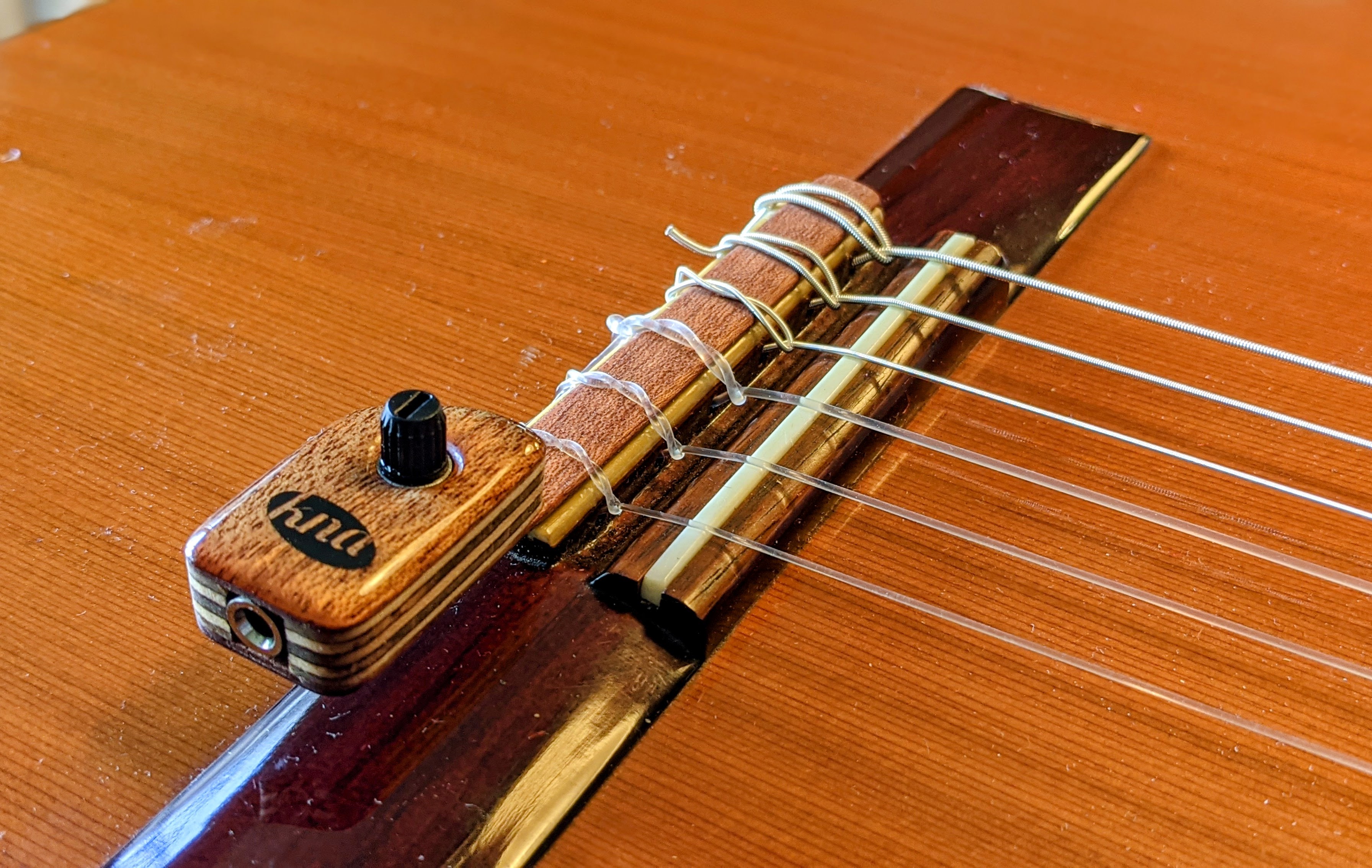
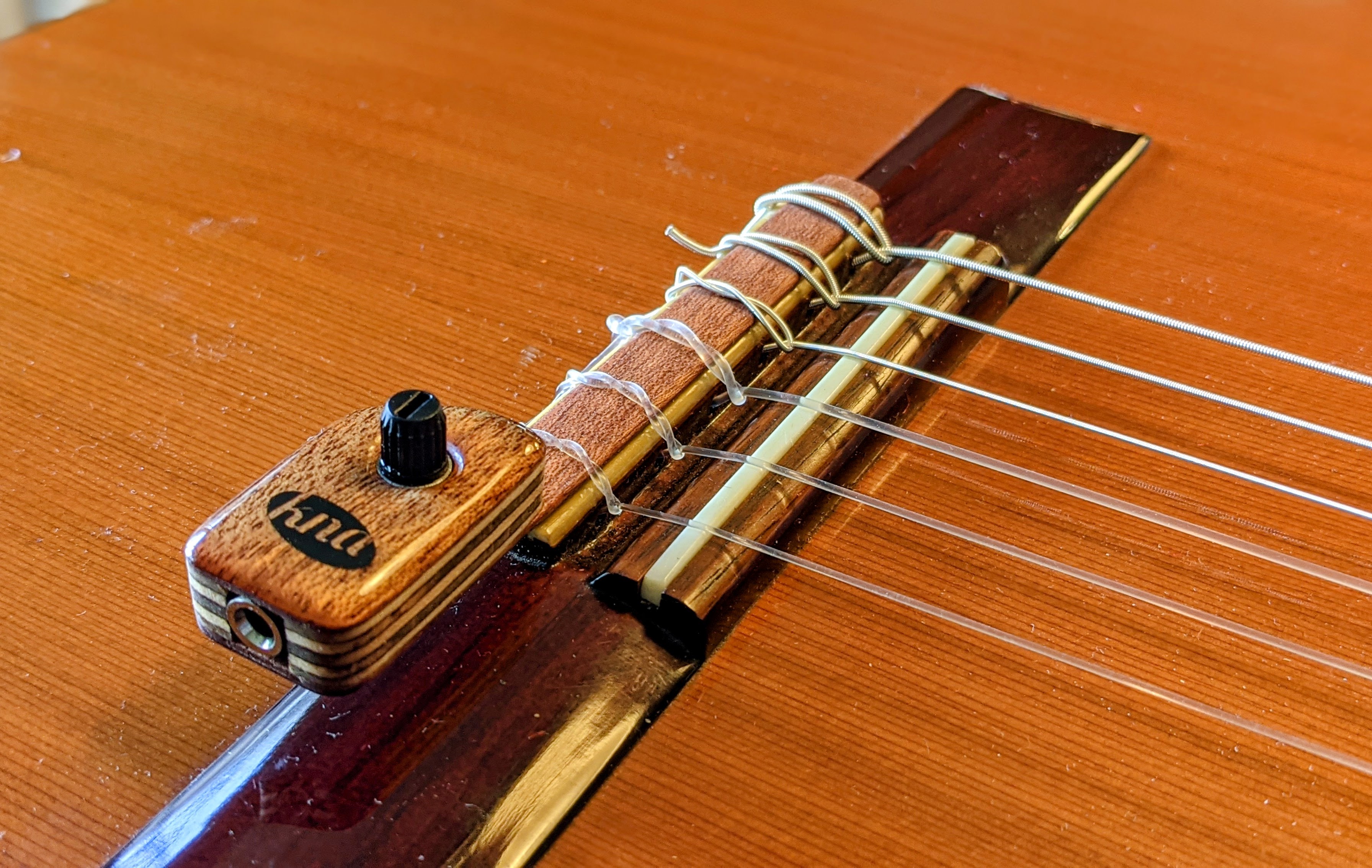
But with NG-2, because it sits on the tie-down bar, the cord is completely out of the way. You can see that in the picture of my guitar. Plus, you’ll notice that the jack elevates the cord above the soundboard, so there’s no worry of it contacting the soundboard and vibrating while playing. The KNA folks really got this right!

How It Sounds

Now, as far as sound is concerned, I couldn’t be happier. The pickup is incredibly sensitive and as I mentioned above, manages to pick up even subtle harmonics. Look, it’s not going to be nearly as good as miking the guitar, but then to really capture the sound of an acoustic instrument, you have to have a hell of a good microphone, or use a couple of them.

The volume control is very nice, though it does seem to have a logarithmic taper to it, so little movements of the knob at the upper end of the volume sweep make huge changes in the volume. But that’s not really a big deal. Luckily there’s a nice resistance in the action of the knob, so you won’t have to worry about knocking the knob and changing the volume. Then again, the pickup is really out of the way of the playing area so that should never be an issue.

Below is a set of clips I put together to demonstrate the pickup. The first clip is the raw sound of the pickup with no EQ or any kind of signal processing. The second clip is the raw clip, but with a slightly scooped EQ, with super light compression (1.8:1) and with a touch of reverb and room ambience. The third clip pans the processed clip to the left and I play a solo with a longer tail reverb and deeper room ambience, keeping the compression and EQ the same.

I’m simply beside myself with how natural this pickup sounds. The raw recording is incredibly close to how my guitar sounds naturally. It really sounds like the guitar is right in front of me. Just amazing! And when I add just minimal processing, it takes the sound over the top!

It’s not common to get this kind of sound at such a reasonable price. The value proposition of this pickup alone makes it worth getting. But the ease of installation plus the sound quality makes this pickup – at least to me – the best choice for amplifying a classical guitar.

For more information, visit the KNA Pickups NG-2 page.

Read Full Post »

The NG-2 installed on my classical guitar

A few years ago, a friend of mine kindly gave me three guitars that belonged to her late uncle: A 1990 Simon & Patrick PRO acoustic, a 1993 Godin Artisan ST v5, and a 1972 Hiroshi Tamura P40 classical guitar. I fixed up the S&P and the Godin and have gigged with both since I got the guitars. But I didn’t touch the Tamura because I’m not a classical guitar player. So I kept it in its hardshell case, out of the sunlight.

But a few weeks ago, I started envisioning playing and recording solos with a classical guitar to get that natural woody sound that only a nylon string can produce. So I brought the P40 to my local guitar repair to have it set up and strung. When I got it back, I couldn’t believe just how gorgeous it sounded and just how well it projected its sound (I’ll do a review on the guitar at a later date).

The only problem was that if I wanted to gig with the guitar, I needed a pickup. Unfortunately, the soundhole is too small to fit my pickup of choice, which is a Seymour Duncan Mag Mic. Plus, the Mag Mic is really optimized for steel-string guitars. So I had to do some research.

One thing that I didn’t want was something that required me to drill a pickup hole in the guitar. The P40 is a real vintage guitar, and while it doesn’t have a big street value, it carries with it a lot of sentimental value for me and I didn’t want to be drilling holes in it, lest I alter its sound or mar the memory of my friend’s uncle. So I needed a good, portable solution. My search led me to the KNA Pickups NG-2.

The incredible thing about this pickup is that it sits on top of the tie block right behind the saddle. You loosen your strings so that you can slide the pickup right under them. It’s ingenious! It literally took me ten minutes to install it, with most of the time spent loosening my strings enough to be able to slide the pickup into place.

I do have to admit that I was a little leary of the pickup’s sound because it’s a piezo and they’re notorious for producing that “piezo quack.” But all my concerns were laid to rest once I plugged it into my amp. Once I dialed in the EQ, I couldn’t believe just how natural the pickup sounded. It really captured the woody tones of my guitar!

To be honest, the pickup does have a slight hum plugged straight into my amp, but I was able to get rid of most of the hum by dialing back the volume on the pickup, reducing the input gain on my amp, and controlling volume with the master volume. I should be able to eliminate it for the most part with a notch filter. And when using it to record, I can just isolate the frequency and take it out of the mix. Yeah, it’s a bit more work, but for how it sounds despite that hum, I couldn’t be happier.

When I do my full review on the pickup, I will include sound clips.

Read Full Post »

« Newer Posts - Older Posts »