Feeds:
Posts
Comments

Archive for the ‘Guitars’ Category

I love overdrive pedals. I have a bunch of them. But I realized that part of why I have so many has a lot to do with not really understanding how to set them up properly. I’d get an overdrive pedal because a demo I heard sounded great, or I loved how it was voiced. But when I’d get it home, it just wouldn’t sound quite right, so I’d put it in my “storage” area.

But as I got more experienced with setting up my amps, I also began to understand how to set up my overdrive pedals. And now that I have a bunch, I’ve got a variety of pedals to choose from to get the sound I want depending on my sets or my mood – okay, I admit it: It’s mostly due to my mood. 🙂

Admittedly, I did a lot of forum lurking as well to gain insights on setting up an overdrive, so a lot of what I’ll be sharing here comes from the things I’ve learned from others in addition to the stuff I’ve learned on my own.

What actually motivated me to write this was a conversation that I had with a friend. I asked him what he thought of a particular overdrive pedal, and he said he didn’t like the way it sounded. I looked at him a little puzzled and said, “Maybe you didn’t set it up right.” And that led me to say that not all overdrives are created equal, and you have to set them up according to how they work best, or how they were intended to be used. Truth be told, I haven’t spoken to him since that conversation, so I have no idea if he tried what I suggested. But in light of that, I decided to share my thoughts.


Related Articles


Types of Overdrives – Not Necessarily What You Might Think

Before we get into the actual setup of an overdrive, I thought I’d go into a discussion about types of overdrives because how you set up an overdrive has a lot to do with the type of overdrive it is. No, this isn’t a discussion about circuit types or transparency. I suppose this could be related to the circuit type on which an overdrive is based, but I’m not that electrically savvy, so I’ll discuss this in more practical terms.

From my experience with having played several overdrives over the years, I’ve found that they fall into roughly two different categories (mind you, these are my own terms): Interactive and Standalone. Interactive overdrives are meant to interact with the preamp of your amp, and together they produce the overdrive sound.

Standalone overdrives are typically purpose-built to mimic an amplifier, and though they can certainly be set up to be interactive, they can function just fine on their own in front of a clean amp.

Notice that I haven’t named any specific overdrive models. The reason why is that overdrives sound different with different amps. For instance, the EHX Soul Food sounds great as a standalone overdrive in front of my Fender amp. But it doesn’t sound nearly as good as a standalone overdrive in front of my Plexi-style amps, so I set it up as an interactive overdrive for those amps.

So the idea behind interactive vs. standalone has little to do with a specific type or model of overdrive; rather, it has to do with how the overdrive sounds with your amp.

Setting Up an Overdrive

I have two processes that I go through to set up an overdrive. At this point, I know all my pedals and whether they’re standalone or interactive, but I still follow the same processes for my different pedals when I set them up on my board. Also, if I come across or get a new overdrive, I first assume that it can be a standalone overdrive, then if I find it doesn’t work well that way, I’ll then set it up to be interactive. Here are the step-by-step processes I follow:

Setting Up a Standalone Overdrive

  1. Set up the amp:
    1. Clean
    2. Set EQ to work with your guitar
  2. Set guitar volume to the middle
  3. Guitar EQ where you want it
  4. Set overdrive with all knobs to the middle.
  5. Engage the overdrive and get it to unity gain (so that when you engage it, your volume doesn’t change), or to just get a small volume bump when the pedal’s engaged.
  6. Set the EQ on the overdrive
  7. Adjust the overdrive/gain knob to get your desired amount of distortion from the pedal.
    1. You will probably have to make adjustments to the level knob to maintain unity gain.
  8. Evaluate the sound and feel by playing around with chord progressions and licks.
    1. All the while, raise and lower your guitar volume to see how the pedal responds.
  9. Repeat steps 5 and 6 until you dial in the right volume/sound/feel.
    1. If the volume, sound, and feel are fine for you, then you’re all set and ready to gig and the overdrive pedal will work fine as a standalone device.
    2. If the sound doesn’t feel “right,” chances are you’ll have to do some interaction with the preamp of your amp, so continue to the next section.

Setting Up an Interactive Overdrive

  1. Set your guitar volume to the middle (It’s important you start here)
  2. Set up the amp
    1. Set Gain/Volume so the amp is at the edge of breakup.
      1. You’ll know it’s there when you turn up the guitar’s volume and the amp begins to distort, then cleans up when you turn it down. Also, if the guitar’s volume is set to the middle, if you strum hard, it will break up.
      2. This is the reason you set your guitar volume to the middle so you can affect the preamp easily.
    2. Set EQ on the amp
  3. Set guitar EQ where you like it
  4. Set overdrive with all knobs at their middle positions
  5. Engage the overdrive
    1. More likely than not, you’ll get a big volume boost when you engage at this level, so you’ll have to adjust both the overdrive’s level and amp’s volume/master knobs to get to the right volume.
      1. If you don’t have a master volume, turn down the overdrive’s volume/level knob to get to a manageable volume.
    2. Because you want to get both overdrive AND amp distortion, you’ll want to get a small volume bump when you engage the pedal as you want the amp to go over the edge of breakup.
  6. Now, play around.
    1. See how the combination responds to volume swells on your guitar.
    2. Make adjustments to the overdrive gain to get the right combination of pedal and amp distortion.

The Importance of EQ

Notice that I mention setting EQ on the amp, guitar, and overdrive pedal. Setting EQ is extremely important because it can be the difference-maker in your overall tone. There’s no “ideal” EQ setting. But for me as a rule of thumb, I want to get a rich, slightly bright tone that sits well in the mix and isn’t so warm compared to the other instruments so it won’t get washed out when we’re all playing together.

Also, for live gigs, I usually don’t touch my amp or pedal EQ once I get them set up. I use my guitar’s tone knob to adjust how warm or bright my sound to be.

Amp/Pedal Combinations

All that said, if you’ve followed the steps for setting up an interactive overdrive, and it still doesn’t sound right no matter what you do, then the pedal sucks. Just kidding. 🙂 Truth be told, I’ve found some overdrives work better with different amps. If you have another amp, then try the pedal out in front of it.

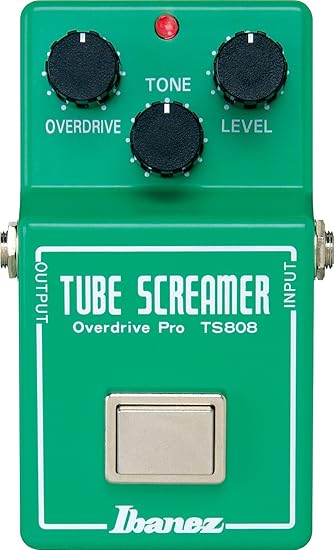
For instance, Paul Cochrane of “Tim” and “Timmy” pedal fame recommends not using the pedal in front of a Fender Blackface amp. I don’t have a blackface amp, so I had to take him at his word, but the Timmy works great in front of all my amps. For me, I will not use my venerable Ibanez TS-808 TubeScreamer in front of my vintage Marshall-style amps. It just doesn’t sound good to me, no matter how I set it up.

I think it’s because the TS produces a big midrange bump when engaged, and my amps are voiced bright, so it ends up sounding piercing like little ice picks on my eardrums. Even EQ adjustments don’t work for me. But in front of my Fender Hot Rod, the TS truly screams! My Hot Rod has the classic Fender “scooped” tone, so the predominant midrange of the TS fills in the mids.

WHERE You Play Matters

Seems obvious right? Well, it’s not. In fact, what might sound great in your bedroom or living room may sound like crap on stage. That smooth, round bottom end that sounds so luscious in your headphones may just get you lost in the mix when you play with a band.

A few years ago, I went to see Joe Satriani play the Hendrix Experience concert. When Joe finally took to the stage, he sounded HORRIBLE! Way too much bottom end and way too much compression. He had to crank his guitar to be heard and the sound was just deafening. The FOH guys finally got his tone dialed in and Joe had to make some changes – I’m assuming, EQ changes – to his pedals. After that, they were able to bring volume down to comfortable levels.

In my own experience, I normally set my EQ a little brighter than when I’m at home. When I’m playing on stage and my amp is pushing some serious air, being a tad brighter helps cut through everything. But I’m careful about going too bright because that could get really harsh.

What About Stacking Overdrives?

That gets a bit more complicated, but I’d follow the basic procedures above, treating the trailing pedal as the amp. In this case, I’d tend to set up the amp as clean and have the trailing pedal always on. There lots of ways to approach this as well. I know one guitarist that uses three at once to get his “sound.” More power to him! 🙂

But truth be told, I hate to dance on my board, so even though I will use a couple of overdrives, I only use one at a time depending on the kind of voicing I want. I also, don’t like complicate my sound finding the right balance of multiple overdrives. I just want to play. Granted, I could do a lot of pre-gig work to get that, but for me, employing the KISS theory works best.

Many people like to stack, and that’s great. Stevie Ray Vaughan used to use two TubeScreamers stacked together; one as an overdrive and one as a booster.

Wah-wah and Overdrive

If you don’t use a wah-wah pedal, then you can ignore this section. But I thought it would be important to add this to the mix, mainly because I’ve found that certain overdrives work better depending on where the wah-wah pedal is placed. Admittedly, my personal preference is to place the wah pedal after my overdrives. But there are a few boutique overdrive pedals that I have that work much better when the wah pedal is in front of them. Not sure why this is. Luckily, I only have a couple of pedals that act this way, so I know not to use a wah pedal with them if I have it set up after my overdrives.

Exploration

To close this out, I have to admit that I’m a bit of an overdrive junkie. I may not buy every single one that piques my interest, but I do check out new overdrives when I run across them. The great thing about overdrives is that they really are all different, even the knock-offs, so I’ll continue to explore overdrives. I never know what I might find. 🙂

Read Full Post »

Two Hands, Please!

I have a friend who played ice hockey as a kid in Canada, and years ago, as we were sharing stories about hockey (I used to coach), I mentioned that one of the toughest habits to ingrain into players was using two hands. My friend laughed at that and said, “You know how I learned? My coach taped my hands to my stick.” That convention has changed over the years, as the predominant philosophy now is that the stick should always be on the ice to provide a passing target.

But thinking about “two hands on the stick” got me thinking about playing guitar. Pick out a random guitar instruction video on YouTube. Chances are that the focus of that video will be how to place the fingers of your fretting hand on the fretboard. Some might mention the picking pattern you should use or the direction of your picking motion.

No doubt that stuff is useful. But what I’ve found sorely lacking in so much guitar instruction is right-hand technique. It’s almost as if the right is treated as an afterthought. But let’s not forget that while the left hand forms the notes and chords, it’s the right hand that gives those notes and chords a voice! It is also the right hand that provides the rhythm and just as importantly projects the style of music being played.

I’ve encountered so many players, young and old alike who can just burn up the fretboard. But ask them to switch styles from what they’re comfortable playing and it’s often a disaster. In the early days of my old worship band, I had a young guitar player who was into thrash and speed metal, and that kid had speed like you wouldn’t believe. But in the beginning, all he could play was metal. He was great at it. It took me months to teach him right-hand technique to be able to play different styles of music. For instance, we worked on a claw-hammer variant that I picked up from Michael Hedges for rhythmic fingerstyle playing and worked on various palm and finger muting things to add space.

But in the beginning, all he could play was metal. He was great at it. It took me months to teach him right-hand technique to be able to play different styles of music. For instance, we worked on a claw-hammer variant that I picked up from Michael Hedges for rhythmic fingerstyle playing and worked on various palm and finger muting things to add space. All the while, I would constantly have him feel the rhythm of the song and try to align his rhythm on the guitar with the pulse of the music.

Apart from that little aside, the challenge with and beauty of playing worship music (at least with my old band) is that we played all sorts of styles from hard rock to funk and even jazz-tinged music. I used to tell my guitar players, “A G is a G is a G, no matter what style of music you’re playing. But a G played as a power chord for a rock song is going to be significantly different than a G played in a blues song. Same chord, different style.” It’s what you do with the right hand that makes all the difference in the world.

I’ve probably shared all I need to share on this subject, so I’ll just part with these words: IT TAKES TWO HANDS TO PLAY GUITAR.

Read Full Post »

OkkoDiabloGHSignature[23709]I’ll admit it: I’ve become somewhat cynical about unsolicited product announcements; especially those from manufacturers of whom I’ve never heard. Part of it is due to the fact that I get a lot of them and I just don’t have the time to put out announcements. Another reason for my cynicism is that a lot of “new” pedals tend to be a riff or duplication of an existing, common device. Can you say TubeScreamer clone?
But to be fair, I read pretty much all the announcements that drop in my inbox because – and to be completely honest – I’m a gear slut. I don’t get GAS attacks all that often anymore, but that doesn’t mean I don’t enjoy reading about new gear. Besides, I’ve been pleasantly surprised in the past because I always hold onto the hope that something different will pop into my inbox.

The Okko Effects Diablo GH appears to be something different.

Yes, it’s an overdrive. But it’s tweakable. Here’s an excerpt from the manufacturer’s product announcement:


The GH model is based on the classic Diablo but comes with a few tweaks and a set of controls that allow you to fine-tune the “feel” of the pedal, the way how it reacts to your pick attack and playing dynamics.

  • DYN(AMIC) controls an internal voltage doubler from 6 to 18 volts for control of “sag”, compression and punch
  • FEED controls lower frequencies in the input signal for tight and clear sounds even with the fattest neck pickups
  • BODY adds low mids in the first gain stage for thick, singing sounds
  • INPUT and MIDS mini switches for further tonal options
  • Independent foot-switchable CLEAN BOOST with tone control, located AFTER the overdrive in the signal chain

I’m not going to lie. This pedal really speaks to me. The DYN, FEED, and BODY controls make this pedal incredibly useful. But having the extra INPUT and MIDS switches really take this pedal over the top for me. The booster is a very nice, added feature, especially if you use it to push the front-end of your amp into full saturation.

When I see gear that immediately makes me think of how it would fit in my rig, it’s usually something I will eventually get. I have my Soul Food, which I just absolutely dig, but when I want a different kind of overdrive sound, this Diablo GH seems to fit the bill nicely with its adjustability. For me, the Soul Food does one thing really really well and gives me a creamy smooth, subtle, soft-clipping distortion. And it adds some color. But from what I can gather from the Diablo GH, it is more of a transparent device. It could be argued that my Timmy pedal can do that job. However, with the tweakability of the Diablo GH, I can set up the pedal for each one of my guitars; something I can’t do to this fine a degree with any other overdrive pedal I have.

Oh yeah… make no mistake, I’m seriously GAS-ing right now… Here are a couple of demo videos by Gregor Hilden for whom the “GH” stands for:

Read Full Post »

Music and Martial Arts

In my younger days, I studied martial arts; specifically, formal Japanese styles such as Shotokan, Gojo Ryu, and Aikido. I went the furthest with Shotokan. But it was my experience with Aikido that probably had the most profound effect on my approach to combat. That was primarily because of my mentor, life coach, and Aikido instructor Dan Retuta of the Crestone Healing Arts Center in Crestone, Colorado.

Admittedly, I never went very far in Aikido; in fact, I more or less just dabbled. But Dan has been a lifelong friend whom I have known for almost five decades, and he has been the wise older brother that I didn’t have. But more than just Aikido, the most important thing I learned from Dan was what I’ll simply call the “warrior way.” It is a way of thinking and acting – living, to put it simply – according to how a warrior would live. And no, it’s not at all about fighting. It’s about honor, courage, discipline, integrity and decisiveness, and belying its name, it’s also about inner peace and stillness.

In one of our numerous conversations, Dan said something to me that has stuck with me since, and something that I have passed on to others whom I mentor and that is: “One of the reasons we repeat a movement or technique over and over again is to have it etched into our entire being, to make it become part of our essential being. That way, when we’re finally faced with a real-life situation, we won’t think about applying a particular technique; we’ll just do what is appropriate for the situation without any thought. In a way, our martial art is revealed in the moment. That is satori, where thought and action are one.”

Sound familiar? In music, we practice techniques over and over again so that when it finally comes time to perform we just execute the technique. Without thinking. A simple way of looking at satori is what many would call being in the zone.

For example, when I was taking piano lessons long ago, my teacher taught me how to play scales. There’s a specific technique for playing scales up and down the keyboard. I practiced that technique for hours at a time to learn all my scales in every key. I did it because my teacher told me to do it, but I didn’t really understand why until she had me learn a more complicated piece that required that I apply the technique. In one section, there was a phrase that had an ascending scale of sixteen eight notes. As I read it, I just climbed the scale, applying the technique I had practiced – without thinking about the technique. After I did that phrase I stopped and said to her, “NOW I get why I practiced all those scales!” She just smiled.

As I’ve mentioned in the past, I recently joined another band. As the new member, I was reluctant to let it all hang out because I didn’t want to offend anyone. But as I’ve become more comfortable with the other band members, I’ve started to be myself; not that I was trying to be someone else in the past, but I was treading a lot more carefully. That changed with my last gig.

When it came time for me to do my first solo, in that instant, I forgot about holding back, and just went for it. I don’t remember what I actually did, but I remember thinking to myself after I finished, Did I actually just play that? 🙂 One of the things I did was a quick sweep pick over a couple of triads; something that I’ve practiced in the past, but never applied. I did it without thinking about it and I realized I did it because it just fit with what I was playing and with the song. I smiled knowing that what I just had was a moment of satori. Such a cool thing!

It is difficult to show exactly how to achieve that state. It’s not as if you can do it willfully; not at all like Okay, now I’m going to get in the zone. But you can prepare yourself first by simply practicing and mastering techniques. Moreover, what I encourage a lot of people to do is simply play against a backing track. But instead of practicing patterns, and thinking about what you’re playing. Just go for it. Don’t care about technique. Play what you’re feeling. It might sound like shit. But don’t care. Feel yourself conjoining and commingling with the music. The more you can separate your conscious, analytical mind, the easier it will be to drop into the zone.

As a Star Wars aficionado, I love the life lessons contained in the movies, especially those that revolve around the Force. As Obi-Wan said in Star Wars: A New Hope: Let go your conscious self and act on instinct. Here’s a clip to close this out:

When it comes to playing music, no wiser words have been said…

ROCK ON!

Read Full Post »

After a gig with my band a few weeks ago, and with other impending gigs coming up where I’d have to use my electric rig, I decided to create two different pedal boards. Using a single one wasn’t an issue the past couple of years because, with my new band, we weren’t gigging that much and I didn’t really feel the need to have a lot of different sounds, so I’d just use my little Pedaltrain Nano, pop on the pedals I needed for a particular gig, and I was good to go. But now that I’m gigging more regularly with my band, and have agreed to join a new church band, I realized that swapping pedals was going to be inefficient. Plus, with my solo gig, I only needed a couple of modulation pedals and a looper, so putting all that on my big board and hauling that around was not a very attractive solution.
Luckily, I have at least two of every pedal I need. 🙂 Not the same brand, mind you, but two or three of the same kind. The fact that I have so many is just previous GAS. I used to be so impulsive about buying gear that even though I’d already have a pedal or some other gear that perfectly suited my needs, I’d hear something in some new gear that “spoke” to me and I’d have to get it. And with pedals, I’ve ended up with two, three, even four of the same type of pedal. This gives me a lot of flexibility, but more importantly, it allows me to run two distinct boards for my electric and solo acoustic rigs.

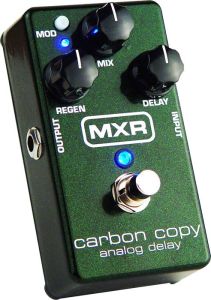
Which brings me to the Carbon Copy… When I got it, I really didn’t need it. In fact, I already had my Mad Professor Deep Blue Delay “DBD” (hand-wired). But I reasoned that I needed a delay for my acoustic rig, and wasn’t willing to shell out another $325 as only the hand-wired DBD was available at the time. So I got the Carbon Copy delay.

As luck would have it, it wasn’t long before the Carbon Copy was back in the box. I had developed severe arthritis in my left hip and started to gig a lot less, and got very sensitive to the amount of gear I would lug when I did gig. So I downsized. I started using my Nano board exclusively and just lived with a couple of pedals.

But now that I’m all healed and have lost a bunch of weight, and I’ve gotten a lot more busy with gigs, I don’t mind lugging a bunch of gear, so I’ve set up two boards: One for electric and one for acoustic. The Carbon Copy has gone onto my acoustic board, and you know what? I absolutely love it!

Unlike my Deep Blue Delay, the Carbon Copy is very subtle when its level knob is set anywhere less than 12 o’clock. I usually set the level at 11 am, then set a long delay time and short repeats. It’s not exactly slapback, but it adds a depth and ambiance to my guitar sound to give it almost a large chamber sound. It’s great for finger-picked songs as the lower level gives me plenty of note clarity with a nice tail at the end. And for solos, well, its subtlety definitely works in its favor. I LOVE doing solos with this pedal turned on.

Don’t get me wrong. I still love my Deep Blue Delay. That will always be my favorite, but I’m absolutely digging the MXR Carbon Copy on my acoustic rig. It would be right at home on my electric board, but well the DBD has that place, and I’ve got that board set up to where I like it.

Now that I’ve been using the Carbon Copy for a few weeks, I like it so much that if it were the only analog delay that I have, I’d be perfectly alright using it all the time. This pedal is a little gem, folks. If you’re looking for a great analog delay, this is one that I’d recommend trying out. It’s definitely much more subtle than others – you really have to crank up the level and repeats to get a definite delay pulse – but as I mentioned above, that subtlety works in its favor, especially for solos.

Read Full Post »

On Rhythm

One of my mentors in guitar and music was an elderly African American man named Patrick who used to come and listen to me play at my restaurant gig. I would go talk to him during breaks or right before I’d go on; or sometimes, on days off, I’d see him at the bar and we’d have long chats about music and gear.

Patrick was a guy in his 70’s who’d seen it all musically. He was jazz player ‘who did a lot of session and tour work with the likes of Miles Davis, the Marsalis brothers, and many other big names. If you saw the movie, “That Thing You Do,” Patrick reminded me of the character Del Paxton. He was a font of musical knowledge and though he never taught me any technique, our conversations had a profound effect on how I approached the guitar and frankly, how I approached playing music in general.

One of our conversations centered around rhythm and expressiveness when doing a lead. “Rhythm is everything; especially with playing guitar, which is a rhythm instrument. But even doing leads, you got to be in the pocket with the rhythm.”

After he said that I looked at him a little quizzically. I inherently knew what he was talking about, but I was curious to find out what he really meant, so he continued, “You gotta be able to feel and anticipate pulse of the song. Most musicians don’t get that. I’ve played with some of the best musicians in the world, but the best of the best have rhythm when they play. They can feel the rhythm of the song and create a rhythm in their solos that fit the song. Some dudes, they know all the scales and modes, but they sound like shit because they just throw a bunch of notes together to say, ‘See how fast I can play?'”

Playing the devil’s advocate, I challenged him and said, “But some might say that in the rock and roll world, part of playing a solo is to show your chops. What you say might be applicable to jazz, but I’m not so sure about rock.” I did say that with a little smirk, so he knew that I didn’t believe that.

Patrick just chuckled, knowing I was bullshitting him and said, “Listen, man, Miles Davis could do more with one note than a lotta guys would do with a hundred. And it don’t matter the style of music. If you’re playing the wrong rhythm no one’s gonna like what you’re playing.”

“But is just a single note rhythmic?” I asked.

“Damn right, if it fits in with the song. It could be four whole notes tied together for four bars! I know you get that. You’re just trying to piss me off,” he retorted.

I laughed and said that I did get it. We conversed about a lot of other stuff after that, but he managed to circle back to the original topic saying, “That whole rhythm thing when you’re soloing… The best players are economical. They play just enough notes to get their point across. It could be a bunch of 64th notes at times. But what they play fits in with the rhythm of the song.”

That conversation is one of those vivid memories that has been forever etched into my memory because it actually made me feel good about my solos. I only know a few tricks and I’m definitely not a speed demon on the fretboard. But that conversation made me aware that what was truly important was being vigilant about playing within the context of the rhythm of a song.

Melody, of course, is extremely important. But melody without a sense of rhythm or played against the rhythm – at least to me – doesn’t sound all that good.

Read Full Post »

20170414_103854

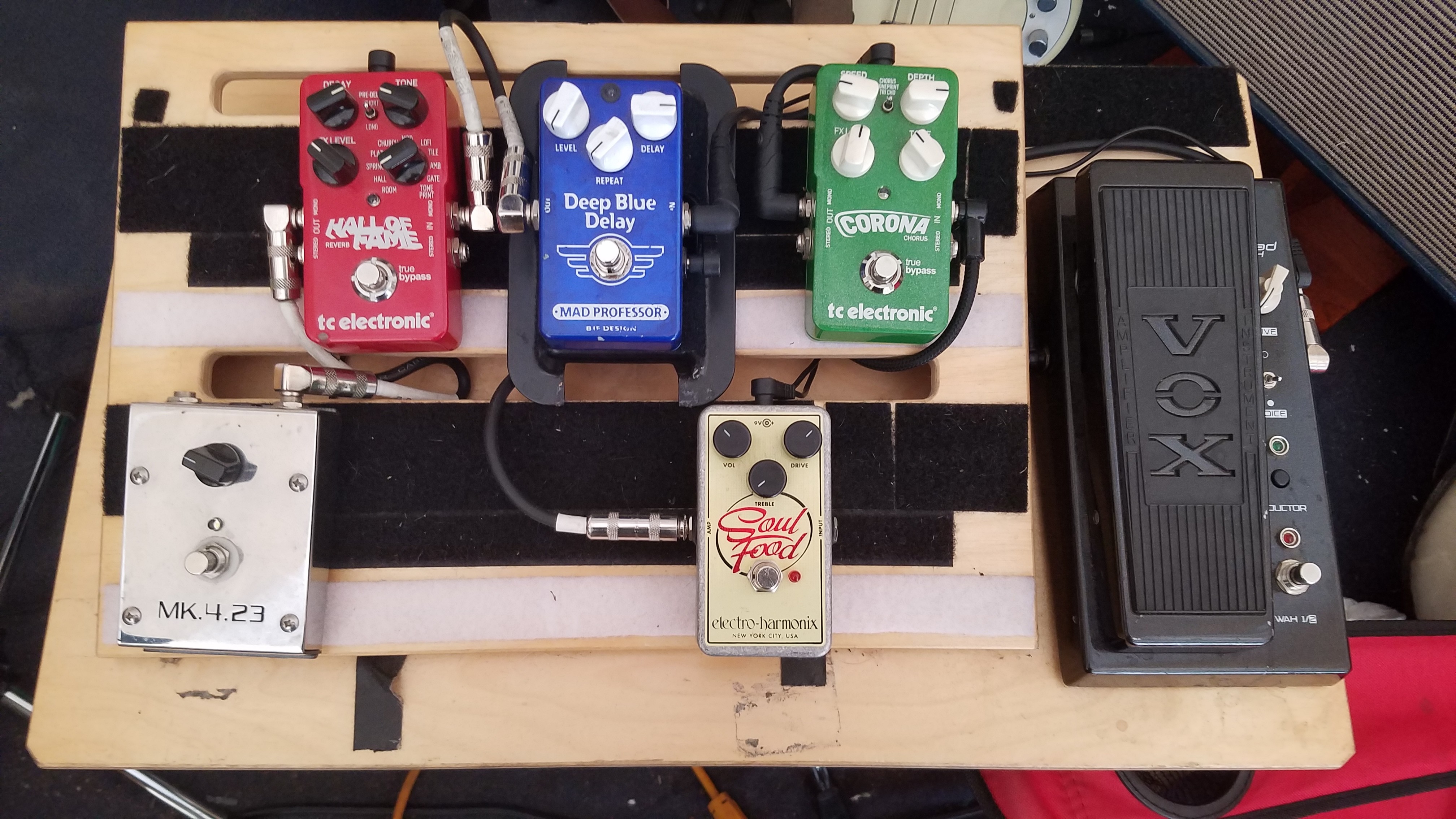
My current pedal board setup is pictured above. The signal chain is as follows: Soul Food -> Big Bad Wah -> Corona Chorus -> Deep Blue Delay -> Hall of Fame Reverb -> Mk.4.23 Booster. Note that the knob settings are not what I gig with. They got turned during transport. 🙂

In any case, my board used to be jam-packed, with both rows filled. I used to have two overdrives and a distortion pedal on the bottom, and the booster would be the last pedal on the left. But I’ve been paring down what I use to the absolute minimum.

No, it’s not because I don’t want to lug more gear. It’s just that I realize that whatever I play now, I just sound like… well… me. So my pedal rig just contains pedals I want to use to enhance my basic tone. In the past, I’ve used pedals to help create my tone. But the better I got, the more I didn’t rely on pedals.

For me, the pedals I’ve installed above are simply must-haves. As far as the modulation pedals are concerned, while I probably don’t absolutely _need_ the chorus, I like to have it, especially when I play clean. It just adds a bit of tonal grease. Delay and reverb are two others I can’t live without. I love the slap-back effect of my Deep Blue Delay, and the reverb, which is always on, adds a little more tonal grease.

I wasn’t going to use a booster pedal at first, but my bandmates at our last gig said that I needed to get my solo volume over the band. I actually thought I was plenty loud. But hey! Twist my arm to crank it up! 🙂

I may add my Timmy overdrive just so I have a bit of variety and to create a transparent overdrive sound. But I have to tell you: That Soul Food is sonic candy. I love that pedal! It gives me such creamy smooth overdrive that intermingles so well with the natural overdrive of my amp that I feel I can take my time adding another pedal.

With respect to my wah pedal. It has been a mainstay on my board, but it wasn’t until recently that I REALLY started using it. With my old church gig, I just didn’t have the occasion to use it much. But with my new rock band, hell! I just use it whenever I feel like it. 🙂 We do covers, but they’re not strict covers, so I use my artistic license to its full extent.

I’m real fickle with respect to pedals. I swap them in and out all the time depending on my mood. But I think I’ve finally found a combination of pedals that works real well for me – at least until I change my mind – again. 🙂

ROCK ON!

Read Full Post »

Wah Wah Wah…

20170318_120643I had a gig with my classic rock cover band yesterday. On a whim, I decided to use my big board so I could use my Vox Big Bad Wah. I got this a few years ago and hadn’t really used it all that much, even though I love playing with a wah. But with my songwriting taking yet another turn to a highly reggae-influenced flavor, I’ve started taking stock of the effects that I use, and wah is certainly an important component.

But moreover, as with all my gig configurations, I put the effects on my board based on how I’m feeling, and yesterday, as I was configuring my board, I thought, Hmmm… I really feel like using a wah today That meant using my big board because I prefer having all my pedals on a single unit, sharing the same power source. It’s an efficiency thing… 🙂

The picture above shows my board configuration for yesterday’s gig. I daresay that that will probably be my configuration going forward. I know… so simple. Just an overdrive, fed into a wah, then out to modulation effects and into my amp. Simple. I used to have 10 to 12 pedals on the board. In fact, the bottom half of the board sported three to four overdrive and distortion pedals. But the Soul Food – and to a lesser extent – my Timmy give me all I need for pedal-based grit. Admittedly, I’ll probably add the Timmy in there next to the Soul Food. But I love that Soul Food pedal so much, I could do with it alone.

Now with respect to my gig and using the wah pedal, in the middle of our first set I was thinking to myself, Why haven’t I been using this the entire time?!! I don’t know if it was fear, or maybe it was because I was so new to being just a lead guitarist. Who knows? I’m not going to spend much time in analysis. But what I do know is that I absolutely LOVE using a wah pedal. I didn’t use it for every song, of course, but I’d switch in an out of it a lot.

My favorite use of it was when we covered the Beatles’ “Come Together.” We have our female singer do this so we raise the key to Em. But I wanted to uglify it a bit, and since the focus is on the bass for that, I played an Em+9 and frequently added a 6th to that. I also added the wah to add a bit of a sinister twist.

When it came time for my lead, whereas I’d normally do that lead riff, I decided to dispense with it altogether, closed my eyes and let my fingers do the talking. With the wah providing that emphasis when I’d bend notes upon the fret board. I was having so much fun with the lead that I think the rest of the band just let me wail until I was done. I really don’t know how long I jammed. I just know that it was longer than normal, and when I finished I had a shit-eating grin on my face. Using the wah then was just an inspirational experience.

Frankly, I don’t even know how good I sounded. For all I know, I sounded like total shit. But I was just played with loose abandon, letting whatever was inside me come out through my fingers. But I think I did a good job because the audience were hooting afterward, and the lady who put on the event just looked at me and said, “Wow…”

The point to all this is that there have been times in my playing career where I find something – in this case, my wah pedal – where something just clicks. It’s strange, it’s new, and perhaps a bit weird feeling. But rather than run from it, I dive head first and immerse myself in the experience, wanting to discover where it takes me. That was yesterday. Now my wah-wah-wah isn’t because I’m crying. It’s a wail of pure inspiration!

Read Full Post »

No lead-in. Just watch…

What technique! Those descending scales reminded me of a clean version of Yngwie Malmsteen. The dude shredded those scales! And NO distortion!

All I know is that I’m determined to be playing proficiently past 80. Les Paul played up until he died at 95, and his right elbow was locked into place!

Simple AMAZING!

Read Full Post »

“The proper function of man is to live, not to exist. I shall not waste my days in trying to prolong them. I shall use my time.”

~ Jack London

I was watching a documentary on the great Raiders quarterback, Ken “Snake” Stabler. In one segment, the narrator mentioned that Stabler was well-read, and an avid reader of Jack London. And during that section, the narrator mentioned one of my favorite Jack London quotes, which I listed above.

That’s such a powerful statement because the implication is that we aren’t here in this life to just “be,” but to act. To put ourselves on the line every day and live, and live life in such a way that we can fulfill what my Native American brothers in the past have said: “It’s a good day to die.” To me, that quote can be summed up in three words: “Go for it!”

I’ve taken that approach with playing guitar. As of the past few years, I’ve been getting into reggae. I can honestly say that while I haven’t morphed my music entirely to reggae, the influence is definitely there. I’ve struggled in making the transition. I love all sorts of music, and my writing contains influences from the many musical styles I both write and play.

But lately, at least for me as an artist, I’ve realized that reggae isn’t so much a sound or even music with a set pattern. There certainly is a foundation of that there; however, what I’ve come to realize is that reggae for me is simply the expression of good vibes. Sure, it can be political and even express disdain for the system, but the underlying root is to give people that sense of “irie.” I may be reading it completely wrong. But this is my personal interpretation.

Circling back to that Jack London quote, right or wrong interpretation, I’m just going for it. I’m not letting myself focus on whether or not my music fits in with the genre. What I’m after is a feeling, a “vibe.” And to be completely honest, I’m not really worried about being discovered and making it big. The best I can do is create music, and if people like what they hear, then that pleases me. After all, our purpose is to live and not exist.

In any case, here’s my latest song called “Let It Ride.”

Read Full Post »

« Newer Posts - Older Posts »