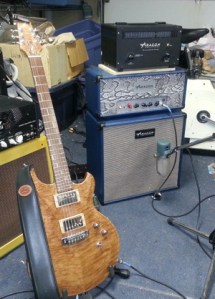
Feeds:
Posts
Comments

Archive for the ‘Guitars’ Category

Katie May and the Aracom VRX18

Katie May and the Aracom VRX18

I’m in a waking dream right now; caught in the solace after a night spent in the presence of pure beauty; her siren-song resonating into the deepest recesses of my soul. Closing my eyes, I see the visage of her elegant curves. I can feel the smoothness of her golden-brown skin. I can hear the dulcet tones she sings from my ministrations as I gently caress her smooth body and run my fingers up and down her neck. She is Katie May, and she is my lover.

Dirty mind… Katie May is my custom guitar made by Perry Riggs, good friend and luthier of Slash L Guitars. I have had her for a few years now, and every time I play this guitar, I’m transported to Never Land, and start waxing poetically; such is the effect she has on me. It’s visceral, sensual. I’m completely transported to another world when I hear the sounds she produces. When I play this guitar it’s the musical equivalent of making love. While there’s not an exchange of body fluids, there is certainly an exchange of energy; a connection that is too difficult to describe and would only be diminished by mere words. It’s like I’m having an affair!

To be honest, I’ve kept her at home and played her mostly in my studio because she’s so precious to me that I don’t want to even leave the possibility of her getting dinged or – God forbid – stolen at a gig. But last night, I decided to take her with me to band rehearsal. Don’t know why, but I felt she was calling to me. Felt this little voice in my head saying, “You need to play me… I want to sing…” So I packed her up in a gig bag, and went to rehearsal.

From the very first notes I played, I knew it was going to be a magical night for me. Clean or dirty, Katie May’s voice rang sweet and clear; never too deep, never too shrill. Just pure musical tones that just set my heart on fire. I had only played out with her with my old church band. But as both primary guitarist but also pianist, she didn’t get much play time. But with my new band, where I’m the lead guitarist, any guitar will get a workout, and Katie May proved her worthiness as a workhorse. So I’ve made the decision that for my new band, she will be Guitar Numero Uno.

Here’s a quick clip that – at least to me – demonstrates her incredible voice. In this song, she was plugged directly into my trusty Aracom VRX18 Plexi.

Last night, I played her though a Fender DRRI Limited Edition. Talk about a divine pairing! But truth be told, the real test for her will be this coming Saturday when the band plays a benefit concert. I’m SO looking forward to showing her off!

Read Full Post »

spearheadI’ve had several offers for reviews from manufacturers over the past year or so, but since I wasn’t in a band at the time and only doing solo gigs, I’d turn them down. You see, from the outset of writing this blog, I didn’t want to be a “me too” review site and review everything under the sun. The main reason was that since this blog is essentially a labor of love and done when I had available time, I had to be very choosy about what I’d review. To narrow down the list, I decided I’d only write about gear that I would personally use, or had real potential of being used in the studio or playing out. And that usage mainly revolved around gigging with my band.

But since I’ve joined a new band, my GAS has been ignited, so to say, so that I’m now much more inclined to look at gear and write about it. And it’s funny how energy works… As soon as I started thinking about getting and writing about gear, I started getting contacted by gear makers. Coincidence? Maybe, maybe not. But regardless of that, a recent contact I got was from a company called “Iron Age Guitar Accessories,” asking me if I’d take a look at their bone and horn picks.
jazzrtI have to admit that I’m a bit of a sucker for picks made with natural material. I still use my Red Bear Trading picks regularly, and the fact that the Iron Age picks are made from actual bone and horn – materials I’ve never played with before – intrigued me enough to accept the offer.

I asked to review the Spearhead (shown above on the left) and the Jazz RT picks (shown to the right). They have two other sets: Jazz XL and Jazz3, but I only asked for the picks that I thought would fit my usage. Let me share my first impressions. I’ll go over my general impressions then talk about each individually.

General

Before I received the picks, I was a little concerned that because they’re a natural material, they might not be very durable or have that much longevity. But once I got them, it’s hard to believe they’re made of a natural material. They’re absolutely solid.

As for how they feel while holding them, they feel awesome! There’s nothing like the feel of a natural material; they feel “grippier” to me. For my solo acoustic work, I’ve been using Wegen picks “Twins.” These are great-feeling guitar picks, but my only beef with them is that despite the grip ridges etched into the picks, they slip. I don’t have that problem with my Red Bear Trading picks even though they don’t have any grip etchings. The Iron Age picks, on the other hand, are etched with cool designs that doubly serve as grip ridges. But the material itself is more grippy to me as compared to my Wegen picks, and that bore itself out on my Saturday-night gig where I used the Jazz RT.

All in all, I’m very excited about these picks! So now, onto my impression of the individual picks…

The Spearhead

Iron Age states on their site that this is a shredder’s pick. I can see that. It’s smaller than a standard pick (though bigger than a Jazz 3). It’s sharp and pointy for pinpoint accuracy while picking out notes and it’s a dream for pinch harmonics. It’s nice and thick without being too beefy, so movement over the strings is nice. But having said all that, this is just a great pick for playing electric guitar. The point brings out the highs, while the bevel makes it easy to move over the strings. The notches are actually cool, and make a nice guide for sliding the length of the string for a dramatic slide move before a power chord. 🙂

But I’m not a shredder, and love this pick! For playing solos, I prefer a pointy end because I want the highs to help cut through the mix. Plus the pointy-end provides much better note clarity. So for even one who plays at a much slower pace, this is a great pick! I’ll be using it this week at band rehearsal. I can’t wait!

The Jazz RT

As I mentioned above, I played with the Jazz RT this past Saturday evening. For me, this is the perfect pick for acoustic guitar. Its slightly larger diameter and round, beveled point produce a nice, balanced tone, and for leads (I solo over looped phrases), I got this incredible hollow-body tone out of my Yamaha APX900. This pick has just become my go-to pick for my solo acoustic work. And that’s saying a lot because I do roughly 150 solo acoustic gigs a year, so this will be a true test of the pick’s durability. Luckily you get two in a set, so I think I’m set for at least the next several months, if not the next year. It will depend on the wear.

I also love the pick’s tapered bevel. The beveling starts at about the midway point (lengthwise), then tapers to a nice edge at the point. That’s not apparent in the pictures, but what it amounts to is making it VERY nice for strumming. I strum with the pick angled at about 30-45 degrees, and the beveling really helps in this. I have to say that Iron Age really thought through the design of the Jazz RT.

Would I use it for electric? I’m not really sure. Perhaps. I see this pick as a great strumming pick. The point certainly has a nice edge to it, but the notes will come off much more warm. I prefer my electric notes to sit in the higher frequencies.

In any case, these picks arrived at just the right time because my Wegen Twins are finally showing their age after two years of regular use. Thee Wegen’s are still great, but there’s a lot to be said about these Jazz RT picks!

Overall Impression

I think Iron Age is onto something with this material. The feel and tone of these picks are perfectly suited to my style of play. I’m looking to be using these picks for a long time!

Read Full Post »

VERY Cool Storage Rack

Like many, I tend to ignore ads when I’m surfing the Web, especially on Facebook. But this morning, I saw a picture on a Facebook ad that really intrigued me, so I clicked on it. It just so happens that I had been considering adding some kind of storage rack for my guitars to my living room, but the solutions I had seen, while certainly serviceable, weren’t furniture-quality. Wouldn’t make a big difference to me, but the boss-lady would not like it at all. Enter DRS Racks, modular, furniture-grade guitar and bass racks.

Now THAT’s totally cool. The racks come in two styles: Alpha and Bravo. Both can be stacked (Alpha on top of Bravo) to form a single unit (they call it A/B, duh 🙂 ), so you can store up to 14 guitars in a single unit, and from what I can see, it doesn’t take up much space at all. Here are features of the Alpha rack:

  • Built from solid, environmentally sustainable Bamboo
  • Holds 7 instruments (Bass, Guitar, Acoustic / Hollowbody and Electric)
  • Replaceable finish safe padded inserts are designed to allow easy access while keeping your instrument from falling out of the rack.
  • The padded base can be assembled in two directions to help accommodate oddly shaped instruments.
  • Pre-drilled to stack on Bravo rack
  • 38″ w X 33″ h x 18″ d
  • Designed to fit in the most compact flat box, these racks ship anywhere in the world and assemble with a single (provided) 4mm Allen wrench.

Made from Bamboo? I LOVE things made from Bamboo! As an amateur gourmet cook, I’ve had several cutting boards made from bamboo, and I won’t use any other kind. The reason? Even if bamboo gets wet and warps, it’ll return to its original shape when it dries. Bamboo is also lightweight, but extremely durable. You can gouge bamboo, but it won’t chip because it’s a fibrous grain.

From what I could see from the pictures, these are beautifully finished. So, problem solved! A utilitarian piece that looks like furniture! For more information, check DRS Racks’ site: http://www.drsracks.com/.

Read Full Post »

fender_drriOkay… so I’m in a band… again… And I’ve got GAS… again…

BUT having reviewed literally hundreds of different kinds of gear of over the life of this blog (has it really been 9 years?), I’ve developed the discipline to not give into my initial urges and force myself to test gear thoroughly and in a variety of settings before I make a decision about getting something.

I tell you, that guilty-before-proven-innocent attitude has literally saved me thousands of dollars as I would discover that many things I’ve tested may sound great in one or two settings, but just fail horribly in other areas. Not that something has to perform well in all areas, but it must perform well in the area in which I will be using it the most.

Such is the case with the Fender Deluxe Reverb Limited Edition amp that I borrowed from a friend with the intent to buy it if I really liked it. My first sound tests were great, as they focused almost entirely on the clean tone. We all know that you just can’t go wrong with Fender cleans. But then I hooked it up to an attenuator so I could crank it up without bursting my eardrums.

Talk about a deflating experience. The custom speaker sounded like crap, so I bypassed the internal speaker and hooked up the amp to my custom Aracom 1 X 12 with the Jensen Jet Nighthawk, and the skies parted, and manna rained down from heaven. So I resolved to swap out the speaker before my band rehearsal and see how it would perform.

But life happens, and I just couldn’t find the time to do a speaker swap. But I wanted to test the amp in a band environment, and so I took it to my rehearsal as-is; no attenuator, just the stock configuration. When I got to rehearsal, I hooked up my gear, and set the amp to about 5, so I could get a little breakup with the volume knob on my guitar set to dead-center. That way, I could clean up the signal or dirty it up more with just some volume sweep. But I also took an overdrive pedal with me for some extra oomph when it was time for me to do a solo.

Dammit! I couldn’t believe my ears when we started going through our songs. The tone was absolutely marvelous! So much so that about a half hour into rehearsal, I made up my mind: I was going to keep the amp. What I realized was that the stock speaker, which I hadn’t been all that impressed with needed to be pushing air for me to really get a feel for what it was capable. And when it was able to gets the SPLs up, my mind was blown. This truly was one of the best-sounding amps I’ve ever heard, and that’s saying a lot, as I’ve heard some GREAT amps. It was right on par with the quality of my Aracom amps’ tone. Some people had mentioned that the amp produced a bit of an ice-picky sound. I didn’t get that impression whatsoever. It might very well be that up close you’d get that kind of artifact. But standing 8-10 feet away from the amp, I just got a very nice, rich tone that didn’t have any noticeable high-frequency artifacts. For me at least, I was in tone heaven!

So here’s my dilemma: I dig no, LOVE this amp. But unlike my previous experience with other gear where I loved the tone right away, only to be disappointed when I used it in the environment that I was going to be primarily using it, with the Deluxe, it was the exact opposite experience. I had mixed feelings initially, but when I used it where I’d normally be using it, it was #mind-blown!!! That was NOT supposed to happen. Rehearsal was supposed to confirm my initial findings. Instead, it turned my world upside-down! And instead of my GAS being relieved, I’ve got it stronger than ever!

Another thing that really appealed to me was the amp’s simplicity. With just a single volume knob with no master, you just set it where you’re comfortable, and just go. I know, a lot of people like to have a master volume. Almost all my amps besides this one have a master volume. BUT, with this amp, I look to it as being more of a platform for pedals. It doesn’t have enough overdrive to do it on its own; that is, if you don’t want to make your eardrums bleed or completely step on the band. So I’ve been using it with overdrive and distortion pedals, and it rocks with those! So the setup for me, is set the EQ’s to the guitar I’m playing, then set the volume level where it’s comfortable.

I’m actually quite impressed that I don’t see any modifications that I have to make – yet. Just for shits and giggles, I may replace the pre-amp 12AX7’s with some 1959 RCA Mil-spec tubes that are just wonderful workhorse tubes and sound great to boot. I may even bias the power tubes just a tad cooler to add a smidgen of clean headroom. But frankly, I’m in no rush to do either. The amp is freakin’ awesome as-is!

Read Full Post »

BeatBuddyAt first blush, this idea sounds funny, but it’s not, because it can potentially train you for the real thing. Okay, okay… I’ll let you in on it. Imagine practicing to the drunkenness level of your drummer, with the variations of playing that that implies. Funny, right? But it’s also a bit on the serious side. A drunk drummer is unpredictable, and it’s incredibly difficult to prepare for playing with a drummer who’s inebriated. Well the guys at Singular Sound who make the awesome BeatBuddy drum machine pedal are releasing a firmware update today that does just that. Here’s a snippet Moshe from Singular Sound sent me:

This April 1, we are going to release a Sobriety Function for the BeatBuddy, as part of our new Firmware 1.83 update. Musicians will now be able to practice with a drummer of varying levels of sobriety, dialing the setting from sober to tipsy to drunk to wasted. Talk about a tool that prepares you for real life situations!

Though we’re releasing this on April 1, this is actually not a joke. We are just trying to get the BeatBuddy users to download the new firmware update, which will also include tons of amazing new features with a wide variety of practical uses.

Besides the Sobriety function, the firmware update includes A LOT of fixes and improvements. Here’s a list of what to expect if you already have the pedal:

Sobriety function: Control how drunk your BeatBuddy is!  One of the things BeatBuddy fans always tell us is that they love how their BeatBuddy never gets drunk (or shows up late, or drinks your beer, the list goes on…), but sometimes it’s kinda fun to jam with a drunk drummer!  So we’ve included a Sobriety setting (just press the Drum Set and Tempo knob at the same time to enter Settings – it’s the fourth option down).  When Sober, BeatBuddy plays perfectly as always.  When Tipsy, BeatBuddy’s had a few beers and starts drifting on the tempo a bit.  When Drunk, BeatBuddy has had way too many beers and a few shots and starts drifting on the tempo A LOT as well as throwing in some random fills. When Wasted, BeatBuddy is probably a danger to himself and to others, especially your musical sanity — he’ll be all over the place tempo wise, throwing in random drum fills, transitioning to other song parts when he’s not supposed to and just banging on the cymbals in the most annoying way.  Luckily, unlike your human drummer, BeatBuddy sobers up instantly.  Just change his setting 🙂

Sleep Mode:  You may have noticed that like most guitar pedals, the BeatBuddy does not come with a power button.  The only way to turn it off is to unplug it.  So we created a sleep mode that puts the BeatBuddy in a low power state.  Just press the Drum Set and Tempo Knobs at the same time to enter Settings and select Sleep Mode.  This will put your BeatBuddy to sleep until you’re ready to jam with him again.  Don’t worry, unlike most heavily-sleeping drummers, the BeatBuddy can be woken up with a touch of any button or knob.

Visual Metronome while stopped:  Many players have told us that they begin some songs by playing alone and then bringing in the drums after an intro — but it’s hard to play that intro to the right tempo without the drum going.  So we made the visual metronome active while in stopped mode so you have a visual cue of the tempo of the drums when you bring them in.  And since some intro fills aren’t full bar fills (they may start on the second or third beat of the bar, instead of the first), the beat where the intro fill starts is darker than the rest.  But if you like the way your BeatBuddy was without the visual metronome active while stopped, you can adjust it in Settings > Main Pedal > Visual Metronome.

Hands free folder navigation: You can set your footswitch to go to the next song or to the last song in a folder, but until now there was no way to use the footswitch to enter or exit the folders themselves.  So we added the capability that when a footswitch is set to Song Advance or Song Back, holding the footswitch down enters or exits a folder.  Please note that this will only work with Momentary (unlocked) type footswitches, not latching (locked) ones. We changed Official BeatBuddy Footswitch from latching to momentary around 1 year ago.  To test the type of footswitch you have go to Settings > Footswitch > Footswitch detector.

Complete MIDI Control:  One of the most common requests we have gotten is for full MIDI support so that the BeatBuddy can be integrated with other systems, programs and devices.  We have worked extensively to map practically every function of the BeatBuddy to MIDI(with MIDI CC Controls) so that you guys can have the most powerful possible tool and use it in creative ways.  You can control the Volume or Tempo with an app like MIDI Designer.  Or you can set a MIDI footswitch to trigger an outro fill with a single press or to skip from song part 1 to song part 3 and then back to song part 2 — you can skip to any part at will!  This is especially useful for Keyboard Players who would like the BeatBuddy to sit next to them on the keyboard instead of on the floor so they can see the BeatBuddy’s screen.  For full details on MIDI Mapping, see the User Manual.

Autopilot Mode: Because of the BeatBuddy’s new capability to respond to CC commands, it is possible  have the CC commands programmed into them so fills and transitions are played automatically.  We will be releasing new versions of the Most Popular Cover Songs packages in the BeatBuddy Library which the BeatBuddy will play the way the original song was played — but you will still have the capability to improvise using all of the BeatBuddy’s live control functions. Stay tuned for the announcement regarding this new content.

Instant song selection with Bank Select / Program Change: Now you can use Onsong or other apps to instantly go to a certain beat when selecting a song — this is especially useful for musicians who have hundreds, if not thousands, of songs in their repertoire and don’t want the hassle of search for that one beat on their BeatBuddy when the audience requests a random song.  Just select the song in Onsong, and your BeatBuddy will instantly go to the beat you have set to that song! 

Technical Detail:  To select a song, set your app to MSB 0 (make sure this value is always 0), LSB (0-127) selects the BeatBuddy song folder where 0 is the first folder, 1 is the second folder, etc. — we know this is confusing, but that is how the MIDI standard works, beginning at 0, not at 1.  And Program Change selects the song in the folder, where Program Change 0 is the first song, Program Change 1 is the seconds, etc.

MIDI Merge:  The BeatBuddy now has the capability to merge MIDI commands it receives with the MIDI commands the BeatBuddy generates and output the merged commands through the MIDI Out port.  This allows you to use a tablet to control the settings on your BeatBuddy and other devices in your MIDI chain while at the same time using the BeatBuddy as a source of MIDI clock and other MIDI commands.  The MIDI Merge protocol we developed has the lowest possible latency.  To Enable this feature, select:  Settings > Main Pedal > MIDI Messages > MIDI Out > Output Type > MIDI-Merge

Added additional settings:  

 –  Settings > Main Pedal > MIDI Messages > MIDI Out > Sync > Always On / While Playing / Disable: You can now set when the MIDI Clock signal is sent out by the BeatBuddy.  This is useful for if you want to play with your MIDI connected device (like your looper or effects), but one of your songs doesn’t include the drums, so you don’t want the BeatBuddy’s tempo affecting your other device.  

 –  Settings > Main Pedal > MIDI Messages > MIDI In > Control Change (CC) > Enable / Disable:  You may want to pass CC MIDI commands through the BeatBuddy to your other devices, but not have the BeatBuddy be affected to them.  

 –  Settings > Main Pedal > MIDI Messages > MIDI In > Notes Off > Choke Notes / Ignored: BeatBuddy now chokes notes when external notes are received with a velocity of 0.  This allows long notes to be cut short.  

 –  Settings > Main Pedal > MIDI Messages > MIDI Out > Notes > Enable / Disable:   Some devices (notably the Pigtronix Infinity) have trouble when receiving MIDI Notes, so we have set this default to off.  If you wish to turn on MIDI Out Note streaming so the BeatBuddy’s MIDI notes are sent to another device (such as your DAW), change this setting.

 –  Settings > Main Pedal > MIDI Messages > MIDI Out > Next Part & Time Signature > Enable / Disable: Some devices (notably, the Eventide Timeline) seem to have problems when receiving certain MIDI Messages, such as the the time signature midi message or the Next Part Midi message (CC102).    

Many bug fixes:  

 – Critical bug that was causing the BeatBuddy to reset after 2 to 3 hours of playing
 – Bug that caused a reboot of the BeatBuddy when no accent hit was present and footswitch was pressed
 – USB connection bug that prevented correct operation when BeatBuddy is in Folder / Drum Set / Song Selection window
 – Various minor bugs

All the fixes/enhancements were made by users, except for the Sobriety function. I personally had mentioned better MIDI control/sync early in the pedal’s infancy, but what they’ve added has far exceeded my expectations. What started out as a pretty cool idea has evolved into a very powerful tool. To be completely honest and transparent, I’ve used my BeatBuddy almost exclusively as a practice tool. But with the expanded MIDI control, I’ll be using it in many more applications; specifically, when creating demos. Drum loops are cool, and they serve their purpose, but there’s something that’s “organic” about playing with a drummer – albeit virtual – it just feels more real.

If you don’t have a BeatBuddy, why not? 🙂 Get one. You’ll dig it. If you do have one, do yourself a favor and get the latest features. I’m going to be doing that as soon as I can.

Read Full Post »
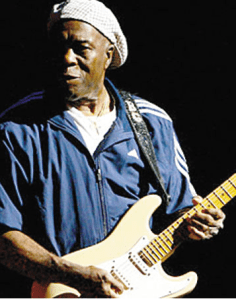
buddy_guy

Got the following in an email from Keith at Ernie Ball:

Ernie Ball, the premiere builder of strings, accessories, guitars and basses, has a new documentary series, Ernie Ball:The Pursuit of Tone on AT&T AUDIENCE Network (DIRECTV ch.239 or on AT&T U-verse ch.1114), that kicks off March 25 with blues legend Buddy Guy talking frankly about a wide range of topics  — from how he got his start with a 3-string guitar to Muddy Waters’ last words of advice.

Here are a few clips from Ernie Ball: The Pursuit of Tone (https://www.youtube.com/watch?v=kpmXaiJ64_w) . In this clip Buddy opens up about his reputation as a wild and crazy guitar player, “I started kicking the music stands off the stage,” Buddy says at one point. Also, included is the official trailer (https://www.youtube.com/watch?v=thQs9A0hWa8)  from the new series.

Unfortunately, if you don’t have DirecTV or AT&T U-verse, you can’t watch it. Hopefully, after the show airs, they’ll post it in its entirety on YouTube.

I’ll admit that I’m not a “blues guy,” but I do appreciate shows where icons of certain genres talk about their craft, and Buddy Guy is certainly an icon! I watched the clip on YouTube, and though short, you could just feel his passion for what he does.

Read Full Post »

fender_drriOkay, I lied. I said in my previous article that I’d have a First Impressions article in the next couple of days. But I got to play around with the amp for a couple of hours yesterday and decided that I played it enough to get a good idea of what I like and don’t like, at least a first blush.

What I Liked

The cleans with this amp are just as expected from any Fender tube amp: They’re spectacular. With just a little bit of reverb grease (around 2-3), the cleans sound deep and alluring. Played with my American Deluxe Strat with Kinman HX pickups and my ’59 Les Paul Replica, I just fell in love with the clean tone this amp creates! Old Leo got it right with the cleans on his amps. There’s nothing like a Fender clean sound. I realize that it’s not for everyone, but I’ve always been a fan.

As far as overdrive is concerned, this amp wants to growl. It stays pretty clean up to 4 on the volume knob, then will start breaking up. With the higher-output HX pickups on my Strat, I could get a great gritty tone with the volume knob on my guitar set at about 6-7; then just a little grittier when I dime my volume. It’s a completely different experience with my Les Paul, even with the lower-output Dr. Vintage PAFs. Set at about 5, I could get tons of grit, then cranked, I’d start getting some compression out of the power tubes. Upping the amp’s volume to 6-7 got me into tons of distortion. The cool thing was that the amp cleaned up very well, when I brought the volume down on my guitar, so it’s totally controllable.

What I Didn’t Like

While I liked the nature of the grit coming from the tubes, I didn’t care too much for the actual tone. Cleans were fine, well, as I said, “spectacular.” But I’m playing lead guitar in a classic rock band, and I’m anticipating using the amp to get a great rock sound. To me, that’s not possible with the stock speaker.

While I love Jensen speakers – I’m a huge fanboy of the Jet series – I’m not too keen on Jensen alnico speakers; at least for rock. For blues, they sound great, and when I did play bluesy stuff which didn’t require much grit, I loved the tone. But when I pushed the amp hard, the speaker breakup turned a little flabby for my tastes, and the amp lost a lot of dynamics and touch-sensitivity, and sounded “mushy.” It was a very “meh” experience. I think that’s a factor – at least for me – with Alnico speakers. I’ve only liked them for rock tones when there’s a couple or a few in a cab. But in a 1 X 12, their tone just doesn’t appeal to me.

I originally thought that with a 40 Watt speaker, I could get a great tone as the combination of tube and speaker breakup would produce something nice. But what I found was that particular combination didn’t really do it for me. The amp itself breaks up early, and around 6-7, I get all the breakup I need when I dime my guitar’s volume. Plus, when I bring my guitar volume down to 2 or 3, the amp cleans up. So that’s definitely the sweet spot, amp-wise. Unfortunately, the 40 Watt speaker can’t take that kind of gain.

But it’s a damn good thing that I have a lot of gear!

I pulled my 1 X 12 cabinet loaded with my latest favorite speaker, the Jensen Jet Nighthawk, and everything changed. My disappointment overdriving the stock speaker was complete erased when I when I hooked that cabinet up. The thing about the Nighthawk is that it has a full bottom-end, but not so beefy that it overshadows the tone. At the same time, the mids are tight and understated and the highs are just high enough to cut through a mix. So while you might think that the speaker might be on the warm side, it’s actually not. It’s more of a scooped tone (you’ll see what I mean if you at the frequency response chart on the link I shared above).

What this means for this amp is that it’s the perfect foil for the natural midrange I’ve come to expect from amps equipped with 6V6 power tubes, and totally balances out the tone of the amp. And yes, it is 75 Watts, which means that by using this speaker, the amp got a whole lot more clean headroom, which was why they put a lower wattage speaker in, to get breakup early. But for me, the amp itself produces all the overdrive I need. I don’t need metal crunch because I’m playing classic rock. If I ever need more, I just have to plug in my EWS Little Brute Drive, and I’ll get all the crunch I need.

That said, with the 75 Watt speaker, I could crank up the amp to pretty high levels to really push the tubes, and unlike the stock speaker, the overdrive did not sound flabby, nor did I lose the dynamics and touch-sensitivity as I did with the stock Alnico.

To get to that kind of drive without pissing off my wife who was working in the next room, I did use an attenuator (an Aracom DRX). No, I wasn’t at bedroom levels because that would just sound funky. But it was above conversation levels. At that volume the speaker wasn’t breaking up at all, so what I got was pure amp tone. In a word, the tone is inspiring.

Overall Initial Impression

To be perfectly honest, and  I know that this is purely subjective, in stock configuration, this amp is really meant for the blues. I originally thought otherwise based upon a pretty good demo I saw on YouTube of this very amp that it could be used for rock and softer alt-rock. But the guy doing the demo was playing a standard Strat, so the demo only displayed a fairly narrow set of its capabilities as standard single-coil pups just won’t push the front-end as much as my Kinman HX and humbuckers. Like I said, it’s a totally different story with a Les Paul.

That’s not to say that if you throw a couple of pedals in front of it, you can make it rock as-is. You can do that, but for me, I like my overdrive to come predominantly from my amp, then use an overdrive pedal to help push it over the edge and add only a touch of its own dirt to the signal. So that option is kind of out of the question.

Speaking of clean headroom… considering the configuration, I’m wondering what target market Fender had in mind for the Limited Edition DRRI. It’s certainly pretty to look at with its wheat grille and burgundy tolex. It almost screams “furniture,” which might imply that this is a bedroom or living room piece, as opposed to the more pedestrian standard DRRI, which sports an 80 Watt Jensen C12-K. That’s more headroom, but that kind of volume is more like gig volume to me.

But considering I don’t like the stock speaker, which might be the noose that kills this for me, with the right speaker, this can do rock, and do it quite well. Plus, it’s a combo, which is what I’m looking for with my new band. I don’t really want to lug a head and cab around.

All in all, I like this amp  – a lot – so I think I’ll hold on to it for awhile. Admittedly, I won’t make my final decision until I use it at a gig, but I think it’ll work just fine once I swap out the stock speaker.

Read Full Post »

fender_drriI haven’t been this excited about some gear in a long time! Actually, I haven’t done all that much reviewing in awhile. Sure, I’ve done some little things here and there, but haven’t done an amp in a LONG time.

When I picked this up at my buddy Dave’s house yesterday (he was my right-hand man in my previous band), I remarked that I haven’t done any amp reviews in awhile, and that I’ll probably write a review of it since I’m testing it to see if I want to buy it from him. A large part of me not writing is that I haven’t been in a band for a year and a half, so my “need” for gear and subsequently my GAS has been seriously curtailed. He laughed, saying the same thing. Now that he’s in another band, he’s starting to buy gear again (actually, I’m jealous because he’s setting up his living room as a jam center).

He even showed me some pedals that I really need to check out, like the Mad Professor Silver Spring Reverb. OMG! Talk about gooey, wet ‘verb! I played that pedal with a Les Paul Custom, into a custom Aracom VRX18. Could’ve sworn I was playing through a Fender amp! Gorgeous!

What really excites me about this amp is getting it into its breakup zone. Fender amps are known for their clean headroom, so when I hook up my attenuator to this, I’m hoping it’ll be a revelation! We shall see… 🙂

So… GAS is in full flow right now! I’ll probably post a “First Impressions” article in the next couple of days. ROCK ON!

Read Full Post »

This article leading up to the book advertisement is important. Give it a read…

In any case, that article kind of hit home with me in that while I feel it’s important to know theory and scales, I believe that you can eventually arrive at that knowledge in your learning journey. Music is meant to be played. And especially with guitar, which is a rhythm instrument, I feel it’s more important to get the movement of the right and left hands down, then get into theory way later, after you’ve learned to actually play some songs.

For instance, I’ve found that with many of the younger players who’ve played with me in my church band and who’ve taken a lot of lessons is that their left hand technique is often far superior to my own, but they can’t play anything outside of what type of music they like. To a person, I found that is because they have horrible right-hand technique. So I tell them that although it’s important to know chord shapes and scales and how to place your fingers on the fretboard, all that is meaningless unless you use your right hand, which is the hand that actually makes the sound! So I tell them that although they may not like various genres of music, I give them a challenge to be able to play reggae, country, blues and even latin music to get used to working their right hand.

You gotta love the energy of kids, especially if they love to play. All of them to whom I issued the challenge would go and practice, then show me later on what they’ve learned. Then I’d say, “Okay, open the book to number ____, and let’s see if you can play it.” And they can play. At that very moment, they get it.

For example, I had one kid who was absolutely flailing on guitar. He had the heart, but he couldn’t keep a beat. At the time, I was on kind of a blues kick, and I told him to go study John Mayer, and learn to play along while listening so he could practice playing with a group, and to be aware. The kid went off to school, then came back during his summer vacation, and just blew me away with what he’d learned. Not only could he play every single John Mayer lick, he had built the confidence to be able to play with the band.

The point is that all people need most of the time is a little nudge in the right direction. And with guitar, right or wrong, the direction I tend to nudge people is to simply play different kinds of music. I suppose that mimics my own experience as I learned to play via chord charts to songs, and figuring out how the original artists executed their tunes. I didn’t have YouTube. I just had vinyl records and cassette tapes. It wasn’t until years later that I started applying theory. I play with modes – a lot – now, but I’ll be absolutely honest: I didn’t start thinking about them until a few years ago when I wanted to expand my improv palate.

Circling back to lessons… Don’t get me wrong, I’m not at all against taking lessons. I’ve taken them from time to time to learn different things. I think the problem I have is learning technique for technique’s sake, and learning it divorced from the context of playing a song. Take learning the major scale for instance. It’s one thing to know the notes of the scale up and down the fretboard. That’s pretty easy. And I suppose you could just take a scale and start playing around and eventually come up with something while playing over a chord progression. But the major scale doesn’t really become meaningful until you apply it to modes, and having a song or practice chord progressions to play against.

I’ll leave a deeper discussion of modes for another time, but I will say that it wasn’t until I started studying modes that all the work with the major scales that I had learned actually became useful because all modes are simply expressions of a certain major scale played over a chord progression.

And I didn’t even learn modes in the academic way, where a mode is described in the spelling of the mode. For instance, with the Mixolydian mode, R W W H W W H R, or something like that. To me, that was always confusing. Even when someone would say, “If you want to play the Mixolydian mode in any key, just remember that it’s simply that scale with a flat-7th.” WTF?!!

The best explanation for the Mixolydian I ever got was this: Since the Mixolydian mode is the fifth mode, simply take the root note, then count backwards along the scale where that root note is the fifth in a major scale. Then play that major scale. So for example, if we want to play D-Mixolydian, we’ll count backwards where D (the root) is the fifth of a major scale. In this case, it would be the G-major scale. So if you want to play D-Mixolydian, then play a G-major scale because that includes all the notes of the D-major scale with a flat-7th. There’s a lot more to it than that, but just learning how to find a particular node for any key really expanded my improvisational toolkit. That didn’t take any formalized lesson. It just took practice to learn.

That kind of segues into my final point which is simply this: Play or die. As I mentioned above, music is meant to be played, and there’s a price to be paid to become proficient with any instrument whether it’s a guitar or piano or even your voice. To me the only way to internalize anything that we learn is to apply it, and that’s especially true of learning an instrument.

Read Full Post »

Please… Don’t Be Full of S$%t…

Check out this video of a Branford Marsalis interview…

The best line for me was: “We live in a country that seems to be in… …just a massive state of delusion where the IDEA of what you are is more important than you actually being that.”

OMG!!! That phrase rang true for me on so many levels, and not just music, and frankly, not just kids. I call it the “American Idol Syndrome,” where people have been led to believe that they’re good just because they happen to participate in something; or that they can achieve fame and fortune by simply showing up. I’d bet that 99% of the folks that enter aren’t very talented (remember, there are thousands that show up for the auditions in each city), and I’m also willing to bet most just don’t have the drive to do what it takes to achieve, let alone sustain their success. But they certainly think they do and that attitude is exacerbated by those around them saying how good they are.

Don’t believe me? Just look at all the past winners. While several have enjoyed professional success to some degree, arguably the most successful of them is Carrie Underwood. That chick has put in time! Sure, “Idol” put her on the map, but you don’t win multiple Grammys and other awards on talent alone.

Though not of the “Idol” ilk, the same could be said of Taylor Swift. Again, I’m not a fan of her music, but that young lady WORKED to achieve her success and fame, moving to Nashville at the tender age of 14 to pursue her dream of songwriting. She was recognized for her talent, yes, but if you think she didn’t work to get where she’s at now…

I’m not going to disparage any single person directly, but over the course of my long musical career, and especially the last several years, I’ve met so many people who have been told they’re good by those around them, and they just aren’t very good. The plain fact of the matter is that to be GOOD, you have to work at it. As Malcolm Gladwell wrote in his incredible book, “Outliers,” the best people in any profession that he studied spent at least 10,000 hours honing their craft. 10,000 HOURS! The best aren’t the best because they have talent. The best are the best because they have talent and are willing to put the work in to the point where they are recognized as being the best or at least among the best at what they do. These people are definitely not full of shit.

So what’s the point to this? Other than not mimicking the title of this article, realize that there are no shortcuts, and just because you have talent doesn’t mean you’re going to be a success. As I tell my kids, “You gotta work at it, baby…”

Read Full Post »

« Newer Posts - Older Posts »