 After many years of using solid state amps, I finally started looking at tube amps; specifically, boutique tube amps. I’ve looked at and played several from folks like Dr. Z, Mesa, King Amplification and a bunch of others. But boutique amps are VERY EXPENSIVE. And upon the recommendation of a very knowledgeable acquaintaintance (mentioned previously), I purchased a Fender Hot Rod Deluxe to tide me over until I could afford the $2500-$3500 for a boutique amp.
But no matter what boutique tube amp I decide to buy, one thing that struck me about about tube amps is that they’re LOUD!!! Yeah, I know, a lot of that comes from the types of volume pots installed on many amps, but irrespective of that little issue, tube amps just rock the house with their tonal clarity and their ability to punch through a mix. Unfortunately, they can get so loud that they squash the rest of your band (let alone shatter the eardrums of your audience), and that’s the bad part because most tube amps, especially Mesas and Marshalls just don’t sound right until they’re cranked and really pushing their power tubes. But in small to medium-sized venues, you’ll have people running for the door! 
So I went looking for a solution where I could push my power tubes but not break windows (or in a specific personal instance, not have the next-door-neighbor calling me at 1 am to “turn my f&*king amp down”). In any case, the answer lay in a box called a power attenuator. There are several types, and I won’t bore you with technical details, but the gist of a power attenuator is just that: it attenuates the signal coming from your amp. You simply place it between your amp and your speakers and it outputs a lower signal – thus lower volume. What this means is that you can crank your amp to the level that you’d like and achieve an overdriven tone, but do it at a significantly reduced volume level.
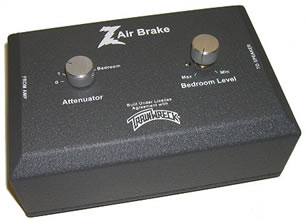
The hot ticket right now seems to be the THD Hot Plate. But there are others out there as well. Personally, I like the Dr. Z Air Brake because it has a very simple set up (just two knobs), and is much more versatile right out of the box than the Hot Plate. This is because it automatically adjusts to the proper impedance of your amp; whereas you have to get a specific Hot Plate model that matches your amp’s impedance level. Choose the wrong one and you could be in a world of hurt! So I’ll be going with the Air Brake.
However, since I have a home studio, I will also be purchasing the Weber Mass 100 because it has a EQ’d DI direct output that I can run directly into my MBox 2. That’s very useful for studio work, but way too complicated for stage work. Besides, even though I only play with 4 effect pedals (BBE Sonic Stomp [you gotta get this – or better yet, get a rackmount sonic maximizer], Ibanez TS-808 Tube Screamer, Boss DD-3 delay, and Boss CE-5 chorus), I have more than enough knobs to twiddle with, and the Air Brake is simple enough to use on stage – two knobs. I tend to be a set it and forget it kind of guy and only like to channel switch to my gain stage or switch the TS-808, so the less I have to play around with, the better.
Anyway, if you’re a guitar player who’s in search of maintaining your tone but saving your eardrums – as well as those in your audience – then a power attenuator is the thing for you.
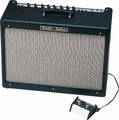 A few days ago, I got a Fender Hot Rod Deluxe, and as I mentioned, I was just blown away by the sound. As I’ve mentioned before, there’s nothing like the tube sound, and according to articles I read and people that I’ve spoken to about this amp, it’s a great entry-level tube amp that you can a lot of mileage out of. Since I’ve gotten it, I’ve been playing it at least a couple of hours a day – it’s that good!
 Guitar Gear