Just got my latest issue of Guitar Player, and as usual, went to the gear section first to see if there were any new and interesting pieces of gear. Normally, the stuff there is pretty tame, but I got really intrigued by a short product review on the Harmonic Capo. Unlike a normal capo that you place on a particular fret to play open chords at a particular fret position, the harmonic capo is placed at a harmonic fret: 12th, 7th, or 5th, and it will play the harmonic there. But the really cool thing about this is that unlike a normal capo, where you can only play the frets above the capo’d position, with the harmonic capo, you can play at frets above AND below the fretted position of the capo. It’s a very interesting concept that can yield some very interesting tonal possibilities. Check out this video by the inventor:
Archive for the ‘musicians’ Category
New Gear: Bob Kilgore’s Harmonic Capo
Posted in gear, gear reviews, guitar, guitar gear, guitarists, Guitars, Music, musicians, tagged capo, gear, gear reviews, guitar, guitarists, Guitars, musicians on September 22, 2008| 3 Comments »
New Gear: Fishman SoloAmp
Posted in gear, gear reviews, guitar, guitar gear, guitarists, Guitars, Music, musicians on September 19, 2008| 1 Comment »
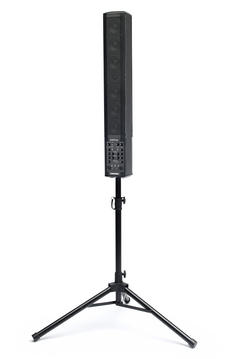
Fishman SoloAmp
Okay, I admit it, I’m a sucker for gadgets. Aw hell! I wouldn’t be writing this blog if I wasn’t! So there I was earlier this evening, surfing the web in search of new gear, and lo and behold, I run across the Fishman SoloAmp, a 220W bi-amp for acoustic guitar and vocals. It’s an amp and a PA in one package, and I have to tell you, for solo gigs, it seems too good to be true.
Here are some specs from the Fishman web site:
- Compact Line Array = Ultra wide horizontal dispersion & deeper sound penetration
- Two Mic/Instrument Channels
– High-quality preamps
– 3-band EQ
– Phantom Power
– Independent Reverb level
– Effect Loop
– Feedback-fighting Phase and Notch filters
- Drivers
- Auxiliary Stereo Input with Level control
- Four Digital Reverb effects with master level
- Balanced XLR D.I. outputs for both channels and main mix
- Unique Monitor I/O for improved on-stage ensemble monitoring
- Mute with remote footswitch input
- Tuner Output
- Ships with Stand and padded Carry Bag (w/ wheels)
- Dimensions: 41.5′ H x 5.6′ W x 6.6′ D
- *Weight: 25 lbs without Stand, 35lbs with Bag and Stand
– Six 4′ mid-woofers, patented dual gap, high excursion design, neodymium magnets (200W)
– One 1′ neodymium soft dome tweeter with level control (20W)
I’ve only listened to sound bites and audio from the Fishman site, but from what I could tell, this lightweight PA kicks ass for small venues!
I do a lot of solo gigs and I’m always looking for ways to reduce the size of my rig. The first step for me was getting the DigiTech Vocalist Live 4 that acts as both a harmonizer and mixer. Combined with something like the SoloAmp… okay… I have to stop slobbering now. 🙂
If anyone has tried one of these, please let me know!
Heading Into New Territory
Posted in Music, musicians, songs, songwriting, tagged Music, songwriting on September 19, 2008| Leave a Comment »
As part of my five-year-plan to be on the road touring, I entered three of my songs into the Song Door International Songwriters Competition. This is a big step for me as I’m crossing into completely new territory. It’s one thing to get acclaim from your friends, it’s an entirely different matter to have your music put under the microscope. I’m both excited and nervous at the same time! Anyway, here are the numbers I chose:
I don’t know how they’ll match up against the competition, but I have high hopes!
Review: VOX Satchurator
Posted in Effects, GAS, gear, gear reviews, guitar, guitar gear, guitarists, Guitars, musicians, pedals, tagged Effects, GAS, guitar, Guitars, pedal, Satchurator, stomp box, vox on September 11, 2008| 35 Comments »

 Vox Satchurator |
Summary: From grind to snarl, the Satchurator can deliver it. Built like a tank, with chicken head knobs, and a fire engine red paint job. Definitely gig-worthy! “More” switch is awesome!
Pros: Incredibly versatile, this box has the ability to deliver a wide variety of tones. Cons: Just a nit: True character of this pedal doesn’t come out until you’re at gig levels in volume. Price: $129 Street Features (fr. VOX site):
|
I am not shredder; never was, never will be. It’s just not my style. But that doesn’t mean I don’t love the sound of distortion and playing with a distorted sound. In fact, to me, there’s nothing like the sweet, sustained, and compressed tone of saturated power tubes, or the dirty color that comes from a great overdrive or distortion box. Thus, I’ve had several stomps over the years from DS-1’s to MXR’s to my current line up of a Tube Screamer, Bad Monkey and an OCD. Each pedal has its own unique character, and I employ all of them either individually or by chaining a couple together. It now looks like I’m going to add to my lineup.
When I first heard about the VOX Satchurator, I got excited. I figured anything that was designed and built to Joe Satriani’s specifications had to at least be something to take a good look at, if not outright buy. Plus, with VOX being known for high-quality, I knew that whatever was produced from this partnership would not be crap. So I knew that it would be a good bet that I’d get this pedal. In fact, I’m writing this review right after my test. But luckily, I’m not THAT impulsive that I left the store with one in hand – though I have been known to buy first think later. Luckily I have my trusty GAS Calculator to keep those impulses in check. 🙂 I scored a 5, which is on the high side of still considering the gear and just one point below of getting it, but I didn’t score a 6 or above, so I held back on my purchase for now (honestly, it’s a matter of available funds 🙂 ). Now back to our regularly scheduled program….
Okay… if you read no further, please read this:
THE SATURATOR WILL NOT MAKE YOU SOUND LIKE JOE SATRIANI!!!
No one sounds like Satch, but Professor Satchifunkilus himself. You may use the exact same equipment (I used a JSX for my test, but I used a PRS SE Custom Semi-hollowbody for one of the guitars and a Strat and Epiphone Les Paul for the others). You may even have incredible technique that matches or surpasses the maestro, but you will not sound exactly like him. I’m only saying this because I don’t want you to get your hopes up. What you do get though, is the same TYPE of distortion tone that Satch gets. What you do with that is entirely up to how you play; and that is a good thing. Okay, ’nuff said.
Here’s my take on the Satchurator: Forget about how cool it looks – it looks AWESOME, by the way – the Satchurator is an incredibly versatile distortion box that can serve up mild grind to unadulterated, in-your-face, lewd, crude, with a mouth full of food snarl (got that saying from Guitar Player mag 🙂 ). It also has incredible attack and volume knob sensitivity at any volume level.
The Satchurator is also not for the faint of heart. Once you switch on the box, you get breakup, even with the gain swept to zero. In other words, once it’s on, you’re committed to having even modest amounts of distortion in your signal. To coin a phrase from a close friend, “This ain’t for pussies.” But the cool thing is that the distortion is highly controllable based upon your guitar’s volume knob and how you attack the strings. From a volume knob perspective, I just DIG how the Satchurator responds to volume knob settings. Want less distortion, just sweep your volume down. Want more bite, do the opposite.
When I test pedals, I usually start out with everything set in the 12 o’clock setting. Through my test, which was about 45 minutes, I only moved the gain knob twice: All the way down to get a gorgeous bluesy breakup, then all the way up to see how bad the pedal clipped, which surprisingly enough, it didn’t do. For the rest of the test, I just kept the gain set at the centerline, then used a combination of attack and volume knob sweeps to dial in the right amount of distortion that I wanted. From a gigging standpoint, the less you have to bend over or crouch to set pedals, the better.
It has been noted that Satch actually plugs the Satchurator into a clean amp, then sweeps the gain knob. Personally, I like the sound that power tubes produce, so I set the JSX into the first gain stage, but left it pretty clean, allowing the Satchurator to drive the tubes into breakup. I do have to say that I loved that combination of tube breakup along with the Satchurator distortion.
More really is more…
There’s an interesting switch on the right side of the pedal called “More.” This switch provides even more gain when you switch it on. It’s great for cutting through a mix. The interesting thing is that the boost effect is less dramatic with higher gain settings on the pedal. With the gain knob pegged, pressing More definitely adds more, but it’s just a bit more, like going from 10 to 11 on your amp. Where I had it set at 12 o’clock, the More switch was nicely dramtic, and it’s something that I’ll definitely be using when I gig.
Will play nice with the other kids...
I didn’t get to try this feature out, but the Satchurator also includes a toggle switch called “Pad.” Apparently, this allows the pedal to play well with high output pedals like wah pedals and not change your tone. It essentially “pads” their signals so the Satchurator’s tone doesn’t fluctuate wildly. I’ve never seen a pedal that had this feature. Very, very useful. Once I put the Satchurator in my chain, I’ll definitely be using the “Pad” to help tame my vibe pedal that could potentially cause wild tonal fluctuations, which it does with my OCD, which doesn’t like to be played with the vibe.
So how did it REALLY perform…
I wish I had more time to try out a couple of other amps, but alas, I just didn’t. But I did try it out with three guitars, so that’s good. Here’s my synopsis:
- The first guitar I played it with was PRS SE Custom. This is a semi-hollowbody guitar. I’m glad I switched to another guitar because I wouldn’t buy the pedal if I just did my review with just that guitar. It’s not that the guitar was bad, and it wasn’t that the tone that was produced was bad. It’s just that the combination of this particular guitar with the Satchurator was uninspiring. I wasn’t blown away.
- After the PRS, I switched to a Strat, and my inspiration meter went through the roof! The sound was FAN-FREAKIN’-TASTIC!!! I had the same result with Epi LP I plugged in. In other words, at least from my perspective, the Satchurator sound best with solid body guitars. To be fair, I probably could’ve coaxed a great sound using the PRS, but with limited time, I didn’t have the patience. And in a gigging situation, the last thing you want to do is tweak.
Wrapping it up
As I mentioned above, this pedal will not make you sound like Satch, but it will give you the same kind of distortion Satch employs. I love that kind of distortion. It’s not super-compressed, but it’s also not so open that it comes across as hollow. As with Baby Bear’s porridge in “Goldilocks and the Three Bears,” it’s just right!
PRS DGT Field Test – c/o “Tweed Demon”
Posted in gear, gear reviews, guitar, guitar gear, guitarists, Guitars, Music, musicians, tagged gear, goldtop, guitar, guitar gear, musicians, PRS on September 7, 2008| 6 Comments »
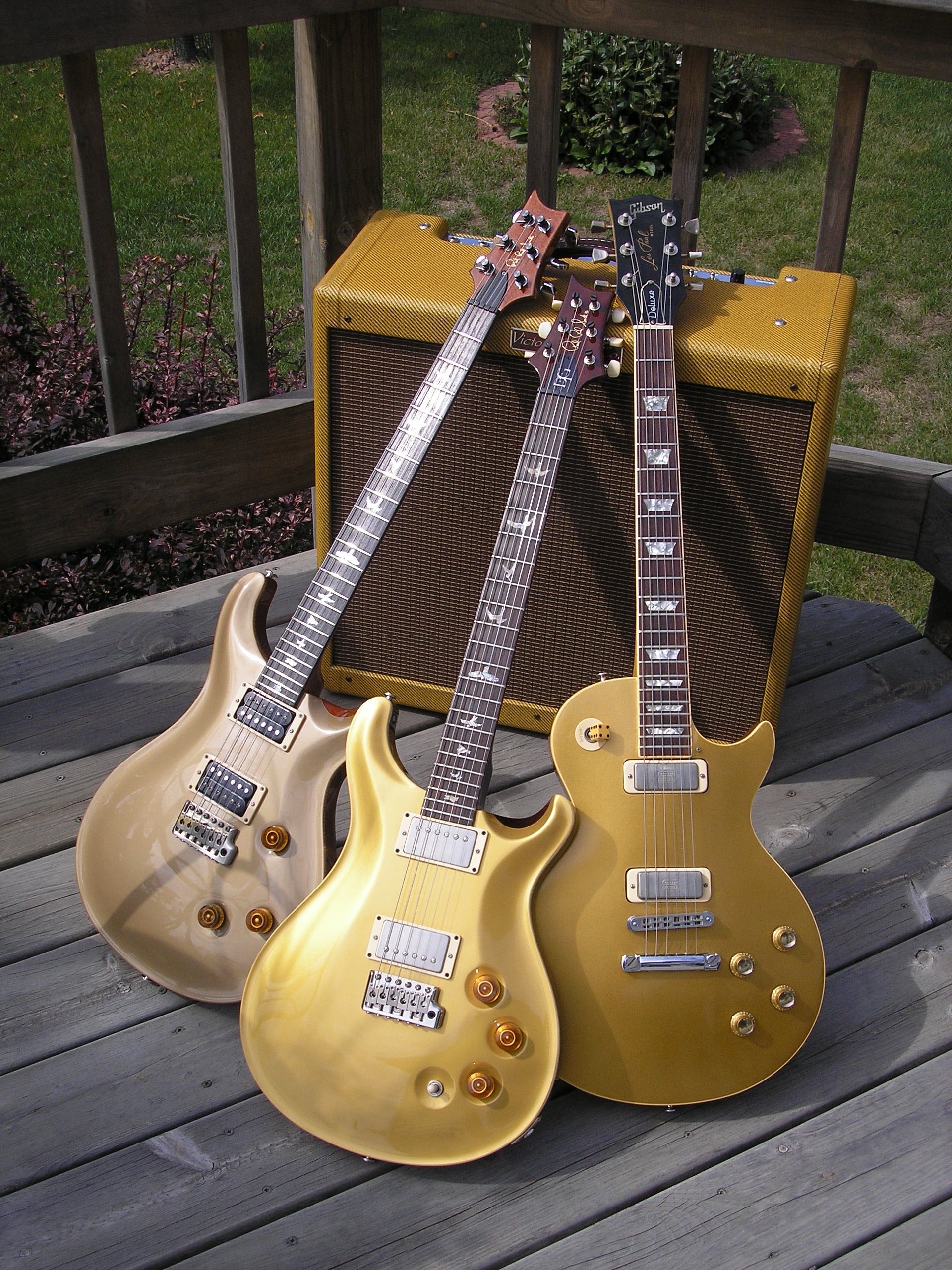
Tweed Demon's Goldtop PRS
There’s nothing like someone sharing their personal experience with gear. This post comes courtesy of Paul Garvey, aka “Tweed Demon,” a Guitar Gear reader who shares our passion for gear. Read on!
BTW, the picture is of his personal gear – I love the Victoria amp!
——
I’ve always loved goldtops from the first time I was 12 years old and sneaked my way into a high school dance just to watch the band. I was transfixed on the guitarist who was wielding an early Les Paul Deluxe with soapbars… I thought that was about the coolest looking guitar I’ve ever seen. I saved my nickels and dimes bagging groceries until I had enough money to buy my own a few years later (that was in ’78). I bought my first PRS about a decade later after getting that same feeling watching that guitarist with Joe Ely’s band who everyone now knows- David Grissom. Then in ’92 my wife gave me a goldtop PRS Custom 24 for my wedding anniversary present (yup, she’s a keeper). Needless to say, I’ve always loved goldtops and I’ve always loved the versatility of PRS instruments as the name PRS has become synonymous with quality high-end production guitars. For a guy that plays a lot of covers, I always felt these guitars were a necessity for anyone who doesn’t want to carry a carload of axes to every gig. I’ve always been a believer that good tone comes from the hands….a great amp helps…and big strings equals big sound. Then in 2007 when I read that PRS was coming out with a David Grissom signature model I felt intrigued.
I’ve tried all the PRS models to date and frankly, I liked the McCarty’s, but I felt the pickups were a bit vintage sounding to my ears and lacked a bit of clarity. In addition, I like the spongy feel to string bending that a trem can give a guitarist – particularly one who uses heavier strings (I use 11s on all my guitars, 12s on my ES-175). So when I read the specs on the DGT, new neck carve, jumbo frets, more open sounding pickups, added a trem, twin volume controls, and it comes in a goldtop… I knew I had to have one.
When I picked up my DGT at my dealer, the first thing I noticed was the finish. This is a nitrocellulose lacquer finish over a poly seal coat. The finish on this guitar is truly amazing. I have a nitro re-issue Fender, and that finish is downright soft by comparison. The finish on the DGT is very thin and hard…very hard. Hard like glass. I tapped on the back of the neck with my knuckle and the wood rings like a bell. Acoustically, I would describe it in a word- “resonant”. The gold was much deeper and brighter than my other goldtop PRS which appeared almost beige or buff colored by comparison (see attached photo). The deep gold with the mahogany back and neck really look like those great Gibson’s from the mid to later ’50s. Very cool. One drawback is that the finish is very fragile and will pick up a few dings very easily. On the flip side, it will break-in nicely and you can “relic” it the old fashioned way…by playing it.
The bigger frets (6100s) are great. I’m used to using 11guage strings, but these frets make 11s seem like 10s from a bending perspective. The neck again is much more “vintage Gibson-like” than any other PRS I’ve played. I would compare it closer to the D-carve on my Custom 22 Soapbar only narrower. The feel was very comfortable, and it almost immediately felt like an old friend. If you’re not used to a nitro finish, you will notice a bit of stickiness to the feel, which will fade with time as the guitar breaks in. And if you’ve never smelled newer nitro, it gives off a scent all its own – which may take some getting used to in a small practice area. But that too, should get better with time.
The phase II locking tuners are top notch. I have the same tuners on my CU22 and love them. The only difference is the “Kluson-type” vintage look to the ivory buttons. In addition to the cool look and function, they seem to keep this guitar well balanced by reducing a bit of weight in the headstock area.
My first night out with the DGT I would have to give it the grade: Incomplete.
Half way through my first set I was really starting to open up with this instrument. Then I felt like I wasn’t playing in tune and it was driving me nuts. My intonation was really whacked. I picked up my CU22 Soapbar and finished the set. On break I noticed two of the screws holding my saddles in place loosened up, one fell out completely, and the hex nut holding my trem was 80% out of its threads. Wha the? I did manage to find the lost screw, but the DGT rode the bench the rest of the night. Anyway, to fix the problem, I added a dab of medium (blue) threadlock to the bridge screws and re-intonated the guitar. Problem solved. A word of advise – let all threads dry first if you use threadlock, it will take off the finish if the chemical comes in contact with any painted surface. I use this stuff on my motorcycle everytime I replace any screw. Maybe PRS should start using threadlock in its production process. If I only had one guitar with me, I would have been screwed…literally.
The second night out with the DGT was with much better results…Grade: A. The first thing you notice about this guitar is just how spot on David Grissom was with his pick-up design. I understand about a years worth of R & D went into them. The pick-ups quite frankly are the best sounding PAF-like pickups I’ve ever played. The picks are very balanced with incredible clarity. Comparing them to my CU24, I would say clearer, more pronouced lows and highs and very open sounding pleasing harmonics, with far better sustain, which surprises me do to the clear clean sounds. The split coil sounds are also very clear and open. I would say the split bridge pickup delves more into Telecaster territory rather than Strat. Very snappy. The split neck can give you some nice strat-like neck tones. However, if you’re looking for the strat out of phase “quack” sounds, they’re not here. You may better appreciate a Custom 24, Swamp Ash Special, CU22 Soapbar, or a 513. But, if you want the beautiful open sounds of a great PAF, with some tele spank, this is THE guitar.
Another interesting and well thought out feature of this guitar is the dual volume controls. The versatility with this feature is endless and I found myself immediately using it. One of my favorite positions in the single coil mode, dual pickups is to roll the neck pickup back to about 8.5 or 9 just to give the mellow center position a little more snap. Very cool.
Looking under the hood on the DGT you will notice that the volume pots each carry an extra capacitor used as a treble bleed. There had to be a lot of research and trial for the proper values used here. The volume controls ARE volume controls! No loss of tone. You can roll the volume back with incredible clarity. It made me realize what I was missing all these years. It was a real eureka-type moment. A great feature for old school surfing of that saturated zone with a great cranked low-wattage tube amp- just by manipulating that volume control. What fun.
I normally don’t feel compelled to write these kind of reviews for any new piece of gear. But, I feel this guitar is special. I used to think the Modern Eagle was PRS’s crowning achievement in production-level guitar. The DGT almost gave me an epiphany of sorts. I really believe the DGT is this generation’s 59 Les Paul Standard only incredibly more versatile. In fact I felt so strongly on how great this guitar was, that I e-mailed David Grissom himself and told him job “well done”. David e-mailed me back and said how much he appreciated my comments and that he likes to see his guitar in the hands of “players”. Somehow I know he’s going to get his wish – in big way.
(any guitar gear heads can email me with questions/comments at: pgarvey222 (at) yahoo dot com.)
—————
Okay… jealousy sets in… 🙂 Thanks to Paul for this wonderful, personal analysis!!!
Product Spotlight: Peavey Windsor Studio Amp
Posted in gear, gear reviews, guitar, guitar gear, guitarists, Guitars, Music, musicians, recording, tagged amps, guitar, guitar gear, Music, musicians, recording on September 2, 2008| 1 Comment »

Peavey Windsor Studio
At-A-Glance: 15-20 Watt Class A tube amp, 12″ speaker, balanced XLR out with mic simulator.
Price: $399.00 (street)
Features:
- Class A Power Amp can use various octal power tubes including EL34 (stock), 6L6GC, 6550, 6CA7, KT88, KT66, or any variation on these types
- Two 12AX7/ECC83 Preamp tubes
- 15-20W (rms) into 4, 8, or 16 Ohms with “Power Sponge” output power attenuator
- No negative feedback in Power Amp
- High & Low Gain Inputs
- Preamp Volume
- Low, Mid, and High EQ
- Footswitchable Boost function
- Footswitchable Effects Loop
- Spring Reverb
- Transformer balanced XLR Recording Output w/passive mic simulator
- XLR Ground Lift switch
- Dual Speaker Outputs
- Impedance Selector
- 1/4″ TRS footswitch jack for Boost and Loop defeat
- 12″ Blue Marvel Speaker
I’ve never been much of a Peavey fan, but there’s something VERY cool about this little amp. For starters, I dig the fact that you can use different pentodes with it – and you can switch them with out re-biasing! Imagine getting that glassy sound with a 6L6GC (standard in Fender deluxes), then switching over to a KT88 for a more compressed overdrive sound. That feature alone makes it really attractive. But on top of that it also has a built-in attenuator!
This ain’t a giggin’ amp – least not for anything more than a small venue. As the name implies, it’s made for the studio, and with its included features, it’s clear that that is what it’s made for. For home recording stiffs like me, this amp seems like an ideal amp to have in my home studio. I used to be really dubious about low-power amps, but for low volume applications, you just can’t go wrong with a low power amp. Why? Simply because you can get low wattage amps into breakup at a much lower volume than with higher output amp. And with the right mic placement, in many cases you can’t tell just how little that low wattage amp really is. 🙂
But here’s the real kicker for me: It costs $399 retail. You can find it on EBay for even less! That alone is worth a look. Now I know that you might be thinking that this is just a cheap amp. Maybe it is, but based upon the demo below, I think this amp may deliver WAY more value than for what it’s selling. Check it out:
I’m going to have hit a Guitar Center or another local shop that carries one to try it out. If you’ve got or played one, I’d love to hear your insights!
It’s Always Tough…
Posted in gear, guitar, guitar gear, guitarists, Guitars, Music, musicians, tagged guitar, guitar gear on August 29, 2008| 5 Comments »
…to sell off gear.
Yesterday, I sold “Rusty,” my Gibson ES-333. I hadn’t played Rusty much for the last several months, and even though I used him on a recording recently, I just didn’t feel that attached. It was a bit of a sad occasion, but I’m looking forward to replacing him with something else. Besides, testing new models from SAINT Guitars will be absolutely awesome!!!
Got a Facebook? Join The Guitar Life Group on Facebook!
Posted in guitar, guitar gear, guitar lifestyle, guitarists, Guitars, inspiration, Music, musicians, tagged guitar, guitar life, guitarists on August 27, 2008| 3 Comments »
If you’re a member of Facebook, I’ve just created a new group called “The Guitar Life” to share experiences of living the guitar life. This is a totally open group, and I like to invite everyone to join and share!
What is today’s version of Rock Star style?
Posted in Music, musicians, style on August 25, 2008| 4 Comments »
In other words, what does a rock star look like nowadays? In the late 50’s and early 60’s it was clean cut and suits with skinny ties. By the latter part of the 60’s and into the 70’s it was the “hippie” or “mod” look. By the 80’s glam hit the scene and spandex and big hair was de riguer for the day. The 90’s was dirty jeans, dirty hair, and lumberjack shirts. Ugh!
So what’s the style nowadays?
BTW, can’t really count metal in this because that has had a fairly consistent style all these years. Mind you, this isn’t a bad thing, either.
Review: BOSS TU-2 Chromatic Tuner
Posted in gear, gear reviews, guitar, guitar gear, guitarists, Guitars, Music, musicians, tagged gear, gear reviews, guitar, guitar gear, Music, reviews, tuner on August 25, 2008| 2 Comments »

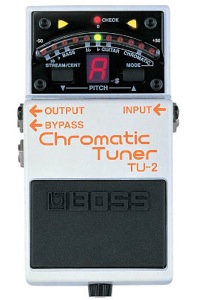 BOSS TU-2 Chromatic Tuner |
BOSS TU-2 Chromatic Tuner Summary: Basic, no-frills chromatic tuner in a convenient stomp box that can also double as a power source. Pros: Super-convenient stomp box makes on-stage tuning a breeze. Tuning mode automatically cuts off signal to the rest of your board for relatively “silent” tuning. Cons: Only has 11 total LED’s, so fine adjustments aren’t possible. Price: New $99 Street Features (fr. BOSS site):
|
Let’s face it: Tuning is a fact of life when you play any musical instrument. And if you’re like most gigging musicians, you don’t have a guitar tech at your gigs to tune your guitars in between songs. For that, you need a tuner. For years, I used a cheap, hand-held analog tuner with a sweep meter for tuning. It was very accurate and did the job well, but as I started to gig more and more, having to turn the volume down on my amp to tune soon became irritating.
So I decided to get a stomp box tuner, and went down to Guitar Center and bought the TU-2. Now I will be the first to admit that I didn’t do much research before buying the TU-2. I’d recently read an interview with Joe Satriani and he had a TU-2. I figured if something’s good enough for Satch then it’s definitely good enough for me. It was a safe bet then, and it’s a safe bet now. The TU-2 is solid performer that’s fairly accurate, though no LED-based tuner could even possibly suss the accuracy of a strobe or analog tuner. But for what it does, I’m pretty satisfied with it.
Another nice feature about the TU-2 is that it can also act as a power source for up to either other pedals. I power up my board with a Dunlop DC Brick, but once I used up the 6 available 9V ports, I couldn’t add more
pedals without having to get another brick. For one or two pedals, that’s just not a good justification when you’re spending 100-bucks. The TU-2 comes with both a DC-in and a DC-out port. You can use a standard 9V cable to hook up another pedal, but it probably makes more sense to spend the $12.99 and buy the BOSS PCS-20A power cord, which will route power up to eight pedals. Caveat: The cable runs between connectors are short. BOSS assumes you’ll be using nothing but BOSS pedals, but with tone freaks, that’s rarely the case. But it is a cheap, convenient solution nonetheless.
So what’s my verdict? I wouldn’t have it if I didn’t think it was useful. It’s not in any way, shape, or form something to do cartwheels over, but it’s a solid pedal that gets the job done. At Harmony Central, when you write a review, they ask you what you’d do if it the gear you’re reviewing gets broken or lost. Were I to review this pedal there and answer that question, I’d probably take a serious look at the Korg stomp box tuner that sports more LED’s and is a bit more accurate than the TU-2. The only thing that would probably keep me from switching is the ability of the TU-2 to provide power to other pedals.
Rock on!!!
 Guitar Gear