Feeds:
Posts
Comments

Archive for the ‘pedals’ Category

GIG-FX Mega Wah

GIG-FX Mega Wah

I never thought that I’d say this, but I’m now looking for a wah pedal. I was working on a song recently and was using my MicroVibe to add a pulse to my signal, but it just wasn’t happening for me. The tone was kind of okay, and as a demo, would’ve been okay. But I realized that I really wanted a wah sound. So I started researching wah pedals.

I tried out a few and really liked the Fender Fuzz wah, dug the sound of the Dunlop GCB-95F Fasel Cry Baby, and liked the Morley Vai Bad Horsie Wah (didn’t know if I wanted to wait for Vox and Satch to come out with the Big Bad Wah). I was just about to pull the trigger on the Cry Baby, when I ran across the GIG-FX Mega Wah. GIG-FX claims that the Mega Wah is six wah pedals in one. That sounds promising, but the problem I’ve had with multi-function pedals in the past is that their voicings have sounded like a collection of compromises, resulting in mediocre tone at best.

But the Mega Wah seems interesting enough, and the reviews on Harmony Central have generally been favorable, for as few of them as there are. From my point of view, having a variety of wah sounds is quite useful. Sometimes you want that big Fasel wah, then sometimes you want the wider sweep of a more modern type of wah, or anything in between. The Mega Wah may just deliver. Of course, I have to try it out to really be sure, but that’s what I love about this hobby of mine!

The only thing that would probably hold me back from buying it, if it indeed sounds great is the price. At $199, it’s not cheap, whereas at $99, the Cry Baby is very well positioned for my budget. But it’s all about bang for the buck with me, and I’m willing to pay a bit more for much more capability. We’ll see…

Read Full Post »

Durham Electronics Crazy Horse Fuzz Distortion Pedal

Durham Electronics Crazy Horse Fuzz Distortion Pedal

If you’re not a Neil Young fan, read no further. But if you dig that big fuzz drive sound like I do, you’ll love the Crazy Horse Fuzz Distortion pedal. I haven’t personally played this one, but from what I’ve heard, it’ll serve up that “Crazy Horse” sound! But wait, there’s more!

This pedal is very cool in that it is a drive AND a fuzz pedal in one. So not only can you get the Crazy Horse sound out of this, but by varying the mix of drive and fuzz, you can achieve all sorts of different distortion characteristics. But in addition to drive and fuzz level controls, plus the standard tone and level knobs, a VERY cool feature of this pedal is the voltage knob, which will allow you to “starve” the pedal of its voltage, so you can vary the output from thin and fizzy to thick and ballsy!

Being a boutique pedal though, this kind of functionality comes at a price: $249.00. It’s not quite as steep as others in its class (think Fulltone, Mad Professor, etc.), but it’s also not cheap. View the video below for a great demo!

Read Full Post »

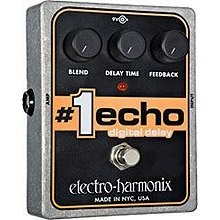
Electro-Harmonix #1 Echo

Electro-Harmonix #1 Echo

Over the years, I’ve had a love-hate relationship with delay pedals. My first taste of delay was an analog EchoPlex in the early 80’s. But focusing on acoustic guitar – actually only able to afford an acoustic guitar – at that time, I didn’t see the need for a contraption like that. Then U2 and The Edge entered my musical radar a couple of years later in the early eighties, and I of course had to get a rig where I could use a delay. So with what little money I had, I purchased a 25 Watt Roland amp, a Boss CE-2 Chorus, and a Boss DD-3 Digital Delay.

Little did I know that you had to have some technique to play like The Edge, and I quickly became disenchanted with trying to play like him. I just didn’t have the technique nor experience! So I held onto the amp, kept the CE-2, and sold the DD-3. I’m kicking myself now for getting rid of the DD-3 as it was a “Made in Japan” model that still had some hand-wired circuitry that makes it much-sought-after delay. Oh well…

Fast-forward to today, and I’ve owned several delay pedals. Again, the operative word is “owned,” because I don’t have one now. But I do have the technique, and I’m thinking that some of the stuff I’m writing could actually use some delay. Enter the Electro-Harmonix #1 Echo.

I’m normally a little leary of EH pedals, but this one seems promising, at least from the reviews I’ve read and the sound bites I’ve heard. Reviews are generally pretty good, but one thing’s for certain: All this thing does is delay. It doesn’t do any modulation or phasing. It just delays, and that’s exactly what I’m looking for! I’m going to have take one out for a spin, but it certainly seems like it will serve the purpose. And for a $99, it’s certainly not a huge investment. Let’s look at features:

  • True bypass (Yowza! that’s cool)
  • up to 2 second delay
  • Wet/Dry Blend for blending the amount of dry and wet signal – very cool
  • Feeback control – kind of like decay

Check out the videos

Read Full Post »

Jacques Overtube Vintage Pro Overdrive Effects Pedal

Jacques Overtube Vintage Pro Overdrive

The Dawg likes to sniff around for new and interesting gear all the time. Unfortunately, I don’t always have time to write or test stuff out. But I do love it when I come across some potentially awesome gear, and I take the time to share it here. The Jacques Overtube Vintage Pro Overdrive most definitely fits the bill in that department. By the way, think “Jacques Cousteau” when pronouncing the name… 🙂

The Overtube is supposedly a faithful reproduction of the original TS-808 Tube Screamer circuit. Now you might be thinking, as did I, that that is nothing special. But what is special about this pedal is that little toggle labeled “CASC” between the Tone and Drive knobs. “CASC” stands for “cascade” and it’s meant to simulate running two TS-808 pedals simultaneously ala SRV!

Check out this video on Guitar Player TV. I’ll be damned if that pedal doesn’t do a Tube Screamer exceptionally well! And with the cascade on, this pedal sounds sweet as can be with lots of thick mid-range wail!

As many of my readers know, I’m a big fan of the mid-rangy kind of drive distortion, so I’m gonna be hard-pressed not to give this pedal a whirl.

It’s a steal at $139!!! Check it out!

Read Full Post »

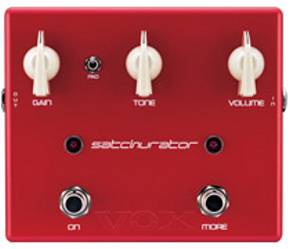
Vox Satchurator

Vox Satchurator

Summary: From grind to snarl, the Satchurator can deliver it. Built like a tank, with chicken head knobs, and a fire engine red paint job. Definitely gig-worthy! “More” switch is awesome!

Pros: Incredibly versatile, this box has the ability to deliver a wide variety of tones.

Cons: Just a nit: True character of this pedal doesn’t come out until you’re at gig levels in volume.

Price: $129 Street

Features (fr. VOX site):

  • Analog distortion pedal designed under the complete supervision of Joe Satriani
  • Controls for Gain, Tone and Volume
  • ‘More’ gain boost switch enables two footswitchable distortion sounds in one pedal. This gain boost is dramatic when gain knob is set low, and is a subtle solo boost when gain knob is set to maximum.
  • ‘Pad’ switch pads down input to allow for high gain pedals (such as modern wahs) placed before Satchurator. Up is pad ‘ON’. Down is pad ‘OFF’ for full Satchurator effect.
  • High gain, low noise design provides vintage to modern distortion sounds
  • Dynamic circuit is highly responsive to rolling off the guitar’s volume and preserves the guitar’s high end when the volume is rolled off.
  • Cream chicken-head knobs for precise positioning and high visibility on dark stages

I am not shredder; never was, never will be. It’s just not my style. But that doesn’t mean I don’t love the sound of distortion and playing with a distorted sound. In fact, to me, there’s nothing like the sweet, sustained, and compressed tone of saturated power tubes, or the dirty color that comes from a great overdrive or distortion box. Thus, I’ve had several stomps over the years from DS-1’s to MXR’s to my current line up of a Tube Screamer, Bad Monkey and an OCD. Each pedal has its own unique character, and I employ all of them either individually or by chaining a couple together. It now looks like I’m going to add to my lineup.

When I first heard about the VOX Satchurator, I got excited. I figured anything that was designed and built to Joe Satriani’s specifications had to at least be something to take a good look at, if not outright buy. Plus, with VOX being known for high-quality, I knew that whatever was produced from this partnership would not be crap. So I knew that it would be a good bet that I’d get this pedal. In fact, I’m writing this review right after my test. But luckily, I’m not THAT impulsive that I left the store with one in hand – though I have been known to buy first think later. Luckily I have my trusty GAS Calculator to keep those impulses in check. 🙂 I scored a 5, which is on the high side of still considering the gear and just one point below of getting it, but I didn’t score a 6 or above, so I held back on my purchase for now (honestly, it’s a matter of available funds 🙂 ). Now back to our regularly scheduled program….

Okay… if you read no further, please read this:

THE SATURATOR WILL NOT MAKE YOU SOUND LIKE JOE SATRIANI!!!

No one sounds like Satch, but Professor Satchifunkilus himself. You may use the exact same equipment (I used a JSX for my test, but I used a PRS SE Custom Semi-hollowbody for one of the guitars and a Strat and Epiphone Les Paul for the others). You may even have incredible technique that matches or surpasses the maestro, but you will not sound exactly like him. I’m only saying this because I don’t want you to get your hopes up. What you do get though, is the same TYPE of distortion tone that Satch gets. What you do with that is entirely up to how you play; and that is a good thing. Okay, ’nuff said.

Here’s my take on the Satchurator: Forget about how cool it looks – it looks AWESOME, by the way – the Satchurator is an incredibly versatile distortion box that can serve up mild grind to unadulterated, in-your-face, lewd, crude, with a mouth full of food snarl (got that saying from Guitar Player mag 🙂 ). It also has incredible attack and volume knob sensitivity at any volume level.

The Satchurator is also not for the faint of heart. Once you switch on the box, you get breakup, even with the gain swept to zero. In other words, once it’s on, you’re committed to having even modest amounts of distortion in your signal. To coin a phrase from a close friend, “This ain’t for pussies.” But the cool thing is that the distortion is highly controllable based upon your guitar’s volume knob and how you attack the strings. From a volume knob perspective, I just DIG how the Satchurator responds to volume knob settings. Want less distortion, just sweep your volume down. Want more bite, do the opposite.

When I test pedals, I usually start out with everything set in the 12 o’clock setting. Through my test, which was about 45 minutes, I only moved the gain knob twice: All the way down to get a gorgeous bluesy breakup, then all the way up to see how bad the pedal clipped, which surprisingly enough, it didn’t do. For the rest of the test, I just kept the gain set at the centerline, then used a combination of attack and volume knob sweeps to dial in the right amount of distortion that I wanted. From a gigging standpoint, the less you have to bend over or crouch to set pedals, the better.

It has been noted that Satch actually plugs the Satchurator into a clean amp, then sweeps the gain knob. Personally, I like the sound that power tubes produce, so I set the JSX into the first gain stage, but left it pretty clean, allowing the Satchurator to drive the tubes into breakup. I do have to say that I loved that combination of tube breakup along with the Satchurator distortion.

More really is more

There’s an interesting switch on the right side of the pedal called “More.” This switch provides even more gain when you switch it on. It’s great for cutting through a mix. The interesting thing is that the boost effect is less dramatic with higher gain settings on the pedal. With the gain knob pegged, pressing More definitely adds more, but it’s just a bit more, like going from 10 to 11 on your amp. Where I had it set at 12 o’clock, the More switch was nicely dramtic, and it’s something that I’ll definitely be using when I gig.

Will play nice with the other kids...

I didn’t get to try this feature out, but the Satchurator also includes a toggle switch called “Pad.” Apparently, this allows the pedal to play well with high output pedals like wah pedals and not change your tone. It essentially “pads” their signals so the Satchurator’s tone doesn’t fluctuate wildly. I’ve never seen a pedal that had this feature. Very, very useful. Once I put the Satchurator in my chain, I’ll definitely be using the “Pad” to help tame my vibe pedal that could potentially cause wild tonal fluctuations, which it does with my OCD, which doesn’t like to be played with the vibe.

So how did it REALLY perform

I wish I had more time to try out a couple of other amps, but alas, I just didn’t. But I did try it out with three guitars, so that’s good. Here’s my synopsis:

  1. The first guitar I played it with was PRS SE Custom. This is a semi-hollowbody guitar. I’m glad I switched to another guitar because I wouldn’t buy the pedal if I just did my review with just that guitar. It’s not that the guitar was bad, and it wasn’t that the tone that was produced was bad. It’s just that the combination of this particular guitar with the Satchurator was uninspiring. I wasn’t blown away.
  2. After the PRS, I switched to a Strat, and my inspiration meter went through the roof! The sound was FAN-FREAKIN’-TASTIC!!! I had the same result with Epi LP I plugged in. In other words, at least from my perspective, the Satchurator sound best with solid body guitars. To be fair, I probably could’ve coaxed a great sound using the PRS, but with limited time, I didn’t have the patience. And in a gigging situation, the last thing you want to do is tweak.

Wrapping it up

As I mentioned above, this pedal will not make you sound like Satch, but it will give you the same kind of distortion Satch employs. I love that kind of distortion. It’s not super-compressed, but it’s also not so open that it comes across as hollow. As with Baby Bear’s porridge in “Goldilocks and the Three Bears,” it’s just right!

Read Full Post »


A few months back, I had heard some buzz about Joe Satriani teaming with Vox to come up with some new pedals, and just recently caught wind of the first pedal from this partnership called the “Satchurator.” When I first read about it, I was thinking to myself, “Now this is cool…” I’ve known about Satch being a pedal freak for awhile, so I figured that having his input into a new pedal would be worth a look; and based on my few hours of research, and listening to samples and watching videos (I’ll insert a couple below), this pedal is worth more than just a look. It looks like I’m gonna get it!

Okay, just what I need… yet another drive/distortion pedal. But there’s something very very cool about the sound that this pedal produces, and from my perspective, it has nothing to do with trying to sound like Satch (even though people say that this is Joe’s tone in a box). For instance, I’d rarely, if ever crank the gain full. My stuff is more on the bluesy side of things, and the distortion this pedal produces can be really thick at higher gain levels from what I’ve heard. Nah, this is a different brand of distortion altogether. It’s not as mid-rangy as a Tube Screamer, but it’s also a little thicker than an OCD – it’s kind of hard to describe.

Of course, I’ll have to do a test drive before I actually buy it, but it sure looks like a winner to me. Let’s look at the features (from Vox):

  • Analog distortion pedal designed under the complete supervision of Joe Satriani
    Controls for Gain, Tone and Volume
  • ‘More’ gain boost switch enables two footswitchable distortion sounds in one pedal. This gain boost is dramatic when gain knob is set low, and is a subtle solo boost when gain knob is set to maximum.
  • ‘Pad’ switch pads down input to allow for high gain pedals (such as modern wahs) placed before Satchurator. Up is pad ‘ON’. Down is pad ‘OFF’ for full Satchurator effect.
  • High gain, low noise design provides vintage to modern distortion sounds
  • Dynamic circuit is highly responsive to rolling off the guitar’s volume and preserves the guitar’s high end when the volume is rolled off. (NOTE: This means it cleans up nicely when you lower your guitar’s volume – SLICK)
  • Cream chicken-head knobs for precise positioning and high visibility on dark stages

Now get this: THIS BOX IS STREET PRICED AT $129.00!!! Holy Simolians, Batman! That’s incredibly affordable! I am totally blown away by the price of this pedal! I’d kind of come to expect paying a steep price for something from Vox (can you say “Virage?”), but this just blows me away. Anyway, here a couple of videos I found while surfing:

Guitar World Review

Vox Demo

And from Joe himself…

Read Full Post »

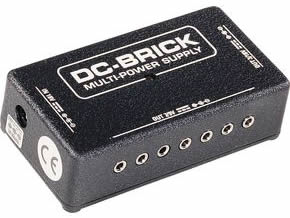
Dunlop DCB10 Brick A power supply? I know, kind of mundane, but if you’re still using 9V batteries, you might want to rethink your power supply needs. Here’s a common situation: You’re in the middle of a set, and your beautifully clean tone starts getting kind of fuzzy. It’s not too bad at first, but worsens as the gig progresses. You look down at your effect pedals, and one pedal’s light seems to be a bit dimmer than it normally is. You realize the battery is going dead. So after the song, you go back to your gig bag to get another 9V. You’re shocked to find that you don’t have a spare!
That situation happened to me this past weekend. I recently added a couple of pedals to my chain, but because my 1-Spot only had 5 connectors, I had to use batteries in my new pedals. The batteries were only a couple of weeks old, so I thought I was safe. Was I ever wrong. I had to rewire my signal chain to bypass those pedals. It wasn’t so bad, but it was a pain in the ass because I was in the middle of a set. After this experience, I decided to look into getting a more robust power supply that could power all my pedals.

So why the DCB10? Simply because as far as power supplies are concerned, I think it’s the best one I’ve ever had! It has 7 9V connections, and 3 18V connections – plenty to power up most boards. What really excites me about this pedal are the 18V connections. I have a Fulltone OCD that can take 9V or 18V power. At 18V, the headroom on the pedal just soars! But I digress… In addition to all the connections, the unit doesn’t introduce any hum. My 1 Spot could get a little noisy, and was a bit of frustration point for me. But the brick makes my chain as quiet as can be. A lot of this has to do with the fact that in addition to being a power supply, the Brick is also a power regulator/conditioner, so you get a consistent current going to your pedals at all times. This also means that you have built-in surge protection, which could be fatal to your pedals.

The Brick is also built like a tank, with a heavy-duty metal casing, so it is definitely a road-worthy power supply. Finally, the Brick can be used with any power source, from 110 to 240 (you’ll have to get an adapter for 240), which means you could gig anywhere in the world and not have to worry about swapping out your pedal board’s power supply.

Price: $190 retail / $99 – $109 street

A note about pricing: If you look for this on EBay, make sure you figure the shipping costs into the total price you pay. A lot of EBay vendors list the Brick for $99, but charge $19.95 for shipping. I bought mine from a local shop for $109 flat. Caveat Emptor!

Read Full Post »

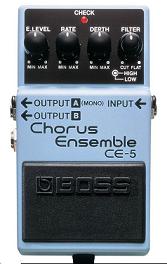
BOSS CE-5 Chorus EnsembleWhen it comes to chorus sounds, Roland/BOSS is pretty much the standard for the last twenty or so years. The CE-2 has especially been very sought-after used pedal 1) for its simplicity and; 2) for it’s analog design. I owned a CE-2 back in the 80’s, and have since kicked myself since I traded it for other hardware – that I don’t use at all anymore! Since then, BOSS has gone through a couple of renditions with the Chorus Ensemble line, and now offers the CE-5 Chorus Ensemble. A pedal that even though digital, sounds pretty darn good.
The CE-2 was a simple affair: Just two knobs for rate and depth, and a single output. With the CE-3, Boss introduced a “stereo-like” affair with two outputs, and three knobs, introducing a “Stereo Mode” knob to control how the outputs generated their sound. The CE-5 does away with the Stereo Mode knob and replaces it with an Effect Level knob, and a dual knob used for Hi- and Lo-cut filters.

In my opinion, the Hi/Lo Cut knob is what makes this pedal special. With it you can really shape your chorus sound from bright and smooth to dripping wet. All in all, you can’t go wrong with this pedal; and for less than $80, it’s a deal.

Starting with this review, I’m going to start giving summary ratings at the bottom of each review, similar to what you’d see in one of the trade rags.

BOSS CE-5 Chorus

  • Price: $129 (<$80 street)
  • Pros: Very versatile. Can produce a wide range of sounds
  • Cons: Can take awhile to dial in the sound you want
  • Summary: Great sounding chorus at a great price

Read Full Post »

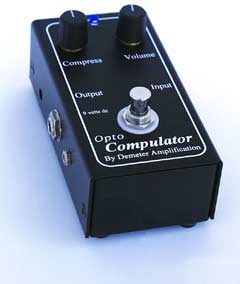
Demeter Opto CompulatorI was at a casino last weekend, sitting in a bar with a couple of friends and listening to this great duo play classic rock hits. During one of their breaks between sets, I went to the stage to talk to the guitarist (he had a cool name: Buford) and checked out his gear. He had a fairly simple setup: Just two effect boxes going into a Vox amp modeler that then went straight into his mixing console. What caught my eye though were his two effect pedals, both by Demeter (pronounced Deh’ meh tur) Amplification. One was Demeter’s FUZ-1 Fuzzulator drive box, and the other was the Opto Compulator. I knew a bit about the Fuzzulator, but I wanted to know more about the Compulator, as I’ve been considering purchasing a compression pedal for some time. So I asked him a few questions about the box. Here’s how the conversation went:
What’s your main application for the compressor?
Even though this is a pretty small stage, we’re playing in a fairly open environment at low volume. When I need to play distorted, I’ve got to fatten up my signal a bit, so I can cut through the crowd noise. Distortion always thins out your tone a bit, so this helps me compensate for that.

Doesn’t a compressor affect your overall tone?
In general, yeah. But this has got to be the most transparent compressor I’ve ever used. With this box, I maintain my tone, but just give it a slightly fatter delivery. And like I said before, in this environment, I need a fatter signal to cut through the crowd noise. I’ve played with a bunch, and this one is the absolute best I’ve ever had.

So what’s so special about the Compulator?
Like I said, it’s really transparent, and the compression effect is so subtle, most people wouldn’t even notice – I hardly notice it myself, but I know when it’s not on. And maybe there’s a bit of me being used to the sound. Other than that, it’s real easy to use. You have two knobs: The left-hand knob controls the amount of compression you want to dial in, and the other knob controls the gain. You also have a little trim dial on the side that you can adjust with a small screwdriver to trim the volume up or down – but I’ve never had to use it.

Can I do an A/B comparison from a slight distance away?
Sure thing. Step back about 20 feet, and I’ll show ya.

So I stepped back, and he played some chords and riffs with it on, and with it off. I’ll be damned! He was right. His tone was the same, but had just a tad fatter quality! Now that’s transparency! And that demonstration convinced me on the spot that the Compulator is the box I’m going to buy.

About compression…

For a good article discussing the general concepts of audio compression, click here. It doesn’t go into into the heavy technical details of compression, but it definitely helps to demystify how it works. For a more comprehensive and technical discussion, click here.

COMP-1 Opto Compulator Features

  • Compress Knob – controls amount of gain reduction up to 30dB.
  • Volume Knob – increases/decreases the output volume (aka “makeup gain”).
  • Trim Pot – very nice feature to adjust the unit’s preamp gain. If you plug a hot instrument into the unit, you could get distortion. You can knock down the input gain to avoid that.
  • Powered by a 9 volt battery, but also has a standard 9V jack.
  • Street Price: Generally around $199.00 (do a Google search)

My prospective usage

I normally play in very small, low-ceiling venues, so compression has not been a big issue for me. However, when I play with my band at my church, I have to play at fairly low volumes, which makes playing in distortion a huge challenge, because in order to hear the effect, I have to turn up my volume. That usually makes me stomp on the mix. With a fatter signal, I should be able to punch through the mix much more effectively without having to pump up my volume too much (or as much as I have been 🙂 ).

After hearing this unit, I’m convinced this is the right pedal. And getting input directly from a guy who swears by it and was willing to demonstrate how it worked had me sold.

Read Full Post »

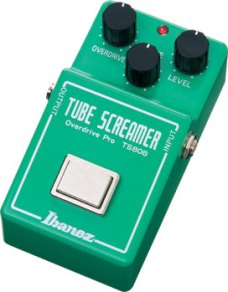
Ibanez TS808 Tube ScreamerSince I recently did a review on the Fulltone OCD, I thought that I’d do a review on the much-revered TS808. As many in the know, this is the pedal that defined Stevie Ray Vaughn’s sound. But it’s not the reason why this pedal is so special. The Tube Screamer has a unique, transparent tone; the keyword being “transparent.” Want to add drive and breakup to your tone – just switch it on. What you’ll get is a warm-sounding overdrive that is like candy for the ears.

Like the OCD, this is not a distortion box. It’s an overdrive box. The difference between overdrive and distortion are important, because they involve different approaches to the electronics. Click here for a good discussion. Overdrive boxes are known as “soft clipping” devices where gain is inversely proportional to input signal. Usually the boost is in the midrange with the high and low ends slightly cut off. The Tube Screamer is a pure midrange booster, and produces a beautiful, warm tone. The OCD on the other hand also boosts in the middle, but has added electronics that add sustain and boost harmonics and overtones. With the OCD, you can get a FAT, almost compressed tone. With the TS, you just get a boost – but that’s not a failing in the least!

As with the previous review, neither pedal is better than the other. They both have their uses. When I want lots of sustain – especially with solos – I’ll use the OCD. But for general broken-up rhythm, I’ll use the TS, but that’s not necessarily a de facto standard…  In any case, let’s discuss some features…

Note to metal players: This is not the pedal for you, if you’re looking for a real hairy kind of distortion. Think of this box as a driver to achieve pre-amp distortion. That tends to be on the brighter side. This box will not produce a fat tone, so buyer beware!

But if you’re looking for warm type of pre-amp breakup, this box is for you! It couldn’t be easier to use, either. Just three knobs: Overdrive, Tone, and Level. To get the tone you like, just fiddle with the knobs until it sounds right to you. Generally, I set the tone knob to 12 o’clock, which is pretty neutral (though the tone knob really doesn’t have that much dynamic range), set the overdrive to 10 – 12 o’clock, then set the level to slightly louder than the volume of my amp with the box switched off.

As far as build quality is concerned, it’s an all-metal casing. I gig with this box a lot so its hefty weight and solid build is a boon to gigging. And unlike the normal toggle switch you find on most boxes, the TS is (de)activated with a square switch. It’s not only aesthetically pleasing, it’s also really functional. The only beef I have with the box is that the light source of the LED is set kind of deep, so you have to be practically right over the box to see if it’s switched on or off.

Finally, the Tube Screamer is not cheap. A “Re-issue” like mine will set you back ~$169.00, while vintage boxes run up to $450.00. All I can say is that the money you spend is entirely worth it!

Read Full Post »

« Newer Posts - Older Posts »