Feeds:
Posts
Comments

Archive for the ‘pedals’ Category

5 Tone Bones - Gear has stellar performance, value, and quality. This is definitely top of the class, best of breed, and it's a no-brainer to add this to your gear lineup!

IK Multimedia Stealth Pedal

IK Multimedia Stealth Pedal

Summary: It’s official, IK Multimedia’s StealthPedal has just been released! The new StealthPedal is a lesson in packaging up familiar components to produce something totally unique. This is the first of its kind: A USB-powered guitar audio interface/software controller that you can use for recording or playing live as well as controlling any “Powered By Amplitube” software (or any MIDI-controllable software). With the StealthPedal, IK Multimedia completes the picture in providing an end-to-end computer-based guitar performance and recording solution.

Pros: Truly plug and play, it is automatically recognized by “Powered By Amplitube” software, and requires very little configuration.

Cons: None

Price: $199 Standard Bundle / $399 Deluxe Bundle

Specs:

• USB powered audio interface and pedal controller
• 2 balanced / unbalanced audio inputs (hi-Z or line level)
• 24 bit A/D and D/A conversion
• 44.1/48 kHz operation
• 2 balanced audio outputs
• Headphones output
• Volume control
• Built-in expression pedal and MIDI foot-switch
• Multiple LEDs can operate as Tuner or Level indicators with AmpliTube
• External double switch and expression pedal inputs
• Classic, rugged metal Wah-style construction
• High-quality, low-noise input stage (109dBA /104dB RMS S/N ratio)
• Control all “Powered by AmpliTube” software/plug-ins

• Control any MIDI controllable software/plug-ins

• Standard Bundle includes AmpliTube 2 Live standalone and plug-in, AmpliTube X-GEAR, Ampeg® SVX UNO standalone and plug-in, Sonoma WireWorks Riffworks™ T4, and AmpliGrooves Loops by Sonic Reality
• Deluxe Bundle: AmpliTube 2, Ampeg SVX, AmpliTube X-GEAR, Sonoma WireWorks RiffWorks t4, AmpliGrooves
• Compatible with all the most popular DAW software supporting ASIO and Core Audio drivers on PC and Mac
• Endless software expandability with AmpliTube modules

Tone Bone Score: 5.0 – I love enabling technologies that make anything that I do easier, but also add a ton of value. That can definitely be said of the new StealthPedal from IK Multimedia. A quick glance at picture of the unit, and you may think: Okay, just another pedal-style software controller. It is that, but it is also so very much more!

The StealthPedal is also an extremely easy-to-use, full-functioning analog-digital audio interface that you can use for recording or running modeling software live through your computer. And with 24-bit analog-digital, digital-analog conversion, and 44.1/48 kHz operation, you can count on the SteathPedal to produce high-fidelity sound in the studio an on the stage.

The StealthPedal looks just like a mere expression pedal from the top view. But look at the sides and the input and output jacks belie its humble appearance. On the left side of the pedal are ¼” jacks for right and left output, an 1/8” for headphones, another ¼” jack for a dual-switch external switching unit (extra), and the USB jack. On the right side of the pedal are ¼” jacks for inputs, a volume control knob, and a ¼” jack for plugging in another expression pedal. In other words, this “pedal” packs a punch and is so much more than what it appears!

Wah, wah, wah

It took me awhile to figure out that I had too early versions of X-Gear / Amplitube Fender to be automatically recognized the StealthPedal. My bad entirely. But once I had the right versions installed, adding software stomp effects and controlling them via the StealthPedal was a total breeze! The software automatically assigns the StealthPedal to control the first effect with some default behavior. For instance, with a wah effect plugin, the foot pedal is assigned to the wah effect and the switch is assigned to bypass. But you can change behavior simply by clicking the “setup” button at the top-right of the application window. It can’t get much simpler than that!

In the Studio

But before I even tried using it to control the included Amplitube software, I wanted to see how it performed as an audio interface. In this usage, I was totally blown away! Whereas other audio units such as those from DigiDesign require a software driver to operate (yes, even on the Mac), at least on the Mac, the StealthPedal follows Apple’s lead in design: Plug it in and it just works! So in a very real way the StealthPedal is aptly named as it just does what it does without you knowing how – or having to know how it works! Note that you do need a driver for Windows. But on my Mac, the process to be up and running took less than 5 minutes! That’s incredible!

Launching GarageBand, I just went into the preferences, and selected the StealthPedal as my input and output devices. I ran an unbalanced line from my mic pre-amp into the first input jack of the StealthPedal, added and setup a new track, hit record and started jamming on my guitar that was plugged into my amp. The StealthPedal worked as expected – actually a lot better than I expected because I was expecting only “okay” signal quality, considering the price point of this unit. Boy, was I wrong. The recorded signal was just as clean as my MBox 2, with no apparent shading of any kind. That put a smile on my face. And another thing that really blew me away was that lag was virtually non-existent. There was tiny bit, but nowhere in the realm of the lag that I normally get with my MBox 2. Amazing!

Then plugging my guitar directly into the StealthPedal, I fired up the Amplitube Fender plug-in, selected an amp, and started playing. This was truly the first time I could switch on track monitoring and not get thrown off from the lag!

What’s Not Obvious Is Usually Where the True Power Lays

Think about this carefully because it’s important: The real impact of the StealthPedal is not necessarily in its features, but in what it provides as a solution. As I mentioned above, the StealthPedal completes the picture for IK Multimedia to provide an end-to-end computer-based guitar performance and recording solution. I don’t say this lightly. Not only do they have totally kickass amp and effects modeling, with the StealthPedal, they now have a high-quality, high-fidelity guitar audio interface and software controller! Add to the fact that the StealthPedal requires ZERO setup to use (Mac only, sorry folks), and you’ve got a complete solution for all your computer-based guitar audio. And because the StealthPedal was built to work specifically for “Powered By Amplitube” products, you never have to worry about compatibility problems! I don’t know about you, but that’s just incredible to me. But wait there’s more!

Because it is a MIDI controller, the StealthPedal can also be used with other amp sim software via MIDI. So this just isn’t a solution for the AmpliTube user, it can be used by virtually all recording guitarists, and other musicians as well!

Overall Impressions

What can I say? I dig the StealthPedal! In the next couple of weeks, I’m going on a trip. Guess what’s coming with me? A guitar, the StealthPedal, a mic pre-amp, a mic, and a couple of cords. That’ll be enough to record any song, and besides the guitar, all that will fit into my computer bag!
Read Full Post »

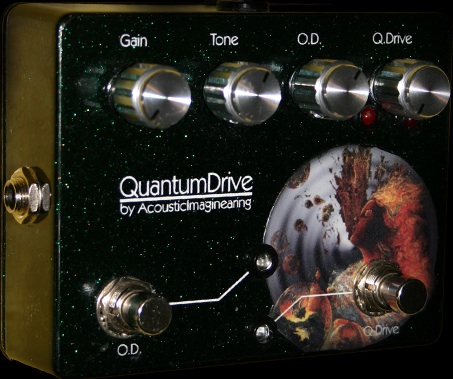
Acoustic Imaginearing Quantum DriveBrand-new from what appears to be a brand-new kind of overdrive/distortion, Acoustic Imaginearing has just released its new QuantumDrive, overdrive/distortion pedal. Folks, this appears to be totally new technology; the first and only that employs quantum mechanics tunneling to produce its distortion sound!

I’m no physicist, so I’ll let you do your own research on what quantum tunneling is. But this is a totally new twist on distortion! Here’s the press release:

The QuantumDrive, A.I.’s flagship product, is a versatile and unique overdrive and distortion unit that uses a patent pending process to dynamically shape the sound of the guitar by means of a quantum tunneling device. Quantum tunneling is a curious physics principle which allows matter to “pass through” other matter which would normally be impenetrable. A.I. has developed a means of using this effect to modify a guitar signal in unique and previously unheard of ways. The quantum distortion appears to add a vowel sound to the signal as well as emphasizing the consonant, fricative guitar distinctiveness. Affecting the edge of the waveform and not just the peaks, the result is a very expressive tone when played “in the zone.” Of course the pedal is also capable of wild and quirky, outside the norm distortions — each distinctive to the instrument processed by the Quantum Drive.

The effect is well suited for both guitar and bass, as bass frequencies are retained without becoming muddy. It has been used by Tony Levin on the latest King Crimson tour.

In addition to the distortion channel, the pedal has a solid overdrive channel, also uniquely designed, that can be used independently or chained together with the quantum channel.

I gotta tell you, I love this kind of stuff! And the fact that this is an overdrive/distortion pedal (you know OD is my favorite kind of pedal) is even better! I’m very excited when inventors add a new twist to something familiar. It just goes to show that there’s no shortage of creativity and innovation in the world!

How It Sounds

There are very limited sound clips available on the site, but the interface to listen to them is a bit screwy. I was able to do a debug trace to figure out the sound clip file names. The following clips were done with a Les Paul with the rhythm pickup into the QuantumDrive and output through a Peavey Classic 30. The clips actually aren’t that good, as the massive amounts of reverb kind of mask what could really be a great sounding pedal. But from what I could here, this is a real open sounding distortion, with just a little fizz. What I like is how the signal tails off.

Light Quantum Drive

Medium Quantum Drive

High Quantum Drive

Note that this pedal also has an overdrive that you can mix with the quantum drive as well.

Where to Buy

You can get this pedal on EBay for $165 as a “Buy It Now” or bid on it for $160 starting bid/$225 Buy It Now (in another auction).

This pedal is so new, they only have two dealers. This is a great find!

Read Full Post »

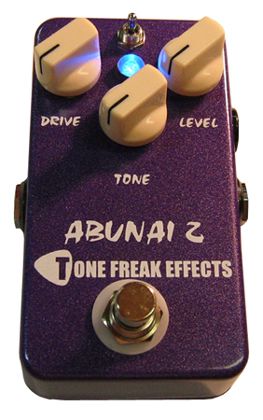
Tone Freak Effects Abunai 2I’ve been playing my Prestige Heritage Elite so much lately that I forgot how fun it was to get funky with my Strat. So this morning, I plugged my Strat into my board, switched on the Abunai 2, and found a sweet spot that would give me just a bit of grind when I played single notes with nice grit when I dug in or played chords. Then I started playing this little funky riff that I just laid down.

I just can’t get over how good this pedal sounds with any guitar! With my Strat, I’ve always tended to play it much more clean than my other guitars. The ’57 Tex Mex pickups – at least to my ears – have never sounded very good with overdrive. I’ve always felt the drive was harsh. But the Abunai 2 really smoothens out the drive, and now I’m diggin’ playing with some real grit on my Strat.

By the way, if you missed the first clip I recorded using my Heritage Elite, here it is below:

My Aracom VRX22 just loves this pedal as well. Some might argue that with such a great amp that has a fantastic overdriven sound that I should be using the natural overdrive of the amp. In answer to that, sometimes I want a completely different overdrive character than what my amp has to offer, and an overdrive pedal through the clean channel of an amp has a totally different character than the drive channel.

Also, in a home studio environment where I have to keep the volume down, an overdrive pedal allows me to get some snarling-dog overdrive without having to crank my amp. And with a pedal like the Abunai 2 that simulates voltage sag and tube compression so well, I can get that cranked amp tone at bedroom levels!

Anyway, I hope you enjoy the clips!

For more information on the Abunai 2, and for other Tone Freak Effects pedals, please visit the Tone Freak Effects web site!

Read Full Post »

5 Tone Bones - Gear has stellar performance, value, and quality. This is definitely top of the class, best of breed, and it's a no-brainer to add this to your gear lineup!

Tone Freak Effects Abunai 2

Tone Freak Effects Abunai 2 Overdrive Pedal

Summary: In Japanese, “abunai” means dangerous, and this pedal’s overdrive tones are indeed dangerous – at least to your other overdrive pedals. With three switchable clipping configurations, you can dial in a myriad of overdrive characteristics that’ll suit any situation, be it live or in the studio.

Pros: The magic’s in the three-way clipping configuration switch. Super simple to use, and very easy to dial in the kind of overdrive character you want.

Cons: None

Price: $199 (through dealers – check out the Tone Freak Effect Contact Page)

Specs:

  • Controls: Drive, Tone, Level
  • 3 clipping configurations
  • True Bypass
  • Neutrik jacks
  • Teflon coated, silver stranded wire
  • Mil-spec PCB
  • Metal film resistors
  • Metal film capacitors
  • Hand assembled

Tone Bone Score: 5.0 – As I shared with Dereck Tabata (maker of Tone Freak pedals), with the amount of gear that I run across, I’m rarely blown away by pedals. But I was completely blown away by the Abunai 2. Step aside Tube Screamer, there’s a new sherriff in town.

One rainy friday night several months ago, I was sitting in an Armadillo Willy’s eating my dinner and surfing the web, while waiting for my son’s hockey practice at the rink across the parking lot to end. I was doing what Internet geeks like myself occasionally do: Search for available domain names, and reserve them, just in case I want to build a site or point them to this blog. In this case, I did a google search on “tone freak.” The first listing was for Tone Freak Effects; an effects manufacturer I had not even heard of at that point.

Being the gear slut that I am, I just had to mosey on over to the Tone Freak site, and check out what they had to offer. And much to my extreme pleasure, they had a bunch of overdrive pedals, my favorite kind of effect! I immediately reached over to my laptop bag and pulled out my ear buds so I could listen to clips. The first set of clips I listened to were recorded with the Abunai 2. From the very first clip, I felt that this pedal was something special. It wasn’t a Tube Screamer tone – it was something altogether different. It had a much “ballsier” sound than a Tube Screamer, but seemed to clip very similarly – at least in the middle position.

Well I got one in for review just yesterday, and from the moment I hooked it up to my board and started noodling, I was in love!!! And by 2am this morning, I was spent, which accounts for why I’m doing a review of the Abunai 2 the very next day. I just couldn’t stop playing (though after the first hour I did stop to take a break and write a First Impressions article)! So today I’m a bit fuzzy and a little worse for wear, but grinning from ear-to-ear because I just spent the previous evening in absolute overdrive bliss! I know some gear is good when it can consume my attention for hours on end. This is the perfect overdrive pedal!

Features and Ease-of-Use

The features are listed in the summary section above, but the most special feature of this pedal is the three-way mini-toggle set between the drive and volume knobs. This controls the variable clipping section which gives you symmetrical, asymmetrical, and no clipping to open up lots of different overdrive tones. As far as ease-of-use is concerned, this pedal’s easy to use. Select the clipping configuration you want, adjust level, gain, and tone, and you’re off to the races!

Interestingly enough, I wanted to get some background information on the pedal before I received it, so I had a nice conversation with Rob at Tone Merchants about the Abunai 2. He indicated that I’d have to spend a lot of time dialing in just the right overdrive tone I wanted, but once I got it, I’d be totally happy. Call me lucky, but I set everything in the middle position to start with, spent maybe 20 seconds twiddling the knobs, and found a sweet spot. I suppose it also all depends on how discerning or nit-picky you are… I’ll just call it luck for my experience. 🙂

How It Sounds

Many words come to mind with respect to how the Abunai 2 sounds: Killer, Inspirational, Ballsy, F-in’ Incredible! All of the above. To date, this is the best-sounding overdrive pedal I’ve ever played, and I’ve played a lot. You know how taken I was with the OCD, but even that lost out to the Holy Fire, which is yet another killer overdrive/distortion that will never leave my board – actually I shouldn’t say “never” because that’s exactly what I said about my Tube Screamer. It’s not transparent – at least not nearly as transparent as the Holy Fire – but the tone it produces is so damn sweet, who the hell cares about transparency? But that said, the tone of your amp doesn’t really change a lot. It just takes on a slightly different character, and that difference is simply wonderful

No matter what toggle position you go with, the Abunai 2 serves up lots of sustain that gives the resultant tone a very 3-dimensional quality. It’s in your face, but at the same time it’s very spacious – even when it’s simulating tube compression!

In case  you missed the previous article where I described how each position sounds, let me rehash it here. Note that I’m not going to try to identify which position refers to symmetrical, asymmetrical or no-clipping; only what it sounds like to my ears.

Middle

The middle position sounds much like a classic overdrive tone. It’s an open type of distortion tone with a nice grind that’s never harsh. This could be the closest you get to a Tube Screamer tone, but it’s significantly different from that tone. This is a great toggle position for playing dirty rhythm parts.

Left

To my ears, this position sounds much like the tone you get as your power tubes start to saturate. You get a bit more voltage sag, resulting in more sustain and compression, but the overdrive tone still remains fairly open. And like an amp whose power tubes are starting to saturate, you get a slight volume drop. So far, this has been my favorite toggle position for leads.

Right

This position simulates fully saturated power tubes adding tons of compression, tons of sustain, and the expected drop in volume as a result -it’s spongy. I compensated for this by adding some clean boost to get the volume back to unity gain. But despite that, notes are clear, and the dynamics are still incredible.

Here’s a sound clip I recorded at around 1am this morning. I played both parts using my Prestige Heritage Elite. For the rhythm part, I set the toggle in the middle position, rolled off the drive to about 10 am, set the gain to unity, and placed the tone dead-center. I had both my ‘buckers engaged for this part. For the lead, I used the left toggle position, upped volume to about 2pm, set the Tone wide open, and set the Drive to about 1pm. The lead was played through my bridge pickup.

I tracked the rhythm part in a single take, and then loop recorded the lead so I could just jam. I’m not sure what iteration the loop was in when I finally stopped. All I know was that it was about 2am, and I took the last “take” and exported the clip to an MP3.

Overall Impressions

As I mentioned above, my head’s fuzzy, I’m a little worse for wear, plus my fingertips hurt from playing so long last night. But what the hell! I was in complete tonal bliss! The Abunai 2 is an absolute dream come true in overdrive tone! This is a pedal that you just have to check out if you’re in the market!

Read Full Post »

Tone Freak Effects Abunai 2 In my ever-constant search for new gear, I accidentally stumbled upon Tone Freak Effects, a little boutique effects shop in Southern California. And you know me, I DIG OVERDRIVE pedals!!! I know, I say that a lot, but I really do. When I listened to sound clips of the Abunai 2, I knew it was a pedal that I had to check out, so I contacted Tone Freak, and asked to do a review on one of their pedals. Dereck Tabata, maker of the effects, emailed me back and offered to have me review the Abunai 2. That was exactly the pedal I wanted to try out because based upon the sound clips of the Abunai 2 Dereck had on his site, it sounded absolutely killer.

Well after a moderate wait for Dereck to set up his new company and for him to create enough stock to send one out, I finally got my review pedal. I just got done playing with it for the last hour, and was so excited by its tone, that I had to release a first impressions article.

So I’ll just say this: After many years, my Tube Screamer is going to get retired for awhile. Mind you, I didn’t say I’d get rid of it. There is something about that Tube Screamer tone that I will always love. But even after just an hour of playing with the Abunai 2 and discovering just a fraction of the plethora of tones it can produce, I think I’ve found an overdrive pedal that I love as much or perhaps even more than the Tube Screamer. I know… I never thought I’d say that.

Let me give you a quick rundown of the Abunai 2…

When you first look at this pedal, you’re totally taken in by the absolutely cool purple, sparkly paint job. The picture here doesn’t do the pedal justice at all. Then you notice that it has a three knob setup, just like most overdrive pedals. Then you plug the pedal in, and that’s where the magic starts. That magic comes from the three-position mini toggle that gives you overdrive tone-shaping possibilities you never thought possible. These three positions give you very different overdrive characteristics. No matter what position you’re in, the tones this diminutive pedal produce are about the most incredible tones I’ve ever heard in an overdrive! Freakin’ awesome! Let me quickly go over each different position.

Middle

I’m starting with the middle position because that position provides that classic overdrive tone. It’s not a mid-range hump like a tube screamer. Like the Creation Audio Labs Holy Fire, the full spectrum of the EQ is represented. The distortion characteristics are pretty open in this position, and the pedal reacts very much like an overdriven tube amp.

Left

This position seems to simulate distortion when the power tubes start saturating and you get just a tiny bit of compression. This lowers the volume just a tad, but it increases the sustain. But the distortion is still open – so far this is my favorite toggle position.

Right

Metal rockers will love this toggle position. This position simulates fully saturated power tubes adding tons of compression, tons of sustain, and the expected drop in volume as a result. I compensated for this by adding some clean boost to get the volume back to unity gain. This is a VERY fun position to play in (that sounds kinda kinky…). Notes just sing and sing and sing in this toggle. But the cool thing is that despite the incredible amount of compression, the pedal maintains a lot of clarity in individually picked notes.

What a great first impression! This pedal totally kicks ass, as I’m sure Dereck’s other pedals do! It’s no small wonder why Greg Howe uses a Tone Freak Buff Puff! When I do my full review, I’ll have sound clips to demonstrate the differences in the tones between the different toggle positions! Rock on!

For more information on this and other Tone Freak Effects pedals, go to their web site!

Read Full Post »

4.75 Tone Bones - Almost perfect but not quite

Barber Direct Drive

Barber Direct Drive

Barber Direct Drive

Summary: The Direct Drive is a nice, fairly transparent overdrive that maintains your amp’s tone that can produce mild grit to over-the-top, searing gain that sustains for days. 


Pros: As overdrive pedals go, this pedal sounds great, and with internal trim pots you can adjust the bass response and presence. This ain’t a Tube Screamer clone by any stretch of the imagination. Plus, it’s handmade and at a GREAT price!

Cons: A little noisy with single coils and P-90’s.

Price: $119 direct

Specs:

Volume, Tone and Drive knobs
Internal Trim Pots to adjust bass response and presence 

Tone Bone Score: 4.75 – I really like this pedal! It’s fairly transparent and clear, and except for a bit of noise with my Strat and PRS SE II Soapbar, this OD delivers great tones at any volume!

If you read this blog with any regularity, you know I have a thing for overdrive pedals; especially in a small home studio like my own, a good overdrive pedal really helps get that drive tone when you have to play at bedroom levels. Unfortunately, not all drive pedals behave well at low volumes. I would have to say that a lot of my overdrive purchasing decisions have been driven (excuse the pun) by how well they perform in low volume situations like a home studio. I’ve played several drive pedals over the years, and while almost all sound great when an amp is pushing some serious air, there’s only a select few that perform well at much lower volumes. So I’m happy to say that the Barber Direct Drive falls into the latter camp!

Ease of Use

What could be more easy? Three knobs for Volume, Tone and Gain. Just dial in the amount you desire of each, and you’re off to the races. But the Direct Drive also provides a cool push-pull pot with the Tone knob that engages what Barber calls “Fat Harmonics” mode for what they call the “Expensive California” amp tone. It’s another way of getting more high-end sparkle and emphasis on overtones and harmonics; much like the Fulltone OCD that has it on all the time. But wait! There’s more! 🙂 Inside the box are internal trim pots for adjusting bass response and 

How It Sounds

It’s certainly fatter sounding than a Tube Screamer, even though Barber claims in their manual that a certain knob setting is an “808 killer.” I tried the Direct Drive at that setting, and it’s close, but sorry, no cigar. But that’s not a bad thing! The Direct Drive has a very distinct personality and definitely a sound and voice all its own! I did mention in the Summary that it’s fairly transparent. It is, but nowhere near as transparent as the Creation Audio Labs Holy Fire which is just about the most transparent overdrive I’ve ever played! But again, that’s not a bad thing. The overdrive characteristics are a bit tighter than a Fulltone OCD and much more even EQ-wise than a Tube Screamer; like I said, it has its own voice.

Here’s a clip I recorded. The rhythm part features a Strat. The Direct Drive’s volume is at unity, tone is dead-center, and Drive is about 10 am to get just a tiny bit of overdrive. The solo employs my Prestige Heritage Elite. The box’s volume is still at unity, tone is about 1 pm, and the drive is set to dead-center. This produces a nice, smooth grind, and lots of sustain.

By the way, the cool thing about that clip is that it was recorded at bedroom level, with my ribbon mic about 2 inches from the grille cloth! For the pedal to create that drive sound at that level is amazing!

Overall Impressions

This is a real kick-ass pedal, and I do have to say that in low-volume situations, this has got to be one of the best sounding drive pedals I’ve played. I dig it!  This is not a pedal I’d just at high gain, gig volume situations. It’s not that the tone is bad, but even though Barber has removed some of the compression characteristics in the later models (the old ones were pretty thick in comparison, apparently), it’s a bit too tight at high gain, especially when you need to punch through a mix. Besides at that volume level, I tend to stay away from my overdrive pedals altogether and just use my Creation Audio Labs Mk.4.23 booster (the best, most transparent booster on the planet, IMO) to slam my pre-amp tubes. 

But for general overdrive duties, this is a great pedal. I actually love its fatter tone when playing in low-volume venues, and for a street price of $119, and being hand-wired to boot, this is a pedal that I don’t think I can ignore! Neither should you! 🙂

Read Full Post »

Lovepedal has been around awhile, and has been known for creating some killer pedals; among them the awesome “Church of Tone,” Plexi-in-a-box drive box, and the Eternity drive, an incredibly versatile overdrive pedal. Just recently, Lovepedal released a line of four pedals that while diminutive in size, create huge tone. These are the Echo Baby, a nice straight-forward delay; the Amp 50, which is a miniaturized version of the Church of Tone pedal; the Pickle Vibe, a VERY nice vibe pedal; and finally, the Mini Buffer, a signal buffer to live on your pedal board to bolster and condition your signal chain. Each pedal measures 3 5/8″ long X 1 1/2″ wide X 1 1/4″ high. As Lovepedal puts it, these are small enough to fit on a keychain. 🙂 Of course, that’s a bit of an exaggeration, but that’s pretty small nonetheless. Check ’em out at lovepedal.com! Here’s a cool video to make you salivate a bit…

Read Full Post »

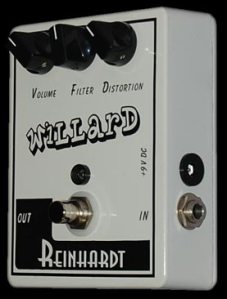
Reinhardt Amps Willard Distortion Pedal

Just ran across this brand-new fuzz pedal from Reinhardt Amps, called the "Willard" distortion pedal. This pedal is pure 80’s fuzz, a sound that I came to love! From the video, it’s clear that this pedal is capable of producing some serious hair, but it also retains a lot of clarity. Built around a true NOS LM308N op-amp chip and based around a big-box Rat of that era, this is a very nice-sounding distortion box. Check out the video below:

Read Full Post »

VOX Time MachineCan’t believe I missed the announcement of its release – I’m usually good about keeping on top of new gear – especially since VOX has been coming out with some pretty awesome stuff as of late. But here it is, the VOX Time Machine Delay. As with the other pedals of this VOX line, this pedal is the result of a very close collaboration between VOX and Professor Satchfunkilus (Joe Satriani). This pedal completes the three pedal line.

The Time Machine Delay features two delay modes (Modern and Vintage) and two EQ modes (Hi-Fi and Lo-Fi). The Modern delay mode provides a transparent delay to retain your orginal tone, while the vintage mode mimicks a vintage analog tape delay. The Hi-Fi/Lo-Fi switch does something similar to the delay modes. Hi-Fi retains your tonal color, while the Lo-Fi mode delivers a “distinctive EQ, combining both high-pass and low-pass filters” to blend better in a mix.

But the thing that I think is pretty incredible is that the pedal has up to 5600 milliseconds of delay – that’s almost 6 seconds! With that you could really do a nice lead loop that you can play over! Damn! Six seconds is a LOT of time. There are lots of layering possibilities with that! That length of delay alone compels me to try the pedal out!

While there are several demos, there aren’t a lot of reviews. Reviews on Harmony Central are mixed. Sound-wise it gets high marks, but one user did point out that the switches seemed a little “rattly,” with no click. Hmmm…. that could be a potential problem. But so far, I haven’t seen any quality issues – but the pedal’s new, so that remains to be seen.

The pedal ain’t cheap, coming it a $199 street, but it has some really great features that definitely worth consideration. Me? I’m really leaning towards the TC Electronic Nova Repeater, mainly because it’s no frills and the tap tempo function using the strum of your guitar is friggin’ awesome – it’s also only $150 street. And based upon the venerable, Nova Delay, it’s a known quantity. However, to be fair, I’m going to have to an A/B to see how the two pedals stack up.

For more information, go to the VOX Time Machine web page.

Read Full Post »

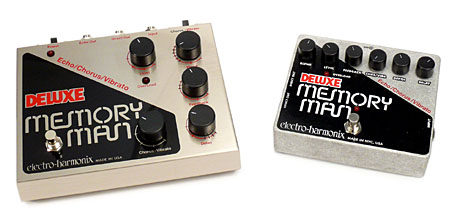
Electro-Harmonix Deluxe Memory Man Old and New

When I first saw the pictures of the new Deluxe Memory Man, I wasn’t too impressed only because I didn’t see the actual size difference between the old and the new version. But Electro-Harmonix has done it: They’ve made a DMM with a smaller footprint. I’ve played the DMM before, and really dug it. There is a certain mojo about this analog delay. But I never considered it because of the real estate it would require on my already space-starved board (though admittedly, it’s time to get a bigger board if I want all my pedals on a single board). Now, with it’s smaller size, this is definitely a pedal I’m going to consider – especially since I’m in the market for a good delay pedal. In any case, here’s the press release from EH:

The original Deluxe Memory Man is considered to be the finest analog delay ever designed. Organic and musical, it has been used by rock and Roll legends and countless musicians since its introduction in 1978. With the desire to make a flawless and smooth transition, Electro-Harmonix proudly announces the “new” Deluxe Memory Man in our rugged and pedal board friendly die-cast enclosure.

Exactly the same components are used in order to maintain the superior analog sound with exactly the same performance qualities. In this case, downsizing to a more rugged chassis was important and only second to maintaining the legendary sound. The exact same sound!

The original Deluxe Memory Man will still be available for a limited time. Musicians in the US and UK can now choose to get the new Deluxe Memory Man, or opt to get the classic. Musicians in the EU can now choose to get the classic original (as right now they only get the die-cast)

Read Full Post »

« Newer Posts - Older Posts »