Feeds:
Posts
Comments
5 Tone Bones - Gear has stellar performance, value, and quality. This is definitely top of the class, best of breed, and it’s a no-brainer to add this to your gear lineup! Sennheiser e835 Dynamic Microphone

Summary: A fantastic and versatile, and super-affordable mic with a wide field that is equally at home with vocals, and instrument/amp sound reinforcement.

Pros: Nice, flat response, with built-in presence boost produces very clear sound.

Cons: None

Price: $99 Street

Sennheiser e835

One of the underlying themes in the reviews I write here at GuitarGear.org is that cheap doesn’t necessarily equate to low quality, and as a gear freak, saving money where I can means I have more money to get more gear. I totally dig on finding excellent gear that doesn’t break the bank, and the Sennheiser e835 falls squarely into that camp.

I discovered this mic a few years ago when my trusty, but tired SM-58 stopped working. By chance, Guitar Center was having one of its blowout sales, and the e835 happened to be on sale for $79.00. So I decided to try it out, and am kicking myself for not buy 4 or 5 of these at the sale price. Oh well…

One thing that I couldn’t stand about the SM-58 was its boomy lows. I’m the type of singer that has the mic close to or touching my lips so that I’m right in the capsule. But with the SM-58, I couldn’t do that because the over-abundance of lows would muddy my vocal tone – and forget about using it to mic a cab!

On the other hand, I found that the e835 has a much flatter tonal response, and close-mic’ing anything is pretty easy, with very little EQ tweaking. It has a built-in presence boost that flattens out the EQ compared to the more scooped EQ of the SM-58. With that kind of flat response, the e835 becomes a very versatile tool that’s usable on-stage, in the studio, and can even be great for mic’ing guitar cabs! At $99 street price, you just can’t go wrong with this mic!

To prove how nice the e835 sounds, let me point you to a song I just recorded using e835. In this song, I used the e835 for both guitars and vocals. With the guitars, I wanted to add a little spacial depth to the guitar tone (I was using a Fender Champ 600 amp with only a 6″ speaker, so I needed a bit of depth), so I close-mic’d the amp with the e835, and used a Nady RM-200 ribbon mic placed off-axis about 10″ away. The Nady only adds a bit of depth, as the e835 does the bulk of the tonal work. But regardless of guitar or vocal, from the song, you can tell that the e835 really shines as a super-versatile mic.

I actually wrote this song quite awhile ago – I think Christmas Day, 2006. I did an early recording of it – very bad quality, and as I’ve been working on my demo, realized that I hadn’t re-recorded it. This was a must-have song on my demo.

Anyway, here’s the song: http://www.icompositions.com/music/song.php?sid=85823

Note that I have instrumentation details on the iCompositions site, but I will say that my Fender Champion 600 is a really great amp for home studio use. For this recording, I didn’t even bother running the amp through my Hot Rod’s speaker cab. I close mic’d the amp using a combination of a Nady RM200 ribbon mic, plus my trusty Sennheiser e835, which really brings out the low-end without being muddy. In my opinion, the 835 and 935 series mics just blow the Shure SM58 and 58Beta away. I’ll be writing a review on the Sennheiser in a bit… In any case, enjoy the song!

New Song: We Are Called

I wrote this song based upon a passage in the Gospel of Mark, Jesus talks about being called into justice and mercy. The passage inspired me to write “We Are Called.” Note that the only amp I used was a Fender Champ 600. Using two different mics, spaced at different distances to provide a little depth. I placed a dynamic mic right in front of the grille cloth, and a ribbon mic off-axis about 10″ away. The result was a very nice tone. The dynamic mic picked up the lows really well, while the ribbon caught the ambient – all this from a 5Watt amp with a 6″ speaker! Ha! You gotta love it.

For the opening lead part, I did “cheat” a bit and used my Hot Rod’s speaker cab for a bit more tonal depth, but still powered with the Champ. I love that little amp! Here’s the song:

Equipment:

Guitars: ES-333, Strat; Piano, Bass

Drum loops were standard GarageBand loops, and everything was mastered in GarageBand. Not bad for demo-quality work.

Breaking Through…

healsun-rays.jpgI was conversing with a friend of mine who just received his conditional black belt in Tae Kwon Do this past weekend – very great accomplishment. During the course of our conversation, he said the one missing ingredient in his study of martial arts is developing his “chi.” He believes in chi, but is having a hard time grasping what it is all about. Chi is a Chinese word that describes the natural energy of the universe. For sci-fi folks, it’s the equivalent of the Force in Star Wars. Without going into detail, the development of chi is at the heart of martial arts, though it is downplayed in the US because we live in such an empirical society where everything needs to be explained. In any case, my friend wanted to know more about developing his chi. We’ve had previous conversations about this subject, and I’ve related how I developed my chi over the years, so I showed him some techniques. But that’s really not what this blog entry is about…
During our conversation, I said something that compelled me to think about my guitar playing [actually, I’m surprised I even said it]. It was simply this: “Sometimes, in order to even start a journey, you have to give yourself permission.” For quite a while now, I’ve experienced a bit of a block in regards to improvising, admitting that I can’t do it, or saying that I’m purely a rhythm guitarist. Even the solos in the songs that I’ve recorded are the result of countless takes, where I’ve memorized the lead. That’s not so bad, Brian May talked about doing this on some Queen records back in the day. But for me, I realize now that it was fear that was blocking me; my fear of people thinking I sounded bad.

But something changed in me this past weekend. I wrote a new song for Church and I only had an hour or so to lay down tracks so my band had an idea of how I wanted it to sound when we performed it. So I open GarageBand, picked out a click track, laid down the keyboard and bass parts, then laid down the two rhythm guitar parts, then finally added the vocal parts. Realizing that I wanted a bit of solo at the beginning of the song, I quickly recorded a solo in the first 16 bars of the song. I did a quick mix and master, output the song, and wrote it to a CD.

On the way to Church, I listened to what I recorded, then realized I did every single part in one take each – even the solo. I know it’s not a very sophisticated solo, but it was the first time I just put something down without thinking about it. That really inspired me for the service where we were going to do a couple of songs that would require some instrumental interlude.  To make a long story short, when it was my time to solo, I just – did it. I told myself, “Don’t think about what you’re going to do, you know the fretboard well enough now. Just feel the music.” After Mass, someone came up to me and said they really enjoyed the music, and the way I expressed myself on the guitar. How’s that for affirmation? Admittedly, I was somewhat nervous because all my solos had been fairly calculated in the past – I had a pretty good idea of what I was going to do, and how I was going to do it. This time, I was on a bit of shaky ground because the only thing I started out with was the key of the song.

The point to all this is that in giving myself permission to solo, I was able to just do it. Did I make mistakes? Sure I did, but nothing glaring. For the very first time in my life, I was able to just let loose and express a message using my guitar. After Mass, I realized that I could probably have done this for a long time, but my fear of soloing kept me from doing it.

So give yourself permission to pursue your dreams and goals.  Like me, you will be pleasantly surprised by what you can accomplish.

Got Inspiration?

People get inspired by lots of things: Pictures they see, songs they hear, conversations they’ve been in; lots of things. Over the course of my life, like others, I’ve gotten inspired by lots of different things, but certain wise words I’ve heard from various people have probably inspired me the most. Not surprisingly, these have mostly been things people have said to me in the context of me being a musician. I’d like to share them with you here.

“There’s always room in this world for people who are good.”

The Dean of my college said this to me during a meeting where he was deciding whether to let me back into my major, which was Biology. I was asked to take a break for a year to “evaluate” my college career. It wasn’t that my grades were bad, but I was taking under the minimum number of courses and making very little progress that year. I was just focused on ballet and playing my guitar, and didn’t really feel up to pursuing a career in a lab or going to medical school. My Dean felt that my calling was in the performing arts (I didn’t know that he was a fan at the time). As he explained to me, people who are good at what they do get noticed, so if my concern was supporting myself, as long as I put my talent out there, I wouldn’t have to worry about getting gigs.

It took me a long time time – almost 20 years – to actually heed that advice, but I took the plunge and started playing at small gigs a few years ago. I started with just a few, but now I do about 30-40 gigs a year all over my local area. I don’t get paid much, maybe a few hundred a gig, but I totally love it!

“Focus on the goal, and let the universe take care of the details…”

These are very wise words from my friend and mentor, Dan Retuta. Dan is a medicine man as well as being a 5th level black belt in Aikido. Right before I decided to start pursuing music more, I was in a discussion with Dan about the logistics of doing music as well as supporting my family. When Dan said these words, I paused because they really struck a chord in me. The point of these words is that when you focus your energy on achieving a particular goal, you will place yourself in the right situations to achieve that goal. Not only that, you will then become aware of the opportunities that have always been around you to help you achieve your goal. Very cool words…

“We’ve all entered this world with certain talents… …our particular challenge in life is step out of the way to let our talents come through.”

I actually said these words to a bunch of teenagers at a retreat, but I’ve heard them said in a variety of ways by a variety of people. The point of this particular saying is that there are so many people who have never discovered their talents, whatever they may be, because they get caught up in the ways of the world, with the chaos of life, with misconceptions and preconceptions of how their world should be. We all fall prey to this. But if we just quiet our minds, and stop trying to analyze all the minutiae, we’ll discover those talents.

From another perspective, there are those, like myself, who have had to overcome their fears in order to fully discover their talents. Again, all it takes is to step out of the way and let your talents through.

“Wanna make God laugh, tell Him about your plans…”

I forgot where I got this one from, but I look at it as a corollary to my friend Dan’s saying, and also a corollary to my own. Don’t get caught up in planning your life to the letter. Prepare for the future, yes, but always be flexible because you never know what circumstances may arise that will shatter your plans. In other words, live the “NOW.” Be aware of your past, and look ahead to your possible futures, but live NOW! There are things you have to deal with NOW! What’s past is past, and the future is never certain. The only things you truly know are what you know NOW.

So how does all this relate to playing guitar? For me personally, these sayings have served as guides to keep me centered while I pursue my musical career. My goal is to have music (and ministry) be my main source of income within the next few years. I’m taking steps towards that now, but most importantly, I’m keeping my eyes open to opportunities. And let me say that I’m not going to be shattered if it remains that I support my music through another job. I love what I do as a successful engineer. I’m building cool stuff that has an impact on people’s lives, and that’s really cool to me.

In any case, rock on!

Reunion with Rusty

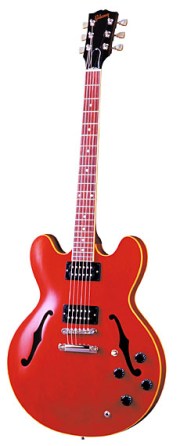
Rusty - My ES-333

Meet “Rusty,” my Gibson ES-333. It’s essentially a 335 without the jewelry (pickup covers [which I don’t like anyways], pick guard, translucent volume and tone knobs, mother of pearl inlays, etc). In other words, Rusty’s a straight-up, no-frills guitar, and out of all my guitars, he’s the most playable and most tonally diverse. I can go from sweet and clean, to gritty, to singing super-sustained distortion – with just the volume knob!

Recently, I was actually thinking about selling Rusty and using the proceeds to get another guitar, but Rusty sings so well, that I just couldn’t think of parting with him. You can hear Rusty as the main rhythm parts in this song:

Praise the Lord My Soul:

In that song, Rusty was plugged straight into my amp, and I recorded him using a Nady RM200 ribbon mic. I actually used him in both rhythm parts: The main G7-C9 riff, and the little funky ditty that’s played over the riff. With the main riff, I’ve got Rusty just at the edge of breakup so I can get a bit of a dirty sound. With the overlay, he’s played completely clean with just a touch of spring reverb. He’s got such a sweet, clean voice with just the touch of an edge. Very cool.

Rock on, Rusty!!!

Top Dawg: NAUDO

I was looking for some videos of a local band here in Northern California, called Big Rain on YouTube, and they did a cover of Bill Withers’ “Ain’t No Sunshine When She’s Gone” in a reggae style. Not bad at all. But as I’ve been looking to expand my current repertoire, I’ve been looking for different songs to cover. “Ain’t No Sunshine…” is very intriguing to me, so I looked for other covers of the song on YouTube, and ran across this dude, NAUDO, from Brazil. His instrumental version of “Ain’t No Sunshine…” on the classical guitar is beautiful, and not only that, effortlessly done. Check out the video. This guy’s awesome!

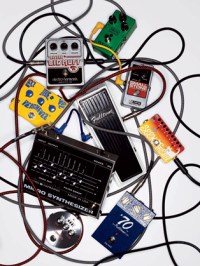
dear01_stompbox.jpgI walked into my garage this morning, which also doubles as my home studio and I looked around and saw several items that I’m not using at all right now. This includes a couple of solid state amps, a few pedals, and a sweet, digital recording workstation that I inherited from my brother that I never use because GarageBand is so much easier. My wife is great about all this, but she recently told me I have to do some spring cleaning. “Look at the big amp,” she said, “You haven’t gigged with that in a couple of years, and I haven’t seen you record with it either. Maybe you ought to get rid of some stuff… Besides, you need to make room for the shelving I want to put in here this spring”

Yikes! Looks like I have to take an inventory of what I can part with, but there is a rub to this. My friend Phil of Phil ‘n the Blanks said to me last week, “Don’t try to hide it, you’ve got GAS. I read your site all the time, and I’m amazed at all the s&*t you buy. Besides, if you get rid of some stuff, you’ll just replace it with other stuff…” OMG!!! How true. I found a place nearby that trades good-condition used gear for store credit. Damn! And on top of that, they’re a G & L guitar dealer! Maybe if I sell enough stuff…

The point? Sure, we gearheads go through periods of spring cleaning, but it’s more like gear rotation, as we rotate in new stuff for the stuff we no longer use.

Why not share your “spring cleaning” story?

Just read a great article in Guitar Jam Daily entitled: Industry Insider: The Cobain Backlash and it got me thinking about what really makes a guitarist great. I know, this is such a subjective thing that if you ask ten different people, you’ll get ten different answers. But I’d like to posit an idea about what makes a guitarist great. The idea hit me because of its simplicity, and it’s simply this: Musicality. I know, rather nebulous but – at least in my opinion – it’s the one word that truly captures the many facets of a guitarist’s greatness. It’s also a term that isn’t limited by style or genre.

Ana VidovicI began thinking about musicality being the key to measuring guitar prowess several months ago after reading an interview in Guitar Player with Ana Vidovic, THE babe of classical guitar. In that piece she talked about really focusing on her musicality, and got me thinking about my own musicality, which then lead me to thinking about musicality being the true measure of a guitarist’s greatness.

So what’s musicality? To put it simply, musicality is the relationship between instrumental technique and musical expression. Achieving a close relationship between the two requires a certain level of virtuosity in the instrument you’re playing and also a thorough understanding of the music being played: Where volume or rhythmic or expression characteristics can be applied within the body of a song. A truly musical musician will add subtle (and sometimes not so subtle) nuances to the things they’re playing; and while quantifying musicality can be a difficult thing, it’s very easy to discern between a musician with a high degree of musicality and someone who isn’t quite as musical.

Unfortunately, many of the guitar magazines out there seem to focus on shredders, so it has warped a lot of people’s views on who would or could be a great guitarist. In their view, the faster you play the better. But speed doesn’t mean at thing as far as musicality is concerned. But as long as we’re talking about speed, let’s look at a couple of pure, lightspeed-quick shredders: Yngvie Malmstein and Herman Li of Dragonforce. Herman Li is incredibly fast and he has tons of tricks up his sleeve. But listen to a few Dragonforce songs, and you realize that he’s using the same licks in practically every song. Where’s the musicality in that. On the other hand, Yngvie has so much more control not only over his speed and dynamics but also the tonal characteristics of the various phrases within his leads. So where Herman is a super great guitar technician, Yngvie is a true maestro.

But let’s not just look at shredders. Remember, musicality is not genre specific. What’s important is the relationship a guitarist builds between his or her guitar with the songs they play. From that perspective, let me list just a few of my favorite great guitarists:

  • James Taylor
  • Albert King
  • Elliot Smith
  • Joaquin Lievano
  • Neal Schon

This by no means is a complete list. I listed guitarists from different genres. None of them were the fastest, and in Elliot Smith’s case, not necessarily a real technician per se, but each brought a very definite musicality to the table in all the songs they play(ed).

So next time you want to compare what guitarist is better, you might think about comparing them on a different level other than speed and technique and ask, “Just how musical is this player?”

A couple of years ago, I called Tom Booth, a prolific Catholic songwriter and recording artist. I was seeking advice on the best way to approach putting a demo together of the songs I’d written for Mass. I wanted to know things such as how much I should budget, what players I should bring in – lots of things. He patiently listened to my questions, and at times interjected with some comments, but his final comment really surprised me. He said that in lieu of going into the studio that I should invest in good recording gear and record my demo at home. I was stunned by this. He didn’t say much more than that, nor did he explain his reasoning. But in retrospect, I don’t think he could’ve given me better advice.


So, based upon that conversation, I invested in a high-powered PC with tons of RAM and huge hard disk space, purchased a simple 2-input DAW (an MBox 2), installed ProTools LE, got a couple of good mics and cables, and was off to the races. I was jazzed to have a killer setup with tons of horsepower, and with ProTools, I’d be able to transfer the stuff I did at home to a studio’s computer. Sounds reasonable, right? Well, that was just the beginning of a nightmare…


I soon found out that you practically need a degree to get down even the most basic operations of ProTools. Yes, it’s powerful, and yes, it’s pretty much the standard, but there’s so much to it with all its internal features – not to mention the plug-ins that come standard with it – I had to spend hours and hours learning how to operate the software before I could become even reasonably productive.


That experience turned me off to recording; so much so that I lost my taste for it after recording just a few songs. The thought of laboring over the niggling details of ProTools and trying to understand how all the plug-ins worked with it made me groan with weariness. So I gave it up. After all, all I wanted to do was get my tracks down and output them to a reasonable sound quality – good enough for a demo.


Mind you, I’m not dissing ProTools. If I had the time to spend with it, I’d be all over the software, learning the ins and outs. But the problem is, as is the case with many home recording artists, I have to feed my family, so I work during the day. I also have a huge family, so my wife and I have to split up duties carting kids around from place to place on weekends. That leaves precious few hours during the week to get my songs recorded. With my lack of experience with ProTools, and the daunting task of having to learn it, I simply gave up on recording, and concentrated on songwriting. I wrote a ton of songs, and in 2006 kind of hit a groove with my songwriting where I was really liking what I was writing. But the problem with that was that the songs were piling up, and I knew that I had to get them recorded.


Up until about 6 months ago, it had been about two years since I had given up on serious recording. I still thought about it, but felt a little trapped by the equipment in which I had invested so much time and money. But luckily, a professional tragedy helped catapult me into recording again. For years, I’ve been somewhat of a poster child for high-tech start-ups. And in early 2007, I joined a tiny start-up that was working in the “Web 2.0” space. It was exciting, I made a very nice salary, and got a good chunk of stock to boot. After two-and-a-half months of being employed there, the company shut down. Our team of 12 employees was brought into a conference room and told by the founder that the company was closed and that we should pack up our things. All the assets would be put for sale, including all our hardware and software. Bummer. But what I got out of it was worth way more than gold.


In the company’s fire sale, I was able to get a bunch of equipment; among them were two iMacs that I purchased for my kids. I set them up, and started playing with one of them. In my explorations, I discovered a little program GarageBand. I had heard of it, but had previously dismissed it as yet another Apple “toy-ware” since I had my own full-blown recording solution (we’re all susceptible to our snobby notions sometimes). Well, in my playing, I started putting loops together, and created a song purely from loops. Then I got some valuable input from my blog buddy Ig at igblog who uses an MBox with GarageBand. I hooked up my own MBox, and whammo! I was back in the recording business!


Admittedly, GarageBand has its shortcomings, and some invaluable tools that I had in ProTools, such as direct WAV editing aren’t present. But more importantly, it allows me to concentrate on recording, and it has decent enough mastering tools to output decent demo cuts. Bear in mind that this isn’t necessarily a plug for GarageBand, and although I love it, there are some other fine, very easy-to-use packages out there.


No matter what package you choose, there some important lessons that I’ve learned in the creation of my own demo that I’d like to share:


  • First and foremost, the most important thing is to get your music out there. Whether or not you do it in the studio or in the comfort of your home, time to production is critical. Don’t let technological barriers get in your way like I did. There are always simpler solutions that will help speed up your process.
  • Speaking of technical barriers, and addressing what Tom Booth said to me, in retrospect, I’d give this advice: Get the recording gear that suits your minimum recording needs, but will give you some decent sound quality. After all, you’re recording a demo, so you’re not after finished production-quality recordings, but something that will convey your sound.
  • Once you have a recording solution, you should consider buying some other equipment:
    • buy a couple of decent mics. You don’t need Neumann. I use a Nady RM-200 ribbon mic and a Senheiser 830 stage mic. I use both interchangeably for vocals and instruments. Of course, if you already have good mics, definitely use them.
    • Invest in a decent mic pre-amp. Presonus makes the TUBEPre which is $99. It’s a great little tube pre that will add warmth to the things you mic.
    • If you can swing it, get a little 5 Watt tube amp for recording guitar parts at low volume. It’s amazing what these things sound like when close-mic’d. You can then use your software package to filter and fatten.
    • If you need MIDI, I’ve found it a lot more useful to have at least a 44-key keyboard with semi-weighted or fully-weighted keys. And you don’t need to spend a mint on a controller. You can get a decent controller for less than $200.
  • Most integrated packages like GarageBand or Logic Express have some basic mastering tools to output your recordings. Learn to use them; especially the dynamics processors like a compressor. Mind you, you don’t want too much compression, but you’ll do yourself a huge favor by controlling your peak volumes.
  • Finally, and I know I said this before: Always keep on telling yourself that this ain’t finished product. It’s not supposed to be finished. It’s supposed to convey to the listener what your sound is all about. You can get it close, and you should, but don’t fret over the little imperfections here and there.