Feeds:
Posts
Comments

A few questions…

First, some background…

I was walking around Downtown Disney (in Anaheim, CA) a couple of months ago, enjoying the various street acts that Disney hires to play. One of the acts was a solo guy who played guitar and sang on top of recorded tracks laid down that were inserted into his mix. I have a bunch of songs that I have in ProTools that I’d love to output and play and sing on top of when I gig.

So my question is: What kind of equipment will allow me to do this? Is an Akai MCP[500, 1000, 2500] the answer? Or is there a more straight-forward solution that doesn’t require sequencing?

Thanks for the input!

GoofyDawg

For the last several years, I’ve led a band at my church. It’s a great group of folks, and I love them all dearly. They’re not only dedicated musicians, but they also share my passion for worship music. Outside of church though, I do solo gigs all over the local area. I have a regular gig at a restaurant, and do parties, weddings, funerals, corporate events, etc.. But lately, I’ve been thinking that I’d like to start a band outside of church, and do bigger venues like clubs. I’m feeling the need of an outlet for the non-secular pieces I’ve written, and many of the arrangements require a full band. It’s hard to pull it off with just a keyboard or a solo guitar.

Of course, the challenge is in finding band mates. I think I need to stew on this a bit more, but if anyone has any input, I’m certainly open to it.

I was in a rush the other day to make it to the pre-service rehearsal at my church. I was farting around and didn’t keep track of time, and realized that though I could make it to rehearsal, I wouldn’t have that much time to set up my usual rig for Mass. I normally bring a couple of guitars, my amp (a modified Fender Hot Rod) and run through 5 effect pedals (Tube Screamer, Boss Chorus, Boss Delay, DigiVerb, and a BBE SonicStomp – and no, I don’t have them mounted on a board – yet). The guitars are A/B’d through a Morley ABY box.

As I said, I didn’t have much time, so I just loaded up my amp, Pearl (my beloved Strat), and my Tube Screamer into my little SUV,  and sped off to church. With so little equipment, I was able to bring it all into the church in one trip, and set up in 5 minutes. Being the leader of the band, it was imperative that I get set up quickly so I could run rehearsal.

Once I got set up, we started rehearsal. As we got further into it, one thing struck me: I wasn’t missing the tone from my other pedals! It helped that none of the songs in the set didn’t require any texturing (some of my songs were written to take advantage of a deep chorus). But just the raw tone coming from the amp (along with some spring reverb), sometimes combined with the edginess of the Tube Screamer, was incredibly pleasing to my ears, and it has made me really re-think the necessity of having a bunch of pedals. Not that I would do away with them altogether, but I’ve now decided to take a much more minimalistic approach to my tone. Actually, it’s sort of a relief, because it means I won’t be buying more gear in the immediate future – though as I’ve written in the past, I do have serious GAS.

But the GAS notwithstanding, there’s a lot to be said about just producing raw tone. Try it out, you may be very pleasantly surprised.

Beauty from Tragedy

pearl_chip.jpg A couple of weeks ago, I was re-stringing Pearl, my trusty Strat when I noticed that something was dreadfully wrong: My high E string was laying flat on the fretboard! I thought I had simply missed placing the string in the groove of the nut, but to my dismay, the nut had chipped at the groove! Who knows where the piece went! It actually didn’t matter whether I found the piece or not – having experienced this before with another guitar, there was no way I could simply super-glue the piece back on. I had to have a new nut fabricated. So I frantically looked for an authorized Fender repair shop near my home in Cupertino, CA, and I found Keith Holland Guitars in Los Gatos, CA. In addition to selling custom guitars and amps, this shop does guitar repairs through its Guitar Hospital (cool name).

I called the shop and spoke to a friendly guy named Jim, and explained what happened. He told me to bring Pearl into the shop, and it would take about a week until the guitar was ready; not that it would take them that long, but they were totally back-logged on repair work as their repair business has boomed – a great problem to have, I suppose. In any case, when I brought Pearl in, Jim did a quick inspection and suggested that I let him do a full setup on the guitar: smooth the frets, straighten the neck, clean out the pots, and adjust the action to what I wanted. I knew there was a slight bow in the neck, so I quickly agreed to the work. I wanted to go from 9’s to 10’s with my strings to get a better ring and sustain, so I knew I’d have to get the action adjusted anyway.

When I got Pearl back, I just couldn’t believe how much more playable she was! Jim lowered the action about a 64th of an inch, replaced the wood shim that I placed behind my tremolo bar and cranked down the bar, and now moving about the fretboard is just simply amazing. BTW, I’ve never been able to get the hang of using a tremolo bar, so I just removed it. Anyway, even with the heavier gauge strings, Pearl plays like silk now! She was great before, but now she’s otherworldly territory! Here are a couple of pics of Pearl:

pearl1.jpg pearl3.jpg

I tell ya, I’m having a bit of a love affair with this guitar. I still play Rusty, my ES-335, but Pearl is definitely my go-to guitar right now. Amazingly enough, I’ve never been a Strat guy. I used to be into fat-toned dual humbucker guitars. But I think as a musician you gravitate towards the sound that meets your particular tonal tastes. As I do a lot of composition, Pearl provides the tone that’s in line with the style I’m writing right now.

I’ve been meaning to write about Justin King, who is simply an AMAZING guitarist. Michael Hedges (who still remains my original guitar here) may have started the trend of expanding the playing possibilities on the acoustic guitar, but Justin King takes what Michael did to yet another level. Words can’t adequately describe his virtuosity; you have to see it to believe it. Here are two videos that I found:

The thing that really impresses me about Justin’s style is that he incorporates his right hand even more into his music, combining rhythmic beating and tapping with flamenco-style strumming. It’s a joy to watch this guy play as you see his hands in a flurry working the body and neck of his guitar. I’m surprised he hasn’t been more widely recognized in the guitar world.

Speaking of the right hand, so much literature is devoted to left-hand or fret-hand technique that completely overshadows the importance of the picking/strumming hand. Folks, this is where you get your rhythm. I don’t know how many guitar players I’ve met who have simply crappy rhythm. Oh, they can pick just fine, but their sense of rhythm and their strumming technique just stinks up the place. Guys like Michael Hedges and Justin King demonstrate that well-developed right hand technique can add dimensions to your playing style that you never thought existed!

Meet My Guitars

I’ve never shared this before, but I’ve always given names to my instruments. It all started out when my Dad gave me a ’79 Yamaha FG-335 dreadnought for my birthday. It had such a deep, rich tone, and I played the hell out of it. I still have it, in fact, but I need to take it to a luthier to have some repairs done (somehow the neck came off the body). That guitar I named “Betsy.”

Betsy

Next up is my Ovation Elite acoustic/electric named “Sunset” for its sunburst finish that reminded me of a sunset.

Sunset

“Rusty” is my beloved ’60 Dot Re-issue Gibson ES-335:

Rusty

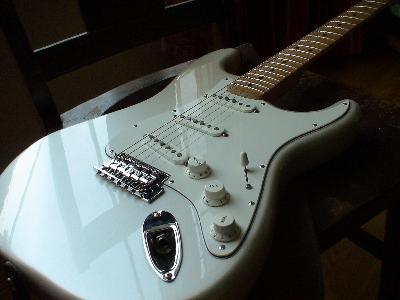
And last, but not least is “Pearl,” my sexy, sweet 60th Diamond Anniversary Strat:

Pearl

I’d love to hear what you’ve named your guitars, or if you do at all.

Bonnie Raitt said it best when she was quoted as saying, “There was simply no one like him,” when speaking about Michael Hedges. That pretty much sums it up about the man who, back in the early 80’s completely revolutionized how the acoustic guitar can be played, and inspired thousands of guitarists the world over to rethink how they approached the acoustic guitar. Seeing Michael Hedges play, you couldn’t help but think, “I didn’t know you could do that with an acoustic guitar.” It was if a veil had been lifted from the collective minds of guitarists the world over. It was absolutely uncanny. The video below is of Michael playing “Rickover’s Dream.” This was the first song where he introduced using hammer-ons and pull-offs not just as a part of a phrase, but as a foundation for the entire song. Hammer-ons and pull-offs weren’t anything new, but this type of application of them had not been done like this by anyone up to that point.

The next video of Michael is a medley of three songs from his Taproot album. These show yet another side of his composition and style.

I’m writing this entry because now and then, I run across something that sparks my memory about Michael. You see, he died tragically in a car accident in 1997. Of all the people I’ve encountered in my life who’ve had a huge influence on me musically, Michael Hedges played a huge role; not from just a technical perspective, but also from the perspective of extension – moving past old paradigms and exploring new territory. He inspired me to look beyond my own perceived limitations as a musician to discover things I never thought possible. I’ve never stopped missing him.

Today, what sparked the memory was seeing Kaki King play on a YouTube video. Personally, I’m not really a fan of Kaki King – her music is just a bit too abstract for me. Compositionally, I just can’t “get” her music, because unlike Michael Hedges, there doesn’t seem to be message or thought to convey. To me (and remember, this is strictly an opinion), it’s as if she cobbles together a string of experiments – okay, I can do this, then add this, then add this, and return here. Good. That’s a song. Add to the fact that her technique is also only okay (again, IMO), and I just can’t get out my head that she pales in comparison to someone of Michaels technical and compositional genius.

If you’re interested finding more about this incredible musician, the best place to start in on the Wikipedia entry for him.

On vacation last week, I told my wife that since we were in Anaheim, there was a guitar shop that I wanted to visit to check out gear. With a slight sigh she replied, “Are you ever going to stop buying guitars? You already have seven.” My reply was simply this: “Nope. And by the way, I only have three that are actually worth anything. But by the time I die, I’ll hopefully have 30 guitars. They’re what I collect, and something I want to pass on to my kids and grandkids.” Amazingly enough, she just nodded and said, “Okay… I know it’s important to you.”

How do you like that? I know I have this crazy obsession with buying guitars (probably even more so than amps) – especially now that I have the financial means to buy them. But it’s especially pleasing to have a life partner like my wife who understands and supports my passion. She knows that I actually work to support my music, and she also knows that guitar is central to that passion.

This is a short post, but I just wanted to say that I’m a very lucky man to have a woman who supports his music.

In a previous post, I mentioned that I may not get a boutique amp after making mods to my Fender Hot Rod Deluxe. But after playing several boutique amps over the past few months, I’ve changed my mind. There are a couple of reasons for this:

  1. First, a boutique amp has a distinct tone. You might think that the distinctiveness is limiting. But it’s not. To me, boutique amps represent the ideal tone right out of the box. For instance, I played a VersaTone 57 from Faustine Amps the other day. It had the tone I’ve been after: Smooth bass, thick mids (but not overpowering), and beautiful, harmonically-laden highs that seemed to float in the air. When driven, the resulting distortion was absolutely smooth as silk, with no high-end break-up. To achieve this tone with my Hot Rod, I’ve had to swap tubes, re-bias the power amp tubes, and throw a few effects at it. And I still get a high-end break-up, which means I have to bring the amp back into the shop to have a couple of resisitors changed. In essence, with bench time and equipment, I will have spent just a couple of hundred bucks short of what I would’ve paid for a VT-57.

    Mind you though, because boutique amps are very distinctive, you have to play a lot of them before you make a decision. I’ve tried out at least 20 different amps, and I’ve finally narrowed my search to two amps, and this search has taken a few months.

  2. Secondly, almost all boutique amps are completely hand-wired. Mass-produced amps such as my Hot Rod use a PCB board to route all the electronics – it’s efficient and cheap. The advantage of hand-wiring is that if you happen to blow a resistor or a capacitor, you can simply swap it out for a new one. On the other hand, you have to replace the entire PCB board if you blow a resistor since it resides on the board itself. Not fun. From what I understand, the typical life for a Hot Rod is about seven years under regular use. There are hand-wired amps from 40 years ago that still function great. For instance, I know a guy who still plays his ’65 Fender Twin Reverb. Back then amps were completely hand-wired, and he’s just made simple repairs over the years. So the point is that boutique amps are designed and built to last for decades, not just a handful of years.

So what about my Hot Rod Deluxe? Frankly, I still love it, and because I’m so satisfied with how it sounds, I’ll continue to play it until it dies. That may be 10 years from now, it may be a couple of years from now. When that happens, I’ll go with a boutique amp. But not before.

In search of boutique tone? There’s no better place than Tone Merchants in Orange, CA. I found this excellent shop online while surfing the web for a boutique tube amp, and recently had the fortune to visit the shop while I was on vacation.

Why is it so special? First off, Noel Evangelista, who runs the place is just a great guy. Very warm and good-natured – and definitely not someone who tries to be a salesman. In fact, when I was first searching for a tube amp, it was Noel who recommended that I buy a Fender Hot Rod Deluxe to get introduced to tube amps. Paraphrasing our conversation a few months ago, “If you’re new to tube amps, then you can’t go wrong with a Fender Hot Rod Deluxe. It’s a great starter amp – plus you get that distinctive Fender clean sound.” Based upon that conversation, that’s exactly what I did, and after a few mods, I’m absolutely lovin’ it!

Secondly, the shop is set up for hanging out. The main amp room is spacious with a couple of comfy couches in the center, so you can relax while you twiddle with the amps. The unsaid sales pitch is simply this: Let the equipment speak for itself. For serious tone freaks, that’s a powerful pitch. Words can’t convey what an amp or guitar does. You have to hear it.

Furthermore, unlike most music shops, Tone Merchants has a very select, very limited inventory of amps and guitars. You won’t find name brands like Fender, Gibson, Marshall, Vox, Bad Cat, Buddha, or any boutique amps that you might read about in Guitar Player mag. The stuff here is all boutique. I played two amps from Cornford and Faustine. Loved both, but really dug the Faustine which has a built-in reactive speaker load attenuator. That’s a very useful addition as well as being a fantastic-sounding amp. For guitars, I played a Heritage 535 classic made by some of the original Gibson guys, which was an even better-sounding ES-335. Real clean, deep tones. But the guitar that I absolutely fell in love with was a Suhr Classic. From a distance, it looks like a Strat with a dual-coil humbucker in the bridge position. But what sets it apart is the absolutely gorgeous, silky-smooth tones it produces. The one I played had an alder body with a maple neck like my own Strat, but the fret board was rosewood, which really smoothed out the tone (I love rosewood fretboards). Ahh… I want this guitar!!!

Anyway, I digress. Tone Merchants also gives clinics and small concerts in their sound stage at the back of the shop. It’s a great place for showcasing local guitarists. If you’re in the area, check out their concert and clinic schedule.

All in all, this is a must-see shop if you’re looking for boutique equipment. Also, if you want to play a Faustine amp, this is the ONLY place to go as they have an exclusive deal with Faustine amps.