Feeds:
Posts
Comments

km1Before I drive into the office each day, I usually start out early and do some work. But sometimes, there are exceptions; especially when I get a musical idea running around in my head. Then I drop everything and track it so I can come back to it later. Yesterday morning was like that. I was happily pounding out code for a project I’m working on then suddenly I heard this tune on an electric piano.

I went to my man-cave and quickly laid down the track. But since I was pressed for time, I just got down the piano part. So this morning I resolved to get a guitar part down. To be honest, I just wanted to jam over the piano part. I never intended my idea to be a full song. Part of it was testing myself to deal with a change from a maj-7 to a minor-dim, and the phrasing I might use.

Of course, there are many ways to skin a cat, but I thought about it for a little bit, and practiced some ways I might deal with it. In the end, I decided on keeping it simple.

Here’s the track:

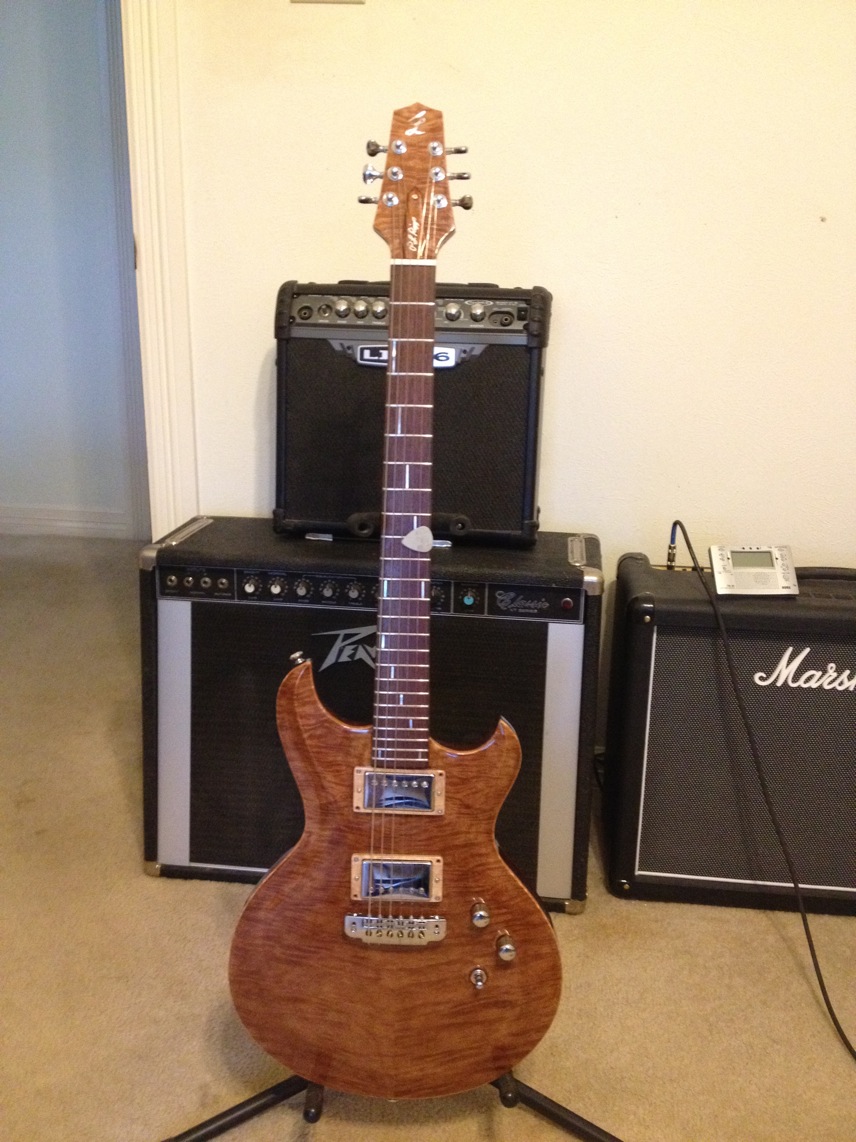
It’s really nothing special as far as the music is concerned, and to be completely honest and transparent, this track is just one of several takes I took while playing around. What was incredible for me in this experience was “Katie May.” This guitar has never ceased to amaze me since I got her. She’s such a dream to play in both tone and feel that she lets me slip into an altered state where my creativity can take over. That’s the mark of a truly great instrument.

Katie May has so much natural sustain and a real purity in her tone. There’s a depth to her voice that’s indescribable. Her voicing is perfectly balanced; I haven’t ever had to EQ this guitar when I play her both in the studio and playing out. I just keep all EQ flat, and let her sing! The only thing I do is add some modulation effects to enhance what’s already there.

Perry Riggs and Slash L Guitars may not be widely known, but take it from me, if you’re in the market for a hand-built guitar, this is a builder you should consider.

Gear used:

Katie May plugged directly into my 1958 Fender Champ (that’s where the noise comes from)

For a long time, I’ve been on a rock kick; specifically, sacred rock (I know, sounds like an oxymoron). But a couple of weeks ago, I was sitting in my man-cave/home studio, plucking away at my guitar when I came up with a simple riff. The riff turned into a song that I decided to track so I could capture the idea, and it sat for about a week. Then this past weekend, I started writing the lyrics. For some reason, the song reminded me of an aged woman at the end of her days, reminiscing on the people she has outlived.

Yeah, it’s a pretty sad theme, but I wanted to capture more than just the bitterness. I wanted to capture the longing and the pride she has for the life she’s led.

Guitar/Amp: Slash L Guitars “Katie May” straight into my 1958 Fender Champ (so, so jangly 🙂 ).
Keyboard: Fender-Rhodes Software Model
Bass: Ibanez G10

Here’s the song:

Closing the Door

Verse 1
In a room of her memories
musty with age
she can see her life’s history,
the joy and rage.
The floors and the tables,
mementos are laid
with a blanket of dust hiding
the price she has paid…

Verse 2
I’ve survived all my children
how can that be?
And the love of my life
has been taken from me
Yet here I am standing
this world I must brave
to carry my torch awaiting
till I’m in the grave…

Chorus 1
It’s not that this life
has been unkind to me
Yet why am I left
just with my memories?
I grew up thinking
this life I would share
and not end these days
with nobody there…

Verse 3
So she dusts off the figures
which brings on a smile
happy with the mem’ries
at least for awhile
She holds each one gently
to feel the embrace
of the love she remembers
from another time and space

Chorus 2
She won’t shed the tears
that are her right to cry
Or raise up her fist
to a life she’s defied
And all of her mem’ries
she’ll hold close to her heart
Believing one day
she’ll get a new start

Verse 4
She crosses the room
and walks to the door
glancing back longingly
as if there were more
She knows that she saw
all there was to see
So she locks up the door
and loses the key…

There’s a guy in my neighborhood who has just completed converting his studio to an entirely digital studio, and he has TONS of guitar and audio gear that he’s liquidating. It’s not a fire sale, but he has some good prices, and not only that, he has some freakin’ awesome pedals that I wish that I had the money for. So… I thought that if I can’t afford them, I’d pass on the list to my readership.

Mind you, there’s a boatload of equipment in the list. Sheesh! I thought I was a gear slut. This guy puts me to shame! 🙂

Here’s the ad he posted in our neighborhood classifieds:

—–

Extensive collection of studio equipment and guitar effects for Sale!

I have completed the migration of my studio to a pure digital setup (software only), and have decided to liquidate my entire hardware collection. The collection includes many rare, limited edition and collectible items.

Unless otherwise noted, all equipment was purchased new, is in mint condition, works perfectly and includes original documentation/manuals, accessories and packaging. The equipment was used briefly in my climate-controlled, smoke-free studio only .

This is not a fire sale – all equipment is priced at fair market value.

• Cash or PayPal only
• No trades | No haggling

Contact: Simon Morrison – simon(didn’t want to get him spammed, so it’s an image)
The Collection
• Addrock Boostmaster | $220
• Alesis DEQ230D Digital Graphic EQ | $400
• AMT Electronics Mattias Eklundh Freak Guitar Overdrive/Distortion | $420
• Analog Man King Of Tone V4 (Standard) | $450
• Antelope Morning Dew EQ – Custom Fireburst | $450
• AYA BM-Fuzz 80 | $285
• Banzai Cold Fusion Overdrive 2 | $435
• Barber B-Custom Dual Discrete [LTD SR/Direct Drive SS] | $375
• Barge Concepts RC-3 | $210
• BBE 882i Sonic Maximizer | $275
• Behringer ULTRA-G GI100 (2) | $50
• Behringer V-Amp Pro | $105 * Sold *
• Blackout Effectors MUSKET Fuzz | $175
• Blackstar HT-DISTX | $200
• Blackstone Mosfet Overdrive 2SV3 | $210
• Boss OD-20 | $100
• Boss PW-10 V-Wah | $85
• BOUTEEK Distorter Preamp LE | $300
• Celmo Sardine Can Compressor | $275
• CMATMODS Brownie | $140
• Creation Audio Labs Holy Fire Overdrive/Distortion | $225
• Creation Audio Labs MK.4.23 48V Pro Boost | $255
• Cusack Screamer V2 (2008) | $255
• D*A*M Sonic Titan – Hammertone Blue – Serial number: 003 | $455 * Sold *
• Diamond CPR-1 Compressor | $225
• DigiTech EX-7 Expression Factory | $175
• DigiTech HarmonyMan | $275
• DigiTech Whammy II | $325
• Dr. Scientist The Cleanness | $185 * Sold *
• Dunlop Crybaby DCR-2SR Rack Wah | $595 * Sold *
• EBS MultiComp Compressor | $200
• Effectrode PC-2A Compressor | $355 * Sold *
• Electro-Harmonix Hot Tubes | $225
• Electro-Harmonix Micro Synthesizer | $275
• Electro-Harmonix Octave Multiplexer | $75
• Electro-Harmonix POG V1 | $255
• Emagic AMT8 USB MIDI Interface | $95
• EMMA OnoMATOpoeia OMP-1 | $255
• EMMA PisdiYAUwot PY-1 | $255
• Empress ParaEq | $255
• ENGL E580 Pre-Amp | $2,550
• Eventide Eclipse V4 | $1,350
• Eventide H8000FW | $4,895
• Eventide PitchFactor | $475
• Farndurk Burgs2 Compressor + Boost (Custom) | $285
• Focusrite VRM Box | $85
• Foxrox Octron 2 | $295
• Fromel Shape EQ | $195
• Fuchs Plush Valve Job | $265
• Fulltone Fat-Boost 2 | $85
• Fulltone Full-Drive 2 MOSFET | $155
• Fulltone Mini-Deja’Vibe | $195
• Fulltone OCD (Version 4) | $110
• Fulltone Robin Trower Overdrive | $175
• Fulltone Ultimate Octave V1 (2000) | $235
• FuzzHugger Dark Boost | $125
• FX Engineering RAF Mirage | $235
• Gallien-Krueger Backline 100 | $355
• Hartman Electronics Tommy Bolin Signature Fuzz | $175
• Heavy Electronics Descend | $135
• Hermida Nu-Valve Overdrive | $295
• Hermida Zendrive 2 | $425
• Hilton Volume Pedal (Low Profile) | $235
• Ibanez TS-808 “Tube Screamer” – Keeley MOD PLUS – 1982 NOS JRC4558 | $285
• Ibanez WD7 “Weeping Demon” | $95
• ISP Technologies Decimator pedal V1 | $115
• ISP Technologies Decimator ProRackG – Stereo Mod Version | $425
• Jersey Girl Fulltender (Wood – Gauche Moltin) | $849
• Jetter Gear Custom Shop Gold 3-D Overdrive | $255
• Jetter Gear Gain Stage Blue | $285
• Jetter Gear Gain Stage Green | $285
• Jetter Gear Gain Stage Red | $285
• Jetter Gear GS3 Dual Overdrive | $395
• Jetter Gear Vibe | $255
• John Landgraff Dynamic Overdrive (early serial number) | $455
• John Landgraff Mo’D (early serial number) | $555
• Keeley Compressor (C2) | $185
• Keeley Compressor (C4) | $225
• Keeley Fuzz Head | $155
• Keeley Hot Head | $185
• Keeley Java Boost (Mullard CV7003) | $205
• Keeley Katana Boost | $175
• Lehle D.Loop | $225
• Lehle Dual SGoS | $325
• Lehle Parallel L | $285
• Lovepedal 200lbs of Tone | $185 * Sold *
• Lovepedal BBB 07 | $235 * Sold *
• Lovepedal Eternity | $215 * Sold *
• Lovepedal White Morph Fuzz | $205 * Sold *
• Marshall JMP 2203 100W Master Volume Head (1979) | $2,225
• Marshall 1960A 4×12 Cab (1979) | $855
• Maxon CP-9 Pro+ Compressor | $250
• Maxon ROD881 | $225
• Menatone Kar Krash (2008) | $255
• Mesa Boogie TriAxis Pre-Amp | $1,795
• Moog Little Phatty Redback Edition (US) | $1,655
• MOTU 828mkII FireWire Audio Interface | $385
• MOTU Traveler FireWire Audio Interface | $385
• MXR ’76 Vintage Dyna Comp (Reissue) | $165
• MXR Distortion + (1979) | $285
• MXR M-108 10-Band Graphic EQ | $100
• NOC3 Effects Compact Pure Drive | $225
• NOC3 Effects Pure Drive | $255
• Old World Audio 1960 Dual Optical Compressor | $325
• Palmer PGA-04 – Passive Load Box Speaker Simulator | $585
• Palmer PGA-05 – Active Stereo Speaker Simulator | $985
• Paul Cochrane Timmy V1 | $200
• Pete Cornish P-2 (2008) | $1,250
• Peterson VS-F StroboFlip Virtual Strobe Tuner | $155
• Pro Co Deucetone RAT | $175
• PS Audio P-1000 Power Plant | $1,855
• Psionic Audio 3.14 V1 | $225
• Real McCoy Custom 3FL (RMC3FL) Wah (Customized) | $285
• RockLand Amps BlueSTone Overdrive | $355
• Rocktron All Access Foot Controller | $555 * Sold *
• Roger Mayer Vision Wah | $655 * Sold *
• Roland FC-200 | $175
• Roland GR-33 | $295
• Roland VG-88 | $295
• Rothwell Love Squeeze | $195
• Scott’s Crispy Cream Treble Booster | $185
• Spaceman Rumblefuzz | $555 * Sold *
• SPL Transducer 2601 | $1,195
• Subdecay Studios Flying Tomato 2.0 | $175
• Subdecay Studios Prometheus | $255
• Suhr Riot | $200
• SWELL G-Max | $385
• T-Rex Mudhoney V1 | $165
• TC Electronic NDY-1 Nova Dynamics | $165 * Sold *
• TC Electronic SCF | $305
• TC Electronic VPD1 | $285
• Tech 21 SansAmp PSA-1 – Version 1.0 | $455 * Sold *
• ToadWorks MEAT V1 | $135
• Toneczar Openhaus (2009) | $555
• VHT G-100-UL Pittbull Ultra-Lead 120W Head (2008) | $2,499
• VHT Valvulator 1 (JJ ECC83S 105/105 Tube) | $165
• Voodoo Lab Micro Vibe | $125
• Voodoo Lab Sparkle Drive | $125
• Voodoo Lab Superfuzz | $125
• VOX ToneLab LE | $225 * Sold *
• VOX V848 Clyde McCoy Wah | $255
• Wampler Ecstasy Drive V1 | $255
• Wampler Triple Recstortion | $255
• Xotic Effects BB Preamp | $165 * Sold *
• Xotic Effects EP Booster | $120
• Xotic Effects RC Booster – Scott Henderson Signature Model (2) | $235
• Z.Vex Super Hard-On (SHO) (2010 LED Hand Painted) | $250 * Sold *

Slash L Guitars has a new web site!

The newest member of my stable is “Katie May” made by Perry Riggs, owner and luthier of Slash L Guitars. This one-man outfit based in Houston, Texas has been producing guitars for just a few years, but these are absolutely special guitars; not just because they’re custom or hand-made (I’ve played plenty of that ilk that have been pretty disappointing). These are neck-through guitars.

Admittedly, when I first played a guitar Perry sent me for review (“Lana”), I was a little skeptical. But the feel, workmanship and playability of the guitar was incredible; not to mention the super long sustain due to the continuous neck (neck-through body). I was in absolute heaven until I had to return the guitar. But I never forgot Lana.

A couple of years after I reviewed “Lana” I received “Katie May” for yet another review. I never returned her. It was love at first strum for me, and Katie May is now a regular part of my rotation – probably putting in more time than my Les Pauls. Imagine that!

Anyway, I just wanted to announce that Perry has a new web site up that I helped put together. It’s pretty basic at the moment, but we’re planning some really cool things for it in the near future. Importantly, there’s a gallery where you can see some of the guitars that he’s built in the recent past.

Possible Answers:

  1. 5 Years Ago – 10 Years Ago: I’m obsessed and have no self-control.
    It wasn’t a pretty sight during that time. I was spending pretty much everything on gear in my lust for finding the right tone. This coincided with my move from solid-state to tube amps.
  2. 3 Years Ago: I’ve purchased all this gear, and I’m a pack-rat and don’t want to get rid of it.
    Yeah, I sold off a couple of things, but for the most part kept pretty much everything I purchased.
  3. 1 Year Ago: Same as 3 years ago, but I’ve refined my use of different gear to different venues/situations. Instead of buying more gear to satisfy a sound that I’m hearing in my head, I look at the gear I have and see if I can get it. More often than not, I’ve found that I have gear that will meet my particular needs.

Answer 3 is how I now answer the wife… 🙂

But seriously, after buying all that gear, what I found is that some gear just works better with some rigs or venues than others – even set lists. For instance, I’m glad I have duplicates of several of my modulation pedals because some work better in a live situation, while others work better in the studio. Furthermore, some work much better with my acoustic rig, while others work better with my electric rig. As a result, I have three pedal boards. One is dedicated to acoustic and two I use for my electric rig.

On my acoustic board, I use an MXR Carbon Copy Delay, Homebrew THC Chorus and a TC Electronic Hall of Fame Reverb for modulation pedals. I also have a simple BOSS LoopStation RC-2 looper along with a TC Helicon VoiceLive Play GTX vocal processor.

For my electric rig, what board I use is really dependent upon how I’m feeling that day, and the amp that I’m playing. I have 10- and a 4-pedal boards. I normally only use my 4 pedal board which will include a tuner, an overdrive, a chorus, and a reverb for pretty much any amp. Occasionally, I’ll swap the reverb or chorus out for a delay pedal, or switch the overdrive out for a distortion pedal.

But occasionally I need a lot of versatility, so I’ll break out the “big” board and load it up as follows:

Lower Level – These go straight into the amp

  • BOSS TU-2 Tuner (I’ve had this forever and it still serves me well)
  • Timmy Overdrive for transparent OD
  • Another overdrive that will work the guitar/amp I’m playing that day (Could be a Tube Screamer-like, or whatever I might be in the mood for color-wise)
  • EWS Little Brute Drive (I might even have yet one more overdrive here that will be used for stacking with the Timmy)
  • VOX Big Bad Wah

Upper Level – These go into my effects loop (and all these work with any amp or guitar I have)

  • TC Electronic Corona Chorus
  • Mad Professor Deep Blue Delay
  • Hardwire Reverb
  • Creation Audio Labs Mk.4.23 Booster

Some might be wondering why I put a booster in the last position. I actually learned this from Mean Gene Baker. It doesn’t necessarily add much volume, but it does ensure that my power tubes get saturated.

As for guitars, I have a bunch, but really only play five of them regularly at this point. I have my trusty Yamaha APX900 acoustic, then for electrics, I use my ’58 Re-issue, ’59 Replica Les Pauls, my custom Slash L Guitars “Katie May,” and an American Deluxe Strat. I’ll occasionally take out my others, but they’re kind of in a dormant state right now…

The cool thing about having so much gear is that I have options. I’ve acquired enough that as I mentioned above, I can almost always find what I need with what I have. The net result is that even though I still dig new gear, I’m now less compelled to go out and even try it because I’ve got all I need right now. Of course, that will probably change as I explore other genres of music. But for now, I’m going to be digging into my “grab bag.”

WTF?

I know, when I discuss what I’m going to discuss here, I’m probably going to sound like a broken record, but so be it. If it needs to be said, it needs to be said:

High-price doesn’t guarantee “better.” But sometimes…

Yeah, what-the-f$%k. For the most part, we gear freaks look in the more inexpensive direction, for we know that in lots of cases with gear, you can get similar or even better performance from something that costs far less than its competitors’ offerings. For instance, for Tube Screamer-like overdrives, the DigiTech Bad Monkey will give you similar performance. But where the TS will cost you in the neighborhood of $160+, the Bad Monkey will cost you all of $50 new (I got mine for $29 used in pristine condition). For that price, you can get a couple and use one as a backup just in case the first one goes south. I actually gave mine away to a kid in my band, but he still has it and uses it regularly, and that pedal’s now a few years old, so inexpensive doesn’t really mean cheaply made either…

But circling back to the “sometimes…” To get that sound that you’ve got in your head, you have to pay for it. And even if you find a “deal,” it’s still going to cost you a significant amount of money. It was that way with my Les Paul ’58 Re-issue. I got a deal in the low $2k’s, but that was still quite a bit of money. The Les Paul sound was/is unique to me. I’ve had and still have other guitars that sound “like” a Les Paul, and most people would probably never be able to tell the difference between the guitars when I play, but there’s really nothing quite as distinctive to my ears. It’s subtle for sure, but I can hear it. Most importantly, it’s a sound that inspires me, and I’m willing to pay the relatively higher price for that to get that sound.

It’s the same thing for people who buy and play a PRS. I’ve personally never gotten into the smooth tones of a PRS, but I have plenty of friends who have one as their main guitar. Their reasoning is exactly the same as mine: The sound inspires them and they’re willing to pay the price to get it.

So how does that apply to the super-expensive gear like a Dumble amp?

I suppose that if you have the means to get one and the sound appeals to you, then by all means get one. But bear in mind that if you’re getting a used one that that amp was custom-tailored for a specific player. From reading various forum posts over the years about people’s experience either playing or owning one, they’ve experienced a bit of a let-down as they didn’t get the response nor feel the magic. I got lucky in my own experience with it, as the amp I played was absolutely incredible. The dynamics were out of this world, there was a subtle high-end shimmer that I had never heard from an amp before. But despite that, ultimately, the Dumble sound wasn’t for me. I’m more of a Marshall-esque type of guy, and I found that with my Aracom amps. And having Jeff Aragaki so close by, he has tweaked my amps to my own personal preferences so that they’re custom-tailored to how I play.

But even still, discussion of a Dumble amp almost invariably evokes a “WTF” from people. Most of us just couldn’t fathom nor justify paying the price of a car for an amplifier. A Dumble amp is to guitars as Screaming Eagle is to wine. They’re both expensive, but enjoyed and praised by those who have the means to obtain them. The rest of us will just scratch our heads and say, “WTF.”

A final word though… There’s a LOT of gear on the market today; literally thousands of pedals, hundreds of types of guitars and amps. If you can’t get inspiration from the pool of gear that’s out there within your immediate reach, I don’t know what to tell you. That too is a “WTF” situation – how CAN’T you find gear? 🙂

So I get this press release this morning that was saying how the LiveTunes iOS app is one of the top-ten music apps in Japan. LiveTunes is an interesting concept in that it adds crowd and reverb effects to simulate a song being played in a variety of venues such as a club or even a stadium. Whatever floats yer boat…

Interestingly enough, the press release tickled the cynic in me, and I started thinking about American Idol, and what it has done to/for music. Before I get into that, my cynicism was sparked by the thought that now even mediocre musicians and singers can create music, then at the touch of a button create a crowd to give themselves yet another way to keep themselves in denial that they still need work to do to EARN those crowds.

Circling back to American Idol, while the ‘Idol folks paint a picture that they’re providing a place for people to realize their dreams, and that ANYONE with a modicum of talent could become a star in just a matter of weeks (as long as they get the votes, but it’s well known that it’s fixed), I think that what it really has done is create and perpetuate a culture where people think they can somehow shortcut the path to success, similar to the get-rich-quick schemes you see on TV at 2am.

It has also emboldened thousands of people into thinking they actually have the talent to make it as a performer in the business. I’ve seen lots of evidence of this at the restaurant at which I’ve been working, now going on thirteen years. Especially when I’m playing inside at the piano, I get people who come to the piano and want to sing. Luckily, we have a policy that only employees are allowed to sing, but sometimes there are situations where they somehow are able to get on the mic. That happened last week when a server allowed the daughter of a customer to sing. I let her sing after doing a quick audition, but let the server know he had totally crossed the line.

The reason he let her sing was because she quite boldly stated that she could out-sing him after he completed one of his tunes. So, taking up the challenge, he brought her to the piano. I was a bit cornered as her entire family was looking on, so I gave her a quick audition and then let her sing. Now, she wasn’t bad, but she certainly wasn’t anything special. Thank goodness she could reasonably hold a tune. As for her being able to out-sing the server, while he’s still young and developing, the answer to that is an emphatic, “NOT!”

After she finished, I thought to myself that this is what American Idol has brought us: A bunch of people with little to mediocre talent who somehow think they have what it takes to make it. Before Idol existed, I never had people come up and ask to sing. But once it got established, it has been a fairly regular occurrence.

Now don’t get me wrong, for the winners, it’s a dream come true for sure, and I would never take that away from them. But let’s be realistic. Except for Carrie Underwood and Kelly Clarkson who do you remember? You could argue that Clay Aiken became a success because of Idol, but really now, how many do you actually remember? Here’s one: Whatever happened to Reuben – the guy who beat Clay Aiken? Talk about a single-dimensional singer who couldn’t break out of his Teddy Pendergrass persona. Where is he?

I hope you’re beginning to see my point about all this: In the music business, as in life, for the most part, there’s no such thing as a shortcut. Some lucky ones squeak through, but most who take the shortcut are quickly forgotten, or worse, aren’t really doing much with respect to their “dream,” which is a real tragedy. And that’s my problem with American Idol. It’s a facade that gives people this false sense that they can shortcut the path to success. But real success comes from earning it. Real success comes from working at what you’re doing day in and day out perfecting your craft; giving up a lot of things that would otherwise distract you from your goals.

I look at my own little corner of the world. I’ve been performing in the area for 30 years; most regularly for the past 15. I’ve worked up enough of a following and notoriety where if I wanted, I could be gigging every night of the week. I only gig up to four nights a week, but the point to this is that I’ve earned it. My only goal musically has been to be able to have the freedom to gig as much as I can. If it’s at a local level that’s fine. If it breaks into something bigger, that would be awesome. But I have a family to support, so I’ve made certain choices about how far I actually want to take it. But for what I can put into it, I’m enjoying a very certain and very real amount of success, and to underscore what I’ve been talking about in this article, it has literally taken me years to get to where I’m at now.

Other working musicians who read this will know what I mean. They know that something truly earned is far more valuable than something won.
I was looking at my web stats today, and invariably, my busiest page is my discussion on overdrive vs. distortion. I clicked on one of the referral links to my site, and saw that it pointed to a forum where folks were debating this very topic. Over the course of the threads, the subject wandered (as they often do – especially with this topic) and someone made a reference to a guitar player being likened an airplane pilot, in that the pilot needs to know how every bit of his craft works in minute detail. Another replied in disagreement that the pilot didn’t have to know HOW every piece worked; the most important thing was that they had to know HOW to use those things but really only know how they worked at a much more abstract level.

It got me thinking about my view of gear. As an engineer, I’m definitely interested in the details of how gear, like pedals, operate to produce their sound. But as a player, I frankly don’t care. I just want to know how it sounds and if I can make it fit with my rigs. For instance with an overdrive pedal, I really don’t care about the voltage levels when I turn the gain knob up or down, or whether or not the pedal uses a JRC4558D transistor and how that reacts to the voltage levels. My main concern is simply this: Does it sound good when I twiddle the knobs? I got a chuckle out of my good buddy Jeff Aragaki when we first met and he started going into technical detail about his amps. He saw my eyes glaze over. I just looked at him and said, “Dude, TMI… Your amps sound f-in’ awesome! Just keep on doin’ what you’re doin’, I’m sold!”

Yes, I do know about the internal workings of a lot of the gear I evaluate. That’s just my natural proclivity to tech stuff, plus it gives my reviews on gear more credibility. But on the other hand, there are some pieces of gear that are completely magic to me, like my hand-wired Mad Professor Deep Blue Delay. I honestly don’t know anything about the internal workings of that pedal. But I do know that it sounds so f-in’ good that I won’t use another analog delay and I don’t care about what makes it do what it does. It just does it and it makes me happy.

If I didn’t write this blog, I’d probably be blissfully ignorant of the gear that I’d buy. I’d just plug it in, and go to town and play. But alas, I write a gear blog, and it serves me and my readers well to be at least moderately technically informed.

Finally, one thing I will say is that after hanging out on gear forums for so many years, I’ve come to realize that while there are some very well-informed folks out there, I do feel that there comes a point where I almost always ask, “Do you really need to know all this stuff to play it?” I feel there’s so much focus on minutiae sometimes that it takes away from the actual purpose of the device; that is, to make music. So think about that when you engage in one of these discussions.

RAWK ON!

It’s called the Firefly pick. It’s the first flashing pick. They’re still in development, but they just got enough startup funding to go to production, and sure, while it’s a bit of a novelty, I think it’s totally cool!

Interestingly enough, they funded the project using KickStarter, and they reached their goal of $30k just recently. I can’t wait to get my hands on one of these. Check out their crowd funding page here.

Yeah, yeah, seems like a gimmick, but I have to admit that when I first saw this, it put a smile on my face, and it’s so unique that I just have to have one. No, it won’t make me a better player, nor will it make my performance any better. But it sure is neato and the neato factor is pretty big with this.

The Firefly pick is a lot like those kids shoes with the LED’s in the sole. Why should the kids have little flashing things? While I wouldn’t where shoes with LED’s, I’d play a pick with an LED. 🙂


Earlier this year, I was actually thinking about closing down GuitarGear.org or not posting to it any longer. The reason was that I just wasn’t buying that much gear, and honestly, I wasn’t taking all that much time to go to music stores to try out gear. On top of that, my day job at a startup has been taking a lot of my time, and with gigging 3-4 times a week, I haven’t had much time to write.

But every time I’d sit down to write a farewell post, I’d stop because GuitarGear.org hasn’t only been a record of the gear that I evaluate, it has also been a public diary of my evolution as a musician and how my views and approaches to music and performance have changed over time. But just as importantly, GuitarGear.org has been a way for me to meet people I would’ve never met had it not been in existence. That interaction with all the great folks that visit GuitarGear.org has been priceless to me, and I’m thankful that I’ve been able to provide a good resource on gear and for all the intelligent discussion that takes place here.

So GuitarGear.org won’t be going anywhere anytime soon. I’ve slowed down with posting articles for now, but I think it’s just a passing phase. Who knows? I’ll probably find another musical direction and will need more gear, and then the whole process starts up again! It has happened in the past, and I have few doubts it’ll happen again.