Feeds:
Posts
Comments

HOF_REVERB

TC Electronic Hall of Fame Reverb

Summary: This is a super-versatile reverb that gives you tons of flexibility with reverb tones, whether you want to add a little “grease” or slather on the ‘verb thick and soupy.

Pros: 10 presets plus it’s TonePrint enabled to give you virtually limitless reverb sounds.

Cons: Can sound a bit monotonous between presets – very spring-reverby – but adjusting the decay and level fixes that easily.

Price: $149.00 Street

Features:

  • TonePrint Enabled
  • Short/Long Pre-delay toggle
  • 10 reverb types
  • Stereo in & out
  • True Bypass
  • Analog-Dry-Through
  • Decay, Tone and Level controls
  • Easy battery access
  • Small footprint
  • High-quality components
  • Road-ready design

Tone Bone Rating: 4.75 ~ Once I sat down with the pedal for a few hours in my studio, I fell in love with it! This is is a great reverb pedal that can provide lots of different reverb options if you’re willing to explore its capabilities. Believe me, it’s totally worth it!

I’ve been using my ToneCandy Spring Reverb for my solo acoustic gigs for the past couple of years. Hands down, there is no better spring reverb simulator pedal on the market. But one drawback of the pedal is that it is extremely sensitive to the power supply used with it. If it doesn’t like it, it’s noisy. Up until recently, I didn’t have a problem with its finicky behavior, as I had a power supply that worked just fine with it. But a couple of months ago, the OneSpot power supply that I was using with my acoustic board went on the fritz, and for some reason, the Spring Fever doesn’t like the new one, and the pedal would produce a very low-level, high-pitched buzz. I could filter it out a little bit with EQ and signal padding on my Fishman SoloAmp, but plugged into the restaurant’s board, the sound was noticeable.

Frustrated by that, I remembered that I had the Hall of Fame reverb in my box of toys. I had gotten it months ago from TC Electronic for review, and though I had written a “First Impressions” article on the Hall of Fame, I hadn’t gotten around to doing a formal review of the pedal. So the other day before my gig, I pulled it out, hooked it up and started tweaking knobs to really see what it could do. After about a half-hour of playing around with it, I was kicking myself for not putting it on my board sooner. Back in August of last year when I first got the pedal, I actually gigged with it a few times; both in my solo acoustic gig and my church band. But I had only used the “Hall” and “Spring” settings, which I did find to be superb. But my formal test revealed a certain character of the pedal that I hadn’t noticed before. It really took setting it up in my studio to discover its subtleties.

Fit and Finish

What can I say? TC gear is always rock-solid and gig ready, and the Hall of Fame is no exception. The footswitch is solid, and provides nice tactile feedback when activating or deactivating the pedal. The knobs sweep smoothly and the pots have good resistance. I do not like loose-feeling pots, it feels cheap. But that’s certainly not the case with the Hall of Fame reverb.

I dig the low-profile, small footprint enclosure. And while the pedal is light in weight, it just feel solid and well-constructed. Again, this is a trait of TC Electronic gear.

How It Sounds

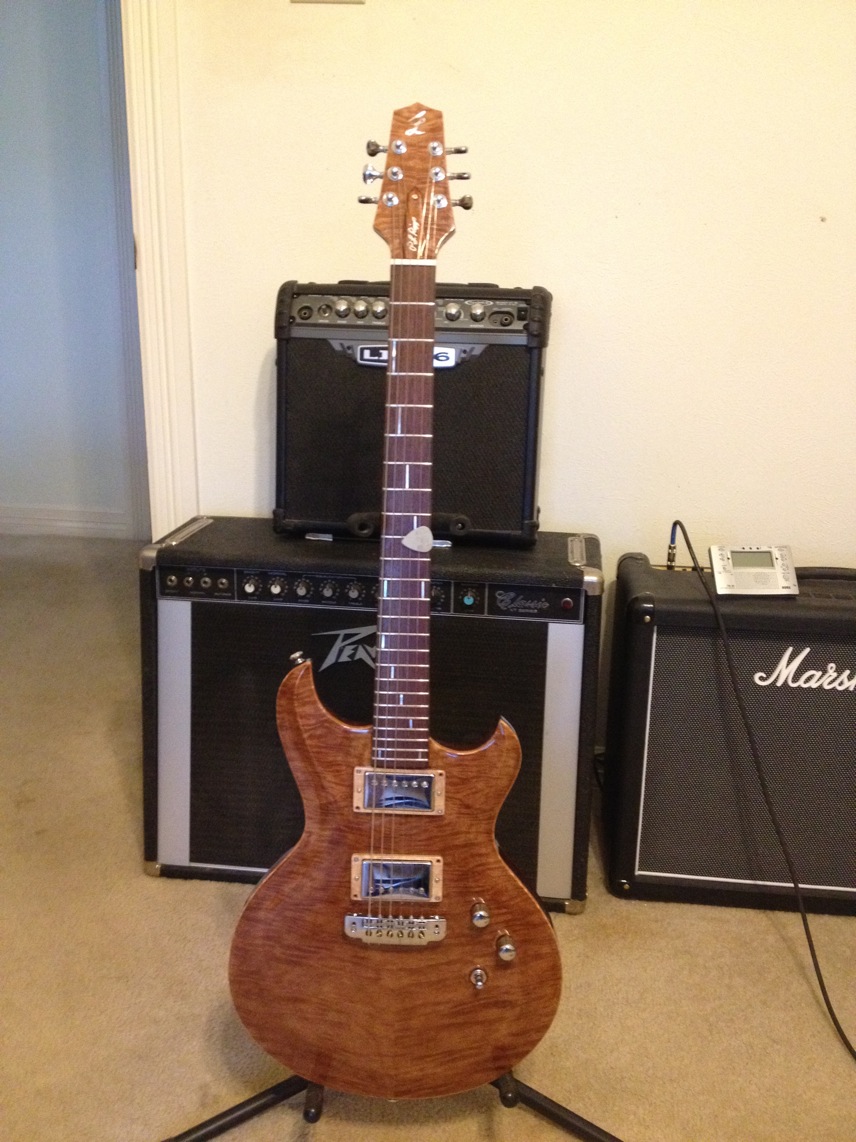
I don’t do surf or real ambient stuff very often, so typically I like to use a reverb to add a little grease or provide a little expansiveness, and the Hall of Fame Reverb does this swimmingly well. I recorded some clips below. All clips were recorded with my Slash L Katie May plugged into the Hall of Fame, which in turn was plugged straight into my VHT Special 6 with a Jensen Jet Electric Lightning (even for a 10″ speaker, it produces a nice bottom end).

The first clip starts out with a dry, then moves from Room to Hall to Church. Level and Decay are both set at noon. This was a test to see how the reverb provides what I call “distance;” that is, just as in real life, as you move to a larger and larger room, the guitar moves further away, and the sound bouncing off the walls provides depth.

The next three clips are my favorites that I used in my last three gigs:

AMB – Level 100% Wet, Decay 3pm

This is by far my favorite setting for acoustic guitar plugged directly into a PA. As the name implies, “AMB” stands for ambient, and it is meant to simulate room ambiance, but not actual reverberation off the walls of a room. As such, it’s a very subtle reverb with an extremely quick decay. It adds just a touch of grease to smooth out the signal. Combined with my Yamaha APX900’s ART pre-amp system, I get a very natural sound. And unless I’m playing a song that requires a bigger room sound, the pedal is set to AMB for 95% of the songs I play.

Room – Level 10am, Decay 1pm

This next one is great with a chorus pedal set to real warm, then used for slower, finger-picked songs

Church – Level 2pm, Decay 10am

When I first started playing around with this setting, I didn’t like it much. I’ve never been much into cathedral settings. But slathering on the wetness level while shortening the decay, makes for a very useful super-ambient sound that I actually used for a few songs over the past few days. It works real well.

Overall Impression

This is definitely a keeper. I love that it is true bypass, so switching it on and off doesn’t produce an audible a signal pop. And owing to its pedigree, this is a great pedal that can easily find a home any board. Of course, as sort of a Swiss Army Knife type of reverb, it could never substitute a real spring or plate reverb or something like a ToneCandy SpringFever. But to add a bit of grease and providing different reverb sounds, the Hall of Fame reverb performs wonderfully and it does it at a price that’s very affordable, and that’s always a good thing!

Monday Profundity

Actually, I don’t know how profound I’ll actually be, but something I learned many years ago has had a profound effect on how I live my life, and on a smaller scale, how I approach playing music. Today’s thought was spurred by a New York Times article on “Mindfulness” that a friend shared on Facebook this morning. In reading the article, I looked back to a time before I was married and doing a lot of soul searching; trying to find the true essence of “me.” In the process, I learned about living in the “NOW,” and always being present.

As one person was quoted in the article, “Intentionally paying attention to the present nonjudgementally” is what living in the “now” is. Developing that sense though isn’t easy because our lives are filled with constant distractions. To live in the now requires quieting the mind. Though it might seem paradoxical, by making our minds still, we actually expand our awareness – of everything. We become responsive as opposed to reactionary. Response is intentional while reaction is instinctual. Big difference between the two.

So what does any of this have to do with playing guitar?

One habit that I’ve gotten into before I start any gig is a few minutes before I come to the microphone, I find a quiet place, or just sit at my rig, close my eyes, and do what I call “drain my mind.” I take myself to a place where I’m not thinking about work or other things that would worry me. I think about the first song I’m going to play, and tap into the emotion of the music and the meaning behind the lyrics. Then I try to feel the energy of the crowd. Once I’m “hooked up,” I start the first song. It’s not really psyching myself up – lord knows I don’t need any motivation to perform. 🙂 It’s literally clearing my mind to open myself up to the songs I’m singing and even more importantly, tapping into the energy of my audience.

I’ve found that when I’m bothered or distracted, it affects my performance. That probably goes for pretty much anything I do, but especially with playing guitar – whether I’m gigging or in the studio or just playing alone – if my mind isn’t clear, I have a hard time expressing myself, and my performance is just flat. For example, a couple of weeks ago, I was really bothered by a programming problem that I was working on solving, and I spent most of my time on the way to my gig thinking about it. I set up my rig, still ruminating over the problem, then I started the gig without first draining my mind. The net result was that I was just going through the motions.

I was sounding okay, I suppose because I was getting some tips, but I wasn’t really connecting with my audience. So instead of doing my typical 1.5-2 hour first set, I cut off my first set at an hour, left the stage for about 15 minutes, and spent the time in a quiet place, going through my routine (I also got a dram of Macallan 18 year old scotch to enjoy 🙂 ). Mind you, I wasn’t really stressed out; I was just distracted. While I was enjoying the vanilla accents of the Macallan 18, I found my “happy place,” and realized that I hadn’t drained my mind before starting. So I took a few minutes to just quite my mind and put the problem away; promising myself that after my gig I’d work on the problem. Once I got back on stage, I felt totally plugged in, and had a great evening. I was so inspired, I did a lot more soloing than I had ever done (that actually established a precedent because I now take a lot more time to solo)! So what about the work problem? Funny thing is that by draining my mind, I found the solution while I was driving home. In quieting my mind, I was able to see the missing connections between my objects. I got home, coded them up, and all was well! It took me all of 10 minutes to solve. 🙂

The point to all that is that when we quiet our minds, we open ourselves up to all sorts of possibilities, plus we allow ourselves to focus more intently. I know that seems paradoxical, but I’ve found that in order to focus, we have to first drain our minds to expand our awareness. Only then can we focus.

ROCK ON!

Got a press release today from a publicist hawking a company called, “Silver Luthier.” These guys specialize in solid sterling silver bling to put on your guitar. Check out that solid silver flame tailpiece to the left. That’s freakin’ cool. It’ll also set you back $1200. Ouch. Or, not satisfied with your Les Paul’s Rhythm/Treble toggle switch cover? You can get a solid silver flame cover for only $180. Look, I don’t want to knock these guys. This stuff is seriously cool, though I know it’s definitely not for me.
Besides, I have enough to worry about over my playing than to worry about how I look while I’m playing. 🙂 But more power to those who can accessorize their guitars with this stuff.

While I look at a lot of gear at big box retailers like Guitar Center, ultimately my business goes to the two local shops near me. The reason is because of their superior and personal customer service. No one walks into those shops without the shop’s employees taking a look, even if they’re with another customer.

But it’s not just the attention, it’s also the little things that they do that keep me coming back again and again. For instance, Guitar Showcase in San Jose, CA has a lifetime guarantee on their in-house made cables. Last night, my guitar kept on cutting in and out, and I traced it to the cable that connects my pedals to the restaurant’s PA board. Since I have another gig tonight, I went down to Guitar Showcase to get a new one. Bringing in the old cable, I told the guy behind the counter my cable failed at a gig last night and needed a replacement for my gig tonight, and he promptly told me to get one off the rack.

Now here’s the cool thing. When he connected it to a cable tester, the cable actually checked out as fine. I said, “Hmm… looks like it’s good, but it was not behaving last night.” He said, “No problem brother, you got a gig tonight, and the last thing you want to worry about is your cable giving you problems. I’ll test it more later, and if it’s fine, we’ll just use it in the shop.”

That’s a little thing for sure, but it’s huge as far as customer service is concerned. That’s why even though I might pay a slightly higher price in the independent shops, I’m willing to pay it because of the feel-good factor I get from their excellent customer service.

My Favorite Local Shops

As I’ve been getting more into playing with modes, there are still times where I sometimes blank; or sometimes, I’m just not “feeling it,” but I have to play a quick solo. In that case, I fall back into the venerable, old minor pentatonic scale. Yeah, it can be pretty boring, but there are a few ways to liven things up. I found some cool videos on YouTube with the same info I learned over the years that has helped me get beyond the monotony.

1. This one is my personal favorite, and something I’ve used A LOT over the years. It’s presented by Scott Henderson. In essence, he demonstrates a way to use the minor pentatonic scale in a modal way.

2. This next one I learned years ago to break out of the “box” patterns and play the minor pentatonic up and down the fretboard.

3. Here are a couple of ideas of playing “outside:”

Of course, knowing the patterns and playing them effectively are two completely different animals. Especially with the pentatonic scale, it is VERY easy to sound like you’re playing a bunch of scales; especially if you play the notes in order and even more so if you always start at the root note (of which I admit is something that took me a long time to break myself). 🙂 Even if you’re playing in the box, you can add chromatic passing notes (as in the blues scale that adds a flat-5), and more importantly, you can break up the monotony simply by doing rhythmic embellishments like playing in groups of triplets and also adding sustained notes to let your solo breath.

I’ve garnered a lot inspiration from studying how Slash plays. Even though he has tons of speed, the thing that I feel sets him apart from other rock guitarists is his melodic expression and especially his use of rhythm in his solos. Here’s Slash playing the theme from The Godfather. When he gets into his improv section, look at/listen for the little nuances he adds to what he’s playing to add depth to his solo. It’s all happening pretty fast, but he doesn’t sound like a wall of sound:

And guess what, he’s mostly in the minor pentatonic scale, but adds some diminished passing notes. Pretty amazing stuff!

Unlike that absolutely stupid Rolling Stone article on the 100 greatest guitarists of all time, I’m not going to be an absolutist with my top 5 list of guitar inventions. I’ve actually been thinking about this subject for well over a year, ever since a journalist contacted me asking for what I thought were the top 4. Five’s a better number.

So what did I base my top 5 on? A lot of my ruminations on the subject centered around utility from the perspective of an active player. So what you won’t see in my list are things like the invention of the pickup. To me, that was way too obvious of a choice. Same thing with the invention of the tube amp. The things I wanted to focus on don’t necessarily have widespread impact, though some certainly do. But they’re things that wouldn’t be the first things that come to mind. Now granted, I’m speaking from my own perspective, and I realize that others may have their own. But as I mentioned above, I’ve been thinking about this list for well over a year now, so I didn’t come up with this quickly by any means.

In any case, here’s my list, not necessarily in order:

  • Capo – As humble as it is, the capo has made a HUGE contribution to music, allowing players to play in different keys, using root chord shapes. It has probably saved a lot of hands from carpal tunnel as well. 🙂 And anyone who calls the capo a “cheater” is full of it. Tell that to the likes of James Taylor, Keith Urban, and Keith Richards (yes, I’ve seen him play with one). Not only does a capo allow you to play in different keys using root chords, they ring much differently because of the open strings.
  • Strap Locks – It takes only one time of dropping your axe when it comes off your strap to learn the lesson and get a set of strap locks. ‘Nuff said.
  • Electronic Tuner – Electronic tuners are far more accurate than any ear tuning. I used an old Seiko tuner for years, then moved onto different kinds. I still use my Boss TU-2 on stage, though I use a Peterson strobe tuner in the studio for more accuracy.
  • Attenuator – These have been around for a long time, and I realize that not everyone uses them, but you’d be surprised at some of the big names that put an attenuator to use, like Joe Satriani, Steve Vai, and Steve Miller. To me, getting an attenuator was a godsend when I got into tube amps; not just in the studio, but also on stage, allowing me to kick up the power on my amp to get the preamp AND power tubes saturated but at the same time keeping my volume down to manageable levels. Big game-changer for me.
  • Gig Bag – With the right gig bag, you can transport not just your guitar, but also all your cables, spare strings and accessories. I actually laughed when I thought of this one because out of all the items I chose, this was the one that I completely took for granted. I used to lug a hard shell case to gigs for years. Then about 10 years ago, my wife surprised me with a padded gig bag for my acoustic on my birthday. Now practically all my guitars have both a hard shell case and a gig bag for transport to a gig.

So there’s my top 5 guitar-related inventions. Yeah, they’re pretty pedestrian choices for the most part, except for the attenuator. To tell the truth, I distilled this list down from a lot of things, but in the end, I focused on the most useful things. It wasn’t easy.

km1My new guitar, “Katie May,” custom made by Perry Riggs of Slash L Guitars just gave me a VERY pleasant surprise yesterday. While I was researching the root cause of a grounding issue I had over the weekend, I contacted Perry Riggs about the wiring scheme of the guitar and how Katie May was grounded. He sent me a very detailed email, plus a hi-res picture of the control cavity, and also explained that Katie May’s humbuckers were coil-tapped!!!

I know what you’re thinking: How did I NOT know that the ‘buckers weren’t coil-tapped. The reason is that even though Katie May is a custom-built guitar, I didn’t specify anything in the build. However, as I shared with Perry, when I reviewed her, I very well could have specified the guitar because to me at least, it was perfect – almost as if I had specified everything, even the neck dimensions! Talk about a kismet moment!

In any case, I’ve been playing her for the last month or so completely ignorant of the coil taps. And upon finding out about it, of course, I immediately set out to try her out.

Now Perry had said to me in an earlier conversation that the Lollar Imperials didn’t sound too good coil-tapped, so I assumed he didn’t do it. Well, he must’ve worked some magic with the voicing because the single-coil mode tone is fantastic! Here’s a clip I recorded this morning before work. It’s a fingerstyle ditty with the guitar set to the neck pickup:

This was recorded directly plugged into my 1958 Fender Champ with a custom-made tweed cabinet with a 10″ speaker. Sorry for the little hum and crackling in the background, but the amp is showing its age. 🙂

I actually have a funky clip that I recorded with the guitar in middle pickup as well, but I forgot to upload it from my recording workstation. In any case, in single-coil mode, the maple of the through-neck really shows its contribution to the tone, which has a distinct top-end sparkle. When picked, the sound is “snappy,” which is perfect for clean, funky, comping.

So here’s yet another tonal dimension that Katie May offers. I just love surprises!

You gotta check out Slash L Guitars. Perry is just a stellar guy, and people who’ve worked with him just rave about his skills as a luthier. He’s not really well-known, and quite frankly, he’s not in it for the money. He just wants to build great guitars, and as a proud owner of one of them, I can attest to their greatness. Katie May is such a great guitar, I haven’t even touched my Les Pauls since I got her. I know, blasphemy! But at least for right now, she’s got everything I need! 🙂

You probably know what they are: Autotune and Compression.

But for me, the overuse of compression is the most heinous offense to pop music; way more so than autotune ever will be. Before I go on, check out this video of Adele singing “Skyfall” at the Oscars this past Sunday:

Did you notice that when she’d the chorus her volume actually went down? That wasn’t just her vocal volume relative to the whole orchestra coming into play; that was compression and a limiter to prevent her volume from going past a certain point. Not to mention it was also a really shitty job of compression and limiting at that. Wrote Rolling Stone about the performance: “Adele’s vocals sounded low in the mix at first, but she turned on the power as her theme song from last year’s James Bond film built to a crashing finale.”

BULLSHIT!
The song as a whole was a mushy, over-produced disaster that was – at least to me – an absolute insult to one of the true power-voices in pop today. I’m not really a fan of Adele, but if I were her and I listened to that performance after the fact, I’d be pissed!
When I hear a production like that, I immediately think that the sound engineer was simply playing god. But it’s not just this particular performance. Almost all the pop songs we hear today are simply solid walls of sound with no dynamics. It’s an assault on the ears!
Admittedly, most of the public just can’t tell the difference because a lot of this has to do with the compression that comes along with MP3s. Then on top of that, you don’t hear any of the big names speaking out against this lack of dynamics. It’s uncanny and inexplicable, really.
But then again, with the music industry execs, things like dynamics and delivering a quality product don’t seem to matter to them. They’re just looking for catchy tunes that will fill their pockets. Why would they care about their packaging as long as the stuff sells, right?
To me it’s a damn shame.
For all you aspiring sound engineers out there: It’s easy to balance a mix by throwing a lot of compression and limiters on it. It requires absolutely no thought, and it certainly makes your life easier. But I think the truest testament to your skill would be to engineer a dynamic mix where you have to constantly work. I’ve observed lots of front-of-house guys over the years. Most just sit on their asses and make an occasional tweak. But the best ones I’ve seen are the ones who have their hands on the controls all the time, working the dynamics, and the results they produce are spectacular. So who do you want to be? Lazy asshole or freakin’ audio wizard? It takes a lot more effort to be a wizard…

ampendage2 Honestly, an amp stand is a fairly utilitarian, pedestrian accessory. But why settle for purely functional when you can look good at the same time? If the opportunity exists, there’s no reason not to add some style to function. The Ampendage Amp Stand gives you the best of both worlds!

A couple of weeks ago, I got an email out of the blue from Ampendage Industries, asking if I’d like to get a sample of one of their amp stands. I read through it quickly, but I was mired in a deadline for work, so I let it drop for a few days. When I finally could come up for air, I checked out their site and… came away impressed. Very impressed.

I’ve got amp stands, but they’re those metal monstrosities that look like the tines of a forklift. What impressed me about The Ampendage when I went to the site was that it looked like furniture! So I quickly replied to Kevin (who contacted me in the first place), apologized for the tardiness of my reply. He replied a few days later, and lo and behold, the stand arrived a couple of days ago.

I would’ve actually had the amp stand assembled earlier than today but the box that it arrived in is pretty small: About a foot and a half by a foot and about two inches deep, and the delivery guy had stuck the box in an organic veggie box that was sitting on my porch for the veggie folks to pick up. I actually saw the Ampendage box sitting in there, but thought my wife had put it out for recycling. She was the one to tell me that it was a delivery for me. Oy-vay!

In any case, I brought it in this morning, and assembled it in all of 15 minutes. Super-easy to assemble, and they include an Allen wrench for the conformant screws used for assembly. All you need is a Phillips for the four screws that attach the rubber feet to the bottom.

ampendage1I gotta tell you: This thing is gorgeous! I thought they were going to send me one of their black, MDF models, but in lieu of that, they sent me the teak model, which is solid hardwood! Damn! I love teak! It has a great grain, it’s very durable, and best of all, it’s very light. The stand itself weighs just less than 8lbs (~3.5 kg for you metric folks), so lugging it to gigs will not be a problem.

For those of you who’ve never used an amp stand, I’ve them to be a must-have on stage. Yes, they do provide better sound projection by leaning the amp back a few degrees – which also helps hearing your amp better on stage, but more importantly, they eliminate ground-effect that really screws up bass frequencies.

I’ll be gigging with this all weekend. I’m pretty stoked about it, and I’m sure my band mates will want to get one for themselves. 🙂 But on the other hand, I may just keep this in my living room where I always have one of my amps for quiet practicing. It actually goes with the furniture in there. It’s really a lovely piece, and the fact that it looks like furniture makes it very tasteful indeed to place there.

In any case, I saved mentioning price until the end because I didn’t want people to dismiss it out of hand because of price. The basic, MDF model costs $59.95. Not a bad price. The hardwood models (maple or teak) cost $89.95. Before you say, “Ouch!” let me say that these are solid hardwood and they’re stained and finished like furniture. Click on the picture on the right side. It’s absolutely gorgeous. If that’s not your thing, that’s cool, but as for me, I like nice, shiny things. Sold!

5 Tone Bones - Gear has stellar performance, value, and quality. This is definitely top of the class, best of breed, and it's a no-brainer to add this to your gear lineup!


For more information, go to The Ampendage site!

I love these obscure emails that I get from out of left field! 🙂 Got a press release from a museum I’ve never heard of this morning, but it really intrigued me because it had to do with Jimi, one of my first electric guitar influences along with Clapton and Frampton. Here’s the press release:

——-

JIMI HENDRIX AND CHARLIE CHRISTIAN AT THE EITELJORG MUSEUM
Guitars! exhibit will showcase instruments played by African-American guitar legends

Indianapolis, IN – Guitars played by two African-American men, whose talent made a revolutionary impact on the way we hear music, will be displayed during the Eiteljorg Museum of American Indians and Western Art’s Guitars! Roundups to Rockers exhibit. The show runs March 9 – August 4, 2013. Among the more than 100 guitars on exhibit are instruments played by legendary guitar god Jimi Hendrix and Charlie Christian, who was the first to make the guitar a lead band instrument.

Jimi Hendrix – Gibson Les Paul custom guitar and remains of a Sunburst Fender Stratocaster
Hendrix is arguably the most influential electric guitarist in the world. But before he rose to greatness, he was asked by some Seattle band leaders to leave the stage. Many audiences were turned off by his playing style. Despite early setbacks, Hendrix persevered to become one of the greatest rock guitarists of all time.  He died in 1970.

Charlie Christian – Gibson ES-250 guitar, played with Benny Goodman
Christian is credited with being the first performer to make the guitar a lead band instrument. He took the world by storm when he joined Benny Goodman’s combo in 1939.  He was brought down by tuberculosis three years later.  His influences in many genres last even to today.  Among those he inspired are Wes Montgomery, George Benson, Chuck Berry and Jerry Garcia.

Both Hendrix and Christian died in their 20s. But their contributions to the music world live on. See their instruments, learn their stories, hear their gifts at the Eiteljorg!

Other guitar greats, honored in our gallery, include Roy Rogers, Kurt Cobain, Woody Guthrie, George Harrison, Buddy Holly, Lowell Fulson, Les Paul and many more.  Guitars!, presented by Eli Lilly and Company, will also include interactive content, guitar playing lessons and performances by local and national recording artists.

For more information about Guitars!, or to book an interview/media tour please contact public relations manager DeShong Perry, dperry@eiteljorg.com and (317) 275-1352.

The Eiteljorg Museum seeks to inspire an appreciation and understanding of the art, history and cultures of the American West and the indigenous peoples of North America. Through its Project New Moon campaign, the museum is attracting new audiences with dynamic new interpretations of its mission. The museum is located in Downtown Indianapolis’ White River State Park. For general information about the museum and to learn more about exhibits and events, call (317) 636-WEST (9378) or visit http://www.eiteljorg.org.

——-

Being that it’s Black History Month, my eldest son is half-black, and my third son is currently on a trip throughout the South on a Civil Rights History tour, I thought it appropriate to show my support by plugging this. But moreover, take away Jimi Hendrix, and you still have a plethora of black musicians who paved the way for rock and roll. Without the blues, without that piece of American history, we’d be nowhere with respect to the rock and roll we all love and enjoy.

But it’s sobering to think that that music arose out of one of the ugliest periods of our great nation. It’s not something we think about too much, but we should.

In any case, if you’re in or around the Indianapolis area, check out this exhibit! Myself, I’d love to see that Les Paul!