Feeds:
Posts
Comments

Posts Tagged ‘amps’

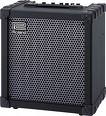
At last night’s weekly gig at the restaurant I play at, I brought my trusty Roland Cube 60. I was in a rush, and just wanted a lightweight amp that I could easily set up.

To be honest, I hadn’t played that amp for a long time, preferring to use my tube amp combos or my SWR California Blonde. But those amps are also HEAVY. The Blonde weight over 50 pounds! My Cube 60, on the other hand, weighs just 30 pounds, and is roughly half the size of any of my other combos.

But weight aside, the Roland Cube 60 is simply a great-sounding amp. Solid-state or not, it doesn’t matter. If it sounds good, then who cares about its circuitry? I was reminded of that last night. I put the amp in Acoustic/JC Clean mode and was rewarded with a gorgeous clean tone that rivaled the cleans of any of my tube amps. Admittedly, the onboard time mod effects aren’t very good (at least to my ears), so I just used my own.

And that brings me to the point of this entry and my previous entry centering on the title: Let sound guide your decisions in buying gear; not the circuitry. With respect to the Cube 60, its Acoustic/JC Clean is modeled after the venerable JC 120 amp; an amp that has proven itself over the years as a viable tone platform. Players like Joe Satriani and Albert King used this amp. I believe Satch used a JC 120 to record Surfin’ with the Alien. And it’s no small wonder these guitar greats used it: The JC cleans are spectacular. They’re not as basso as Fender cleans, being a bit more mid-rangy, but they’re gorgeous just the same.

One thing that struck me last night as well was the wide sound dispersal from that little amp. I was concerned that the diminutive cabinet would be a bit too directional, but all that worry was laid to rest when I did my sound check. The Cube 60 filled the space incredibly well, and was clear from even extreme angles. Needless to say, I’ll be using the Cube 60 for most of my solo gigs going forward.

So definitely a lesson learned once again, that it’s the sound that matters…

Read Full Post »

For a long time I was – and pretty much still to this day – an overdrive pedal lover. I have several, and am waiting for my new Paul Cochrane Timmy to be completed and delivered in the next few weeks. I’ve been wanting one of these for awhile now, and finally bit the bullet and got on the waiting list. So excited! But using an attenuator  – specifically the Aracom PRX150-Pro – changed the way I use overdrive pedals.

In the “old days” before I used an attenuator, I used an overdrive pedal to get grind through a clean amp. Early on, I was using my Fender Hot Rod Deluxe that was all about loud, clean headroom, and I couldn’t get the volume above 2 or 3 before it would be just too damn loud; not to mention, the tubes weren’t working that much at all at that level. Yeah, I could crank the volume then set the Master to about 1/2 to get some dirt, but the pre-amp only distortion of that amp never really appealed to me. So I used overdrive pedals to get that soft-clipping on the front-end, and especially looked to pedals that provided a bit of color.

But once I got an attenuator, the entire game changed. I was able to crank my amps to get both the preamp and power amp sections saturated. For a long while, I actually stopped using overdrive pedals altogether because I was getting all the drive I wanted. I still sometimes just go to my gigs with only a tuner pedal and just plug directly into whatever amp I’m using, though I’m now starting to introduce overdrives to add gain stages to my chain.

But that brings me to the crux of this post… I used overdrives because I couldn’t get sufficient grind at reasonable volumes. But once I got a real transparent attenuator like the PRX150-Pro (I had an AirBrake and tested several), I could finally hear what my amps sounded like fully cranked. But here are some things I discovered once I was able to crank up my amps that I’d like to share:

  • I have 8 amps, and with the exception of two, once I cranked them up, I did not like their fully cranked up tone.
  • A common thing that I found among all the amps where I didn’t like their cranked up tone was a certain harshness or in some cases “fizz” that was not at all pleasing to me.
  • As opposed to getting rid of the amps, I swapped tubes and speakers until I was able to balance out their tone. For instance, with my Aracom PLX BB 18 combo, which is a replica of a Marshall 18 Watt Blues Breaker, the cranked tone was horrendously fizzy to me. So I replaced two preamp tubes with NOS Mullard and GE tubes, and to tame the natural brightness of the amp, replaced the stock Eminence Red Fang with a Fane Medusa 150 which really emphasizes the low-end. It’s now gorgeous, and I use that amp regularly!

The point to all the items that I shared was that once I was able to crank up my amps, most of them just didn’t sound all that good. Lots of folks who are new to attenuators complain about different artifacts being introduced by the attenuator, but based upon my experience, I think a lot of those “artifacts” have a lot to do with them never having cranked their amps all the way up. To me, it’s definitely a case of “you may not like what you hear…”

So if you ever do get a hold of an attenuator, and you crank your amp up, if you don’t like the tone, don’t immediately assume that it’s the attenuator. Especially with the latest generation of attenuators that are much more transparent than the traditional ones, the likelihood that they’re introducing artifacts is pretty low. Look to your amp first, and see what you can do to adjust it to deal with its cranked tone. Personally, I’d start with tubes first; especially replacing new production tubes with NOS pre-amps. I know, they’re getting more and more scarce, but I’ve gotten the best results in smoothing out my tone with NOS pre-amp tubes.

Read Full Post »

I finally got some time to post my very first full video review (the Dumble series doesn’t really count because it wasn’t really a review, but more of a demo). So here, I present to you the Sebago Sound Double Trouble 100, an 100 Watt amplifier from a newcomer to the amp business and another entry in the very popular Dumble-style amp genre.

Intro and Feature Walkthrough

Dirty Tone (Master Volume)

Clean Tone and Wrapup

Overall Impression

As I mentioned in the last video segment, I’m giving the amp a 4.5. Tone-wise, it’s a fantastic amp, but personally, I’m just not in pre-amp-only distortion, and like to have the power amp side working in conjunction with the pre-amp side. It’s just a lot beefier and dramatic to me. Cranked up like this, the amp performs wonderfully; and I especially dig using the boost as it seems to add even more clarity and note separation.

For more information on these great amps, check out the Sebago Sound website!

Read Full Post »

My good buddy Jeff Aragaki of Aracom Amps (http://www.aracom-amps.com) is in a bit of a quandry. His attenuators have been incredibly successful and very well-received by both amateur and pro guitarists. He actually built the attenuator in the hopes that it would raise awareness of his wonderful amps, of which I own three with a fourth on the way. Unfortunately, it sort of backfired because his attenuators are so great that they’ve completely overshadowed his amps. That’s too bad, because they’re great amps, and they’re all I gig and record with.

So to try to raise more awareness of his products, Jeff compiled a few videos that feature moi, Clint Morrison – who’s a pro player out of Austin, TX – and Doug Doppler. Check ’em out. Clint’s and my videos feature both the PRX-150 Pro or DAG, and Aracom amps.

Yours Truly:

Clint Morrison:

Doug Doppler:

For more information on Aracom Amps products, go to the Aracom website!

Read Full Post »

Yeah, I mention it a lot, but I thought I talk about it once again, because it truly has had a HUGE impact on how I approach amps. To me, there’s simply no attenuator on the market that can touch the quality of its sound; well, it doesn’t produce sound of course, but it lets all your tone come through, but more importantly, no matter where you set it, you will always have your dynamics. In any case, I recorded a couple of videos this afternoon, talking about this wonderful device by Aracom Amplifiers.

Part I: Discussion

Part II: Demo

BTW, recorded these clips with an Alesis VideoTrack. Nice little unit. Not sure how long I’ll actually use it because I actually do want a better picture. But for now, it’s great to have an all-in-one solution to get some video out!

For more information on this great attenuator, go to the Aracom PRX150 product page!

Read Full Post »

You know me, I’m a low-wattage amp kind of guy. I find them really versatile and use them in a variety of venues and especially in the studio. But lately, I’ve been playing with a Sebago Sound 100 Watt Double Trouble – it’s a D-style amp – and I can say with confidence that I know what the big amp guys are talking about now. I have to use an attenuator with the amp, but even at lower volumes, there’s a certain thickness to the signal that a low wattage amp just can’t produce naturally.

Now, through the wonders of technology, I’ve been able to EQ low-wattage amps on recordings in such a way to make them sound a lot bigger than they are, but when an amp produces that fatness naturally, all I can say is “Wow!”

Tonight, I brought the amp to my church gig, and just couldn’t believe what I was hearing! The amp sounds great, yes (and I’ll have a full review of it soon), but the sheer power of 100 Watts – even attenuated –  was something I hadn’t experienced before. It’s hard to describe what it was like, but there is definitely a certain dynamicism in the tone and – excuse the pun – a power that my low wattage amps just don’t produce.

Does this mean I’ll get rid of my low wattage amps? Absolutely not because they’re just great tools. But I’ll probably be gigging with something more powerful more often than not from now on… 🙂

————-

As kind of a follow-on to the original article, Jeff Aragaki of Aracom Amps and I spoke this morning, and the real difference-maker between the big amp and small amp – at least to me – is really evident when you have the power tubes in play. In my studio (read: garage), the amp at low gain sounded like any other amp – even my small amps – through a 1 X 12. But when I hooked up the Sebago to my attenuator, and opened up the master volume, all sorts of great things happened in terms of getting a much more complex tone; even clean. So yeah, the power tubes have A LOT to do with the thick tone of a high gain amp.

Read Full Post »

I was so excited to finally get one of these several months ago! I played it A LOT until the original caps finally wore out and started to leak both fluid and the amp started leaking electricity (i.e. I could feel current when I touched the amp – not good!

So I had my good friend and amp genius, Jeff Aragaki of Aracom Amps overhaul the amp. I just got it back a few days ago, and it totally kicks ass! Among Jeff’s mods were:

  1. Replace the original two-prong cord with a grounded three-prong cord. For this, he had to make some adjustments to the heater.
  2. Replace the original caps with new Sprague paper caps.
  3. Replaced the original speaker with a new Weber 8″ speaker.
  4. Provide a way for me to use either the internal speaker or an external cabinet. This was done by connecting the output wire to a jack and running that into a custom switch box that he constructed.

But Jeff actually did one better, and that was to put the amp chassis in a larger tweed cabinet that had a 10″ speaker. What a difference in volume and tone!

That amp is VERY special, and it’s not a small wonder why Jeff Beck is now using Champs. He can get great tones at lower volumes! For instance, here’s a new praise song I recorded using just the Champ for the guitar tracks. The rhythm track was recorded using the 10″ speaker with the mic at the rim of the speaker cone pointed along the angle of the paper so I could capture more of the low frequencies. The “lead,” overdriven guitar used a closed-back external 1 X 12 cabinet with a Jensen Jet Falcon. It sounds like it’s coming from a much bigger amp!

For guitars, I used my trusty Squier CV Tele for the clean rhythm, and used my Gibson R8 Les Paul for the “lead.”

The thing that struck me about playing the amp was how it really responded and felt like an amp 10X its size. The touch-sensitivity and dynamics, especially when cranked, are spectacular with lots of overtones and harmonics. Being naturally brightly voiced, this amp never gets muddy. It’s actually rather unsettling to play this amp at times because it sounds much bigger than it actually is. That’s VERY cool!

Read Full Post »

Since I’ve gotten it, I’ve been absolutely digging the VHT Special 6. It’s such a versatile little amp, with bright cleans and capable of creating some gorgeous, sustaining overdrive. And while I do certainly appreciate its clean tone, this amp totally shines when it’s cranked to hilt.

To demonstrate, here’s a clip I recorded this evening with the VHT Special 6:

Now here’s the thing about recording with a low-wattage amp. I’ve found that almost invariably, it’s difficult to get a big sound out of the stock speaker, no matter where I place the microphone. People recommend recording from an angle lined up along the outside of the speaker cone. I’ve never had much success with that, considering I’m not using any high-end mics. So my solution is to use larger speakers to get that bigger sound.

For this clip, I used two different 1 X 12 speaker cabinets: The rhythm track was recorded using a Fane Medusa 150 speaker to get a bigger bottom end. The lead was recorded with a Jensen Jet Falcon – that’s my favorite speaker at the moment. And of course, because even 6 Watts cranked is very loud, I ran the amp through my Aracom PRX150-Pro and recorded each track at about loud conversation level. It’s just loud enough to move the speaker cone a bit, but not so loud that I’d wake up the neighbors. 🙂

For both parts, I used my Les Paul R8. For the rhythm, I recorded in the middle selector switch biased towards the bridge, and for the lead, I recorded with the bridge pickup only. To make the guitar tone sound even bigger, I added just a tiny bit of compression to each track and added a touch of small room reverb to add some dimension. I didn’t EQ the guitar parts at all. That’s the natural sound of the amp through the speakers I used. The compression keeps the sound focused. At least to my ears, the guitar parts sound like they’re coming from a much bigger amp.

As far as the amp setting were concerned, I was plugged into the hi input with the amp set to high-power mode. Tone and volume were at 3pm, and I engaged the Boost. Even at these cranked settings, the amp will clean up very nicely! That’s how responsive this amp is!

Admittedly, if I were to rewind and go back to when I bought the amp, I’d probably go with the head. The stock speaker is great for practicing, but for gigging and recording, it just sounds much better with at least a 1 X 12. But hey! A handwired amp for $199? Geez! I can live with its shortcomings as what it brings to the table tonally is fabulous!

Read Full Post »

Like any gear freak, I’ve got tons of gear. Just check out the “My Rig” page, and  you’ll see what I mean. I use it all. Now while I rotate my usage of guitars, I use all my amps in the studio. But when playing out, I almost invariably go with a specific type of setup: A humbucker guitar through a vintage-Marshall-style amp; and lately and more specifically, a Les Paul through a Marshall-style amp. That tone simply speaks to me. Clean or dirty, it’s what I almost always go to in a live situation.

At my church gig yesterday, I brought along one of my favorite amps: My Aracom PLX18-BB Trem, which is a “Bluesbreaker” style 18 Watt Plexi clone with two channels and no master volume. With that amp, I usually play in the Bright channel, which is a clone of the Plexi circuitry. This is a simple channel with just one volume and one tone knob. I love this channel! I usually have the volume dimed, with the tone at about 3pm, then control the amount of breakup with my guitar’s volume knob and/or pick attack. That amp just oozes Plexi goodness, and is so incredibly dynamic. The EZ81 rectifier provides just the right amount of sag, where even with the amp dimed to the hilt, it never turns soupy or mushy due to sag. I also loaded it with NOS ’59 GE 12AX7’s in V1 and V2, then have a 60’s JAN Philips 12AT7 in V3. To compensate for the overall brightness of the amp, I loaded a kick-ass Fane Medusa 150 to bring out the bottom end. The net result is that this amp sounds A LOT bigger than its 18 Watts may imply.

Then take all that Plexi goodness and combine it with a Les Paul, and to me, that’s a recipe for rock-and-roll! 🙂

It took me several years to get my “Go-To” tone, which accounts for the gear that I’ve got from my explorations; not that I’d get rid of much of it because in the studio, having lots of gear to get different sounds is important, but for me, when I’m playing out, it’s the Les Paul/Plexi combo all the way. To my ears, there’s simply nothing like the tone that that combination produces!

So what produces your “Go-To” tone?

Read Full Post »

Like many, I participate in various forums on the ‘Net, and I came across a plug for a fascinating article written in 1998 talking about devices that employ tubes – specifically amps and hi-end audio – and does a very good job of explaining why people gravitate towards tubed devices. Here’s the link to the article. It’s long, but worth it!

http://spectrum.ieee.org/consumer-electronics/audiovideo/the-cool-sound-of-tubes/0

Read Full Post »

« Newer Posts - Older Posts »