Godlyke Distribution, which represents several boutique pedal manufactures has just released the HAO OD-16 overdrive pedal. Oh yeah… yet another overdrive pedal. But who cares? As the dean of my college once told me, “There’s room in this world for people who are good,” and as far as guitar gear is concerned, there’s certainly room in this world for good gear, and the HAO OD-16 (pr. “how”), promises to be a pedal that will make gear freaks make room for this pedal on their boards.
Designed and built by HAO in Japan, the OD-16 is a very cool take on the traditional overdrive. It’s ostensibly a Tube Screamer type of overdrive, which might ellicit a “so what” kind of reaction. However, with it’s internal voltage doubling circuit that takes a standard 9V and boosts it internally to 16V (hence the numeric designation), what the engineers were after was more headroom, and much more drive. And baby, this thing delivers all sorts of drive! Check out this demo video:
I dig the fact that you can bypass the internal tone pot to get more “bite” out of the pedal, and of course, true bypass is always appreciated. 🙂 Don’t know about you, but that video is causing me some SERIOUS GAS!!! Oy-Vay!!! Great tones – even out of low-res audio from the vid! I think I need to install a lock on my back pocket.
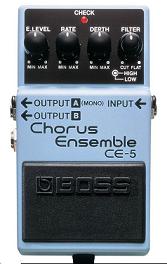
Awhile back, I wrote a fairly quick review of this pedal. That was back in October of 2007. I bought it because I was tired of using modelers and software chorus in my recordings, and also wanted to use a chorus live, which I hadn’t done much of since I had sold my Line 6 Flextone III which has it built in.
At the time, I figured it couldn’t be a bad investment, especially since I paid something like $79 for it. So, after a couple of years, what’s the verdict? It’s a solid pedal, and there’s a reason I haven’t removed it from my board yet (I’m currently looking to get a vintage CE-2): I love the Roland chorus sound!
I suppose you use what you’re used to. For me, using chorus started with the old Roland JC-120. What a great amp, and the stereo chorus was to die for! It was thick and lush, yet ringy and vibrant. Since I didn’t have access to that amp all the time (it was my brother’s), I settled on the CE-2, which I kept into the mid-90’s when I traded it for a DigiTech multifunction pedal – big mistake. Oh well…
In any case, after awhile I needed to get a chorus pedal for my Fender Hot Rod Deluxe. I didn’t even think about it what pedal I’d get. I knew it had to be a Boss. My thought was: How different could it be compared to my trusty old CE-2 which, after all, was a pretty cheap pedal when I bought it, and besides that, Roland chorus was the standard for me. I’d heard some great chorus sounds, but to me, the Roland chorus was where it was at, so I went to my local music store and purchased a CE-5
Well, to make a long story short, once I played around with the pedal, I realized that while it had that Roland chorus tone, the digital version was almost too perfect, and not nearly as warm as I remembered the CE-2 being. It seemed a little sterile. But I kept at the tweaking and was finally able to dial in some very nice, rich tones that came close to what I remembered. After all this time, here’s what I’ve come to observe about the CE-5:
The CE-5 doesn’t do extreme settings very well. In fact, they can be downright ugly; especially if you crank up the rate and depth knobs. But as they say, do things in moderation, and with moderate settings, the CE-5 can produce wonderful tones! The best operating range I’ve found for Level, Rate and Depth are no less than 9am and no greater than 2:30. At the high-end, you can get some very cool leslie effects by upping the depth, reducing the rate and upping the level. In general though, I don’t tend to stray too far away from 10 to 2 on the sweep.
All the knobs interact well with each other – almost too well – as minute changes on one knob really effect the others, making you have to compensate to keep the tone under control.
The Hi/Lo cut combo knob is killer – something I wish the CE-2 had. What they do is subtle, but very useful.
Even for as simple as it is, you really have to play with the settings before you find the right tones. I’ve had a few years with this pedal now, so I know where to set the knobs for the effect I want. But it did take time.
Given all that, don’t take it as a negative. My feeling is that hard work is rewarded, if you’re willing to do it. I took the time, and now that I’ve got the tones dialed in, I really like the pedal, which is why I’m not in a real big rush to replace it.
Here’s a clip I recorded with different settings. There are three sets of recordings, starting with my dry signal, then activating the chorus. The chorus sounds go from moderate-heavy to moderate to light in the final chord progression. I used my Gibson Nighthawk 2009 into an Aracom VRX22 amp. Here’s the clip:
I recorded the guitar completely dry, with the mic (e609) about 1/2″ from the grille cloth.
Granted, the Roland chorus sound isn’t for everyone. There are so many great ones out there, but for me, I’ll stick to the familiar. Rock on!
I’ve known about Handwired-Effects for a few weeks now, but didn’t really talk about it too much because their site didn’t have much on it, and they only had a single pedal. But now that they’ve got a few, I felt it was time to talk about them. Handwired-Effects has pretty much come out of nowhere with their pedals. Their initial offering is pretty straight-forward: a chorus, an overdrive, and a limited run “preamp overdrive” custom made for Dario Lorina.
I know… New pedal companies are started all the time so what has piqued my interest in Handwire-Effects? It’s actually not their products but their location that made me raise my eyebrows. Most new pedals seem to come primarily out of the US and Japan. Handwired-Effects is based in Switzerland. In all my years of buying gear, I’ve never used a guitar product made in Switzerland. No, I’m not thinking that these pedals may be better because of the “Swiss watch” thing. 🙂 But it sure is interesting that it’s located there…
Unfortunately, they don’t have any clips of their products, save a poor-quality video of Dario Lorina playing the Dario Lorina custom box at NAMM. We’ll just have to wait and see…
You know… For the most part, I have few regrets about my life. Yeah, I’ve made my share of mistakes, and have learned from them, but there are some things that just seem to stick in my craw, especially when I reminisce about gear that I’ve had.
Back in the 80’s, I was a big Michael Hedges fan, and must’ve seen him play live more than 50 times. I remember the day I saw him and he had added chorus to his chain. Mind you, he was an acoustic guitarist, and before he became widely known, it had always been Michael and his guitar, straight into the PA. Then he added a rather sophisticated EQ. But what struck me the hardest was when he added a chorus. For as much of a fan that I was, I don’t know which one he had. But when he came out with “Breakfast In the Field” in 1981, and used the chorus to amazing effect on songs such as “The Magic Farmer” and “Rickover’s Dream” which, incidentally, I had already heard live before the album came out, I knew I had to get a chorus!
At the time, I didn’t know an amp from a refrigerator. I was your classic folk acoustic player who happened to know cowboy chords. Be that as it may, I saved some money and went down to Guitar Center where I bought a cheap in-hole pickup for my guitar (which I still have 30 years later – it’s a Yamaha FG-335), a Roland 25 amp, and a Boss CE-2.
Even through all that cheap equipment, there was something special about the CE-2. It had just two knobs: Rate and Depth, and you could dial up incredible chorus tones with it! I can recall the warmth of the tone, and the magical way notes danced in the air. Hey! I sucked at the time, but I remember the feeling I got. Perhaps part of it was due to the satisfaction that I could cop some similar tones to Michael Hedges (though I could never play like him). Who knows? But that was one special pedal. And I traded it back in the late 80’s for some DigiTech multi-function reverb/flange/chorus pedal that I thought was “neat.”
Okay, hindsight is 20/20. Who could’ve known at the time that a cheap $79 pedal could define the chorus tone. I don’t care what other people say about other choruses that have since come out. I recall someone “correcting” me in the early days of this blog about the TC Electronic chorus being more of a standard. I was pretty new to the blog scene and didn’t want to piss anyone off at the time, so I didn’t really come back with anything. But had I more balls at the time I would’ve said, there’s a reason why people are paying for the MIJ green and black label choruses for over twice the price of the original. There was something extremely special about that Roland JC-120 chorus circuit. Everyone else who followed with their own version just did a tweak. Mind you, there are some GREAT choruses out there. But in my mind, the CE-2 had the goods!
I dig the folks over at Catalinbread, and even though I haven’t gotten any of their gear – yet – I do like what they produce. Earlier this month, they released a second version of their WIIO overdrive pedal. Admittedly, I didn’t even know they had a first version, but it’s here.
From what I could gather about the WIIO, it’s supposed to be a Hiwatt in a box – very cool – and apparently, it is designed to be super-responsive to pick attack and volume knob levels; much like an amp. Here’s a demo video I found:
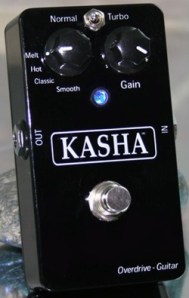
I know, I know… I talk about this pedal A LOT, and I’ve already reviewed it a few times… (here’s the original) But I keep on discovering so many great things about this pedal that makes me want to talk about it. Just when I think I’ve got it dialed in, I find yet another thing that it does that just completely turns me on!
Tonight, I was screwing around with my song Strutter yet again. I’m done writing it, but I wanted to practice, and that song is really fun to practice to; I just mute the lead tracks and have at it. Mind you, all I wanted to do was practice and play “Blondie,” my Squier CV Tele – I didn’t have anything else in mind.
So I hooked up my Aracom PLX18 BB and started playing over the rhythm track. Folks, this amp just oozes classic Marshall “Bluesbreaker” tone as is, but just for shits and giggles, I decided to switch on my KASHA Overdrive to add a little flavor to my tone because I was working on a new song recently where I loved what this pedal did – especially with the PLX18 BB! For that song (which I’m still writing) I didn’t want to add too much gain. All I wanted to do was add some texture. So I thought it might just sound good while I practiced over Strutter. Man, was that a good call!
Here’s an A/B clip of sorts of the first two verses of the song. In verse 1, I’m playing the PLX18BB with nothing added – just a touch of room reverb as an insert in the mix. In the second verse, I switch on the KASHA overdrive (still with some reverb in the mix). The pedal is in the “Hot” channel, and I set the gain knob at 12 o’clock, which just provides a bit of a gain boost (it’s capable of adding up to 15dB of boost in this channel), but this channel also sustains for days, adding a touch of high-end sparkle. Here’s the clip:
Please excuse the little playing mistakes I made… 🙂 It’s nothing really egregious. In any case, when you compare the two verses, the difference in tone is actually subtle, at least to my ears. But from a playing standpoint, the amount of touch-sensitivity and sustain that was added made the second verse so much more musical and so much more inspiring to play. And speaking of subtlety, I think that is yet another mark of a great overdrive pedal. To me, overdrives should be transparent, they should never alter your tone – that’s what fuzz and distortion are for. At the most, they should simply add EQ emphasis, and that’s it. And that’s why I love the overdrives I play through: Tone Freak Abunai 2, GeekMacDaddy Geek Driver, Creation Audio Labs Holy Fire, the KASHA overdrive, TubeScreamer, and believe it or not, a Bad Monkey. They all bring to the table their own little voicings, but none of these alter your basic tone.
Great gear evokes a sense of inspiration – at least in me – that makes me want to keep playing and playing and playing. I just can’t say enough about this pedal. At around $200, it is worth every penny I paid for it. Thanks, John Kasha for coming up with such a fantastic pedal! Now back to playing!
A couple of months ago, I asked the question, “Where have all the overdrives gone?” in response to a trend that I was noticing that there seemed to be fewer new overdrives being released after a long period where new overdrives from different pedal manufacturers were coming out every week. I guess they were waiting for NAMM to come because “They’re BAAAAACK!”
The latest to arrive on the scene is actually a re-issue from Wampler pedals: The Limited Edition Pinnacle(2) reissue. Wampler is an effects company I’ve known about for a long time, but have never actually played or owned one – even though I’ve always been impressed with their tone. In any case here’s Wampler’s explanation for coming out with the re-issue:
The original Pinnacle(2) evolved into the pinnacle over the span of a couple of years. During that time, we’ve had a ton of customers ask us about coming back out with the original version which had a stomp-switchable gain boost. While the current pinnacle and the original pinnacle 2 were 95% the same circuit-wise, some felt that there was a certain ‘magic’ to it. Since we’ve had so many requests for it, we decided to come out with a limited version of it complete with the gain boost stomp switch. We are only building a small number of these so unfortunately when it’s gone – it’s gone. At this time, it is only available on this website.
So how does it sound? Well, it can do quite a bit, actually. But it is really known for its ability to cop a great “brown sound” tone. Here’s a great video that demonstrates this (this dude can cop EVH pretty good):
I find it amazing that the amp he used was a software amp. AmpliTube has really come a LONG way!
As Wampler mentions, there are only going to be a limited run of these pedals. But here’s the real winner for me: This pedal is only $179.00! I need to tie down my hand so it doesn’t reach for my wallet!!! 🙂 It’s definitely worth a look!
I really don’t know why I love overdrive sounds so much. I guess that there’s something really primitive inside me that loves that growling tone. Who knows? Who cares? I love ’em!!!
Oo-la-la! T-Rex will soon be releasing a new distortion pedal called the Tonebug Distortion. Not much info on it yet, but it is supposed to lay on tons of gain. I was fortunate enough to see a video from the folks at GearWire that quickly demonstrates what this pedal can do.
Admittedly, I’ve preferred overdrives over distortion boxes, but I’m really liking the tone from this puppy! Don’t know if I’d shell out $399 for it, though. But T-Rex pedals are premium pedals, so that’s not a surprising price.
Being sick sometimes has its advantages because even though I’m half brain-dead with a head cold, I can take some time to surf the web in search of gear. This morning, I read a press release on Harmony Central about the new Toadworks Fat City Dual Overdrive. Being a big fan of overdrive pedals, I went to the Toadworks site to read about this new pedal.
I had tried a Mr. Ed distortion awhile back – it was okay – but I wasn’t thrilled – but I’ve always dug dual overdrives and stacking, so this looked promising. I read about the pedal, and it sounds really cool. All hand-wired with high-quality components. Also, a little out of my price range at around $300. Still, it looks like it’s worth checking out just to see how it sounds.
While I was on the site, I started looking at all the other pedals Toadworks offers, and the one that REALLY caught my eye was the Toadworks Ajax. Rather than try to explain it (since I’ve never even used one), here’s the product summary from the Toadworks site
Ajax is essentially a 2-channel line mixer, combined with a buffered Y-splitter, with the ability to invert (180°) the phase of one input signal, as well as one of the output signals.
Ajax has a wide range of uses, including:
– Two-channel mixer – With independent input level controls, Ajax can act as a simple 2-channel mixer.
– Multi-guitar interface – Ajax has two buffered inputs, allowing you to connect (and play) two different instruments at the same time.
– Input phase correction – When combining two signals, there is always the possibility that the signals may be out of phase with each other. Ajax can invert the phase of one input to eliminate unwanted frequency cancellation.
– Multi-amp interface – Ajax has two output jacks, allowing you to send the signal to two different amplifiers simultaneously.
– Output phase correction – When connecting the two output jacks to two separate amplifiers, you may find that the amplifier outputs are out of phase with each other. Ajax can invert the phase of one output to eliminate unwanted frequency cancellation.
– Stereo expander – when using two amplifiers (or recording direct to a stereo interface), it can be desirable to invert the phase of one of the amplifiers, creating an ‘expanded’ sound – this is especially useful with modulation effects such as chorus, flanger, etc. The output phase inversion is performed using the stomp switch, so this can be done on the fly.
– Effect Combination – If you are lucky enough to have two Ajax devices, you can split the output signal of the first unit, applying varying amounts of effects to each signal indepentently, and recombining the signal using the second Ajax. Using this method, you will have access to new sounds and effect combinations that are otherwise impossible.
– Simple buffer – Putting Ajax first in your signal chain will provide a simple buffer, eliminating concerns about signal loss in true-bypass effect chains.
– Clean boost – Both the input and output Level controls are capable of linear boost, making Ajax a simple clean boost with no frequency attenuation.
This pedal is very intriguing to me, as I’ve recently been experimenting with playing two amps simultaneously. I know, you can do that with an ABY pedal, and I do that, but I really like the phase inversion and the input and output boost. This has lots of possibilities. Funny though, this pedal has been out for a year, and there is very little information or reviews on it.
I announced the Skull Crusher back in September when it first came out. Based upon the KASHA overdrive (but with some upgraded wiring and electronics), it has since gotten the attention of several prominent guitarists. Now George Lynch is playing through it, and HE LOVES IT! Check out this video:
How’s that for an endorsement. I’ve said all along that the KASHA overdrive is just about the best overdrive I’ve ever played, and I’m not alone in saying that. With guys like George Lynch touting how good the Skull Crusher is, you owe it to yourself to check it out! I know, some people don’t go for the look, but it’s the tone that matters.
 The HAO OD-16, that is…. 🙂
 Awhile back,


 I know, I know… I talk about this pedal A LOT, and I’ve already reviewed it a few times… (
 Being sick sometimes has its advantages because even though I’m half brain-dead with a head cold, I can take some time to surf the web in search of gear. This morning, I read a
 Guitar Gear