Feeds:
Posts
Comments

Posts Tagged ‘Effects’

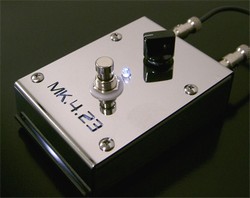
Creation Audio Labs Mk.4.23 Boost

Creation Audio Labs Mk.4.23 Boost

As many know who read this blog regularly, I’m a bit of an overdrive/distortion pedal nut. Just love the things. Silicon, germanium, doesn’t matter. I’ve always dug the tones boxes like the Fulltone OCD and Ibanez TS-808 produce. But then again, I never had good enough tube amps whose natural distortion didn’t require some bolstering.

Then I discovered Reason Amps, and did a review of the Reason SM25, which the guys at Reason graciously sent me to evaluate and to show to some local dealers. For the first time in my playing career, I’ve been playing an amp that has a knock-your-socks-off natural distortion. It’s so pleasing that I just don’t need overdrive or distortion pedals to get that saturated sound. It’s in the amp!

But the one thing that I found that I missed when playing with the amp at a couple of recent gigs was the volume boost I’d set up in my drive pedals to play a lead. It wasn’t that big a deal; I just set up the base volume of the amp a little louder than normal, then use the volume knob on my guitar. And for most situations that has worked out well. But when the band gets really loud, I need some extra oomph, and that’s when I started thinking that a booster pedal would really help.

And wouldn’t you know it, by pure coincidence, Anthony Bonadio at Reason called me last week and asked me if I had tried out the Creation Audio Labs Mk.4.23 Boost pedal. He claimed that it was best boost pedal he’d every played through, and that it was completely transparent. It takes your guitar’s signal and just makes more of it; totally transparent. Then told me he’d send his own out to try with the SM25. Then I got really interested. Check out the video demonstration below:

Flat EQ response, and a single volume knob? What could be easier?

I know there are lots of booster pedals out there. But from my research, it seems that most add some coloration of their own, or have an extra “drive” knob to add overdrive. From my perspective, a booster should just well, boost; that is, take what you have and just give you more of it. And from what Anthony has said, and from the reviews I’ve read, this seems like it does just that.

If this is enough for you to take a bit, you can only get the pedal at Creation Audio Labs directly. But don’t dispair! This pedal is only $149.00!!! Can you believe it?!!! Creation Audio Labs want to reach as many people as possible, so they eliminated the middle man and sell their pedals direct. So what used to be $250+ pedal is over a hundred bucks cheaper!

I think those pedals are definitely worth a look for price alone! Creation Audio Labs has been known as a great boutique pedal maker, and to have them get into the range of more affordable pedals is absolutely awesome! Check ’em out!

Read Full Post »

The problem with evalutating pedals online is that you can’t really audition them very easily – especially in combination with other pedals. But BOSS has gotten us one step closer with the new BOSS VPB-2 or Virtual Pedal Board. It’s very cool in concept. You go to the VPB site, select a style of music and a combination of pedals appears on the page. A loop in the style you’ve chosen begins playing, and you can then activate/and de-activate pedals to see how they change the recorded signal just by clicking on them. You can also swap some of the pedals out for the current style.

Check it out here: BOSS Virtual Pedal Board 2

Read Full Post »

MXR '76 Vintage Dyna Comp Pedal

MXR

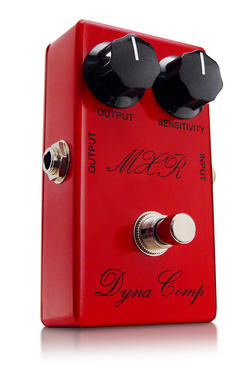
Over a year ago when I was looking for a compression pedal, one of the pedals I reviewed was the MXR Dyna Comp, along with the Boss CS-3. I didn’t like either of them. The CS-3 was way too squishy and I thought it significantly altered my tone. The MXR wasn’t quite as bad, but I still thought it did enough tone alteration to pass on it.

As many might know, I ended up going with the Maxon CP9 Pro+, which I felt didn’t alter my tone, no matter how far I squeezed the signal. I love the pedal, and when I play my Strat, it’s almost always on.

But in my search for a compressor back then, I ran across several discussions on the classic Dyna Comp from the 70’s. People raved about its transparency, and how it was a highly sought-after pedal. In fact, a search on eBay revealed that I couldn’t get a vintage one for under $250. Yikes! For a pedal that brand new goes for under $80, the vintage Dyna Comp must’ve been really special.

Well, the folks at the MXR Custom Shop have produced a limited run of the classic Dyna Comp replete with the script lettering, and more importantly, the EXACT same circuitry as the original. According to the article I read, the IC’s used in the original pedal haven’t been produced since the 80’s. But the Custom Shop folks seemed to have found some – at least enough to produce a limited run.

I looked on the Dunlop site for any information about the new pedal, and there was none to be found. No prices either. Count on this baby to hit collectable status real quick. Also count on it being priced a hell of a lot more than its newer sibling, which you can get at Musician’s Friend for $69.99. Now given that I already have a kickass compression pedal, I’m probably won’t be in the market for one, but I sure would love to get my hands on one just to review it.

For those of you who are a bit dubious of using a compression/sustainer, please don’t scoff. I will admit that for high-volume, high-gain situations, a compression sustainer is not really needed. You’ll get a lot of compression from your saturated power tubes. But for those of us who mostly play in low-volume applications, a compression/sustainer is a total life saver.

The restaurants and church that I play at have high ceilings, and of course, there’s the ambient crowd noise to deal with – especially at the restaurants. To help cut through the crowd noise, and to deal with the expansive acoustic environment without turning up too loud, I couldn’t do without a compression pedal. This is especially true when I kick in distortion, which tends to “spread” out your sound a bit. With a compression pedal, you fatten up your tone and produce a more even volume, albeit a tad less dynamic.

You might think that the loss volume dynamics is a bad thing, but before I got my CP-9, I had to fight my volume all the time – it was frustrating.

Apparently, the newer M-102 version with serial numbers starting with ABxxx are true bypass, and sound really nice. Maybe the one I tried at the time was not one of ’em. Oh well… In any case, if you’re interested, you can check it out at Musician’s Friend:

MXR M-102 Dyna Comp Compressor Pedal


You can also check out the Maxon CP-9 Pro+ here:
Maxon Nine Series Compressor Pro+ Pedal

Read Full Post »

Dunlop Cry Baby GCB-95

Dunlop Cry Baby GCB-95

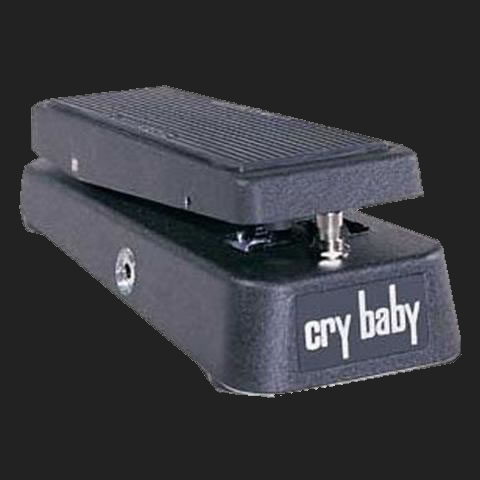
About a week ago, I wrote an article about getting a wah pedal. I had tried out and listened to several, and actually dug on a lot of them, but I just kept on coming back to the original Cry Baby. There has just been something about the classic sound of the Cry Baby that just makes me close my eyes with a smile of complete satisfaction while I’m playing.

For other players, this classic wah sound may not be their cup of tea, but this is the sound I grew up with. Every cop show on TV in the 70’s had a guitar played through a wah, and of course, let’s not forget Jimi who took it to another dimension. And it’s not like I’m going to try to play like Jimi – frankly, no one can – it’s just a sound that I’m used to, and it puts me in a time warp, back to when I was a kid.

Did nostalgia make me pick the GCB-95? It probably had a lot to do with it, but that’s the thing about tone: It’s what you like that matters. I didn’t get that nostalgic feeling of my youth with a lot of the other pedals. Yeah, I do admit there were some really awesome ones out there that I was ready to buy, but I figured that those could actually wait. I just couldn’t justify making a substantial investment into something that was so new to me. But I could get a Cry Baby at a fraction of the price, and I figured that since I was so new to playing with a wah, it would be best to instead make a minor investment to try out the technology before I spent a couple of hundred on a more expensive model. So, I forked out a reasonable $49 bucks at my local used gear shop for Cry Baby in excellent condition and saved even more money to hedge my bet.

So after a day, what’s my take? Well… I should’ve gotten a wah a long time ago! Don’t know what it is about it, but I’ve taken to it like a fish to water! Not to say that I’ve completely mastered it in a day, but it sure does feel natural. And you know what? The Original Cry Baby may be bordering on the vintage with respect to tone, it may only cost $69 used, and may be considered way too low tech for more modern players’ likings, but it totally does the job for me. I’m very satisfied.

Read Full Post »

GIG-FX Mega Wah

GIG-FX Mega Wah

I never thought that I’d say this, but I’m now looking for a wah pedal. I was working on a song recently and was using my MicroVibe to add a pulse to my signal, but it just wasn’t happening for me. The tone was kind of okay, and as a demo, would’ve been okay. But I realized that I really wanted a wah sound. So I started researching wah pedals.

I tried out a few and really liked the Fender Fuzz wah, dug the sound of the Dunlop GCB-95F Fasel Cry Baby, and liked the Morley Vai Bad Horsie Wah (didn’t know if I wanted to wait for Vox and Satch to come out with the Big Bad Wah). I was just about to pull the trigger on the Cry Baby, when I ran across the GIG-FX Mega Wah. GIG-FX claims that the Mega Wah is six wah pedals in one. That sounds promising, but the problem I’ve had with multi-function pedals in the past is that their voicings have sounded like a collection of compromises, resulting in mediocre tone at best.

But the Mega Wah seems interesting enough, and the reviews on Harmony Central have generally been favorable, for as few of them as there are. From my point of view, having a variety of wah sounds is quite useful. Sometimes you want that big Fasel wah, then sometimes you want the wider sweep of a more modern type of wah, or anything in between. The Mega Wah may just deliver. Of course, I have to try it out to really be sure, but that’s what I love about this hobby of mine!

The only thing that would probably hold me back from buying it, if it indeed sounds great is the price. At $199, it’s not cheap, whereas at $99, the Cry Baby is very well positioned for my budget. But it’s all about bang for the buck with me, and I’m willing to pay a bit more for much more capability. We’ll see…

Read Full Post »

Durham Electronics Crazy Horse Fuzz Distortion Pedal

Durham Electronics Crazy Horse Fuzz Distortion Pedal

If you’re not a Neil Young fan, read no further. But if you dig that big fuzz drive sound like I do, you’ll love the Crazy Horse Fuzz Distortion pedal. I haven’t personally played this one, but from what I’ve heard, it’ll serve up that “Crazy Horse” sound! But wait, there’s more!

This pedal is very cool in that it is a drive AND a fuzz pedal in one. So not only can you get the Crazy Horse sound out of this, but by varying the mix of drive and fuzz, you can achieve all sorts of different distortion characteristics. But in addition to drive and fuzz level controls, plus the standard tone and level knobs, a VERY cool feature of this pedal is the voltage knob, which will allow you to “starve” the pedal of its voltage, so you can vary the output from thin and fizzy to thick and ballsy!

Being a boutique pedal though, this kind of functionality comes at a price: $249.00. It’s not quite as steep as others in its class (think Fulltone, Mad Professor, etc.), but it’s also not cheap. View the video below for a great demo!

Read Full Post »

Electro-Harmonix #1 Echo

Electro-Harmonix #1 Echo

Over the years, I’ve had a love-hate relationship with delay pedals. My first taste of delay was an analog EchoPlex in the early 80’s. But focusing on acoustic guitar – actually only able to afford an acoustic guitar – at that time, I didn’t see the need for a contraption like that. Then U2 and The Edge entered my musical radar a couple of years later in the early eighties, and I of course had to get a rig where I could use a delay. So with what little money I had, I purchased a 25 Watt Roland amp, a Boss CE-2 Chorus, and a Boss DD-3 Digital Delay.

Little did I know that you had to have some technique to play like The Edge, and I quickly became disenchanted with trying to play like him. I just didn’t have the technique nor experience! So I held onto the amp, kept the CE-2, and sold the DD-3. I’m kicking myself now for getting rid of the DD-3 as it was a “Made in Japan” model that still had some hand-wired circuitry that makes it much-sought-after delay. Oh well…

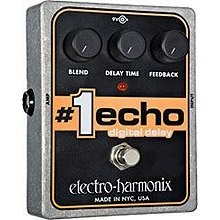
Fast-forward to today, and I’ve owned several delay pedals. Again, the operative word is “owned,” because I don’t have one now. But I do have the technique, and I’m thinking that some of the stuff I’m writing could actually use some delay. Enter the Electro-Harmonix #1 Echo.

I’m normally a little leary of EH pedals, but this one seems promising, at least from the reviews I’ve read and the sound bites I’ve heard. Reviews are generally pretty good, but one thing’s for certain: All this thing does is delay. It doesn’t do any modulation or phasing. It just delays, and that’s exactly what I’m looking for! I’m going to have take one out for a spin, but it certainly seems like it will serve the purpose. And for a $99, it’s certainly not a huge investment. Let’s look at features:

  • True bypass (Yowza! that’s cool)
  • up to 2 second delay
  • Wet/Dry Blend for blending the amount of dry and wet signal – very cool
  • Feeback control – kind of like decay

Check out the videos

Read Full Post »

Jacques Overtube Vintage Pro Overdrive Effects Pedal

Jacques Overtube Vintage Pro Overdrive

The Dawg likes to sniff around for new and interesting gear all the time. Unfortunately, I don’t always have time to write or test stuff out. But I do love it when I come across some potentially awesome gear, and I take the time to share it here. The Jacques Overtube Vintage Pro Overdrive most definitely fits the bill in that department. By the way, think “Jacques Cousteau” when pronouncing the name… 🙂

The Overtube is supposedly a faithful reproduction of the original TS-808 Tube Screamer circuit. Now you might be thinking, as did I, that that is nothing special. But what is special about this pedal is that little toggle labeled “CASC” between the Tone and Drive knobs. “CASC” stands for “cascade” and it’s meant to simulate running two TS-808 pedals simultaneously ala SRV!

Check out this video on Guitar Player TV. I’ll be damned if that pedal doesn’t do a Tube Screamer exceptionally well! And with the cascade on, this pedal sounds sweet as can be with lots of thick mid-range wail!

As many of my readers know, I’m a big fan of the mid-rangy kind of drive distortion, so I’m gonna be hard-pressed not to give this pedal a whirl.

It’s a steal at $139!!! Check it out!

Read Full Post »

Ibanez Jemini Distortion Pedal

Ibanez Jemini Distortion Pedal

Does the guitar playing world need yet another distortion pedal? That’s almost like asking if your town needs another Starbucks. Hmmm… maybe that’s a bad analogy because while we could probably do without yet another coffee commodity, I for one don’t ever mind seeing another distortion pedal hit the market.

And just when I thought I’d heard all the variations of distortion around, and that not much else could be done, along comes Ibanez with yet another mind-blowing distortion box, designed by none other than one of my guitar heroes, Steve Vai. I gotta admit it: I’m really impressed with this latest offering from Ibanez – at least as much as I was impressed with the Vox Satchurator. Don’t get me wrong; it’s not because of Steve Vai, or because I’m a Vai wannabe. It’s because there’s something about a great distortion sound that evokes a visceral response inside of me. It’s hard to explain. So I’m more than pleasantly surprised about the Jemini because it produces a GREAT distortion sound; at least from what I could tell from this video starring Steve Vai and Steve Vai – you’ll get the joke once you watch it:

Leave it to Steve Vai to not only demonstrate his mastery over the guitar, but the eternal showman manages to make the video a joy to watch. I was laughing my ass off at his antics! He’s so likeable!

Okay… now for a reality check… I really would like to get this pedal, but at $199, it’s a bit out of my price range right now. But being two distortion pedals in one for that price, it’s a hundred bucks a pedal. That’s actually not bad at all. But I have to admit, I have my sights set on a Satchurator right now. I kind of go for the more mid-rangy type of distortion. But I’m not going to let that keep me from taking one out for a spin.

On a final note, what’s been really great as of late is that big-name gear manufacturers are finally producing what could be considered boutique-type pedals. Having played with the Satchurator, that thing is built like a tank, and it just kicks ass. The Jemini appears to follow suit of well-made, gig-worthy quality. That’s very pleasing to me, because I’m a big proponent of getting great sound without breaking the bank.

Read Full Post »

Vox Satchurator

Vox Satchurator

Summary: From grind to snarl, the Satchurator can deliver it. Built like a tank, with chicken head knobs, and a fire engine red paint job. Definitely gig-worthy! “More” switch is awesome!

Pros: Incredibly versatile, this box has the ability to deliver a wide variety of tones.

Cons: Just a nit: True character of this pedal doesn’t come out until you’re at gig levels in volume.

Price: $129 Street

Features (fr. VOX site):

  • Analog distortion pedal designed under the complete supervision of Joe Satriani
  • Controls for Gain, Tone and Volume
  • ‘More’ gain boost switch enables two footswitchable distortion sounds in one pedal. This gain boost is dramatic when gain knob is set low, and is a subtle solo boost when gain knob is set to maximum.
  • ‘Pad’ switch pads down input to allow for high gain pedals (such as modern wahs) placed before Satchurator. Up is pad ‘ON’. Down is pad ‘OFF’ for full Satchurator effect.
  • High gain, low noise design provides vintage to modern distortion sounds
  • Dynamic circuit is highly responsive to rolling off the guitar’s volume and preserves the guitar’s high end when the volume is rolled off.
  • Cream chicken-head knobs for precise positioning and high visibility on dark stages

I am not shredder; never was, never will be. It’s just not my style. But that doesn’t mean I don’t love the sound of distortion and playing with a distorted sound. In fact, to me, there’s nothing like the sweet, sustained, and compressed tone of saturated power tubes, or the dirty color that comes from a great overdrive or distortion box. Thus, I’ve had several stomps over the years from DS-1’s to MXR’s to my current line up of a Tube Screamer, Bad Monkey and an OCD. Each pedal has its own unique character, and I employ all of them either individually or by chaining a couple together. It now looks like I’m going to add to my lineup.

When I first heard about the VOX Satchurator, I got excited. I figured anything that was designed and built to Joe Satriani’s specifications had to at least be something to take a good look at, if not outright buy. Plus, with VOX being known for high-quality, I knew that whatever was produced from this partnership would not be crap. So I knew that it would be a good bet that I’d get this pedal. In fact, I’m writing this review right after my test. But luckily, I’m not THAT impulsive that I left the store with one in hand – though I have been known to buy first think later. Luckily I have my trusty GAS Calculator to keep those impulses in check. 🙂 I scored a 5, which is on the high side of still considering the gear and just one point below of getting it, but I didn’t score a 6 or above, so I held back on my purchase for now (honestly, it’s a matter of available funds 🙂 ). Now back to our regularly scheduled program….

Okay… if you read no further, please read this:

THE SATURATOR WILL NOT MAKE YOU SOUND LIKE JOE SATRIANI!!!

No one sounds like Satch, but Professor Satchifunkilus himself. You may use the exact same equipment (I used a JSX for my test, but I used a PRS SE Custom Semi-hollowbody for one of the guitars and a Strat and Epiphone Les Paul for the others). You may even have incredible technique that matches or surpasses the maestro, but you will not sound exactly like him. I’m only saying this because I don’t want you to get your hopes up. What you do get though, is the same TYPE of distortion tone that Satch gets. What you do with that is entirely up to how you play; and that is a good thing. Okay, ’nuff said.

Here’s my take on the Satchurator: Forget about how cool it looks – it looks AWESOME, by the way – the Satchurator is an incredibly versatile distortion box that can serve up mild grind to unadulterated, in-your-face, lewd, crude, with a mouth full of food snarl (got that saying from Guitar Player mag 🙂 ). It also has incredible attack and volume knob sensitivity at any volume level.

The Satchurator is also not for the faint of heart. Once you switch on the box, you get breakup, even with the gain swept to zero. In other words, once it’s on, you’re committed to having even modest amounts of distortion in your signal. To coin a phrase from a close friend, “This ain’t for pussies.” But the cool thing is that the distortion is highly controllable based upon your guitar’s volume knob and how you attack the strings. From a volume knob perspective, I just DIG how the Satchurator responds to volume knob settings. Want less distortion, just sweep your volume down. Want more bite, do the opposite.

When I test pedals, I usually start out with everything set in the 12 o’clock setting. Through my test, which was about 45 minutes, I only moved the gain knob twice: All the way down to get a gorgeous bluesy breakup, then all the way up to see how bad the pedal clipped, which surprisingly enough, it didn’t do. For the rest of the test, I just kept the gain set at the centerline, then used a combination of attack and volume knob sweeps to dial in the right amount of distortion that I wanted. From a gigging standpoint, the less you have to bend over or crouch to set pedals, the better.

It has been noted that Satch actually plugs the Satchurator into a clean amp, then sweeps the gain knob. Personally, I like the sound that power tubes produce, so I set the JSX into the first gain stage, but left it pretty clean, allowing the Satchurator to drive the tubes into breakup. I do have to say that I loved that combination of tube breakup along with the Satchurator distortion.

More really is more

There’s an interesting switch on the right side of the pedal called “More.” This switch provides even more gain when you switch it on. It’s great for cutting through a mix. The interesting thing is that the boost effect is less dramatic with higher gain settings on the pedal. With the gain knob pegged, pressing More definitely adds more, but it’s just a bit more, like going from 10 to 11 on your amp. Where I had it set at 12 o’clock, the More switch was nicely dramtic, and it’s something that I’ll definitely be using when I gig.

Will play nice with the other kids...

I didn’t get to try this feature out, but the Satchurator also includes a toggle switch called “Pad.” Apparently, this allows the pedal to play well with high output pedals like wah pedals and not change your tone. It essentially “pads” their signals so the Satchurator’s tone doesn’t fluctuate wildly. I’ve never seen a pedal that had this feature. Very, very useful. Once I put the Satchurator in my chain, I’ll definitely be using the “Pad” to help tame my vibe pedal that could potentially cause wild tonal fluctuations, which it does with my OCD, which doesn’t like to be played with the vibe.

So how did it REALLY perform

I wish I had more time to try out a couple of other amps, but alas, I just didn’t. But I did try it out with three guitars, so that’s good. Here’s my synopsis:

  1. The first guitar I played it with was PRS SE Custom. This is a semi-hollowbody guitar. I’m glad I switched to another guitar because I wouldn’t buy the pedal if I just did my review with just that guitar. It’s not that the guitar was bad, and it wasn’t that the tone that was produced was bad. It’s just that the combination of this particular guitar with the Satchurator was uninspiring. I wasn’t blown away.
  2. After the PRS, I switched to a Strat, and my inspiration meter went through the roof! The sound was FAN-FREAKIN’-TASTIC!!! I had the same result with Epi LP I plugged in. In other words, at least from my perspective, the Satchurator sound best with solid body guitars. To be fair, I probably could’ve coaxed a great sound using the PRS, but with limited time, I didn’t have the patience. And in a gigging situation, the last thing you want to do is tweak.

Wrapping it up

As I mentioned above, this pedal will not make you sound like Satch, but it will give you the same kind of distortion Satch employs. I love that kind of distortion. It’s not super-compressed, but it’s also not so open that it comes across as hollow. As with Baby Bear’s porridge in “Goldilocks and the Three Bears,” it’s just right!

Read Full Post »
« Newer Posts - Older Posts »