Feeds:
Posts
Comments

Posts Tagged ‘GAS’

Click for larger image

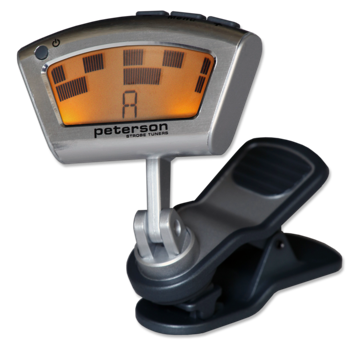
I just did a review of this awhile ago, but I thought I’d go into a bit from an actual usage perspective.

As I reported in my review, I took it to my weekly solo acoustic gig, and it worked fantastically. I also took it to my Sunday church gig and used it on another guitar: My Fender Stratacoustic, which is a really tough guitar to tune. I also use it regularly in my home studio and it works flawlessly.

Okay, I know. It’s just a tuner. However, what I find so special about it is that it’s the first clip-on tuner I’ve used that is really accurate. Plus, it has Peterson’s sweeteners built in, and to me, the sweeteners make all the difference in the world. Sweetners are minute adjustments to the tuning so that chord intervals sound, well, sweeter. Guitars are generally built to even temperament; that is, they’re set up so that each string is tuned to an exact frequency.

The idea behind the Peterson tuning sweetners is that even temperament is fine until you play chords. We’ve all been there. Tune up the guitar with a standard tuner like a TU-2. The tuning sounds fine. Then you play a chord, and you have to make adjustments so the chord sounds good. The sweetners take this in to account, and instead of tuning to the exact pitch frequency, tune a little off to account for presses on the strings. The result is that when you tune with a Peterson tuner, you rarely make post tuning adjustments. Very cool.

Originally, I thought I’d simply use the StroboClip in my home studio, but I’ve found it to be an invaluable tool for gigs. For instance, as the lead guitarist in my church band, I often do solos with a lot of bending which, after awhile, will make the tuning drift a bit. With my StroboClip, it’s simply a matter of turning down my volume, then doing a quick tune. Oh that reminds me! I totally dig the LCD screen for tuning. Even for how small the unit is, the movement of the checkerboard pattern makes tuning a lot easier than trying to nail it with a bank of LED’s.


Read Full Post »

I’ve had this secret desire to own a Rick Turner Model 1 for a long time, though I never really shared that desire with anyone. For the past few years, my focus on gear acquisition has been on electric guitars and amps, with the occasional acoustic thrown in. But a Rick Turner guitar has always been in the back of my mind.

So what originally led me to this? Well, one guy in my church band plays one, and another is having one built for him right now. My latest conversations with them have led me to consider having one built.

If you’re not familiar with Rick Turner guitars, all you need to do is turn to Lindsey Buckingham of Fleetwood Mac. He has been playing a Model 1 (probably a customized version of it) for years. To me, this is the answer to the hybrid guitar; much more so than the Taylor Tx series. Lindsey uses it for both acoustic and electric, and having heard the guitar live, it does both fantastically well!

One of my concerns about hybrids has always been what I feel is the compromise sound, and I’ve always been a bit disappointed in the electric tones of hybrids. But as Rick’s pedigree includes a stint with Gibson development, he certainly gets the electric part. And amazingly, with the peizo pickup, the acoustic tones when plugged in are incredibly natural sounding.

My buddy’s guitar is going to cost about $2850 before tax for a custom build, if I remember correctly. I don’t have that kind of cash on hand right now, but considering the price and what he’s getting for it (he’s using some exotic woods), that’s not bad at all! My personal taste runs to the standard mahogany, so I’ll see what that’ll cost me. Either way, it looks like I’ll be saving my pennies for awhile. πŸ™‚

Anyway, here’s a video of a Lindsey Buckingham solo as he plays his Model 1:

Update: Got a price list for the Model 1. I’ll be waiting for awhile, but I think the wait will be worth it.

Read Full Post »

I was answering a comment on one of my videos this morning on YouTube, when I came across a great series on understanding tube amps posted by Old Tone Zone (http://www.oldtonezone.com). It’s a 7-part series, and goes through various features of tube amps. Here’s the first video in the series. If you want to view it with the playlist, go here: http://www.youtube.com/watch?v=Yc-78AKIo5A&feature=BF&list=PL2D0A1CC3FC96F1CA&index=1.

Read Full Post »

I finally got some time to post my very first full video review (the Dumble series doesn’t really count because it wasn’t really a review, but more of a demo). So here, I present to you the Sebago Sound Double Trouble 100, an 100 Watt amplifier from a newcomer to the amp business and another entry in the very popular Dumble-style amp genre.

Intro and Feature Walkthrough

Dirty Tone (Master Volume)

Clean Tone and Wrapup

Overall Impression

As I mentioned in the last video segment, I’m giving the amp a 4.5. Tone-wise, it’s a fantastic amp, but personally, I’m just not in pre-amp-only distortion, and like to have the power amp side working in conjunction with the pre-amp side. It’s just a lot beefier and dramatic to me. Cranked up like this, the amp performs wonderfully; and I especially dig using the boost as it seems to add even more clarity and note separation.

For more information on these great amps, check out the Sebago Sound website!

Read Full Post »

My church bandmates were a bit tired of this bluegrass-style “Joy to the World” that we’ve done for the past few years at Christmas Mass, and they asked if we could do a new song. Well… in keeping with our much more straight-ahead rock style, I came up with an 80’s punk version of Angels We Have Heard On High. πŸ™‚ That’ll wake everyone up!

By the way, the guitar (my R8 Les Paul) was recorded in the bridge position through the AWESOME VHT Special 6. I used a 1 X 12 external speaker cab loaded with a Jensen Jet Falcon. The amp was cranked, in the high input, high output, with the booster engaged! HA! It has a much bigger sound than its 6 Watts! It was actually pretty loud in my studio!

Also, MERRY CHRISTMAS!!!!

Read Full Post »

A couple of weeks ago, I did a gear find announcement about the new EH Freeze pedal that essentially takes what you’re playing such as a chord or note and freezes it. The video demonstration was particularly awesome, and very intriguing. Intriguing enough to where I needed to check it out. So I did, and…

I’d rather use a looper. πŸ™‚ The premise is great: Strum a chord, or pick a note, press and hold the button, and what you just strummed is held in place.

When I first saw the video, I was thinking that it would be great for my solo acoustic gigs where I could solo over the frozen chord. But after playing around with the pedal, I realized that I like soloing over live loops than just a single chord. No doubt, the pedal offers some interesting possibilities.

One thing that I found was really cool was using the latch mode while playing chord progressions. In latch, freeze is always on, and each time you press the button the pedal freezes what you’re playing at the time. With chord progressions, it’s cool because it really helps fill the space, but the problem for me – and probablyΒ  most players – is that I don’t do just a straight strum. I palm mute, I tap the strings, I pick out bass lines and such, and this is where it’s really tough to use this pedal.

Interestingly enough, lots of bass players have picked up this pedal. For bass, it makes lots of sense because you’re mostly playing single notes at a time. But if you slap or play two- or three- note chords like my bassist does, I think the pedal would get limited usage.

I suppose you could use it to get infinite sustain, but for that, I’d rather use something like the Pigtronix compressor/sustainer. While it won’t give me infinite sustain, it’ll give me enough for my needs. πŸ™‚

So the verdict? I like the pedal, but not enough to actually put it in my chain. Quality-wise, it’s built solidly and that’s not an issue. I think for me, it would get very limited usage, and while I can get it for around $100, there are other things I’d rather use $100 for…

Read Full Post »

I love playing through a 2 X 12. I have an Avatar G212 Premier made of 3/4″, 13-ply baltic birch. It’s a bright cab, and has a big resonating chamber, which really gives a nice 3-D effect to my sound. I originally had it loaded with Celestion Blue and Gold speakers, and they sounded great, but I just felt the Blue didn’t have enough bottom end for my preferences. So I recently swapped the Blue out with a Jensen Jet Falcon. Yeah, that’s right. I now have one of the most expensive Celestion speakers and just about the most inexpensive Jensen speaker in my cab. And you know what? It totally works.

The one thing I like about ceramic speakers is that they have a nice, tight bottom end. The Falcon has a great bottom end that provides a real nice “oomph” to my sound. Alnico speakers – at least in my experience – are much more mid-rangy, with an emphasis on the upper-mids. The Gold has a fantastic, bright tone. It’s rich, and has a super-smooth breakup. So mixing the ballsy ceramic Falcon with the alnico Gold seemed like a good idea, as I postulated that I’d get a nice balanced sound.

I did the swap this afternoon, right before my church gig. I was a little nervous because my soldering skills are highly suspect. But I took my time, and the swap was done without incident. Then I went to test it out. The cleans were deep and lush, and the big space that the Avatar cab provides gave my tone real depth! Loved it.

Then I cranked my amp to hear the breakup. Yikes! It was pretty harsh and stiff, but I was kind of expecting that, considering I installed the Falcon right out of the box. It wasn’t too bad, but I could feel the stiffness.Β  But I was determined to bring it to my gig, so an hour later, I loaded it up in my car and away we went.

Luckily, the songs I chose for Mass were mostly clean, so I didn’t have to drive the speaker too hard, but I played it straight for three hours (two hours of rehearsal, then an hour for service), and by the end of the service, I could really feel the Falcon loosening up. Our last song was a rocker, and I cranked my amp. I was greeted by a fantastic, ballsy tone that had a real complex tone; exactly how I envisioned it! So now I’m a believer in mixing ceramic and alnico. It’s a great combination!

So what am I going to do with the Blue? I honestly haven’t made up my mind. That’s not a cheap speaker by any stretch of the imagination. But it is only 15 watts, so I can really only use it with a lower wattage amp. That’s maybe not a bad idea. I could use it with my ’58 Fender Champ, or as an extension cab for my VHT Special 6. We’ll see…

Read Full Post »

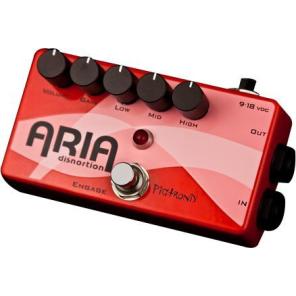
I usually keep up on new stuff, but the Aria has been around for about a year now. Can’t believe I missed it! In any case, I just spoke with Dave Koltai of Pigtronix, and he said the Aria was the result of releasing a product with no marketing. I take it that Dave is one of those back-room geek dudes who come up with lots of amazing shit, then just put it out there. πŸ™‚ Actually, after speaking with him, he’s a really cool guy, and it’s great to meet someone who has a passion for what they do, and that was clear that he has a passion for creating great pedals.

I’ve known about Pigtronix for quite awhile, but it wasn’t until I got the press release on the Keymaster and shared it, that I started looking in on Pigtronix’s product line. They’ve got an impressive array of pedals. The one that I’m really keeping an eye on is the Philosopher King pedal, which is a compressor/sustainer, grit, and envelope filter. Have to save my pennies up for that one, but it’s definitely something I’d like to add to my board. But more to the immediate, I also came across the Aria Disnortion pedal, and that’s what this post is about…

I love dirt pedals! I’ve got a bunch of ’em, and for some reason, I just can’t get enough of ’em (I know… I say that a lot, but it’s true). Each one that I have has a different character, and they rotate on my board with seeming regularity as I get the in the mood for different tones now and then. As of late, I’ve really been into more transparent overdrives and boost, as I love the natural sound of my amps when overdriven, and the Aria definitely seems to fit the bill.

Now with respect to transparency, let’s face it, nothing is transparent. Everything you put on your board will change your tone. But what I tend to look for – especially in dirt pedals – is that they don’t take anything away, ESPECIALLY dynamics and and note separation. Some pedals I’ve tried in the past sound pretty decent and have lots of dynamics, but at high gain levels, lose clarity and note separation. While I’m not a speed demon on the fretboard by any stretch of the imagination, I do have more of a legato style of playing where I play several notes in one complete phrase which I’ll end with a bend or sustain, depending upon what I’m playing. So note separation is VERY important to me. There’s nothing worse than playing a well thought out phrase, only to lose it in a mush. From what I’ve heard from the demonstrations by Peter Thorn and Andy at Pro Guitar Shops, even at high gain settings, the pedal retains note separation. That’s a huge plus!

Another plus of this pedal that I can see is the 3-band active EQ that provide 12dB of cut or boost to really shape your tone. The gain knob will give you clean boost to fuzz, which makes this an incredibly versatile dirt pedal. This ain’t no one-trick-pony; that’s fo sho!

Then add to all that this pedal retails for a street price of $149, OMG! I have to get this pedal! πŸ™‚

For more information on the Pigtronix Aria Disnortion (no, it’s not a typo), visit the Pigtronix Aria product page!

In any case, for your viewing/listening enjoyment, check out these demo videos!

Peter Thorn

Andy @ ProGuitarShops.com

Read Full Post »

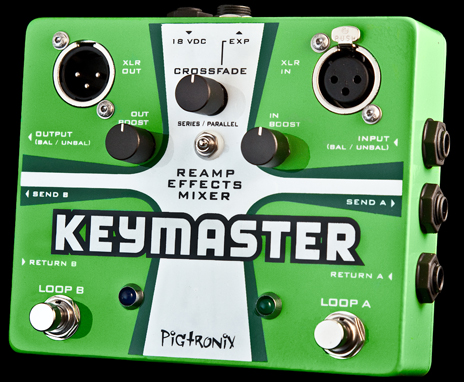
I’m not too sure how to actually describe this “pedal.” It’s a dual looper, but could be used as a switch box, or a DI box. You could use it to direct your signal to two different effects loops and with the crossfade knob, mix in just the right amount of signal from each loop. As an impedance matching DI box, you can use it to go directly into a board or DAW. Or you could keep things very simple and use the box to go from one guitar to two amps, or two guitars to one amp. The possibilities for using this box are immense! Very interesting.

Here’s a copy of the press release I got from Pigtronix:

Pigtronix introduces the Keymaster – Impedance Matching Effects DI

Pigtronix Keymaster is an impedance matching, effects mixing direct box that allows musicians to do more with the gear they already own. Without loss of tone, the Keymaster routes any sound source (XLR mic, line level or instruments) into effects via two, true-bypass loops and then optimizes the mixed effects signal for your instrument amplifier, mixing console or DAW.

The Keymaster’s unique and intuitive arrangement provides musicians of all types with an elegant solution for routing their sound through effects in a creative fashion and then out into any device without losing signal integrity. The two loops can be switched between series and parallel, with a CROSSFADE function for on-board or expression pedal controlled blending of different effects. Input and Output boost controls add up to 10db of gain both before and after the loops.

The Keymaster lets musicians easily blend their instrument’s natural tone with a floor processor or even cell phone and laptop computer based effects using a standard expression pedal. Vocalists and horn players can use the Keymaster to control their effects mix from the stage. Guitar players can now mix pedals like a DJ does two turntables.

Already in use by some of the world’s top producers and FOH mix engineer’s, the Keymaster elegantly answers the unmet needs of musicians at every level, opening up endless realms of possibility for combining the effects you already own.

“I use the Keymaster to run the Piano mic through my Leslie Cabinet, drum mics into spring reverb and to get vocals into guitar amps. This pedal kills. You need it, I can’t live without it.”
Hector Castillo – Producer / Engineer for David Bowie, Bjork, Roger Waters, Brazilian Girls

I get lots of press releases, and there are just a few that I’ll forward to my readers. The gear simply has to be interesting enough for me to publish. This is definitely something I could put to use in the studio – or even on stage. It’s definitely worth a look! In any case, check out this video describing the pedal:

Read Full Post »

Before I go into the specific company in question, my thought is if it plays and sounds great, and more importantly, it moves me enough to want it, then I’d probably let its questionable ancestry go and just buy the item.

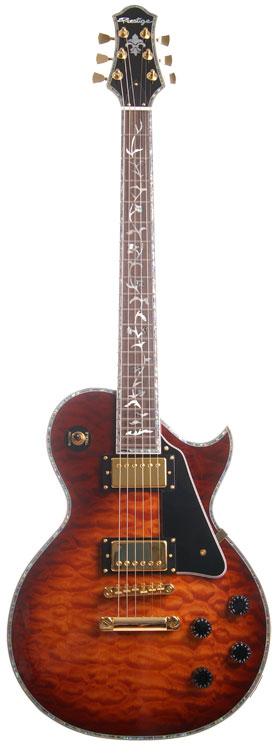
Prestige Heritage Elite - Lite Sunburst

I did just that with my Prestige Guitars Heritage Elite. I bought my Heritage Elite, which is a fantastic guitar, actually before I knew of the controversy – so too late for me. These guitars are Les Paul-style guitars that the company say are cut and shaped in Korea, then accessorized in Vancouver, BC, Canada. Prestige also provides the woods. All that sounds well and good as Gibson does this with the Epiphone line, and PRS does it with its SE line.

But here’s where the controversy starts. These guitars are EXACTLY like this: http://www.unsung.co.kr/html/products/ulp523.html, which is a made by Un-Sung Musical Instrument Company, and this one: http://translate.google.com/translate?js=n&prev=_t&hl=en&ie=UTF-8&layout=2&eotf=1&sl=ru&tl=en&u=http%3A%2F%2Fjetguitars.ru%2Fshow_9104259 by Jet Guitars in Russia. The latter two share the same model number so the Jet is obviously a re-label of the Un-Sung. Plus, the Samick company in Korea makes something that is eerily similar to the Heritage Standard.

All that said, Prestige says they use two different manufacturers in Korea – the same foundries that produce Epiphones and another popular brand, and that Un-Sung makes copies of these, which are actually constructed in China.

Who knows what to believe? I do know that the tops of the Prestige guitars are full caps, not laminates (you can see the sandwich layers from the pot cavity). My Elite sounds and plays great, and though I don’t use it nearly as much as I used to as I now have real a Les Paul and a ’59 replica, it still gets play time because the Duncan ’59 and JB pickups sound absolutely sweet!

So, knowing what I know now, however uncorroborated, would I still have bought the guitar? Yes. I would have bought the guitar because all things being equal, this is just a great guitar, and you can still get them for a GREAT price on EBay from “acemate,” who sells lots of gear from Canadian manufacturers.

Mind you, it doesn’t have the sound of a Les Paul, but it does have a sound all its own, and that sound is actually quite aggressive. If I had to do it all over again, I’d probably buy the Heritage Standard, as the Elite is a bit too pretty, and I’m always concerned of getting it dinged up.

Would I recommend it? Absolutely. If you’re looking for a LP-style guitar but don’t want to pay the price, and don’t want an Epiphone, Prestige Guitars are a great lower-cost alternative!

For more information, go to the Prestige Guitars website!

Read Full Post »

« Newer Posts - Older Posts »