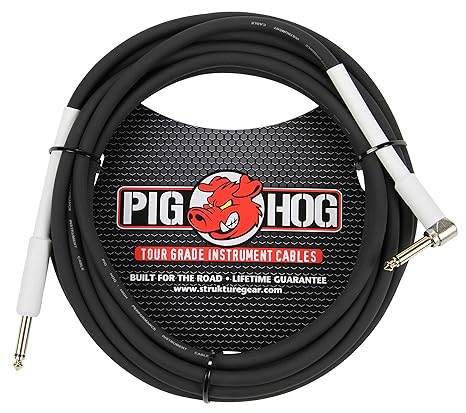
Summary: This is a heavy-duty cable that looks like it’s meant to last. And for someone like me who gigs a lot, durability is the key.
Pros: Uses 8mm wire and a thick shielding. Right out of the box, I felt that this cable is totally road-worthy. And did I mention PigHog cables have a no questions asked lifetime warranty?
Cons: None
Features:
- High performance instrument cable
- 8mm high quality rubber outer covering
- 1/4″-1/4″ connector
- Lifetime guarantee
Street Price: $19.95
Right before my gig started a couple of weeks ago, I completely lost the signal to my amp. I didn’t panic because as they say, shit happens. We were literally a few minutes from the start, so I unplugged from my pedal board, and plugged directly into my amp and did the gig with no effects. It wasn’t a big deal.
But what was a big deal was the loss of signal. After the gig, I check out my board to see if I had knocked a power connector. Everything was fine. All my patch cables were in place. I finally narrowed it down to the cable connecting my board to my amp. I guess it was its time… But it served me well for almost 20 years through literally thousands of gigs (I take care of my cables).
But it got me to thinking that I hadn’t replaced my cables in a LONG TIME. And lo and behold, I just happened to check my email and saw an ad from American Musical Supply that they were having a flash sale and what would you know, they had these PigHog 10-foot cables on sale. I immediately ordered two of them.
I knew nothing about PigHog cables. I didn’t even know they were considered one of the more expensive brands. But they were only $14.95 apiece, so what the hell! I went for it.
It was later when I received the cables that I got impressed. These are THICK and have a solid feel. The connector jack bodies are wrapped, so no worries about the circuit covers ever twisting off.
But the kicker for me is the lifetime, no-questions-asked guarantee. A company that provides that obviously stands by their product; so much so that they wouldn’t offer this if they knew their cables wouldn’t last!
As far as capacitance and sound are concerned for those who are curious, I have no numbers. I really don’t give a shit. The cables work. I plug them into my rig and I get my sound. Then I set the EQ on my amp and play.
But I do get comfort on how well these cables are built. I feel as if I can trust them to withstand the rigors of packing and gigging. For me, durability and reliability completely trump capacitance. Besides if I plug a cable into my rig and my highs are slightly rolled off, what do I do? I go to my amp and add some mids and/or treble… Uh… duh?
Overall Impression
Cables are boring. They’re pedestrian. But I want to have good, durable cables that will last a long time. I understand the whole low-cap thing, but as I said, that’s less important to me than durability. Besides, the only time I’m concerned about low-capacitance is with my mic cables in my home studio. I don’t know if they really make that much of a difference, but I use them just the same.
But as far as these cables are concerned, I’ll probably get some more; especially patch cables.
 Audiophiles for years – excuse the pun – have heard cable manufacturers’ and experts’ claims of “cable break-in.” It’s a huge, ongoing debate, though most seem to believe it’s folly. In the guitar world, I haven’t heard of this from cable manufacturers; at least from the brands I buy. But I have heard it from seemingly well-informed musicians who claim they can hear the difference between a broken-in cable and a brand new cable. These people pride themselves on their “golden ears,” and often pull rank by providing their “bonafides” of degrees or what-not to add credibility to their claims. They are so convincing that lots of uninformed, unsuspecting musicians fall prey to their claims and in turn take them as scientific fact. Then in turn spend hundreds, maybe thousands of dollars on super, high-end cables that they’ll “break in,” and magically, their tone will be right. Hey! More power to ’em.
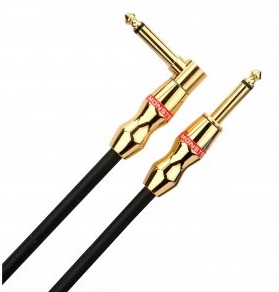 As much of a gear slut that I am, I’ve realized that I’ve completely overlooked one incredibly important piece of gear at GuitarGear.org that can have a huge effect on your tone: The guitar cable. Actually, I’ve shied away from this subject, much like I shied away from talking about speakers. Why? Because like speakers, there’s really no definitive way to classify cables as “good” or “bad,” no matter what materials are used. It’s a very subjective thing; that is, you have to use your ears to make the determination of what sounds good to you and what doesn’t.
 Guitar Gear