Feeds:
Posts
Comments

Posts Tagged ‘guitar effects’

As you may know, I own a Prestige Guitars axe – actually one they no longer have in their current model lineup (though they list it in their models area) – the Heritage Elite, which I call “Sugar” because she actually smells sweet in addition to sounding sweet. The Heritage Elite is a very ornate take on a Les Paul copy; a lot of people actually don’t like how busy all the decorations are, which might account for why it’s not on their current model lineup. But the tone and sustain are wonderful, so that guitar is a keeper for sure. But I suppose in an effort to be a bit more “true to form,” Prestige has come out with a new axe, called the “Classic,” that I am sure will turn heads.

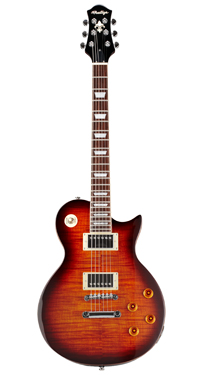
The Classic is a very nice take on a classic Les Paul design. It features a AAA flame maple top, on a super-light, carved, mahogany body and mahogany neck with a rosewood fretboard. As with the Heritage, it sports the classic Seymour Duncan 59/JB Neck/Bridge pickup combination, independent volume and tone knobs, and a 3-way selector switch. Not sure what the bridge is, but when I last spoke with Prestige, they were moving away from Gotoh Tone-o-matic to GraphTech. Sure looks like a Gotoh to me, but I’d have to see it up close to tell.

When I look at the picture, if it weren’t for the lower horn, I’d swear this was a Les Paul! I dig the mother of pearl inlays on the fretboard, and the graceful lines of the body; speaking of which, the back is contoured, so in addition to being light, it is apparently incredibly comfortable as well. Great combination!

Here are specs from the Prestige Site:

  • 24 3/4” scale length
  • 1 11/16” nut width
  • Carved mahogany, maple bound body
  • AAA Grade flame maple top
  • Mahogany neck
  • Bound rosewood fingerboard
  • Mother of pearl trapeze fingerboard inlay
  • Mother of pearl prestige logo & decal
  • Seymour Duncan SH1-59 (neck) SH4-JB (bridge) humbucker pickups
  • 2 Vol. / 2 Tone / 3-way toggle controls
  • Grover tuners
  • Tune-o-matic bridge & Stop Bar
  • All chrome hardware
  • Available in natural sunburst finish

And to top it of, here’s a Guitar World video demo of the Classic:

Even with the low quality video, you can hear how that guitar just sings. It has a sweet sound, but can also get really aggressive. That’s one of the reasons I love playing my Sugar, which is a great guitar. But I might just have to get me one of these classics to gig with… OMG! More GAS!!!!

For more information, check out the Prestige Guitars product page!

Read Full Post »

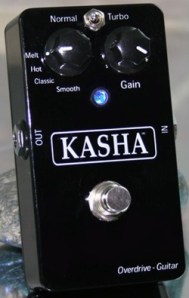
I know, I know… I talk about this pedal A LOT, and I’ve already reviewed it a few times… (here’s the original) But I keep on discovering so many great things about this pedal that makes me want to talk about it. Just when I think I’ve got it dialed in, I find yet another thing that it does that just completely turns me on!

Tonight, I was screwing around with my song Strutter yet again. I’m done writing it, but I wanted to practice, and that song is really fun to practice to; I just mute the lead tracks and have at it. Mind you, all I wanted to do was practice and play “Blondie,” my Squier CV Tele – I didn’t have anything else in mind.

So I hooked up my Aracom PLX18 BB and started playing over the rhythm track. Folks, this amp just oozes classic Marshall “Bluesbreaker” tone as is, but just for shits and giggles, I decided to switch on my KASHA Overdrive to add a little flavor to my tone because I was working on a new song recently where I loved what this pedal did – especially with the PLX18 BB! For that song (which I’m still writing) I didn’t want to add too much gain. All I wanted to do was add some texture. So I thought it might just sound good while I practiced over Strutter. Man, was that a good call!

Here’s an A/B clip of sorts of the first two verses of the song. In verse 1, I’m playing the PLX18BB with nothing added – just a touch of room reverb as an insert in the mix. In the second verse, I switch on the KASHA overdrive (still with some reverb in the mix). The pedal is in the “Hot” channel, and I set the gain knob at 12 o’clock, which just provides a bit of a gain boost (it’s capable of adding up to 15dB of boost in this channel), but this channel also sustains for days, adding a touch of high-end sparkle. Here’s the clip:

Please excuse the little playing mistakes I made… 🙂 It’s nothing really egregious. In any case, when you compare the two verses, the difference in tone is actually subtle, at least to my ears. But from a playing standpoint, the amount of touch-sensitivity and sustain that was added made the second verse so much more musical and so much more inspiring to play. And speaking of subtlety, I think that is yet another mark of a great overdrive pedal. To me, overdrives should be transparent, they should never alter your tone – that’s what fuzz and distortion are for. At the most, they should simply add EQ emphasis, and that’s it. And that’s why I love the overdrives I play through: Tone Freak Abunai 2, GeekMacDaddy Geek Driver, Creation Audio Labs Holy Fire, the KASHA overdrive, TubeScreamer, and believe it or not, a Bad Monkey. They all bring to the table their own little voicings, but none of these alter your basic tone.

Great gear evokes a sense of inspiration – at least in me – that makes me want to keep playing and playing and playing. I just can’t say enough about this pedal. At around $200, it is worth every penny I paid for it. Thanks, John Kasha for coming up with such a fantastic pedal! Now back to playing!

Read Full Post »

A couple of months ago, I asked the question, “Where have all the overdrives gone?” in response to a trend that I was noticing that there seemed to be fewer new overdrives being released after a long period where new overdrives from different pedal manufacturers were coming out every week. I guess they were waiting for NAMM to come because “They’re BAAAAACK!”

The latest to arrive on the scene is actually a re-issue from Wampler pedals: The Limited Edition Pinnacle(2) reissue. Wampler is an effects company I’ve known about for a long time, but have never actually played or owned one – even though I’ve always been impressed with their tone. In any case here’s Wampler’s explanation for coming out with the re-issue:

The original Pinnacle(2) evolved into the pinnacle over the span of a couple of years. During that time, we’ve had a ton of customers ask us about coming back out with the original version which had a stomp-switchable gain boost. While the current pinnacle and the original pinnacle 2 were 95% the same circuit-wise, some felt that there was a certain ‘magic’ to it. Since we’ve had so many requests for it, we decided to come out with a limited version of it complete with the gain boost stomp switch. We are only building a small number of these so unfortunately when it’s gone – it’s gone. At this time, it is only available on this website.

So how does it sound? Well, it can do quite a bit, actually. But it is really known for its ability to cop a great “brown sound” tone. Here’s a great video that demonstrates this (this dude can cop EVH pretty good):

I find it amazing that the amp he used was a software amp. AmpliTube has really come a LONG way!

As Wampler mentions, there are only going to be a limited run of these pedals. But here’s the real winner for me: This pedal is only $179.00! I need to tie down my hand so it doesn’t reach for my wallet!!! 🙂 It’s definitely worth a look!

I really don’t know why I love overdrive sounds so much. I guess that there’s something really primitive inside me that loves that growling tone. Who knows? Who cares? I love ’em!!!

For more information, go the Wampler Pedals site!

Read Full Post »

Oo-la-la! T-Rex will soon be releasing a new distortion pedal called the Tonebug Distortion. Not much info on it yet, but it is supposed to lay on tons of gain. I was fortunate enough to see a video from the folks at GearWire that quickly demonstrates what this pedal can do.

Admittedly, I’ve preferred overdrives over distortion boxes, but I’m really liking the tone from this puppy! Don’t know if I’d shell out $399 for it, though. But T-Rex pedals are premium pedals, so that’s not a surprising price.

For more information, check out the T-Rex site!

Read Full Post »

I announced the Skull Crusher back in September when it first came out. Based upon the KASHA overdrive (but with some upgraded wiring and electronics), it has since gotten the attention of several prominent guitarists. Now George Lynch is playing through it, and HE LOVES IT! Check out this video:

How’s that for an endorsement. I’ve said all along that the KASHA overdrive is just about the best overdrive I’ve ever played, and I’m not alone in saying that. With guys like George Lynch touting how good the Skull Crusher is, you owe it to yourself to check it out! I know, some people don’t go for the look, but it’s the tone that matters.

For more information, go to The Tone Box site!

Read Full Post »

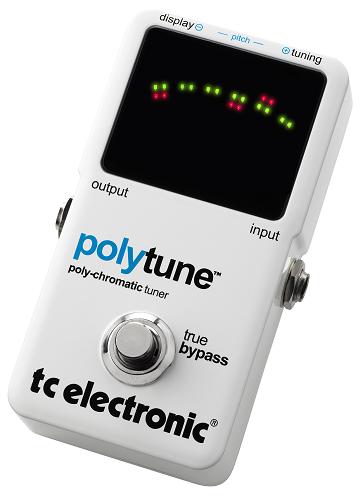
Could this be the last tuner pedal you’ll ever need?

I don’t see how I missed this! I scour the ‘net daily for new stuff, especially from companies that are known to create really high-quality stuff – like TC Electronic. These Scandinavians are incredible inventors, and I haven’t seen or played one one thing of theirs that I didn’t like – though I could rarely afford it. But they’ve come out with a new tuner – yes, a tuner, of all things – that is completely different from any other tuner on the market. It’s called the “Polytune.” As its name implies, it is a polyphonic tuner; that is, the tuner can detect all your strings at once, and you can see which ones aren’t in tune at the click of a foot switch. Unlike traditional tuners that require you to check each string individually, with the Polytune, you strum your open strings. The LED’s will show you which strings are in tune and which aren’t.

In my experience, more likely than not, at any given time only one or two will be out of tune. So imagine the time you save by NOT having to check and tune each string – only the ones that need it! Check out this video to see how it works!

And at $99 bucks… SOLD!!!

Here are some features:

  • 0.5 cent accuracy
  • Standard size box
  • Tune by strumming
  • Can automatically switch between chromatic and polyphonic tuning (it will detect if you’re hitting a single string)
  • Customizable preference settings
  • Has a 9V output jack for powering other pedals
  • True bypass
  • Adjustable reference pitch from 435Hz to 445Hz
  • Supports drop tuning all the way down to B!
  • Works with 4 and 5 string basses as well

It may not have the accuracy of a TurboTuner, but who the hell gives a flying f$%k! .5 cent accuracy is nothing to shake a stick at, and the fact that you can see the tuning of all your strings at once is incredible! Can  you say KICK ASS!!! I’ve never even seen this thing and I want to give it 5 Tone Bones! Check out the TC Electronic web site for some detailed information!

Could this be the last tuner I’ll ever want? Until someone comes out with something better – and at a better price, for that matter, probably not. I want to get one right now. Unfortunately, they’re only available for pre-order. Hmm… oh well, I supposed I can wait. 🙂

Read Full Post »

I'm running a poll to find out how much gear GuitarGear.org visitors have.
I'll keep this post up for awhile so we can get some stats.

Read Full Post »

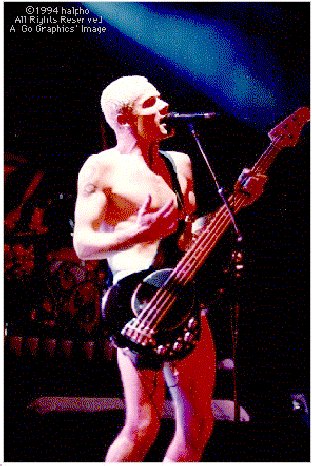
O thou with such dirty little minds! I’m not talking about some Red Hot Chili Peppers-style playing with a tube sock around my member. I’m talking about playing with zero effects! So there!

For the past few weeks, I’ve recorded and gigged several times with no effects at all, and the only pedal I use is my trusty BOSS TU-2. The first time I did it, I was being lazy and didn’t want to break down my rig from my studio – especially since I was in the middle of laying down some tracks and didn’t want to lose my settings. But that first time turned into a second, then a third, and so on.

I’ve found it to be refreshing on a number of fronts; not the least of which is the much lighter load I have to lug around. But more importantly, I think it has really helped my playing as I can’t rely on pedals to fill in the gaps. For instance, I’m a lot more aware of how I’m sustaining notes, and trying to hold them as long as possible before I have to move on.

I know of lots of players who don’t use pedals at all, and for quite awhile, I couldn’t imagine life without pedals. But “playing naked” has really helped me to not rely on them. I used to always use overdrive pedals as my main source of drive, but I now use them as accents. I used to slather on the reverb but now, I rarely use it, except in the studio and even there, I use it sparingly.

Don’t get me wrong, I’m not going to put my board away. There are times when I need a pedal for a particular song, but for the most part, I can do without them, or just use them to provide tonal accents. In a way, I feel liberated…

Read Full Post »

Click for full size view

What do you get when you have a group of product development consultants who are avid guitar players who want to find a way to stop “workin’ for the man,” but not create a bunch of “me too” products? You get StageTrix Products. These guys are brand-new, and from what I can gather, their approach to creating guitar gear centers around what you might call convenience products for guitar players.

Take, for instance, their pedal risers that I reviewed back in October. These gadgets that raise the back row of your pedal board may not make music, but they sure make the making of music a helluva lot easier. Here’s proof: The solo part of my latest song, Strutter, was recorded in a single take, with one punch-in at the very end of the song after I was done. In between sections, I was activating/deactivating effect pedals on the fly – something I’ve never done in a recording. I usually stop the recording, activate the pedals, then continue on. Granted, I had enough time between sections to do the switch on the fly, but I will submit that I couldn’t have done without the back row of my board being raised; in other words, how my board used to be. The point here is that that little convenience made a world of difference for me in my recording.

Enter the Pedal Fasteners. For $9.99, you get a pack of three, pre-cut hook-and-loop strips that are dimensioned to fit standard-size pedals. You might say, “So what? I can just get some Velcro from my local crafts store and be done with it.” You certainly can, but my experience with that stuff is that the glue used with these cannot withstand higher temperatures. They get all gooey, and once the glue has melted, the glue must change chemically, because its sticking power is lost. You ever get that stuff on your hands? I rest my case… 🙂 Pedal Fasteners, on the other hand, have a glue that can withstand up to 200 degrees Fahrenheit; more than enough for even a hot car interior, and the mere fact that you don’t have to cut them to size is killer!

I recently replaced the velcro strips on all the pedals on the front-row on my board with Pedal Fasteners. No cutting, (except for the center section (which you could conceivably push out, but I wanted clean edges and didn’t want to risk tearing, so I used a sharp utility knife). They work great, and even stick to rubber! I’d recommend removing the rubber though… I’ve had mixed results with that, but I did it to test it out – it’s sticking just fine so far.

So if you’re tired of having to cut fasteners to size, and even more tired of that messy goo once the glue has melted, you owe it to yourself to get a couple of pack of these!

For more information, please visit the StageTrix Products site!

Read Full Post »

A friend of mine asked me to recommend a pedal that would push his amp into overdrive so it would just be his amp distorting. Naturally, I recommended a transparent clean boost that would slam the front-end of his amp and make his pre-amp tubes clip. So I lent him my Creation Audio Labs Mk.4.23 clean boost (best I’ve ever used, btw). He hooked it up, turned on his amp, slung his axe, strummed a chord, immediately muted and turned to me saying, “Dude, this doesn’t sound right.”

“What do you mean?” I replied,  “It sounds fine to me.”

“It’s too bright!” he exclaimed.

“Dude,” I replied, “That’s how your amp sounds when you overdrive the tubes. Actually, that sounds killer. Lemme try…”

So I took his guitar, and did a couple of riffs, and bent and held a note to get some feedback. The tone was rockin’!

“That was cool, dude, but it’s still really bright,” he said.

“Oh brother, bleed off some highs from your tone knob, for chrissake,” I said, obviously getting a little exasperated.

He did, I played a bit more, then gave the guitar back to him.

“That was better,” he said, “but it doesn’t sound quite right.”

“Ha! That’s because you’ve been using a Tube Screamer for so f$&kin’ long for your overdrive sound, that you’ve never really known what your amp really sounds like when it’s overdriving without any help,” I quipped.

“You know, you’re probably right,” he said, “but it’s what I like, so I think I’ll stick with it. Sorry dude…”

“Hey! Not a problem, you just gave me the material for my next article! Thanks!” I exclaimed.

The point of that story is that for some, transparency isn’t pleasing to them at all. With my friend above, he was used to the Tube Screamer’s mid-range hump, and when he heard his amp overdriving with the full spectrum of the EQ, he didn’t like it all. I also met a dude who uses a compressor that’s always on to fatten his tone and punch through the crowd noise when he’s playing (he plays a lot of open, public spaces). In either of these cases, it’s all good because as the old saying goes, beauty is in the eyes of the beholder.

The reason why I brought this is up is because there’s a lot of talk among gear freaks about transparency; that is, the natural sound of our guitar(s) and amp(s) without any coloration. By convention, transparent tone sets the baseline for our sound, which we then color with effect pedals. That seems to be the convention. For some however, that baseline includes some coloration; like my friend who always has his Tube Screamer on. Again, beauty is in the eyes of the beholder.

Admittedly, for myself, before I started using attenuators to get the natural cranked tone of my amps, I was someone who used a Tube Screamer or OCD to get my grind. Once I started using attenuators, it actually took me awhile to get used to not only the transparent, natural, cranked sound of my amp but also the dynamics as the pedals I used added sustain and compression. But now, and for the last few years, transparency is where it’s at for me, and it has really opened up a whole world of tone for me. More importantly, it has helped me understand how different types of amps, especially tube amps, sound in their natural states.

Please don’t get me wrong, there is absolutely nothing wrong with using pedals to form your baseline at all! But if you do turn on a dime, as it were, and decide to go for transparency, be prepared for a little surprise. When you suddenly experience the full spectrum of EQ from your gear – especially with the case of a great attenuator like the Aracom PRX150-Pro that enables you to get the cranked tone of your amp at reasonable volume levels, you may not like it as your ears are used to the altered tone from your pedals or other devices you’ve had in your signal chain to achieve your baseline tone.

But I will say this: I do argue for creating your baseline tone as transparent as possible. As celebrity chef Emeril Legacie says about cooking, “It’s very easy to add ingredients, but it’s a lot more difficult to take them away.” With respect to your rig, if you build on a good base of transparent tone, it’ll have some very good effects on how you approach your tone. I’ll share with you a few points of what I discovered:

  • I’ve come to appreciate the natural character of my amps. I use four amps (though I normally gig with only two of them). These are all based on different power tubes: 6L6, 6V6, EL84, and 6AQ5. These all have different characters when cranked. When I’m recording, I can pick an amp that fits the type of response I’m after.
  • A fallout of the the first point is that I’ve found that I’m using effect pedals a lot less; especially overdrives, which I still love, but I use only to provide a different character. For instance, while I totally dig the sound of my main gigging amps, Aracom VRX22 and VRX18, the drive channels are on the  bright side when pushed. But if I want a little low-end oomph for some rhythms, I switch to the rich clean channels of these amps, and get my grind from one of my overdrives, like my Tone Freak Effects Abunai2, that has a clipping circuit, plus adds both compression and sustain (this pedal rocks, by the way).
  • Going more barebones in my approach has also made me a better player – especially with respect to sustain and vibrato. Where I used lean on my pedals as a bit of crutch to get sustain, I’ve had to learn how to eek out as much sustain from my guitar using just my fingers. Once I started getting that down, it was a whole new ballgame for me.

Whew! I didn’t mean to write an entire treatise! 🙂 But to close this out, if you’ve never really experienced the natural tone of your gear, I encourage you to do so. It might just blow you away. Then again, you might not like what you hear, and that may give you pause to research getting another amp – that’s never a bad thing…

Read Full Post »
« Newer Posts - Older Posts »