This morning, my aunt sent me an e-mail that contained the following story. The story was so powerful for me as a musician that it literally brought tears to my eyes. Please read on!
—
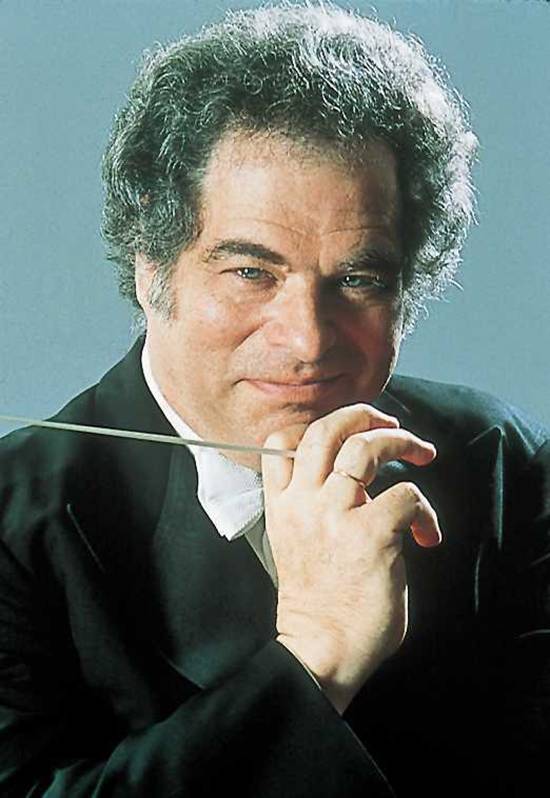
On Nov. 18, 1995, Itzhak Perlman, the violinist, came on stage to give a concert at Avery Fisher Hall at LincolnCenter in New York City. If you have ever been to a Perlman concert, you know that getting on stage is no small achievement for him. He was stricken with polio as a child, and so he has braces on both legs and walks with the aid of two crutches. To see him walk across the stage one step at a time, painfully and slowly, is an awesome sight.
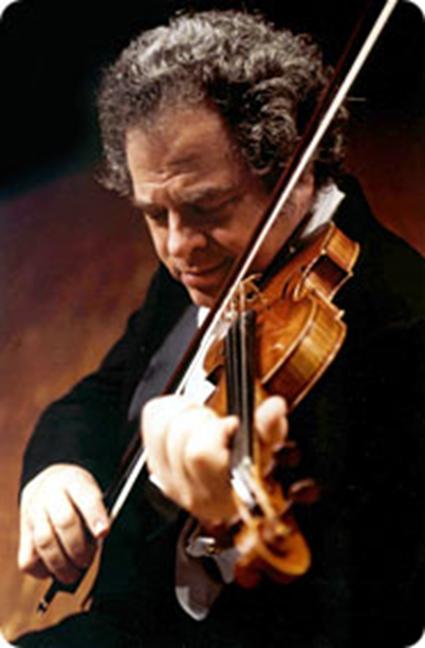
He walks painfully, yet majestically, until he reaches his chair. Then he sits down, slowly, puts his crutches on the floor, undoes the clasps on his legs, tucks one foot back and extends the other foot forward. Then he bends down and picks up the violin, puts it under his chin, nods to the conductor and proceeds to play.
By now, the audience is used to this ritual. They sit quietly while he makes his way across the stage to his chair. They remain reverently silent while he undoes the clasps on his legs. They wait until he is ready to play.
But this time, something went wrong. Just as he finished the first few bars, one of the strings on his violin broke. You could hear it snap – it went off like gunfire across the room. There was no mistaking what that sound meant. There was no mistaking what he had to do. We figured that he would have to get up, put on the clasps again, pick up the crutches and limp his way off stage – to either find another violin or else find another string for this one. But he didn’t. Instead, he waited a moment, closed his eyes and then signaled the conductor to begin again.
The orchestra began, and he played from where he had left off. And he played with such passion and such power and such purity as they had never heard before.
Of course, anyone knows that it is impossible to play a symphonic work with just three strings. I know that, and you know that, but that night Itzhak Perlman refused to know that.
You could see him modulating, changing, re-composing the piece in his head. At one point, it sounded like he was de-tuning the strings to get new sounds from the m that they had never made before. When he finished, there was an awesome silence in the room. And then people rose and cheered. There was an extraordinary outburst of applause from every corner of the auditorium. We were all on our feet, screaming and cheering, doing everything we could to show how much we appreciated what he had done.
He smiled, wiped the sweat from this brow, raised his bow to quiet us, and then he said – not boastfully, but in a quiet, pensive, reverent tone – “You know, sometimes it is the artist’s task to find out how much music you can still make with what you have left.”
What a powerful line that is. It has stayed in my mind ever since I heard it. And who knows? Perhaps that is the definition of life – not just for artists but for all of us. Here is a man who has prepared all his life to make music on a violin of four strings, who, all of a sudden, in the middle of a concert, finds himself with only three strings; so he makes music with three strings, and the music he made that night with just three strings was more beautiful, more sacred, more memorable, than any that he had ever made before, when he had four strings.
So, perhaps our task in this shaky, fast-changing, bewildering world in which we live is to make music, at first with all that we have, and then, when that is no longer possible, to make music with what we have left.
—
That is now my favorite quotation, and it not just applies to music. It applies to life in general. With respect to us gear and tone freaks, I think that this story is so applicable to us. The whole point in getting all the gear that we get is to make music, not just to produce tone. I’ve always been a big proponent of using what I’ve got on hand. For years, where I was just playing acoustic guitar – and didn’t have the disposable income I have now – all I had was my guitar and a little amp. So my challenge was to try eek out as much tone from what I had. From reading the story above, it makes me pause to think – do I really need “X?” Can achieve the same thing with what I’ve got?
I’m still a gear freak, so I’ll probably still buy gear, but this story has really helped change my perspective… Rock on!!!
Godlyke Distribution, which represents several boutique pedal manufactures has just released the HAO OD-16 overdrive pedal. Oh yeah… yet another overdrive pedal. But who cares? As the dean of my college once told me, “There’s room in this world for people who are good,” and as far as guitar gear is concerned, there’s certainly room in this world for good gear, and the HAO OD-16 (pr. “how”), promises to be a pedal that will make gear freaks make room for this pedal on their boards.
Designed and built by HAO in Japan, the OD-16 is a very cool take on the traditional overdrive. It’s ostensibly a Tube Screamer type of overdrive, which might ellicit a “so what” kind of reaction. However, with it’s internal voltage doubling circuit that takes a standard 9V and boosts it internally to 16V (hence the numeric designation), what the engineers were after was more headroom, and much more drive. And baby, this thing delivers all sorts of drive! Check out this demo video:
I dig the fact that you can bypass the internal tone pot to get more “bite” out of the pedal, and of course, true bypass is always appreciated. 🙂 Don’t know about you, but that video is causing me some SERIOUS GAS!!! Oy-Vay!!! Great tones – even out of low-res audio from the vid! I think I need to install a lock on my back pocket.
Fooled ya, didn’t I… You probably thought this was going to be about an actual guitar. From the picture, it’s obviously not about a guitar, but it is related. Let’s start out with a story…
Awhile back, my buddy Phil, of Phil ‘N The Blanks, a local classic rock cover band, shared a story with me. He was playing along, rockin’ out when suddenly his a strap loop came off its peg and his guitar ignominiously clattered to the floor, wreaking sonic mayhem in the clube ala Pete Townshend, and seriously banging up his axe. His lead guitarist laughed and said, “Now it’s a workin’ man’s guitar. I warned you a long time ago to get strap locks, and you wouldn’t listen. You learned the lesson the hard way.”
I didn’t have to have what happened to Phil happen before I learned that lesson mainly because I was able to catch my guitar before it hit the ground, so no harm no foul. But once that happened, the next day I was at the music store and bought strap locks for all my guitars. Now I won’t buy a guitar without having strap locks included in my order.
If you’re one who doesn’t mind playing a guitar with dings and scratches, maybe strap locks are low on your list of accessories to get. But you don’t want a workin’ man’s guitar, do yourself a favor: Get strap locks!
But then there’s the type of strap lock to choose as well. I’ve used two types: Schaller and Dunlop. I prefer Schallers because of their “cup” design. I feel it’s more secure, and the screw won’t get torqued. I absolutely hate Dunlops. Yeah, they install pretty easily, but the strap is actually held out away from the body, and I’ve found that with heavier guitars, the screw will get torqued and loosened. When that happens, even though the locking bolt will still go in the hole, the lock will not engage because the screw head keeps the bolt from sliding all the way in. I almost had a $4000+ custom guitar crash to the floor recently because of this very issue. Needless to say, I changed the locks to Schallers.
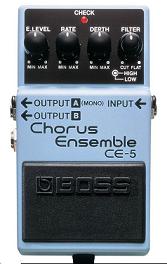
Awhile back, I wrote a fairly quick review of this pedal. That was back in October of 2007. I bought it because I was tired of using modelers and software chorus in my recordings, and also wanted to use a chorus live, which I hadn’t done much of since I had sold my Line 6 Flextone III which has it built in.
At the time, I figured it couldn’t be a bad investment, especially since I paid something like $79 for it. So, after a couple of years, what’s the verdict? It’s a solid pedal, and there’s a reason I haven’t removed it from my board yet (I’m currently looking to get a vintage CE-2): I love the Roland chorus sound!
I suppose you use what you’re used to. For me, using chorus started with the old Roland JC-120. What a great amp, and the stereo chorus was to die for! It was thick and lush, yet ringy and vibrant. Since I didn’t have access to that amp all the time (it was my brother’s), I settled on the CE-2, which I kept into the mid-90’s when I traded it for a DigiTech multifunction pedal – big mistake. Oh well…
In any case, after awhile I needed to get a chorus pedal for my Fender Hot Rod Deluxe. I didn’t even think about it what pedal I’d get. I knew it had to be a Boss. My thought was: How different could it be compared to my trusty old CE-2 which, after all, was a pretty cheap pedal when I bought it, and besides that, Roland chorus was the standard for me. I’d heard some great chorus sounds, but to me, the Roland chorus was where it was at, so I went to my local music store and purchased a CE-5
Well, to make a long story short, once I played around with the pedal, I realized that while it had that Roland chorus tone, the digital version was almost too perfect, and not nearly as warm as I remembered the CE-2 being. It seemed a little sterile. But I kept at the tweaking and was finally able to dial in some very nice, rich tones that came close to what I remembered. After all this time, here’s what I’ve come to observe about the CE-5:
The CE-5 doesn’t do extreme settings very well. In fact, they can be downright ugly; especially if you crank up the rate and depth knobs. But as they say, do things in moderation, and with moderate settings, the CE-5 can produce wonderful tones! The best operating range I’ve found for Level, Rate and Depth are no less than 9am and no greater than 2:30. At the high-end, you can get some very cool leslie effects by upping the depth, reducing the rate and upping the level. In general though, I don’t tend to stray too far away from 10 to 2 on the sweep.
All the knobs interact well with each other – almost too well – as minute changes on one knob really effect the others, making you have to compensate to keep the tone under control.
The Hi/Lo cut combo knob is killer – something I wish the CE-2 had. What they do is subtle, but very useful.
Even for as simple as it is, you really have to play with the settings before you find the right tones. I’ve had a few years with this pedal now, so I know where to set the knobs for the effect I want. But it did take time.
Given all that, don’t take it as a negative. My feeling is that hard work is rewarded, if you’re willing to do it. I took the time, and now that I’ve got the tones dialed in, I really like the pedal, which is why I’m not in a real big rush to replace it.
Here’s a clip I recorded with different settings. There are three sets of recordings, starting with my dry signal, then activating the chorus. The chorus sounds go from moderate-heavy to moderate to light in the final chord progression. I used my Gibson Nighthawk 2009 into an Aracom VRX22 amp. Here’s the clip:
I recorded the guitar completely dry, with the mic (e609) about 1/2″ from the grille cloth.
Granted, the Roland chorus sound isn’t for everyone. There are so many great ones out there, but for me, I’ll stick to the familiar. Rock on!
I’ve known about Handwired-Effects for a few weeks now, but didn’t really talk about it too much because their site didn’t have much on it, and they only had a single pedal. But now that they’ve got a few, I felt it was time to talk about them. Handwired-Effects has pretty much come out of nowhere with their pedals. Their initial offering is pretty straight-forward: a chorus, an overdrive, and a limited run “preamp overdrive” custom made for Dario Lorina.
I know… New pedal companies are started all the time so what has piqued my interest in Handwire-Effects? It’s actually not their products but their location that made me raise my eyebrows. Most new pedals seem to come primarily out of the US and Japan. Handwired-Effects is based in Switzerland. In all my years of buying gear, I’ve never used a guitar product made in Switzerland. No, I’m not thinking that these pedals may be better because of the “Swiss watch” thing. 🙂 But it sure is interesting that it’s located there…
Unfortunately, they don’t have any clips of their products, save a poor-quality video of Dario Lorina playing the Dario Lorina custom box at NAMM. We’ll just have to wait and see…
You know… For the most part, I have few regrets about my life. Yeah, I’ve made my share of mistakes, and have learned from them, but there are some things that just seem to stick in my craw, especially when I reminisce about gear that I’ve had.
Back in the 80’s, I was a big Michael Hedges fan, and must’ve seen him play live more than 50 times. I remember the day I saw him and he had added chorus to his chain. Mind you, he was an acoustic guitarist, and before he became widely known, it had always been Michael and his guitar, straight into the PA. Then he added a rather sophisticated EQ. But what struck me the hardest was when he added a chorus. For as much of a fan that I was, I don’t know which one he had. But when he came out with “Breakfast In the Field” in 1981, and used the chorus to amazing effect on songs such as “The Magic Farmer” and “Rickover’s Dream” which, incidentally, I had already heard live before the album came out, I knew I had to get a chorus!
At the time, I didn’t know an amp from a refrigerator. I was your classic folk acoustic player who happened to know cowboy chords. Be that as it may, I saved some money and went down to Guitar Center where I bought a cheap in-hole pickup for my guitar (which I still have 30 years later – it’s a Yamaha FG-335), a Roland 25 amp, and a Boss CE-2.
Even through all that cheap equipment, there was something special about the CE-2. It had just two knobs: Rate and Depth, and you could dial up incredible chorus tones with it! I can recall the warmth of the tone, and the magical way notes danced in the air. Hey! I sucked at the time, but I remember the feeling I got. Perhaps part of it was due to the satisfaction that I could cop some similar tones to Michael Hedges (though I could never play like him). Who knows? But that was one special pedal. And I traded it back in the late 80’s for some DigiTech multi-function reverb/flange/chorus pedal that I thought was “neat.”
Okay, hindsight is 20/20. Who could’ve known at the time that a cheap $79 pedal could define the chorus tone. I don’t care what other people say about other choruses that have since come out. I recall someone “correcting” me in the early days of this blog about the TC Electronic chorus being more of a standard. I was pretty new to the blog scene and didn’t want to piss anyone off at the time, so I didn’t really come back with anything. But had I more balls at the time I would’ve said, there’s a reason why people are paying for the MIJ green and black label choruses for over twice the price of the original. There was something extremely special about that Roland JC-120 chorus circuit. Everyone else who followed with their own version just did a tweak. Mind you, there are some GREAT choruses out there. But in my mind, the CE-2 had the goods!
Man! Haven’t written a full song with vocals in awhile. Life happens, and it’s not the easiest thing to get the time to write. So the other day, I came up with a funky groove. It started out as a simple blues in Em, bouncing back and forth between Em7 and Bm7. I knew I didn’t want to just stick to a 1-4-5 kind of pattern, so I added some altered chords to kind of “jazz” it up a bit. The title has nothing to do with the music. 🙂 It’s the subject matter of the lyrics, which is divorce. Don’t know how I got on that line of thinking; maybe it was from people around me who have gone through it. Anyway here’s the song:
Equipment Used:
Rhythm (left and right sides): Squier Classic Vibe Tele (50’s)
Lead: Gibson Limited Run Nighthawk 2009
Amp: Aracom PLX18 BB w/Trem
Notes:
I originally laid down the rhythm with Pearl, my MIM Strat. But those Tex Mex pickups were just too bright for an already bright vintage Plexi-style amp. Way too much high-end attack. So, I switched to Blondie. That Tele is just so damn versatile!
I just love that vintage Marshall tone. Funny thing, I was never into Marshalls until recently, but since I’ve been playing Aracom amps, that’s the tone I just love!
The Nighthawk is just awe-inspiring! The tones that guitar can produce are simply phenomenal. The mix between the P-90 and the Burstbucker is to die for! I love that guitar!
I dig the folks over at Catalinbread, and even though I haven’t gotten any of their gear – yet – I do like what they produce. Earlier this month, they released a second version of their WIIO overdrive pedal. Admittedly, I didn’t even know they had a first version, but it’s here.
From what I could gather about the WIIO, it’s supposed to be a Hiwatt in a box – very cool – and apparently, it is designed to be super-responsive to pick attack and volume knob levels; much like an amp. Here’s a demo video I found:
Summary: After a 10 year hiatus, Gibson returns the Nighthawk to market, with a slightly different look and electronics. Make no bones about it; this guitar is SWEET!
Pros:Looking for a super-light but versatile guitar? Look no further. The Nighthawk has it all, and can do it all from swampy blues to all out RAWK! Its thinline body makes it absolutely comfortable to play, and the neck is perfect!
Tone Bone Score: 5.0 ~ Talk about love at first strum! The Nighthawk is like a cross between an SG and a Les Paul, and I can’t say enough about how great this guitar plays and sounds!
When I have enough time to go to my favorite shop near work, like any gear freak, I’m like a kid in a candy store; especially this little place in Redwood City, CA called Gelb Music. I’ve known the guys there for a number of years, and they’ve always steered me in the right direction. Unfortunately for me, they also know that I have a HUGE weak spot for non-mainstream gear. Such was the case when I walked into the shop today to ogle some Les Pauls. They’ve known that I’ve been jonesing for one for awhile, but they must have a sense about what appeals to me, because one of ’em will say, “Dude, those Pauls are nice, but you gotta check out this…” And in “checking it out,” I’ve since ended up with a MIM Strat, a Roland Cube 60, a Squire Classic Vibe Tele, an Ibanez GSR200 Bass and numerous pedals.
So here I was, minding my own business, admiring the Les Pauls hanging from the ceiling, when Tommy did the “dude you gotta check this out,” I told him, “Tommy, don’t do this to me. You know what happens when you do that.”
“I know, man,” he replied, “And I know you’ve been looking at the Pauls, but you gotta check this out [pulling down this gorgeous honey-colored Gibby from the hanger]. It’s the most playable f-in guitar in the shop, and dude! The tone this thing produces is incredible. Here. Check out the neck!” Handing me the guitar in the process.
I was immediately overtaken by the light weight of the guitar. If that axe weighed 6 lbs, I’d be surprised (a look at the Gibson Nighthawk site lists the average weight at 4.6 lbs). Then as I moved the guitar into a playing position, I noticed how absolutely perfect the neck is. I love that 60’s thin neck! It’s a shallow “C” with a slightly wider profile. It’s faster than all get-out, and oh so comfortable to play! But I’m getting a bit ahead of myself…
Fit and Finish
This is one beautiful guitar! The bookmatched figured maple top is absolutely stunning, and the transparent amber lacquer brings out the three-dimensionality of the wood grain. The high gloss of the lacquer further enhances the effect – it’s like liquid sunshine. To provide definition both body and neck are bound with a white binding.
Speaking of wood, the light mahogany is flawless and all the joints and seams are perfect.
The Nighthawk 2009 is quite a bit different from the original that came out in 1993, even though it retains the same body shape. The original seemed to be Gibson’s answer to the HSS Strat, and had a 5-way pickup selector. With this version, Gibson has gone with a BFG setup with a P-90 in the neck and an awesome BurstBucker 3 in the bridge. The pickup selector switch is now a 3-way toggle and has been moved to the upper bout like a Les Paul (which I love). The neck sports a solid mahogany base with a rosewood fretboard and medium-jumbo frets with a scale length of 24 3/4 inches – just like a Les Paul.
The hardware provides an added touch of vintage feel to the look of the guitar, from the Kluson tuners and chrome Tune-o-matic bridge and stop tail piece, to the gold top hat volume and tone knobs. Even though the Nighthawk 2009 is a limited run guitar, it’s clear that Gibson didn’t just want this to be novelty guitar where they could get away with using cheap materials. Everything about this guitar screams high-quality down to the little details. I’m impressed!
In fact, at a distance, you might easily mistake this guitar for a different Les Paul model. I certainly did when I saw Billy Joel in concert. His guitarist was slinging this gorgeous Gibson that looked like a Les Paul. But it kind of confused me with its body shape and three knob setup. I kept on wondering, “Did Gibson create a new model Les Paul?” I’ve since been corrected.
Playability
There’s one word that comes to mind when I play this guitar: Comfortable. My favorite guitars have always been those that sound, play, and feel comfortable, and the Nighthawk is all about comfort. The 60’s thinline neck with wide profile is so easy to play. I found myself not worrying at all about where my fingers were and just playing. The action is low and fretting notes is so easy. But with the medium-jumbo frets, wiggling your fingers creates some very nice vibrato without even bending the strings! The pickups are in the perfect place for where I strum, which is right between them, so no chance of banging my finger on a pickup in a hard strum as well.
To me, this is a player’s guitar. I know that some people have complained that it doesn’t faithfully reproduce the original. But I believe that the original was just too quirky and didn’t really have player ergonomics in mind. For instance, the pickup selector switch. I dig that it’s in the classic Gibson position. It is so much more accessible – I don’t even have to look to switch pickups.
The Les Paul scale length on the Nighthawk makes bending – even the slightly brittle shop strings which I will replace today – a breeze. The setup is perfect and there’s nary a string that frets out or dulls. Like I said, this is a player’s guitar.
How It Sounds
Gibson states, “Today’s version is still all about a guitarist keeping his options open. With two volume controls, a master tone knob and two heavy-duty pickups, guitarists can experiment with endless sounds.” In other words, the Nighthawk is all about tonal diversity, capable of producing super-smooth and sexy cleans to all out snarling dog drive. I’ve played the guitar a little less than a couple of hours, and I’m absolutely blown away by the tones this guitar produces.
The big surprise is the P-90 in the neck. I was expecting it to be bright, but it’s thick and ballsy, with a real emphasis on the lower mids. It might get lost in the mix when played dirty, but the cleans is where this pickup really stands out. The voicing is creamy smooth, and very acoustic sounding.
The treble pickup is classic Les Paul, but just a tad darker which I absolutely love! The Burstbucker 3 produces a rich tone that’s full of harmonics and overtones, without being overly bright.
But the real magic comes in mixing the two pickups in the middle position. Holy crap!!! Talk about tonal complexity! The guys at the shop said that the middle position was their favorite, and I now see why. I immediately fell in love using this setting.
As far as volume balance is concerned, both pickups put out about the same volume, so there’s not this big gain boost when you switch to the treble pickup like you’d get from a Les Paul. I’m thinking Gibson did this to emphasize using the middle position, and blending the pickups together. Nice.
In any case, I got ambitious and put some sound clips together:
Neck Pickup
Clean
Dirty Lead
Rock Rhythm
Both Pickups
Clean
Dirty Lead
Rock Rhythm
Treble Pickup
Clean
Dirty Lead
Rock Rhythm
All clips were played with the Nighthawk (with both volume knobs set at about 7 and tone at 10) plugged straight into my Aracom VRX22 which then ran into my Aracom PRX150-Pro attenuator then out to a 1 X 12 cab with a Jensen P12N. I used a Sennheiser e609 instrument mic, and recorded directly into GarageBand with no volume leveling.
Overall Impressions
I’m still getting acquainted with this axe, but with all the tones that it can produce, I can easily see it becoming my go-to axe, and it isn’t just initial infatuation speaking. This guitar – at least to me – is so sexy from its looks to its sounds! If you get a chance to play one, you’ll see what I mean.
As a limited run, there are not many out there. In fact, some online stores no longer carry them. But you can still find some at online retailers, and if you’re lucky, your local shop will have one. Give it a try!
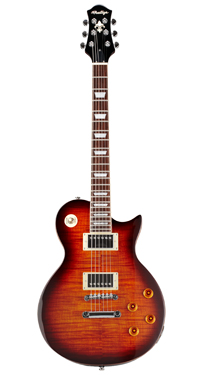
As you may know, I own a Prestige Guitars axe – actually one they no longer have in their current model lineup (though they list it in their models area) – the Heritage Elite, which I call “Sugar” because she actually smells sweet in addition to sounding sweet. The Heritage Elite is a very ornate take on a Les Paul copy; a lot of people actually don’t like how busy all the decorations are, which might account for why it’s not on their current model lineup. But the tone and sustain are wonderful, so that guitar is a keeper for sure. But I suppose in an effort to be a bit more “true to form,” Prestige has come out with a new axe, called the “Classic,” that I am sure will turn heads.
The Classic is a very nice take on a classic Les Paul design. It features a AAA flame maple top, on a super-light, carved, mahogany body and mahogany neck with a rosewood fretboard. As with the Heritage, it sports the classic Seymour Duncan 59/JB Neck/Bridge pickup combination, independent volume and tone knobs, and a 3-way selector switch. Not sure what the bridge is, but when I last spoke with Prestige, they were moving away from Gotoh Tone-o-matic to GraphTech. Sure looks like a Gotoh to me, but I’d have to see it up close to tell.
When I look at the picture, if it weren’t for the lower horn, I’d swear this was a Les Paul! I dig the mother of pearl inlays on the fretboard, and the graceful lines of the body; speaking of which, the back is contoured, so in addition to being light, it is apparently incredibly comfortable as well. Great combination!
And to top it of, here’s a Guitar World video demo of the Classic:
Even with the low quality video, you can hear how that guitar just sings. It has a sweet sound, but can also get really aggressive. That’s one of the reasons I love playing my Sugar, which is a great guitar. But I might just have to get me one of these classics to gig with… OMG! More GAS!!!!
 But this time, something went wrong. Just as he finished the first few bars, one of the strings on his violin broke. You could hear it snap – it went off like gunfire across the room. There was no mistaking what that sound meant. There was no mistaking what he had to do. We figured that he would have to get up, put on the clasps again, pick up the crutches and limp his way off stage – to either find another violin or else find another string for this one. But he didn’t. Instead, he waited a moment, closed his eyes and then signaled the conductor to begin again.

 Awhile back,




 As you may know, I own a Prestige Guitars axe – actually one they no longer have in their current model lineup (though they list it in their models area) – the Heritage Elite, which I call “Sugar” because she actually smells sweet in addition to sounding sweet. The Heritage Elite is a very ornate take on a Les Paul copy; a lot of people actually don’t like how busy all the decorations are, which might account for why it’s not on their current model lineup. But the tone and sustain are wonderful, so that guitar is a keeper for sure. But I suppose in an effort to be a bit more “true to form,” Prestige has come out with a new axe, called the “Classic,” that I am sure will turn heads.
 Guitar Gear