Feeds:
Posts
Comments

Posts Tagged ‘guitar’

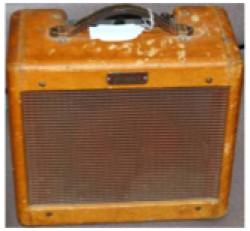
This morning, I was taking stock of gear that I hadn’t played in a awhile, and saw my little ’58 Fender Champ sitting on my workbench. I hadn’t played it for several months. So I hooked it up, and started playing. Now mind you, I’ve had some serious work done on it. I had to have the leaky caps replaced, and I had the amp set up with an A/B switch so I could bypass the stock, internal speaker and use a different speaker cabinet if I wanted. Plus, my good buddy, Jeff Aragaki lent me a custom tweed cabinet that he built that houses a Weber 10″ Alnico speaker.

After getting it all hooked up (I ran the amp into a 1 X 12 with a Jensen Jet Falcon speaker), one thing struck me right away after playing my Strat through it. To me, this is THE classic Tweed sound. But it is also the perfect platform to record completely raw signal, then tweak, which has been done in lots of studios over the years, as a Champ was used to record all sorts of rock and roll.

Take, for instance the following recording:

This was recorded straight into my computer with no EQ, no nothin’ attached. It’s a clean, dry signal that simply captures the tone of my Strat. But apply some reverb and delay effects, some compression, EQ, and that plain signal becomes something else entirely. Here’s the same track, but this time, I’ve textured it with reverb, delay, compression and EQ.

Had the compression make-up gain a little high, so there’s a tiny bit of clipping, but what I was able to get was a super-rich and full sound.

Even dirtied up, the Champ is simply a great platform. Here’s a raw clip of the Champ completely cranked up:

Again, this is simply a fantastic platform from which to shape the guitar sound. So, in this next clip (which again is the same track, but tweaked) I added some compression, reverb, a tiny bit of stereo delay and beefed up the lows with some Fat EQ:

It’s no surprise to me why so many studios have these Champs in their amp lineups.

As for gigging this bad boy, I always run it through speakers that have a good bottom-end response. What results is a nice, scooped tone – VERY American tone-wise.

Anyway, if you can find one of these, get it. Or you can get the ’57 Champ re-issue, which lots of players love. Me, I got mine for $700 (that’s the actual picture of the amp above), and spent roughly $200 on getting the caps replaced and putting in some NOS tubes. Still comes out under the price of the ’57 reissue.

Read Full Post »

…We know it’s good for us, but we don’t enjoy the taste.

That’s a corollary on a saying my cousin shared on Facebook: Truth is a bully we all pretend to like. It got me thinking about some feedback I gave to a young singer/songwriter this weekend on her playing, which was not very good. I first didn’t say it directly and simply said, “That’s a great song you’ve written. If you have a chart, I could accompany you, so you could focus on your singing and not have to think about the accompaniment.”

“I play just fine,” she said.

I replied, “Well… truth be told, some customers last week did mention that while they liked the song, they felt the piano playing was a bit choppy.” (That’s actually the truth; as a few asked me why I didn’t accompany her).

“To you, maybe,” she shortly replied, “I’m not here to be the brilliant musician.”

I said, “Look, you’re reading me completely wrong. I want to make you and your song look absolutely the best, and frankly, your playing is choppy, and you’d have a much better appeal if you had backup that’ll make you shine.”

She wasn’t having any of it. There was a bit more in the exchange that I’d rather not dive into, but I was really taken aback by the arrogance and total lack of humility. I do know one thing, having been performing for over 40 years, she’s in for some serious smack-down. I’ve encountered many performers like that over the years that operate off their own hubris. They get their bubble popped and it’s like their world comes crashing down around them.

Hell! I even operated like that years ago, thinking my own music was something special; only to get feedback from a pro that lyrically, it was cliche, and a lot of my musical phrasing was something that had been done hundreds of time over – in other words, it wasn’t very original. Yikes! I was crushed.

But as Sylvester Stallone said in the movie, Rocky Balboa, “It ain’t about how hard you hit, but about how hard you can get hit and keep moving forward…” And that’s kind of the crux of this entry, dear readers.

We all tout wanting to be honest and receive honesty in return. But honesty is like taking cold medicine. Rarely do we enjoy the taste. But in the end, we actually do feel better. After having experienced that crushing review of my music, I just happened to watch Rocky Balboa and that saying shook me to the core, and I realized that a little humility goes a long, long way. It’s good to believe in ourselves and our abilities, but don’t let that belief turn into hubris. Besides, with humility, we give ourselves room to grow and get better.

After I got that feedback, it actually took me awhile to do some soul-searching – a couple of years, in fact. But I jumped on the horse again, so to say, and started writing again. This time ’round, I went at it with no particular goal in mind; just let the music and lyrics flow. Don’t have expectations of where I think my music should be. It it goes nowhere, that’s okay. But most importantly, really listen to the feedback. So as opposed to parading my music in front of friends and family first, none of my newest songs go out without a professional review from producers in the music industry who critique the songs on their structure, lyrics, and melody. As a result, I think I’ve become a much better writer.

It’s not that I’m following a formula that they prescribe. The reviewer I use the most stresses originality, and absolutely nails me on being cliche. But they are keen on flow and making sure my lyrics make sense. All in all, it has been a great growing experience.

Who knows where my music will go? I’ll be heading into the studio in the next couple of months to start recording and then I’ll get my album out. We’ll see where it goes from there…

Read Full Post »

I recently received an interesting article from the folks over at AmplifiedParts.com entitled, “Describing Tone.” It takes both a scientific (quantitative) look at tone as well as presenting more qualitative ways of describing it. The qualitative section seems geared to describing tone within the context of selling gear, but if you think about it, when we’re talking about tone, we’re doing a selling job. The author, Kurt Prange makes an interesting statement in the article: “If someone told you that a particular speaker sounds ‘rich and creamy with buttery mids and crisp highs,’ they might as well have said, ‘it sounds great, trust me.'” I’ll speak more to that in a little bit. But without further ado, here’s the article:

—————

The Audible Frequency Range and Describing Tone

by Kurt Prange


As guitarists, most of us sooner or later find ourselves in pursuit of tone. A talented guitarist can find a way to make anything sound good, but there should be no doubt that our equipment and the tone it provides can inspire and help fuel our creativity. In pursuit of tonal inspiration, we need to develop a vocabulary to help us find what we’re looking for in our sound.


The Audible Frequency Range

Most guitarists start out by learning the names of the musical notes corresponding to a particular string and fret number, but they are not initially aware that these notes also correspond to the fundamental frequency of the vibrating string. For example, the sixth string played at the 5th fret (low A) in standard tuning has a fundamental frequency of 110 Hz. Any doubling or halving of a frequency is an octave, so the next octave up from 110 Hz would be 220 Hz. In order to develop a vocabulary for tone, we have to think in terms of frequencies as opposed to musical notes.
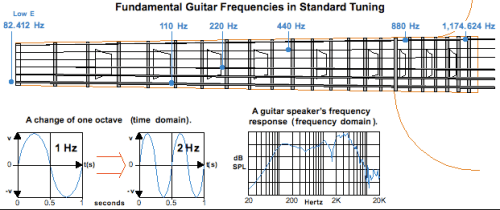
The audible frequency range for us human beings is about 20 Hz to 20,000 Hz (20 kHz). For descriptive purposes, it’s common to divide this range into at least three parts: lows, mids and highs. The specific border frequencies where, for example, lows end and mids begin are not definite. Look at a guitar speaker’s frequency response chart and you’ll see three commonly accepted ranges: lows from 20 to 200 Hz, mids from 200 Hz to 2 kHz and highs from 2 kHz to 20 kHz. With respect to these divisions, the fundamental guitar frequencies are all low to mid range; however, the sound we hear from each note we play also consists of harmonic frequencies in addition to the fundamental. To get an idea of what the fundamental would sound like on its own, just play a note and turn the guitar’s tone control all the way down. You’ve just “rolled-off the highs.”

If you play through an amp with treble, middle and bass controls, you can experiment with the extremes of each control setting to get a feel for how the relative level of each frequency range shapes the overall sound. “Scoop the mids” by turning the middle control down. “Roll-off the lows” and “thin-out” the tone by turning down the bass control. Now, “Fatten-up” the tone by turning the bass control back up.

Describing Tone

Using words to describe how something sounds is not always easy, but in the pursuit of tone it is often necessary. Browse through websites and ads for guitars, pickups, effects, amps, tubes, speakers, etc. and you’ll see a plethora of tonal verbiage that would probably seem like nonsense to the non-musician. When reading through this jargon, you can usually separate the adjectives into at least two groups to get a better perspective of the big picture.

First, there are the basic tonal adjectives that stand on their own. Most guitarists would understand their meaning without the need for much clarification. The words in this group stand on their own because they are closely related to common control settings. Describing tone is simplified considerably when a comparison can be made and most of the adjectives in this group can be paired with a clear opposite. For example, you might compare bright vs. dark for highs, full vs. scooped for mids, fat vs. thin for lows or some other variation to express more or less of a particular attribute. You could say, ‘I’m using Acme brand 12AX7 tubes in my amp and they sound too muddy, I need something that will brighten up the highs and give me more gain.’

Second, there are the ambiguous adjectives that leave you with some doubt as to what they really mean. They serve as a kind of garnish to add personality and make a tonal description sound more appealing or marketable. For example, the highs might be crisp or bell like with sparkle or chime, the mids might be buttery or woody, there might be mid-range honk, the tone could be warm, rich or creamy. This is good stuff if you don’t take it too seriously, but these words don’t really mean much on their own. If someone told you that a particular speaker sounds ‘rich and creamy with buttery mids and crisp highs,’ they might as well have said, ‘it sounds great, trust me.’ Another aspect of this group of adjectives is that they can allow you to identify a target audience that the product was designed to reach. For example, you probably wouldn’t target the death metal crowd with a ‘warm, vintage-voiced pickup with rich fat lows and top-end sparkle to express the subtleties of your playing style in fine detail.’ You’d be more likely to describe ‘fat, thunderous lows with upper mid-range sizzle and crisp highs for brutal rhythm and scorching leads.’

When communicating with other people to get suggestions for which product might get you closer to the sound you’re looking for, it’s usually best to make comparisons, while using mostly adjectives from the first group and going light on those from the second. Of course, the best way to know if something is right for your sound is to play through it yourself and set up an A/B comparison, but that’s just not always possible. So as we journey along in our pursuit of tone, we have to develop a vocabulary to help ourselves and others find the way.

Kurt Prange (BSEE) is the Sales Engineer for Amplified Parts (www.amplifiedparts.com) in Tempe, Arizona, United States. Kurt began playing guitar at the age of nine in Kalamazoo, Michigan. He is a guitar DIY’er and tube amp designer who enjoys helping other musicians along in the endless pursuit of tone.

————————-

Addressing the “ambiguous adjectives” paragraph, I tend to agree with what Mr. Prange has to say for the most part, but I do think that ambiguous adjectives play a key role in describing tone; so long as you make the distinction between the unabiguous and ambiguous. I agree that on their own, ambiguous adjectives do very little to inform me, though they are certainly effective at raising hype – something that happens a lot on forums like The Gear Page. So as a bit of a follow-on to Mr. Prange’s words of wisdom, be very wary of those who do nothing but use unambiguous adjectives to describe the tone of their gear; especially if they’re trying to sell it to you.

The problem with unambiguous adjectives is that they are purely subjective. What might seem “muddy” to one person may be perfectly acceptable to another. To me, I find most Fender amps to be muddy, with really booming lows, but those people who dig that tone, would call them “smooth.” Get the picture?

And then of course, I totally agree with Kurt Prange in that the only way to really see if some gear fits you and your style of playing is to play it yourself. Ultimately, you’re the best judge of great tone. Don’t defer that to anyone else.

Read Full Post »


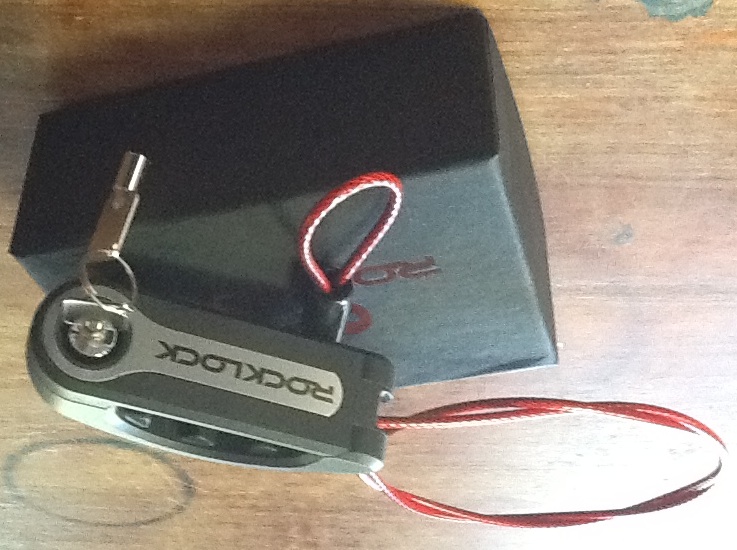
The Rock Lock

Summary: After a year-long wait, the Rock Lock has finally hit the market! What started out as an ingenious idea to provide some gig security for your guitar is not finally a reality.

Pros: Rubberized (or what appears to be rubberized) material around an obviously sturdy, metal locking “C” and attached to a 1/4″ steel braid rope, provide ample security for when you’re gigging, or even in a studio where you want to provide a level of deterrence as well as security.

Cons: None

Features (from the web site):

-Core Constructed from Cutting Edge Metal Replacement Technology

-Heavy-Duty Braided Steel Cable

-1 Year Full Warranty with Registration

-2 Keys Included, with optional Key Registration

-Fits almost all standard 6 string Guitars.
This excludes: 12 String Instuments, Flamenco/Spanish Guitars, and Bass Guitars.

Price: $49.95

Tone Bone Score: 5.0 ~ I’ve been waiting for this to come out since Chris Goulet originally contacted me a year ago. For the gigging musician, this is a must-have.

To me, having a Rock Lock is like putting strap-locks on your guitar. The funny thing about strap locks is that you never think you need them until your guitar comes off your strap button and crashes unceremoniously to the floor. Once that happens, you heed the warnings. But it shouldn’t take having your guitar stolen at a gig to make you buy a Rock Lock. At least for me, even the prospect of having my guitar stolen is enough to make sure I always have good security  for my axes at gigs. But I almost had to learn the hard way.

From late spring to early fall, I play on the patio area outside of the restaurant where I do my Friday gigs. Where I play is a major thoroughfare into the shopping center, so it gets lots of traffic – it’s a great way for me to entertain lots of folks. But the high traffic also presents a much greater danger of my gear being tampered with or stolen. While there are plenty of staff and customers at hand to watch my gear when I take breaks, the position of the “stage” is such that if someone wanted to make a running grab at my guitar, they could do it and get away pretty easily.

Last summer, there was a kid who was watching me play. He was what you might call an “emo,” with long hair swept across his face and a brooding expression underneath. He paid me a couple of compliments on my playing which was pretty cool, then after awhile, he asked if he could play my guitar while I was on break. I nicely told him no as I didn’t have a backup guitar with me, and he walked away, though I saw him a few times walk by eying my guitar. About an hour later, I took a break, and left my guitar out. Lo and behold, there was the kid. He was just about to grab my guitar!

I rushed over and said, “What part of ‘No you can’t play my guitar while I’m on break did you not understand?'”

“I thought it would be cool with you, dude,” he responded.

I said, “No. It’s not cool. Please leave.”

He did, and didn’t return. But in hindsight, if he took my guitar, it would’ve been my fault for not making it secure. And while I assumed that my gear would be safe because so much staff and people were around, the mere fact that that kid could just walk up to my guitar and pick it up made me think that I needed some sort of security.

For awhile after that, I resorted to packing my guitar during breaks and putting it my car or in the restaurant. But either of those options was a bit of a pain. However, with the Rock Lock, I no longer have to do that. I just lock up my guitar and it’s safe!

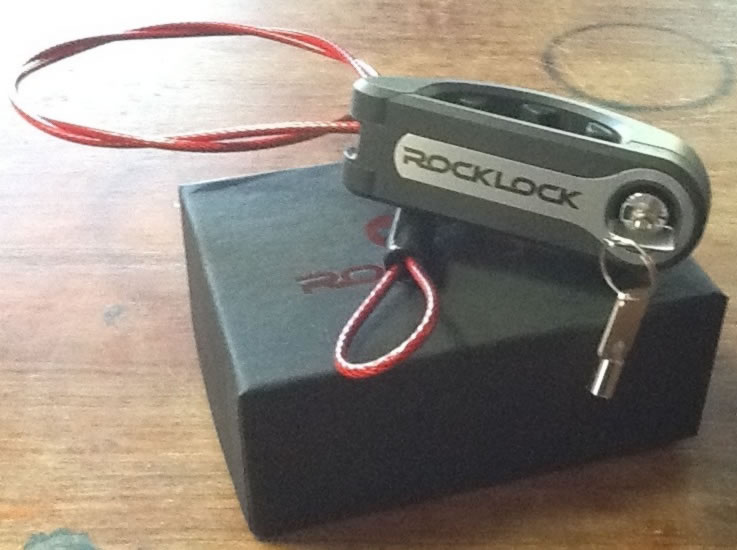
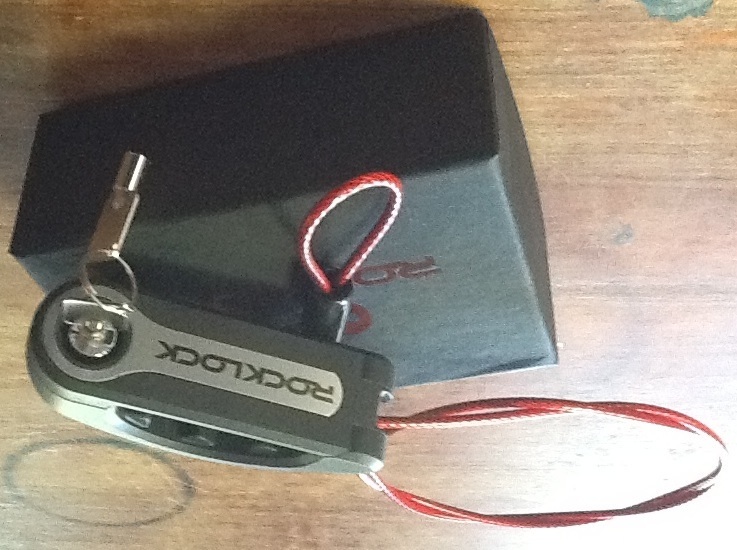
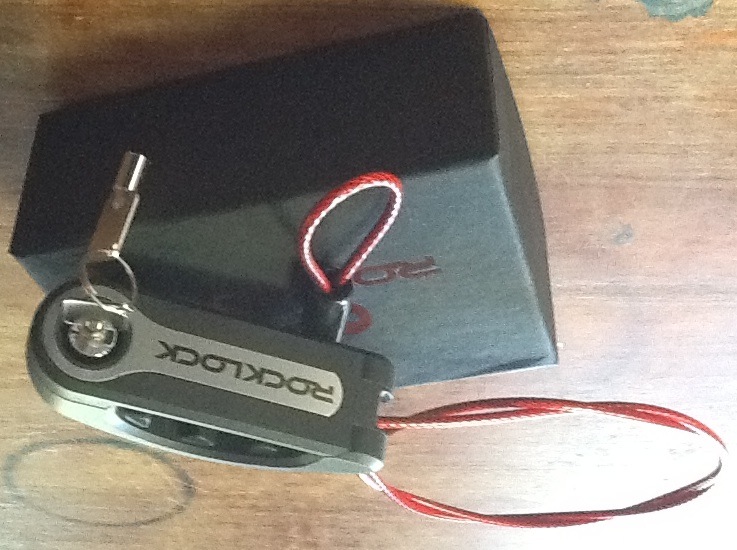
So how does it work? Well, it works very much like a computer laptop tether in that it has a loop at the end of the metal rope that you use to secure to a fixed object. The other end of the rope has a metal stud that gets inserted into the locking mechanism that is essentially a “C” clamp that goes around the neck of your guitar. The locking mechanism has one of those unpickable cylindrical keys. So talk about security! Look at the picture sequence below:

1. First, attach the cable to a fixed object like a pole:

2. Next, attach the cable to the locking mechanism (the stud end slides into an opening at the joint of the lock:

3. Finally, lock your guitar:

How much easier can it be? As I said, this is a must-have like strap locks for security-conscious guitar player. I’ll probably be getting a couple of more of these pretty soon!

For more information on the Rock Lock and to purchase one, visit The Rock Lock Company!

Read Full Post »

I mentioned the DV Mark Little 40 at the end of my previous post yesterday, which was a review on the DV Mark Galileo 15. That Galileo is a great little amp, but the DV Mark Little 40 is what I’m really taking a serious look at right now. If you want more information and specs on this great little amp, then read the product page on it. But what I’m going to discuss here goes beyond just the plain old facts and talk about why I think this amp deserves such a serious look.

What about the title? Well, it’s something that I brought over from my web engineering background, and that is that the best web sites aren’t the ones that are the prettiest or the most technically robust. They’re the ones that are so obvious to use, you don’t have to think about it. With the Little 40, DV Mark has lived up to “Don’t Make Me Think” in a variety of ways.

First off, while DV Mark offers the amp in L34 and L6 models (for EL34 and 6L6), the amp can take either, and will even do 6V6’s (though I think it may have to be JJ 6V6’s that’ll take a higher plate voltage – but I’d have to confirm that). But here’s the kicker: With the Little 40, you’ll never have to bias tubes again! The Little 40 sports smart circuitry that will auto-bias AND match your power tubes (so long as they’re within 20% of each other). How convenient is that? I don’t have the equipment to bias tubes myself – frankly I’m scared to death of working on electrical stuff – so every time I get new power tubes, I have to have someone bias them for me. With the Little 40, I just need to get reasonably matched tubes, and the amp will bias them to their optimal settings. Damn!

In addition to automagically biasing the tubes, there’s a switch on the rear panel that lets you set Low or High bias settings, which means you have even more tonal capabilities at the flick of a switch. This is a really huge thing in my opinion because again, instead of having to do this by hand, you need only toggle a switch to find the right bias setting for what you’re playing.

Also, the Little 40 is absolutely versatile, with its patent-pending Continuous Power Control that allows you to vary the output power of the tubes – not just for volume, but to break up the power tubes early. Full out to 40 Watts, you’ll get maximum clean headroom. But you can dial down the power to 1 Watt, and get breakup a lot earlier. Plus, you can switch between pentode and triode tube operation to get different tones on top of bringing the power down. Then on top of all that, you have a 0/6dB pad to compensate for passive and active pickups.

Finally, at $799, which is only $200 more than the Galileo, getting this amp is absolute no-brainer! And mind  you, these amps are all hand assembled in Italy. How DV Mark is able to sell them so inexpensively is beyond me, but we players can definitely reap the benefits. This is my next amp!

Here’s a nice demo video of the DV Mark Little 40:

Read Full Post »

DV Mark Amps Galileo 15
Summary: From the folks that brought us the big sound in a small package of Markbass bass amps, comes the DV Mark guitar amp line.Pros: Unbelievably rich tone with lots of clean headroom for a low-wattage amp. But you can dirty it up just fine by adding more pre-amp gain. Super-responsive dynamics as well, and the dirty tone cleans up nicely with volume knob or lightening up pick attack.

Cons: None.

Features (from the web site):

All hand-wired and hand-assembled in Italy

Power output:15W

Preamp tubes: 2x ECC83
Power tubes: 2 x EL84, 1 x ECC83
Channels: one
Controls:
> Gain
> Master
> Boost (6dB)
EQ controls: Low – Mid – High (passive)
Speaker outputs:
> One 4 ohm
> One 8 ohm
Optional 1 X 12 and 2 X 12 cabs available (I played the 1 X 12)

Price: $127.97 direct

Tone Bone Score: 5.0 ~ I was already impressed with Markbass amps for bass (the bassist in my church band swears by his Little Mark II), and with the recent introduction of a guitar amp line, I’m VERY impressed with what DV Mark is offering!

I met my good buddy Jeff Aragaki of Aracom Amps at our local Guitar Center today, and the first place we went to was their high-end guitar room where they always have nice guitars. Being Les Paul guys, we of course were ogling the historic re-issues. 🙂 But as we turned to go out of the room, we noticed a display of all-black amps with cool, metal mesh housings, and a brand we’d never seen before: DV Mark. Jeff exclaimed he’d never heard of this brand. I agreed that I hadn’t heard of it either, but the “Mark” in the name made me think that it was associated with the Italian manufacturer who makes Markbass bass amps.

Fit and Finish

The amp has a real modern look to it with its metal housing, and chrome bumpers to protect the knobs, but has an almost old-school feel with the cream-colored chicken head knobs. The logo lettering is “Mesa-ish,” and out of the corner of my eye, as I walked in the room, I actually mistaked the amps for Mesa amps, so I dismissed them. It wasn’t until I looked at the amps directly did I see that it was a different logo.

The amp does have a strap, but it’s unlike other straps I’ve seen. As opposed to being attached to the top, the strap is instead attached to the sides of the amp and run over the top (you can see this if you click on the picture above to enlarge it).

This thing is light, weighing in at just over 10 lbs. The accompanying C112 1 X 12 cabinet weighs about 15 lbs., so lugging the head/cab around to gigs or rehearsals is not a problem. This light weight points back to the Markbass bass amps which are known for small size and weight but a big sound; and does this amp have a big sound.

How It Sounds

So after making a visual inspection of the amp, curious about how it sounded, I went out to the main showroom to fetch a Les Paul from the rack – it was a nice Standard Traditional with the coil-tapping volume knobs (by the way, I want one of these, though I’m leaning towards the Standard Traditional Pro). I plugged in the guitar, and Jeff started twiddling knobs while I played.

We first started with the Master dimed and added very little pre-amp, to test out the cleans. As expected, the completely cranked Master volume produced a bit of hum, though turning a bit, I was able to reduce it significantly. So that wasn’t a negative at all. But despite that, the clean tone was fantastic. We were both impressed by the amount of clean headroom that amp has! The cleans aren’t as deep as Fender cleans by any stretch, but they’re still thick, with perhaps a bit of midrange hump. I scooped the EQ and was rewarded with a beautiful, deep clean that I could play with for hours.

One thing that immediately stuck out with the amp was how loud it was. That alone was impressive because right away, I knew this amp could cut through a mix quite nicely. The 1 X 12 cabinet houses a custom B&C neodymium speaker rated at 150 Watts. I imagine that the speaker is voiced with a fairly robust bottom end, which is probably why the amp sounds so huge. But the cabinet also seems to project and dissipate sound really well because even at lower volumes, the single speaker really filled the space.

As far as dirty tones were concerned, the Galileo 15, powered by EL84 tubes reeks with Marshall-esque tone, but with a slightly more robust bottom end. As such, the Les Paul growled quite nicely. There did seem to be an ever-so-slight filtering of the highs, but I believe that gives the amp’s tone its unique character. It’s voiced similarly to a classic Marshall 18 Watt Plexi, but its slightly darker tone gives it a much smoother output. Needless to say, I dug it.

Overall Impression

The Tone Bones score says it all. This is a great little amp, and one I wouldn’t mind having. However, I will say that it’s not the DV Mark amp that I would buy myself. I rated the Galileo purely on its merit, but I already have amps at 18 and 22 Watts that cover this territory. So if I were to get a DV Mark, the one I’m really hot on is the Little 40, which I’ll discuss in an upcoming entry. But real quick, what has me going about the Little 40 are a couple of unique features that I think are game changers.

First of all, with the Little 40, you’ll never need to bias tubes again because the amp sports special circuitry that will not only bias the power tubes to their optimal operating values, it’ll also match the tubes if they’re within 20% of each other. That is a HUGE feature! Furthermore, the amp sports what DV Mark calls a “Continuous Power Control” which allows you to control the ouput of the power tubes. Similar to power scaling, I presume, it allows you to go down to low wattages, not just for volume, but to overdrive the power tubes earlier. Wide open, the amp has TONS of clean headroom, but dial the CPC back, and you can have nice crunch at reasonable volumes.

Here’s a nice demo from PremierGuitar:

Read Full Post »

As many know who’ve frequented this blog over the past couple of years, they know my love for the Aracom PRX150-Pro attenuator. It has allowed me to record in my garage till the wee hours of the morning, and not get complaints from my wife or the neighbors about being too loud, as I can get down to conversation levels; but more importantly, I can get down to those levels and still retain my tone and especially my dynamics.

With other attenuators, as you increase attenuation, it’s like putting a blanket over your tone. Not so with the PRX150-Pro. I’ve been using it now both in the studio and at gigs for the last couple of years, and it never ceases to amaze me.

For instance, I shared a song the other day called, “Come Together.” I’ve since changed the name to “God’s Love Will Set Us Free” but what I failed to mention was that the electric guitar parts were recorded, close-miked with the volume level being normal conversation level! Though I was using just a 6 Watt amp, even that cranked up is simply too loud to be playing completely cranked at midnight – at least in my neighborhood.

Here’s the final cut of the demo. The electric guitars haven’t been tweaked except for adding just a touch more highs in the EQ (the original tone was fine, but I wanted the guitars to cut through the mix a bit better because there was lots of overdrive):

What great quality at normal conversation levels!

I know, there are those out there that poo-poo the whole attenuator thing, and that’s fine. But for me, I couldn’t live without it – especially in my studio. It’s saving my ears. 🙂

Read Full Post »

…everything just sounds and feels… BAD?

I just got done with my weekly church gig this afternoon, and I have to admit that I was not in the least bit happy with my tone. It completely affected how I played; which felt choppy and contrived, not smooth and spontaneous.

I suppose we’re all bound to have those kinds of gigs, but I have to tell you, nothing puts me in a worse mood than having bad tone.

To be fair to my gear, my clean tone was fine, but my overdrive tone was absolutely muddy. It had no punch, and even with the volume up, I wasn’t cutting through the mix. Ewwwww…

Oh well, I’ll have to play around with my setup a bit…

Read Full Post »

No, it’s not a Beatles cover… 🙂 This is a song about getting over ourselves and listening to God’s voice and feeling His presence in our lives; putting ourselves together with His help.

I got a little inspirational kick while I was recording with my little VHT Special 6 which I used for the electric guitar parts. I had it totally cranked up, ran it through my Aracom PRX150-Pro and out to my 1 X 12 that has a Jensen Jet Falcon in it. Man! That amp sounds A LOT bigger than it’s diminutive 6 Watts. For the left channel guitar, I used my Strat in the bridge position, then used the neck position for the right channel to get a ballsier sound.

Anyway, here’s the song:

[audio https://guitargear.org/wp-content/uploads/2011/10/come-together.mp3]


Read Full Post »

Okay, boys and girls… After announcing this guitar over a year ago, Gibson has finally released the Firebird X er… system. Not just a guitar, this baby packs built-in effects, completely on/off switchable and coil-tapped pickups. It also includes a piezo pickup for getting an acoustic sound. But wait! There’s more! The pickups can be switched to run in series and parallel. But we won’t stop there! The on-board effects can be controlled by sliders on the upper bout of the body, and with the included switch pedal, you can activate those effects.

But just to make sure Gibson didn’t forget anything, they also include an expression pedal for the effects. By the way, the effects are all programmable via USB interface to a computer. Oh yeah… There’s also a boatload of software included.

Even the case is revolutionary (Gibson’s words). It’s lightweight, and includes the obligatory straps, but it’s strong enough to withstand a fall from a six-story building (I wonder if that’s with the guitar in it). 🙂 Oh! And let’s not forget the robot tuning system.

So what’ll all this cost? Supposedly, somewhere in the neighborhood of US$5500.

My thoughts? I’m not sure. It’s certainly very cool. All this in a 7 pound guitar! Wait! It’s not a guitar, it’s a system! 🙂

It certainly is a system, and mind you, I only mentioned a fraction of the features of this guit… er… system. The technology that has gone into it is pretty amazing in both breadth and depth. That, I can’t deny. And to have your pedalboard right in your guitar is pretty freakin’ cool – ala Matthew Bellamy of Muse.

There’s a part of me that says this screams of overkill. But on the other hand, it’s not as if this guitar will be a high-production model. It’s a limited edition. But who knows? If demand is high, Gibby may turn it into a sales platform.

Also, for myself, and myself only, I just want to play. I’m not sure that I’d want to spend a lot of time niggling over effects patches. And besides, though the effects may very well be good – perhaps even awesome – I’ve got the effects I like on my board, and for the most part, especially for my modulation effects, I rarely change where they’re set to (well… except for my Deep Blue Delay).

Don’t get me wrong. I’m really not trying to be cynical here, but something like this would take me awhile to dial in. Like I said, I’d rather pick up a guitar and just start playing, knowing what sounds the guitar will make.

For more information, check out Gibson’s Firebird X site!

Read Full Post »

« Newer Posts - Older Posts »