Feeds:
Posts
Comments

Posts Tagged ‘guitarists’

I’ve always had an appreciation for vintage gear, though the most “vintage” that I’ve ever gone is purchasing several sets of NOS tubes over the years. And quite frankly, though I’ve appreciated vintage gear in general, I’ve never been compelled to be a vintage gear collector as I’m an active musician who uses his stuff all the time.

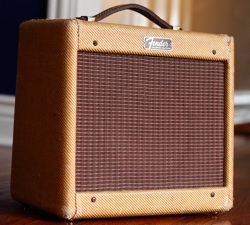
But despite that, I have wanted to get an 50’s tweed Champ for quite awhile. I love small, low-powered amps, and the tweed Champ from the 50’s has been on my list to get for quite some time. After all, that little amp has been used in studios around the world for recording hundreds, if not thousands of Rock ‘N Roll songs.

My only problem with ever getting a tweed Champ was that I didn’t want to spend upwards of $1500 for a mint-condition unit, which is what these puppies go for. And since I’d use it as a player, I’d have to make modifications to it as soon as I got it to make it safe and usable with different cabinets; thus immediately reducing its value.

But luckily there are tweed Champs out there that aren’t in pristine shape, and they’re low enough in cost to warrant consideration. My criteria was that the amp had to work. Period. As long as it did, I wouldn’t have to do too much once I got it. So I found a ’58 Tweed Champ on eBay for a decent price that was missing the back plate, but was still in great working condition, so I purchased it, knowing I’d have to do some mods to make it safe, plus add some longevity to it.

Right now, it’s on transit here, and should arrive tomorrow – I’m so excited! But I will not plug it in until I have a few things done to it, that my good friend Jeff Aragaki of Aracom Amps will be doing:

  1. First of all, it still has the original two-prong plug. Jeff will install a three-prong grounded plug in it – I’m probably going to go with medical grade on this just to be extra-safe.
  2. It was clear from the pictures that a couple of the original capacitors had leaked a little, so they will be replaced with Sprague caps.
  3. The speaker is also hard-soldered to the amp output, so I’m having Jeff install a 1/4″ female jack so I can use different cabinets with the amp.
  4. Finally, Jeff will create a simple backplate to provide some protection to the electronic components.

All of these “mods” will be reversible, so at least I can retain some value in the amp should I ever sell it. However, I probably will keep this amp forever. I don’t even have it yet, and it still holds some nostalgic value for me. Can’t wait until it arrives!

Read Full Post »

I broke the guide post on one of the 6L6 tubes in my trust Fender Hot Rod Deluxe awhile back, and even though the tube still worked just fine, I used it as an excuse to get a new set of power tubes. So after doing a search around the Internet for a new set of 6L6’s, I found myself on Brent Jesse Recording’s (audiotubes.com) site, looking for some NOS replacements for the JJ’s I had in there.

Not knowing what to purchase, I called Brent up, and asked for his recommendation. Surprisingly enough, he recommended a set of Groove Tubes. I said, “Groove Tubes? I can’t stand ’em.” But Brent explained that these particular Groove Tubes were not the imported, relabeled stuff from Russia or China. They’re re-issues of RCA and GE black plates made from NOS materials and constructed here in the US. Intriguing. I’ve purchase a few sets of tubes from Brent in the past, and he has never steered me wrong, so I decided to take a chance and get a pair.

The tubes arrived yesterday so of course, I just had to install them. What’s the verdict? They sound absolutely KILLER! The big test for me – especially with NOS tubes – is to run them full out to see how they break up. The problem I’ve had with late model power tubes in general (but especially with 6L6’s) is that they feel stiff and the breakup can be a bit harsh.

To me, NOS tubes have always felt much more smooth and dynamic. These Groove Tubes tubes are a huge exception to late model tubes. I can’t believe just how nicely these re-issues break up! The distortion is creamy smooth and slightly compressed with nice bloom and sustain without being too squishy – just how I like it! Caveat: They’re not cheap. These tubes are $80 for a matched pair, but they’re worth every penny! I just ordered a second set for spares since these tubes are limited quantity. They may not necessarily be NOS tubes, but as they’re made with NOS materials, there is definitely a limit. So if you’re looking for new production tubes that sound absolutely fantastic, you gotta check these out!

A word on the Fender Hot Rod Deluxe

It’s my contention that the Fender Hot Rod Deluxe is one of the most underrated amps on the market. Okay, I admit it: Stock it doesn’t sound all that good. But with the right tubes and the right speaker, it can sound incredible! Granted, a year or two ago, I wouldn’t have even considered buying this amp because of the huge price hike. I got mine on special for something like $550 in a blowout sale a few years ago. But the prices aren’t all that bad now. They’ve come down significantly from their nearly $900 price tag, and you can find them for around $649. Admittedly, it’ll probably cost $300-$400 more in tubes and replacement speaker, but what you get is an AWESOME amp. I’ll have clips in a few days.

Read Full Post »

…for your guitar playing actually has nothing to do with technique or scales or chords. It’s simply – live a healthy life. As I’ve gotten to middle age, I’ve started to have episodes of different ailments; reaping the fruits of ignoring my health. The latest incident was a recent case of diverticulitis, which is both painful and physically debilitating. But as a result of having this, I’ve been forced to completely change my lifestyle, and it has been great. Because of the condition, I’ve been forced to lay off the booze, eat less red meat, eat tons of veggies and fruits, and exercise regularly.

The net result is that even though I’m still on the mend, I’ve felt better physically than I have in years, and have also been sleeping much more soundly, which is also a good thing.

For many people, that healthy lifestyle is a no-brainer. But for others like myself who live the double-life of working stiff during the day and musician at night, it’s easy to go the fast and simple route as far as health is concerned; that is, not really paying attention, and being too busy to work out and eat right. All I can say to that is even if you’ve been lucky with avoiding health pitfalls thus far, start living healthy now! Don’t wait!

With music being such an integral part of my life, not being able to play would be devastating. So even though I had turned a new leaf last year with my health, it obviously wasn’t enough. I’ve learned my lesson.

Read Full Post »

Being “GoofyDawg,” it’s always cool to find gear with the “dawg” moniker. 🙂 So when I came across Li’l Dawg Amps on one of the forums, I had to check out their web site. All I can say is, “Wow!!!” The reason for that is because I was completely blown away by the prices of these handmade amps! For instance, a 5F1 Champster (based on the 5F1 circuit) in a metal lunchbox enclosure is only $399! After seeing the prices of his amps, I had to get the low-down on the low prices, so I called Jim Nickelson up.

The story of how Li’l Dawg started is actually really cool, and Jim tells the story well in his Story page. What started out as a labor of love turned into a full-on amp business. What a way to retire! This was “supposed” to be a hobby. 🙂 Well personally, I’m glad he took up the hobby because many people have benefited from it.

Jim’s approach to Li’l Dawg is no-nonsense. He can keep the price down because he does all the work himself. He doesn’t advertise, which is another cost saver, and he’s worked out a product system where he turn around an order within 2-3 weeks! That’s amazing as most single man shops typically take months to complete an order.

But what about the amps? Well, I haven’t played one – yet. But Jim specializes in classic Tweed circuit amps, like the Champ and Deluxe. The model that I’m particularly interested in is a hybrid amp that has a 5E3 preamp (replete with jumperable inputs – nice) and a 5F1 power section, called “The Mutt.”

Now, Jim could probably just stop there and produce reproductions, but he has some nice added touches with his amps, such as Mercury Magnetics or Heyboer trannys, Sprague caps, and choices of steel or aluminum chassis.

As Jim shares, he wants to create a “candy store” experience when people choose an amp, and provide a basic foundation from which options can be added. So very nice, indeed! Then when you see the prices well, how could you not consider one of these amps?!!!

In any case, here are a few clips of the Mutt to whet your whistle:

Bright Rock Style

Clean, Chords

Jumpered

I don’t know about you, but that has TONS of classic rock mojo going on! Can’t wait to try one out! Or maybe I shouldn’t – I just may leave with an amp. 🙂 Well, that’s NEVER a bad thing. 🙂

Read Full Post »

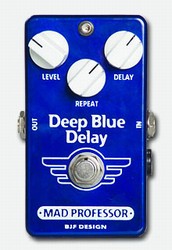
This is a “mini-review” only because I wanted to provide feedback on it after using it, and because I only used it in a limited way. The Mad Professor Deep Blue Delay is a digital/analog delay pedal meaning it is a digital delay with an analog direct signal path – or as Mad Professor puts it, the direct signal path is made of analog amplifiers with no filtering. In other words, it’s supposed to be transparent with no tone coloration.


Okay, I’ll just cut to the chase. This is about the sweetest delay pedal I’ve ever played through! It can do really subtle, ambient stuff, but also nicely textured “The Edge-” like delay. But no matter where you set it, the delay never turns to mush. It retains your tones, and is super-sweet.

At first glance, you might think this is a typical analog delay pedal, but it is a digital delay, and thus nowhere near as dark as I’ve heard analog delay pedals, which has kept me from getting an analog delay in the first place. I just don’t get into the really dark, brooding type of delay. But I’d easily consider the Deep Blue Delay. It’s simply killer!

I only used it with a Yamaha APX900 acoustic to add some subtle ambient textures to my finger picking. I was also running the signal into a nice little Genz-Benz Shenandoah JRLT. Level was at about 10 am, Delay about noon, and Repeat at about 11 am. I wanted to get just a subtle hall-like echo. All I can say was that it performed astounding well! Combined with that sweet ToneCandy Spring Fever reverb pedal, and I was awash in ambient heaven!

I did play with higher levels of each setting, and was amazed at the overall clarity of my tone. No mush or mud. My signal stayed nice and clean, and the note separation was always retained. And with this delay, smooth is the name of the game. There’s nothing harsh in the delay the Deep Blue produces.

Apparently – and I still have to corroborate this – the Deep Blue was designed to be place in front of or in the effects loop of an amp, and can be used either before or after distortion. Pretty amazing, as most time-based effects only work well in a loop and after distortion only. The folks at Mad Professor really put a lot of thought into this pedal. The guy at the shop where I tested it at – and someone whom I trust implicitly – plays the Deep Blue in front of an old Traynor amp, and loves it.

But there is a down side to this pedal, and that’s its price. At a street price between $325 and $350, it’s an expensive proposition, and like the Spring Fever, is probably the only thing that keeps me from getting this pedal. It’s tough to justify spending that much for a pedal, but that’s just me. Once a pedal gets in the $250 range, I start getting a bit antsy. But that said, if I had the scratch to get one, I’d run out right now and grab that pedal! It’s that good! (Damn! Knowing me, I’ll probably end up getting it… 🙂 ).

In any case, it gets 4.75 Tone Bones

Pros – Absolutely fantastic delay! Decay is perfect, and note clarity is like nothing I’ve heard.

Cons – Pricey

Read Full Post »

Every now and then, I go through huge, accelerated spurts of growth in my musicianship. Looking back, each time I’ve experienced musical growth, it almost always has been the result of simply letting go of certain preconceptions or assumptions; or let’s not the beat around the bush: getting over my inherent fear of – whatever: Fear of looking foolish; fear of making a mistake; fear of not being good enough; fear of authority. Take your pick. Whatever the flavor, fear has done more to keep me from truly realizing all that I can be than anything or anyone.

As Frank Herbert wrote in his masterpiece Dune,  “Fear is the mind killer. Fear is the little-death that brings total obliteration.” But as the Bene Gesserit “litany against fear” continues, “I will face my fear. I will permit it to pass over me and through me. And when it has gone past I will turn the inner eye to see its path. Where the fear has gone there will be nothing. Only I will remain.”

I remember that litany hitting me like a ton of bricks when I first read it so many years ago. Basically, the idea behind it – at least from my perspective – is that you accept that you have fear; that fear may even elicit a physical response (stomach churning, cold sweat, etc.), but you will act in spite of that fear. And for those who are curious, I didn’t have that litany memorized. I remembered the first part, but had to look up the rest of it. 🙂

So what does that have to do with playing guitar?

Well, for me, it has or more accurately had to do with playing solos live. I was the consummate rhythm guitar/lead singer type for years, but when I started my worship band nearly eight years ago, I had the dubious distinction as being the most seasoned musician in the group, and with the other guitarists being quite experienced, but more like me, the duties of playing lead guitar and soloing fell on me. I never admitted it to the band, but I was absolutely terrified! But knowing my duty, I started learning all I could about playing lead guitar, learning scales and modes and such.

Then I got stuck; really stuck, because no matter how much I learned about the theory and patterns and licks, that all I was doing for a few years: Just playing linked licks, and just playing patterns. Frankly, what I was playing for solos was pretty old and tired, and reeked of someone else’s stuff. I relied on that stuff because it was safe, but I was scared to venture beyond it. I imagined an abyss of embarrassment from which I could not escape; people laughing at my phrasing.

That all changed this past Christmas season when I volunteered to play guitar for my kids’ school’s Christmas play. This was a very cool contemporary musical where I could crank up my amp (using an attenuator, of course) to get some lead tones, which were plentiful. And because the songs moved so fast, in many cases, I didn’t have time to turn pages, so I was basically forced to get the chord progressions down early, then provide fills and leads as necessary. The cool thing was that I didn’t have the time to let my fear get the best of me, and I just went for it!

Also, because the changes in the songs weren’t blues-based I-VI-V, I just had to be free-form in my phrasing, and concentrate entirely on the melody I was playing, damn the modes, damn the forms, damn the patterns. And after hearing various clips from the show, it all worked! I was actually scratching my head saying, “Was THAT really me playing?”

I now approach solos with the intent of establishing a melodic “idea” then building off that. Most people in the know would say, “Duh!” to me but hey! Better late than never, in my opinion. I still get pangs of fear, especially if I’m not really feeling the groove of a song, and I’ll revert to the old forms and patterns, but I no longer rely on them as a primary means of soloing.

The point to all this is that by breaking through that fear, or in my case, have a situation thrown at me where my fear had no chance to influence me, I was able to grow beyond my limitations at the time. So, fear not and grow!

Read Full Post »

Why? Because every time I satisfy my GAS, they come out with new stuff that gets me GAS-ing all over again, dammit! 🙂 Here I was innocently reading my e-mail this morning when I got Prestige’s latest newsletter that said they were about to release a line of acoustic guitars! Knowing the fantastic stuff they produce, and given that they didn’t release anything more than announcement that they were releasing a new line, I had to give them a call to get more information. I shouldn’t’ve done that. I’m now GAS-ing so damn bad that it’s killing me!

But I got the scoop on these guitars, and before you start thinking, “Yeah, here we go, another import guitar… How good could it be?” Well, let me just say that a major publication already reviewed it and gave their top-of-the-line model a very – excuse the pun – prestigious award. And after I heard the details of these guitars, it’s not a surprise that even before their official release, they already won an award. So here’s at least some preliminary information that I found out…

They will have three guitars in various price ranges. I didn’t get model names, but I did get the makes of each model:

  • The top-of-the-line model has a koa body and koa top
  • The intermediate features a rosewood body and Adirondack spruce top
  • The lowest tier (and only by materials) features a mahogany body and Adirondack spruce top

Though not set, the guitars will range in price from about $1000 to $2100 street, so even the lowest-tier model isn’t anything to shake a stick at; and before you balk at the price, there’s a good reason for the pricing. Prestige didn’t skimp on the features that all three models share:

  • Adirondack spruce X-bracing designed in partnership with Balaz Prohaszka, a well-known European luthier
  • 12″ radius
  • 25.35″ scale length
  • 1 3/4″ nut width
  • D-shape neck
  • Split Bridge Saddles
  • Bone nut, Bone Saddles
  • Ebony Fingerboard, Ebony Bridge, Ebony Bridge Pins, Ebony Strap Pin.
  • Ebony Headstock face
  • Satin Mahogany Neck, Laser Etched Logo and Serial Number behind the headstock.
  • Beveled Cutaway with Paduck inlay, Mother of Pearl Logo, Mother of
  • Pearl Eclipse Fingerboard Inlay, Abalone Rosette
  • Gotoh 501 21:1 Tuners with Ebony Buttons.
  • Paduck/Abalone Body Binding, Paduck/Maple fingerboard binding.

An option for each guitar is the Fishman Ellipse Matrix Blend pickup system. This is a very non-invasive soundhole pickup system that combines an undersaddle pickup with a gooseneck condenser mic. I’ve heard one of these installed in a Taylor acoustic, and it sounds marvelous!

So the pricing is really a reflection in the difference in tone woods used; otherwise, they’re all the same. That is incredibly COOL!

I’d be remiss if I didn’t have pictures, so here are a couple of the Koa/Koa model. These aren’t the pro pics as you can see the reflections of background objects – that’s how glossy the bodies are! Freakin’ awesome!!!

This slideshow requires JavaScript.

These are serious guitars, folks. Can’t you just DIG that beveled cutaway? Damn! I dig little things like that, and the outer bracing is absolutely superb! And another nice touch is the satin finish on the neck. I always prefer that because it allows me to polish it with my own body oils after time. For me, the ebony fretboard is a HUGE selling item! There is absolutely nothing like the feel of ebony; it’s smooth as silk and feels so nice to the touch!

I can’t wait to get a demo into my studio to give it a whirl! I TOTALLY DIG the Koa/Koa! Now do you see why I hate Prestige Guitars?!!! 🙂

For more information, please go to the Prestige Guitar web site!

Read Full Post »


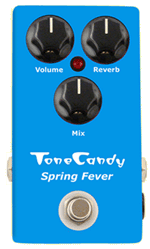
ToneCandy Spring Fever Reverb

Summary: Just about the sweetest spring reverb pedal I’ve ever heard, plus the pedal sports a nice, transparent clean booster that you can even use on its own!

Pros: I’ve heard simulated spring reverbs before, and they’ve been nice, but not THIS nice! Supposedly modeled after the original BOSS spring reverb sound, but takes it way ahead!

Cons: Very very pricey for a just a reverb with boost. Also, doesn’t run on batteries

Features:

  • Volume knob acts as a transparent clean boost
  • Reverb knob acts as a “dwell.”
  • Mix knob controls the amount of wet/dry signal (this is a very nice feature)
  • True bypass
  • All analog except for the simulation chip
  • Can do the full range of spring reverb from adding a tinge of grease to heavy surf.

Price: $275 Street

Tone Bone Score: 4.5 ~ I was completely blown away by the sound of this pedal, but the price completely scared me away. If cost isn’t an in issue for you, you’ll find none better than this!

Being friends with guys at a music shop can be incredibly useful, since they’ll show off their new stock; plus, knowing that I may buy it if they show it to me, they don’t hesitate to show it off. 🙂 Luckily, I usually have enough self-control to not buy most of the stuff they demonstrate.

I have to admit, though, that I was VERY tempted to get this pedal because I haven’t heard one like it – ever! It can slather on the ‘verb quite nicely and note clarity is retained at any setting along the reverb knob sweep. Obviously ToneCandy figured out some great values for pre-delay and trail. I just couldn’t get over how great it sounded with chord progressions and single note picking!

In fact, A/B’ing it with a Fender Deluxe Reverb Reissue just blew me away! It sounded even better than an actual spring reverb! Fender spring reverb, at least to me, is the gold standard in spring reverb, and for a pedal to sound even better than that, well, needless to say, that made a compelling case to get this reverb pedal. Add to that a completely transparent boost, and you’ve got a great pedal that you can put at the end of your signal chain and get all sorts of usage out of it! I could feel the GAS really starting to build up.

Then I asked the price, and my eyes bulged! At $275 for the pedal, that made my GAS go away pretty quickly. If price wasn’t an issue for me, I’d totally go for this pedal, but unfortunately, at that price, I started thinking, “I could get a couple of decent pedals, or even a nice Squier for close to that price.”

Needless to say, I didn’t get the pedal, though I do have to applaud ToneCandy for coming up with a fantastic spring reverb tone. Maybe if I can find one used in the future for a lower price I’ll get it. But for now, I’ll just gaze at it in the glass case when I go to the shop…

Here’s a sound sample:

Read Full Post »

I’ve been playing a solo acoustic gig for about 7 years now, and in all that time I’ve wanted to do lead breaks in various songs. But being a solo artist, and not having all that much time to spend on backing tracks, needless to say, lead breaks were out of the question – until now.

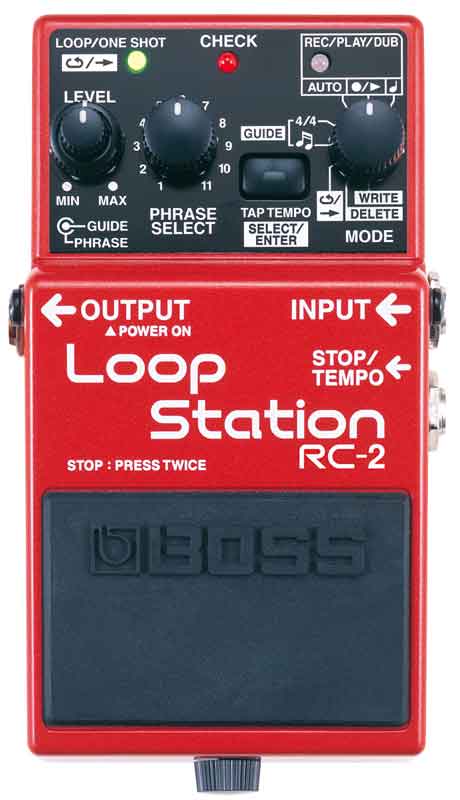
I just picked up a used Boss RC-2 the other day, and since playing with it, I just know that it is going to change the way I do my solo gigs forever. Even if I don’t keep this particular unit (which I probably will for quite awhile, as it does everything I need for now), I’m a total convert to using a looper!

Not that it hasn’t been challenging. Consistent tempo is tantamount to creating loops on the fly. Playing solo, I’ve gotten used to doing rhythmic embellishments, which don’t quite work all the time with a looper, and I’ve had to practice cutting off the record at just the right time. That has probably been the biggest challenge so far. But I’m starting to get the hang of it, and I’m just loving the possibilities it opens up for me!

Read Full Post »

Yamaha APX900 Thinline Acoustic/Electric Guitar

Click to enlarge

As I mentioned in my review of the Yamaha APX900, I’ve had this thing for Yamaha acoustics for many years. Maybe it’s nostalgia or sentimentalism, as my first guitar was a Yamaha, but I’ve always liked their tone. In any case, I’ve full circle with the Yamaha APX900, and I just couldn’t be happier. This is one killer guitar! With its Mocha Black finish, mother-of-pearl “bookend” inlays, and gorgeous binding, it has stunning looks!

But of course, looks don’t tell the whole story. It plain sounds fantastic! Whether plugged in or unplugged, the APX900 has a magical, creamy tone that I’d easily put up against guitars three or four times its price which, at a mere $699 street, makes this an incredible value!

Unplugged, the tone is smooth and well-defined, and even as a thinline guitar, it’s not so thin that sustain is sacrificed. The body resonates and provides lots of sustain. In fact, it’s smaller size belies the big voice that the APX900 possesses. Here’s a clip:

There’s nothing subdued about that tone. For that recording, I used a Senheiser e609 pointed at the front edge of the sound hole about 4″ away from the guitar. The APX900 has an phenomenally even EQ response. When I played back the recording, I had to do a double-take! Make no mistake, that is the raw recording with no EQ or filtering! It’s amazing!

Plugged in, the APX900 shows even more magic. The first thing I noticed when I first played it – direct into a PA – was that it sounded natural; that is, it didn’t sound like an acoustic plugged into a board, where the tone is completely flattened out, and what you end up with is high, mid-rangy, and lifeless. It’s due to the APX900’s ART or Acoustic Resonance Transducer pickup system, which is a system of three pickups; strategically-placed to emphasize or de-emphasize certain EQ ranges. This lets you dial in all sorts of tones! I’m still discovering the possibilities!

Here’s the same progression I recorded unplugged, but with a solo played on top of it. For the “rhythm” part, I have the Low, Mid, and High faders, plus the under-the-saddle pickup’s EQ set to dead-center. With the solo, I added a touch of the mid, plus more highs to cut through. The result is spectacular!

Again, with this clip, I didn’t adjust any EQ on either track, though I did add some reverb for some ambience and to simulate what I’d do on a PA board anyway. The tone is different from the unplugged sound, but with a little playing around with the faders, I can get very close. But no matter, the tone is still killer, and most importantly, the dynamics are fully retained, and on stage, that’s absolutely critical!

So yeah, I really do dig this guitar. I’m looking forward to gigging with it!

Read Full Post »

« Newer Posts - Older Posts »