Feeds:
Posts
Comments

Posts Tagged ‘musicians’

Before I got my Les Paul R8, I spent over two years searching; not just for the right deal, but sifting through all the different models. That meant reading lots of articles, joining several forums, and participating in lots of discussions. I’m glad I took the time, but looking back, it would’ve been great to have a single, definitive source for information on the different Les Paul models. It probably would’ve cut my search time by a significant factor!

As if searching for a Les Paul was bad enough, I was also at the same time looking for an amp. Having cut my teeth on the Fender sound, once I started writing and playing more heavy stuff, I started gravitating towards the Marshall camp. Now luckily for me, I met Jeff Aragaki of Aracom Amps who not only builds vintage-style Marshall-esque amps, he owns several Marshall amps from, including a 60’s JTM 45 that is an absolute tone monster! What a machine! Anyway, he has been my source for Marshall amp information; without him to guide me to the type of sound I was after, I probably would’ve had to resort to my method for finding a Les Paul (Jeff was also instrumental in that camp as he is a Les Paul collector). In the end, the tone I dig from Marshall amps comes from the JTM and Plexi camp. By the way, he’s coming out with a new 50 Watt amp called the “FlexPlex” that includes circuitry for both JTM and Plexi amps, and even has some Dumble-esque features. That’s my next amp!

Circling back to searching for a Marshall amp, I recently came across two articles that include pretty much everything you need to know about the different flavors of Marshall amps, collectively called the “Marshall Shopper’s Guide.” The articles are very detailed, and more importantly, they’re unbiased. Here they are:

Part I: Marshall’s Plexi Era

Part II: Vintage “metal panel” through JCM 2000 Series

To say I was thoroughly impressed by these articles is an understatement. The author, David Szabados, really did a great job with them, and my hat’s definitely off to him for providing such rich information. So if you’re looking for a Marshall Amp, at least in my opinion, there is no better source for getting information on Marshall amps.
Read Full Post »

I’m uh… speechless…

Read Full Post »

Just came across this today, and it is the most comprehensive OD shootout I’ve seen/heard – EVER! This isn’t a simple A/B. This is 36 OD pedals. Very good!

NOTE: If the video keeps stopping, watch the video on the YouTube site directly: http://www.youtube.com/watch?v=WuTt8YFblcE

Read Full Post »

For years I was on an Overdrive kick. I still kind of am. I love dirt pedals despite the fact that I don’t use them nearly as much as I used to, and am patiently waiting for my Timmy to arrive. 🙂 But ever since I went on my quest to get an original BOSS CE-2 chorus, I’ve kind of gotten on a chorus kick as well; not as bad as my overdrive kick, but every time I see a new chorus, I have to at least listen to it. And if I REALLY  like it, I might just buy it. That’s how it was with my Homebrew THC. It just came along at the right place at the right time.

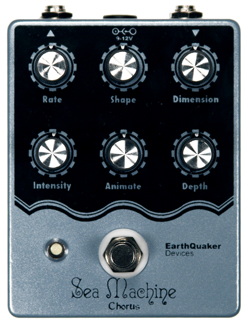
Truth be told though, while I’m not currently in the market for another chorus pedal, the Sea Machine Chorus from Earthquaker devices does give me pause. One thing that always turns me on with respect to gear is versatility, and the Sea Machine certainly cannot be blamed for lack of it. In addition to the tradition, Rate, Depth, and Intensity knobs, the Sea Machine also boasts three other knobs:

  • Animate – adjusts the width of the chorus pitch shift
  • Shape – adjusts the shape of the LFO
  • Dimension – which adds reverb/delay-like ambience to the tone.

This is impressive because from demos I’ve seen, this pedal is capable of producing TONS of different tones from your traditional chorus to leslie to vibe to all-out tweaked!

The pedal retails for $215 online. Here are some demos for your viewing/listening pleasure:

I totally dig Andy at ProGuitarShop.com’s demo as he demonstrates AND explains what the pedal can do, which is a lot. The Dimension feature is absolutely awesome!

If I had to do it over again, and I hadn’t purchased the Homebrew THC, I probably would’ve picked up the Sea Machine. Great chorus!

Read Full Post »

A few years ago, I was perusing a popular guitar-related forum when I came across a post about a particular pedal, and how people were waiting up to three years to get one. I remember at the time that I’d never do that, and I kept to my word; at least until I got on the list to get a Timmy Overdrive. That wait will only be about 6 months, and since I wasn’t in a rush, AND I didn’t have to give Paul Cochrane a down payment, it was a no-brainer putting my name on the list; especially after poring over reviews and sound clips and speaking with Paul directly. There’s other equipment out there that has a long waiting list as well. Analogman’s King of Tone is over a year long. The Faustine Phantom waiting list has been over a year for people who got on the earlier lists (though apparently Tim now has a new production partner and his production times are supposedly going down).

What prompted me to put out this question was that I was thinking about my Timmy on order. Then I thought: What was the impetus for getting on a waiting list? To be completely honest, I’m not sure. But probably a big reason was that I didn’t have to take any financial risk by giving Paul a down payment. Plus, the pedal’s only $129 shipped so it’s kind of hard to go wrong. I _might_ do the same with the King of Tone, but I’m really not sure I’d wait a year or more for a pedal. I guess for me, there has to be a good balance between wait time and financial risk.

Read Full Post »

If Only…

…it were this easy. Plug in a pedal and adjust the amount of my virtuosity. 🙂

Actually, I’m glad that this isn’t so because then I’d never feel the satisfaction of achievement. That’s a really important thing to have, no matter what your experience level is – with anything. We sometimes wish that there would be a simple solution to learning and mastery, but if everything thing were simple, then there’d be no challenge. Look at the movie WALL-E. The people in that movie don’t have to think for themselves or do anything for themselves, and they just turn into slothenly slobs confined to floating chairs.

So dear readers and fellow guitarists, there’s no easy path to guitar mastery. It’s work. But with work come rewards.

Read Full Post »

Usually during winter or summer NAMM, I keep close watch on the press releases and trade rags to make announcements about new gear. I’ve received plenty of press releases for this current Winter NAMM 2011, but there really haven’t been any  new sounds lately to get me excited. Maybe it’s because I have the flu, and I’m a bit grumpy, but nothing I’ve seen thus far has really wowed me. The trade rags still tend to play to the major manufacturers, so all you normally get is the expected set of gear from the expected set of manufacturers, though I do have to say that at least Premier Guitar makes an effort to showcase non-mainstream, boutique gear, as they seem to cater a lot to “The Gear Page Forum” crowd.

So the fact that I hadn’t seen anything new and exciting led me to the question: Do we have all the tones we can get? And by that I mean new classes of tones outside the standard amplitude, frequency, and time modulation classes; and let’s not forget envelope filters and the like. Frankly, all that territory has been well-explored. But some genius may come up with some other thing that will add yet another dimension to guitar tone in the future – it’s just not now.

So where does that leave us?

Well luckily we’re no longer in the days when only a few manufacturers existed and the selection of gear was fairly narrow. With all the boutique manufacturers out there now, there’re all sorts of choices at our disposal. We may not have any new classes of tones being developed, but we do have fairly limitless possibilities to combine gear within the existing classes. That’s a great thing!

For me, there’s still undiscovered country in what’s currently out there. I think my next avenue of exploration will be envelope filters. A lot of my latest music has had a real funk feel to it, and an envelope filter or an auto-wah may just add that little funky zest to my rhythm lines.

I did see this one very interesting – maybe weird – “guitar” called the Kitara by Misa Digital Instruments that’s completely digital. No strings. Each “fret” has a button. The right hand (it also can be flipped to be a lefty) uses a touchpad to generate sound. The Kitara is connected to a synth or software. Interesting concept, but I’m not sure if this will be the future of guitar. It does provide some very interesting possibilities, though. Here’s a demo:

Read Full Post »

Rewind a little more than 30 years ago. It was the summer after my Freshman year in college. I was just starting to take guitar very seriously and I was addicted to seeing the late, great Michael Hedges at the old Varsity Theatre in Palo Alto, CA. Back then, the Varsity Theatre was THE place to see the Windham Hill recording artists when they were making their starts, and before artists like Will Ackerman, Michael Hedges, George Winston, Liz Story, and Mark Isham became the sound of the New Age, yuppie movement in the 80’s. Michael Hedges played there a couple of times a week, and that summer, I was at EVERY show. But among the artists that performed there that I also saw quite a bit of, were a husband and wife duo called Tuck and Patti.

Patti had this low, deep, sensual and moving voice, while Tuck was absolutely INSANE on his Gibson L5. Though I related much more to Michael Hedges during that period, I was completely blown away by Tuck’s absolute mastery over the fretboard!

The first time I saw Tuck and Patti, it was purely inadvertent. I was strolling down University Avenue and heard this great guitar playing coming from the Varsity Theatre’s courtyard, similar to Michael Hedges but much more jazzy. I knew it wasn’t Michael because they were playing Chaka Khan’s “Ain’t Nobody” and Michael played his own stuff. I walked into the courtyard to see this lady singing her heart out, and this weird-looking dude with curly locks playing guitar, his fingers a blur all over the fretboard. I was absolutely mesmerized by his playing! Running bass lines along with rhythm and melody. I’d never seen anything like it!

I’m not sure what prompted me to think of Tuck and Patti today, but I thought I’d share just how incredible this man’s playing is and what a great duo Tuck and Patti are:

And here’s a little demo of Tuck demonstrating his style:

Read Full Post »

For a long time I was – and pretty much still to this day – an overdrive pedal lover. I have several, and am waiting for my new Paul Cochrane Timmy to be completed and delivered in the next few weeks. I’ve been wanting one of these for awhile now, and finally bit the bullet and got on the waiting list. So excited! But using an attenuator  – specifically the Aracom PRX150-Pro – changed the way I use overdrive pedals.

In the “old days” before I used an attenuator, I used an overdrive pedal to get grind through a clean amp. Early on, I was using my Fender Hot Rod Deluxe that was all about loud, clean headroom, and I couldn’t get the volume above 2 or 3 before it would be just too damn loud; not to mention, the tubes weren’t working that much at all at that level. Yeah, I could crank the volume then set the Master to about 1/2 to get some dirt, but the pre-amp only distortion of that amp never really appealed to me. So I used overdrive pedals to get that soft-clipping on the front-end, and especially looked to pedals that provided a bit of color.

But once I got an attenuator, the entire game changed. I was able to crank my amps to get both the preamp and power amp sections saturated. For a long while, I actually stopped using overdrive pedals altogether because I was getting all the drive I wanted. I still sometimes just go to my gigs with only a tuner pedal and just plug directly into whatever amp I’m using, though I’m now starting to introduce overdrives to add gain stages to my chain.

But that brings me to the crux of this post… I used overdrives because I couldn’t get sufficient grind at reasonable volumes. But once I got a real transparent attenuator like the PRX150-Pro (I had an AirBrake and tested several), I could finally hear what my amps sounded like fully cranked. But here are some things I discovered once I was able to crank up my amps that I’d like to share:

  • I have 8 amps, and with the exception of two, once I cranked them up, I did not like their fully cranked up tone.
  • A common thing that I found among all the amps where I didn’t like their cranked up tone was a certain harshness or in some cases “fizz” that was not at all pleasing to me.
  • As opposed to getting rid of the amps, I swapped tubes and speakers until I was able to balance out their tone. For instance, with my Aracom PLX BB 18 combo, which is a replica of a Marshall 18 Watt Blues Breaker, the cranked tone was horrendously fizzy to me. So I replaced two preamp tubes with NOS Mullard and GE tubes, and to tame the natural brightness of the amp, replaced the stock Eminence Red Fang with a Fane Medusa 150 which really emphasizes the low-end. It’s now gorgeous, and I use that amp regularly!

The point to all the items that I shared was that once I was able to crank up my amps, most of them just didn’t sound all that good. Lots of folks who are new to attenuators complain about different artifacts being introduced by the attenuator, but based upon my experience, I think a lot of those “artifacts” have a lot to do with them never having cranked their amps all the way up. To me, it’s definitely a case of “you may not like what you hear…”

So if you ever do get a hold of an attenuator, and you crank your amp up, if you don’t like the tone, don’t immediately assume that it’s the attenuator. Especially with the latest generation of attenuators that are much more transparent than the traditional ones, the likelihood that they’re introducing artifacts is pretty low. Look to your amp first, and see what you can do to adjust it to deal with its cranked tone. Personally, I’d start with tubes first; especially replacing new production tubes with NOS pre-amps. I know, they’re getting more and more scarce, but I’ve gotten the best results in smoothing out my tone with NOS pre-amp tubes.

Read Full Post »

In my last post on cables, one of the respondents replied with a couple of great links. One of them was to Roger Russell’s site on a discussion about speaker wire. In that article, he had a very useful table on wire gauges and maximum cable lengths you should use. I grabbed the table, reformatted it for GuitarGear.org. Here’s the table:

Wire Size 2 ohm load 4 ohm load 6 ohm load 8 ohm load
22 AWG 3 feet max 6 feet max 9 feet max 12 feet max
20 AWG 5 feet max 10 feet max 15 feet max 20 feet max
18 AWG 8 feet max 16 feet max 24 feet max 32 feet max
16 AWG 12 feet max 24 feet max 36 feet max 48 feet max
14 AWG 20 feet max 40 feet max 60 feet** 80 feet**
12 AWG 30 feet max 60 feet** 90 feet** 120 feet**
10 AWG 50 feet max 100 feet** 150 feet** 200 feet**

The “**” indicate that in reality a 50 foot cable length is actually optimal.

I dig information like this because it’s a great reference for when I’m buying cables.

With speaker cables, what you’re concerned with is not capacitance, like you are with instrument cables. What you’re concerned with is resistance. You COULD use a material that has much less resistance than copper, like gold, but you’ll get much more bang for the buck by just going up a gauge (down in number). Personally, I just use 12 gauge wire for my speakers, and the lengths are only 4 feet, so I can use pretty much any load and be assured that I won’t create too much resistance between my amp and cab.

Read Full Post »

« Newer Posts - Older Posts »