Just got my latest issue of Guitar Player, and as usual, went to the gear section first to see if there were any new and interesting pieces of gear. Normally, the stuff there is pretty tame, but I got really intrigued by a short product review on the Harmonic Capo. Unlike a normal capo that you place on a particular fret to play open chords at a particular fret position, the harmonic capo is placed at a harmonic fret: 12th, 7th, or 5th, and it will play the harmonic there. But the really cool thing about this is that unlike a normal capo, where you can only play the frets above the capo’d position, with the harmonic capo, you can play at frets above AND below the fretted position of the capo. It’s a very interesting concept that can yield some very interesting tonal possibilities. Check out this video by the inventor:
Posts Tagged ‘musicians’
New Gear: Bob Kilgore’s Harmonic Capo
Posted in gear, gear reviews, guitar, guitar gear, guitarists, Guitars, Music, musicians, tagged capo, gear, gear reviews, guitar, guitarists, Guitars, musicians on September 22, 2008| 3 Comments »
PRS DGT Field Test – c/o “Tweed Demon”
Posted in gear, gear reviews, guitar, guitar gear, guitarists, Guitars, Music, musicians, tagged gear, goldtop, guitar, guitar gear, musicians, PRS on September 7, 2008| 6 Comments »
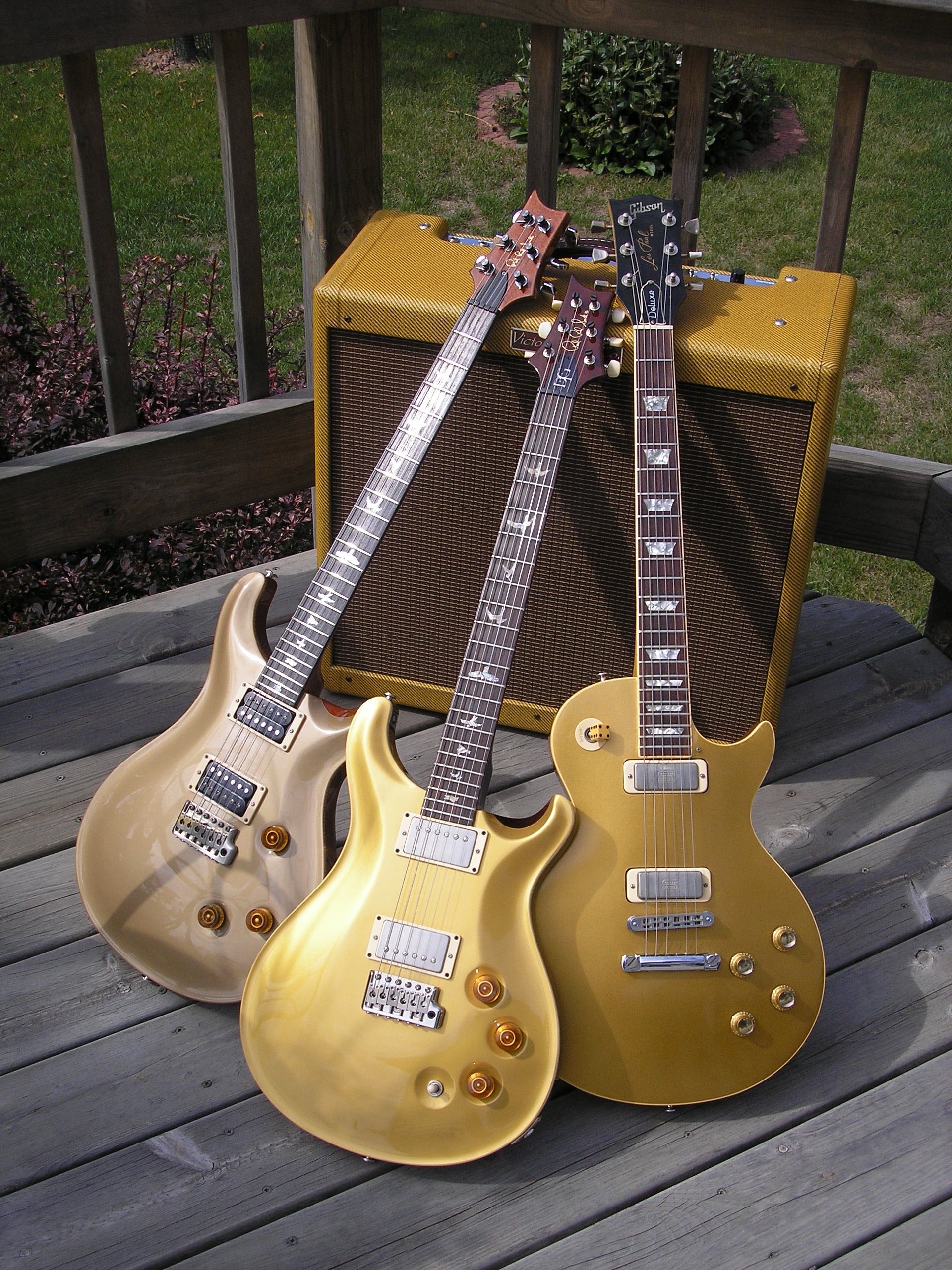
Tweed Demon's Goldtop PRS
There’s nothing like someone sharing their personal experience with gear. This post comes courtesy of Paul Garvey, aka “Tweed Demon,” a Guitar Gear reader who shares our passion for gear. Read on!
BTW, the picture is of his personal gear – I love the Victoria amp!
——
I’ve always loved goldtops from the first time I was 12 years old and sneaked my way into a high school dance just to watch the band. I was transfixed on the guitarist who was wielding an early Les Paul Deluxe with soapbars… I thought that was about the coolest looking guitar I’ve ever seen. I saved my nickels and dimes bagging groceries until I had enough money to buy my own a few years later (that was in ’78). I bought my first PRS about a decade later after getting that same feeling watching that guitarist with Joe Ely’s band who everyone now knows- David Grissom. Then in ’92 my wife gave me a goldtop PRS Custom 24 for my wedding anniversary present (yup, she’s a keeper). Needless to say, I’ve always loved goldtops and I’ve always loved the versatility of PRS instruments as the name PRS has become synonymous with quality high-end production guitars. For a guy that plays a lot of covers, I always felt these guitars were a necessity for anyone who doesn’t want to carry a carload of axes to every gig. I’ve always been a believer that good tone comes from the hands….a great amp helps…and big strings equals big sound. Then in 2007 when I read that PRS was coming out with a David Grissom signature model I felt intrigued.
I’ve tried all the PRS models to date and frankly, I liked the McCarty’s, but I felt the pickups were a bit vintage sounding to my ears and lacked a bit of clarity. In addition, I like the spongy feel to string bending that a trem can give a guitarist – particularly one who uses heavier strings (I use 11s on all my guitars, 12s on my ES-175). So when I read the specs on the DGT, new neck carve, jumbo frets, more open sounding pickups, added a trem, twin volume controls, and it comes in a goldtop… I knew I had to have one.
When I picked up my DGT at my dealer, the first thing I noticed was the finish. This is a nitrocellulose lacquer finish over a poly seal coat. The finish on this guitar is truly amazing. I have a nitro re-issue Fender, and that finish is downright soft by comparison. The finish on the DGT is very thin and hard…very hard. Hard like glass. I tapped on the back of the neck with my knuckle and the wood rings like a bell. Acoustically, I would describe it in a word- “resonant”. The gold was much deeper and brighter than my other goldtop PRS which appeared almost beige or buff colored by comparison (see attached photo). The deep gold with the mahogany back and neck really look like those great Gibson’s from the mid to later ’50s. Very cool. One drawback is that the finish is very fragile and will pick up a few dings very easily. On the flip side, it will break-in nicely and you can “relic” it the old fashioned way…by playing it.
The bigger frets (6100s) are great. I’m used to using 11guage strings, but these frets make 11s seem like 10s from a bending perspective. The neck again is much more “vintage Gibson-like” than any other PRS I’ve played. I would compare it closer to the D-carve on my Custom 22 Soapbar only narrower. The feel was very comfortable, and it almost immediately felt like an old friend. If you’re not used to a nitro finish, you will notice a bit of stickiness to the feel, which will fade with time as the guitar breaks in. And if you’ve never smelled newer nitro, it gives off a scent all its own – which may take some getting used to in a small practice area. But that too, should get better with time.
The phase II locking tuners are top notch. I have the same tuners on my CU22 and love them. The only difference is the “Kluson-type” vintage look to the ivory buttons. In addition to the cool look and function, they seem to keep this guitar well balanced by reducing a bit of weight in the headstock area.
My first night out with the DGT I would have to give it the grade: Incomplete.
Half way through my first set I was really starting to open up with this instrument. Then I felt like I wasn’t playing in tune and it was driving me nuts. My intonation was really whacked. I picked up my CU22 Soapbar and finished the set. On break I noticed two of the screws holding my saddles in place loosened up, one fell out completely, and the hex nut holding my trem was 80% out of its threads. Wha the? I did manage to find the lost screw, but the DGT rode the bench the rest of the night. Anyway, to fix the problem, I added a dab of medium (blue) threadlock to the bridge screws and re-intonated the guitar. Problem solved. A word of advise – let all threads dry first if you use threadlock, it will take off the finish if the chemical comes in contact with any painted surface. I use this stuff on my motorcycle everytime I replace any screw. Maybe PRS should start using threadlock in its production process. If I only had one guitar with me, I would have been screwed…literally.
The second night out with the DGT was with much better results…Grade: A. The first thing you notice about this guitar is just how spot on David Grissom was with his pick-up design. I understand about a years worth of R & D went into them. The pick-ups quite frankly are the best sounding PAF-like pickups I’ve ever played. The picks are very balanced with incredible clarity. Comparing them to my CU24, I would say clearer, more pronouced lows and highs and very open sounding pleasing harmonics, with far better sustain, which surprises me do to the clear clean sounds. The split coil sounds are also very clear and open. I would say the split bridge pickup delves more into Telecaster territory rather than Strat. Very snappy. The split neck can give you some nice strat-like neck tones. However, if you’re looking for the strat out of phase “quack” sounds, they’re not here. You may better appreciate a Custom 24, Swamp Ash Special, CU22 Soapbar, or a 513. But, if you want the beautiful open sounds of a great PAF, with some tele spank, this is THE guitar.
Another interesting and well thought out feature of this guitar is the dual volume controls. The versatility with this feature is endless and I found myself immediately using it. One of my favorite positions in the single coil mode, dual pickups is to roll the neck pickup back to about 8.5 or 9 just to give the mellow center position a little more snap. Very cool.
Looking under the hood on the DGT you will notice that the volume pots each carry an extra capacitor used as a treble bleed. There had to be a lot of research and trial for the proper values used here. The volume controls ARE volume controls! No loss of tone. You can roll the volume back with incredible clarity. It made me realize what I was missing all these years. It was a real eureka-type moment. A great feature for old school surfing of that saturated zone with a great cranked low-wattage tube amp- just by manipulating that volume control. What fun.
I normally don’t feel compelled to write these kind of reviews for any new piece of gear. But, I feel this guitar is special. I used to think the Modern Eagle was PRS’s crowning achievement in production-level guitar. The DGT almost gave me an epiphany of sorts. I really believe the DGT is this generation’s 59 Les Paul Standard only incredibly more versatile. In fact I felt so strongly on how great this guitar was, that I e-mailed David Grissom himself and told him job “well done”. David e-mailed me back and said how much he appreciated my comments and that he likes to see his guitar in the hands of “players”. Somehow I know he’s going to get his wish – in big way.
(any guitar gear heads can email me with questions/comments at: pgarvey222 (at) yahoo dot com.)
—————
Okay… jealousy sets in… 🙂 Thanks to Paul for this wonderful, personal analysis!!!
Product Spotlight: Peavey Windsor Studio Amp
Posted in gear, gear reviews, guitar, guitar gear, guitarists, Guitars, Music, musicians, recording, tagged amps, guitar, guitar gear, Music, musicians, recording on September 2, 2008| 1 Comment »

Peavey Windsor Studio
At-A-Glance: 15-20 Watt Class A tube amp, 12″ speaker, balanced XLR out with mic simulator.
Price: $399.00 (street)
Features:
- Class A Power Amp can use various octal power tubes including EL34 (stock), 6L6GC, 6550, 6CA7, KT88, KT66, or any variation on these types
- Two 12AX7/ECC83 Preamp tubes
- 15-20W (rms) into 4, 8, or 16 Ohms with “Power Sponge” output power attenuator
- No negative feedback in Power Amp
- High & Low Gain Inputs
- Preamp Volume
- Low, Mid, and High EQ
- Footswitchable Boost function
- Footswitchable Effects Loop
- Spring Reverb
- Transformer balanced XLR Recording Output w/passive mic simulator
- XLR Ground Lift switch
- Dual Speaker Outputs
- Impedance Selector
- 1/4″ TRS footswitch jack for Boost and Loop defeat
- 12″ Blue Marvel Speaker
I’ve never been much of a Peavey fan, but there’s something VERY cool about this little amp. For starters, I dig the fact that you can use different pentodes with it – and you can switch them with out re-biasing! Imagine getting that glassy sound with a 6L6GC (standard in Fender deluxes), then switching over to a KT88 for a more compressed overdrive sound. That feature alone makes it really attractive. But on top of that it also has a built-in attenuator!
This ain’t a giggin’ amp – least not for anything more than a small venue. As the name implies, it’s made for the studio, and with its included features, it’s clear that that is what it’s made for. For home recording stiffs like me, this amp seems like an ideal amp to have in my home studio. I used to be really dubious about low-power amps, but for low volume applications, you just can’t go wrong with a low power amp. Why? Simply because you can get low wattage amps into breakup at a much lower volume than with higher output amp. And with the right mic placement, in many cases you can’t tell just how little that low wattage amp really is. 🙂
But here’s the real kicker for me: It costs $399 retail. You can find it on EBay for even less! That alone is worth a look. Now I know that you might be thinking that this is just a cheap amp. Maybe it is, but based upon the demo below, I think this amp may deliver WAY more value than for what it’s selling. Check it out:
I’m going to have hit a Guitar Center or another local shop that carries one to try it out. If you’ve got or played one, I’d love to hear your insights!
Review: Fulltone OCD
Posted in Effects, gear reviews, guitar, guitar gear, Guitars, pedals, tagged distortion, effect pedals, Effects, fulltone, guitar, guitar effects, guitar pedals, guitarists, Music, musicians, OCD, overdrive, pedals on August 30, 2007| 40 Comments »
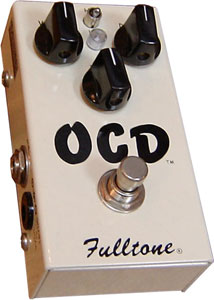
There have only been a few times in all the years that I’ve been playing guitar that I’ve had an epiphany with a pedal, where after just playing a few notes, a light bulb would go off in my head, and I’d exclaim, “That’s the sound I’m after!” The Fulltone OCD did that to me this afternoon. I just love when that happens! Here are some of the features of this little beast:
- First off, it has a true bypass switch, so when it’s off, it’s off, and you don’t have to remove the battery if you’ve got it plugged into a 9 volt power source.
- Volume knob – speaks for itself. But here’s a real treat: The volume knob can give you up to 30dB of boost!!! Need a clean booster? Here it is, plus you can get that sexy, smooth distortion out of it as well. Special note for my friend IG over at igblog: Here’s your clean booster, and you get a freakin’ amazing distortion box to boot!!!
- Tone knob – according to the manual (and I confirmed this as well), the tone knob only affects the high frequencies, but you can use it to sweeten up a lead or get a more squishy, punchier sound – very cool.
- Drive knob – again self-explanatory. It’ll give you more or less distortion depending up on the position you set it to.
- HP/LP switch. This is unique to this pedal. Set it to (H)igh (P)eak and you get glorious sounding bottom end and increased dynamic range, plus more distortion throughout various volume levels. Set it to LP, turn down the drive, and the pedal acts as a clean booster with the volume knob.
How it sounds…
- Whether you’re in HP or LP mode, the thing that I noticed the most was the amount of sustain it added to the notes I was playing. One thing that can be a bit of a frustration for me when playing my Strat is when I bend a high note (above the 12th fret), there’s just not much sustain in the guitar itself (of course, unless I crank my amp). But the OCD adds a lot of sustain with hardly any tonal interference (that makes your sound really muddy).
- As far as distortion is concerned, the OCD will not muddy your tone – especially at lower volumes, and you get all the juicy, complex harmonics that you get out of a cranked amp. With the OCD, your tonal clarity is retained, even with heavy distortion, AND you get those overtones and harmonics – EVEN AT BEDROOM LEVELS!!! Think of the OCD’s distortion as an extension and enhancement of your tone. It’s very much in character with a box like the Ibanez TS-808, another overdrive box that I have that I love for its transparency.
- With the OCD, you also get the touch sensitivity you’d expect out of a cranked amp. That’s yet another amazing thing about the OCD, it’s sensitive as all get-out even at lower volumes.
- I haven’t confirmed this, but from other reviews I’ve read, and from the dude that sold me the pedal (I trust him mightily), the more voltage you run through the OCD, the better it sounds. I only have a 9 volt power supply, but it’ll take up 18 volts, though I’ve read that 12 volts is probably the best.
In a nutshell, if you’re looking for a distortion box that will make your good tone sound even better, this box is for you. That said, before Mike Fuller released this box, there was A LOT of hype surrounding it. Once it was released, a lot of players were disappointed, thinking that this would be the be-all, end-all of distortion boxes. It’s not. It has a different character; actually, a VERY unique character, that will endear it to some, and ward off others, especially those who are expecting a real low-end oomph. The OCD has that, but that’s not its strength. As I mentioned, it’s a tone enhancer, that will break up your signal as much or as little as you want. It won’t pour on oodles of low-end, especially if your setup is on the thin side.
An important note: The OCD works best with a single channel Class A amp, or on the clean channel of a multiple gain stage amp. It does not sound good when used in the drive channel, which already breaks up your tone. That said, if you do use it with a drive channel, either let it do the driving, and turn your amp’s boost down, or turn down the OCD’s distortion, and pump up the volume knob on the box. Otherwise you’ll get a very rough (read: ugly) distortion. A lot of folks have complained about this pedal clipping too much with their amps. Most likely, they’ve tried to use it in the way I described above.
Comparisons? Well, I’m never one to say this box is better than this box, unless the tonal quality is perceptibly that much better. The closest box I can think of to compare the OCD to off the top of my head would be the box I mentioned above: The TS-808 Tube Screamer. But where the Tube Screamer is more of a midrange booster, and it produces a much more crunchy tone, the OCD has much smoother distortion characteristics, and has way more inherent sustain than the Tube Screamer. Which one is better? Neither. For me, they both have their uses, though I’ll have to admit that the Tube Screamer will most likely be my go-to box for crunchy rhythms, and the OCD will be used for leads and more funky rhythm parts played high on the neck.
Sometimes, it’s just in the stars…
I stayed home from work today to take care of my toddler who has an ear infection. He’s been cranky all day with a fever, and of course, the incessant annoyance of the inner ear infection. So to calm him down, and help him take a nap, I took him for a drive. I wasn’t actually intending to go to my local guitar gear shop but I ended up exiting the freeway on the street that the shop was on, and just happened to drive in the direction of the shop (I really wasn’t meaning to go there, dammit! 🙂 ) Anyway, as I was driving, I noticed the “Guitar Showcase” sign, and turned into the parking lot. I figured I could browse around in the nice, air-conditioned space, which would be great for my little boy with a fever. So I put the baby in the stroller and entered the store.
Once I entered the store, I noticed that Peter, who sold me my Fender Hot Rod Deluxe was working behind the counter, so I struck up a conversation with him. He’s a touring musician, so I asked him how the gigging was going, and we swapped stories. Then it occurred to me to ask him about a good drive/distortion pedal that I could use in conjunction with my TS-808 (which he also sold me and also plays through). He said, “Man, here it is: The Fulltone OCD. This’ll do the job for you. You can use it as a clean boost, but you’ll get the sweetest, creamiest distortion you’ve ever heard. Other pedals, can sometimes make your tone turn muddy, but this will break up your signal and retain your clarity.” Peter knows what I play through, and the guitars that I have, so he knows how important my tone is. With that, I replied, “You know, I wasn’t banking on buying any gear today, but based on what you’re saying, I’ve got to try this pedal out.”
So Peter hooked me up to a Hot Rod Deluxe. I played one simple phrase: An ascending minor scale in E. Actually it was more like 4 notes with a bend and vibrato at the end, and my jaw just dropped!!! I couldn’t believe the sexy tones that came out of this little box! It was like the sea had parted and the way was made clear! Then Peter twiddled the knobs a bit, then told me to play some funky rhythm line, and it’s like the song just came to life! I swear, within a minute of playing through the OCD, I just turned to Peter and said, “Sold. I’m gonna play a bit more, but you can start writing up the order. I’m not leavin’ the store without one.” So, I am now the proud owner of a Fulltone OCD.
 Guitar Gear