Feeds:
Posts
Comments

Posts Tagged ‘thoughts’

Sometimes, Simpler Is Better

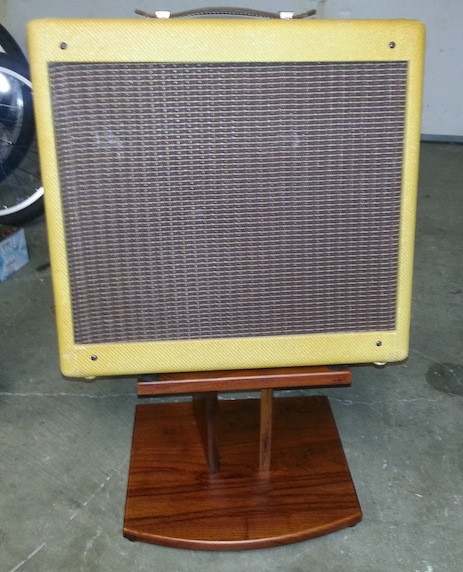
r8_frontToday was my kids’ last day of school at the parochial school they attend, so two of my close cohorts and I played the end-of-school Mass to rock it up one last time before the summer. The Mass was scheduled to start promptly at 8:30am, and I had a meeting at work at 10am, so I decided to keep it simple and bring a fairly sparse rig to the service. Normally, I use either my DV Mark Little 40 or one of my Aracom VRX amps (18 or 22). But today, I wanted a combo, so I brought my original 1958 Fender Champ, and my nano pedal board which just had a tuner, overdrive, chorus and reverb. Since I hadn’t hadn’t gigged with her in awhile, I decided to bring “Amber,” my ’58 Les Paul Standard Re-issue.
ampendage3About 7am, I loaded up my gear into the car, and headed out to the church. When I got there and opened up my trunk, I realized that I hadn’t strapped my pedal board to my gig bag, so I did that; pulled out my amp and cord bag, closed the tailgate, turned around to head to the church, then heard a crash behind me. Yikes! I apparently didn’t snap the buckle to the pedalboard’s strap well enough. Oh well… I figured the case was padded, so no harm, no foul.

Once I got into the church, I immediately set up my rig. Once everything was copacetic, I switched on my power strip, and was shocked to see that none of my pedals were switched on! I was using a 1-Spot for this little board because it’s so convenient. I’d had a connector string go out on me once, and always keep a spare in my cord bag. So I unplugged the 1-Spot adapter from the connector string, and plugged it into one of my pedals, and immediately my heart sank as that pedal didn’t power on. I tried it on another pedal and got the same thing: NOTHING!

Well, not one to panic, I knew that all I _really_ needed was some dirt at times because the Champ doesn’t break up so easily, so I pulled my Timmy off the board, put the board away, then hooked my cables to the pedal. I had a fresh battery in the Timmy so I knew I could use it.

timmyWe started rehearsing once I had everything squared away, and the sound that was issuing from the amp was pure ear-candy. Normally I like to grease up my tone with a little reverb and a touch of chorus, but the tone was sounding so good, I didn’t miss it at all. When I needed dirt, the Timmy gave me the snarling dog grit that I love to hear with my Les Pauls. Add to that the natural sustain of my R8, and it was a purely inspirational experience!

Because we were playing a church service, I had to play a both clean and dirty, sometimes within the same song, but I didn’t need any effect support other than my Timmy. As far as cleans were concerned, I had forgotten how incredible the Champ sounds clean; especially when my Les Paul was hooked up to it. In a previous article, I mentioned that I hadn’t played my Champ in awhile because it would hum after about a 1/2 hour of playing. That changed once I got the RocknStompn power strip. No, this isn’t an ad for that. It’s just that that one component provides such great power signal filtering that I find myself going to that amp almost automatically now because its sound is so magical, and powered by the RocknStompn, it’s DEAD QUIET!

I think what I needed today was just a dose of tonal purity, stripped down bare, with nothing to hide. Like Japanese art, there’s beauty in simplicity as the simplicity conveys the essence of the art, unencumbered by ancillary or unnecessary adornments that could detract from the pure essence. That’s what it felt like this morning. Pure. Essential. It was amazing.

My right-hand man in the band remarked after we finished rehearsing a song that I sounded like I was channeling Jeff Beck. I smiled and thanked him for the compliment, though in the back of my mind I was saying comparing my playing to Beck’s is like comparing a Pinto to a Maybach. But it did get me thinking that other than the occasional use of delay, Jeff Beck’s sound is pure. He has some other effects, but mostly it’s just his guitar and amp. Simple.

Admittedly, I had to work the strings a little more to coax as much sustain out of them as possible. But that was undeniably a good thing because it made my playing so much more expressive. I didn’t rely on any speed – gawd knows I’m not that fast. But when I soloed, I took my time, and let my notes breathe because I knew in the back of my mind that I didn’t have anything to help me with sustain. It was just me and the guitar. A guy I know, Anthony Bonadio, who owns Reason Amps, once told me that all he uses is a booster pedal. I never really got that until today.

I realize that all this might sound old-hat to many, and I’ve spoken about this in the past. But the experiences in the past didn’t hit me like it hit me this morning. Purity definitely has its place, and simple is good. Now this doesn’t mean I’m going to sell off my entire pedal collection. 🙂 But I think I’m going to take the approach of starting out simple first, then adding effects as I need them. For so long I’ve had some pedals on all the time. I’m going to shut them off and let my fingers do the talking.

ROCK ON!

Read Full Post »

What’s in a Name?

Goofydawg here and back from a rather longish hiatus of having a total hip replacement. My goodness! It is an incredible feeling to walk with a normal gait and at speed that I haven’t been able to walk at for almost a couple of years! Yeah, yeah… People always ask why I didn’t do it earlier, but the cold hard fact was that I had to deal with getting my cardiac and pulmonary systems in order first so I wouldn’t die on the table. So after many many months of Lipitor and two different types of blood pressure meds, I got my system back into balance enough to have the surgery. And just two-and-a-half weeks past my surgery, I’m operating without any assistive devices (walker, cane) whatsoever, and not only that, I’ve been able to wean myself of all my pain meds except for one that I use for sudden pain! Nice!

Okay, that out of the way… One of my other life-long passions other than guitar is fine wine, in particular fine Pinot Noirs, Syrahs and Zinfandels. I don’t drink a lot of wine (though I do a lot of tastings over the year), so I usually have no more than two cases in my possession at any time (though I have stash in my nice, cool, dark walk-in closet where I hold the ones I won’t drink for years). With that passion of course, I subscribe to various periodicals and newsletters that I keep around the house. In particular, I keep my K & L Wines newsletter in my bathroom for nice bathroom reading. 🙂

This morning while I was perusing my latest copy of the K & L newsletter, I read a column on the 2010 Burgundy’s that are just now hitting the market. It was the word “Burgundy” that sparked the idea of this article.

Over the years, Burgundy has held several connotations for me. Some thirty years ago, when I first started getting into wine and had no idea about different varietals and regions, whatever, the word “Burgundy” equated to cheap, jug wine that parents would provide at parties. My first taste of red wine was actually a sip of that kind of “Burgundy” when I was 16 years old. I remember thinking to myself, “People actually like this shit?” Little did I know that it was cheap imitation, which in later years couldn’t be termed that because of legal restrictions. Of course, fast-forward to today, and thinking about true Burgundy, made in the Burgundy region of France from the noble Pinot Noir grape, gives me the equivalent giddy, butterflies-in-the-stomach reaction to GAS.

The point of all this is that over time or with education, what a name or term may connote changes. For instance, I used to equate the Yamaha brand with cheap Japanese stuff. But now, Yamaha acoustics are my preferred brand; yup, over other venerable labels such as Martin or Taylor. Why? Simply because Yamaha electronics are second-to-none in my experience. They sound the most natural to me plugged in. Their raw, natural acoustics may not be quite as rich as those others, but since I primarily play amplified, I’ll take a Yamaha over any one of those any day!

Why is any of this important? I bring it up simply because it’s very easy to get locked into a certain way of thinking about different things based upon our current perceptions. Think about all the gear out there. We all have our brand preferences, such as my preference for Yamaha acoustics on stage. But I didn’t develop that preference in a static way. I had to do painstaking research when choosing my stage acoustic. I shared this before; I literally spent months evaluating guitars, and while I had the money to spend on a guitar five times its price, I chose my trusty APX900 much to even my surprise.

I do realize that some things, no matter how much I might try to keep an open mind, remain just cheap or bad (no, for the sake of keeping to my policy of playing nice, I won’t name names). But one thing I’ve learned in the years I’ve been writing this blog is that my perceptions on many things have changed because I became personally informed about them.

Challenge your perceptions sometime. You may be surprised by what happens!

Read Full Post »

Can’t Wait to ROCK!!!

bren_hospitalYup, that’s the Dawg (me) sitting in my hospital room. This past Monday, I had total replacement of my left hip. The surgeon used the anterior technique, which is a relatively new technique here in the US. Basically, with this technique, instead of cutting through the gluteus maximus muscle (your butt), with the anterior technique the surgeon works his way in between the quadraceps, merely cutting through the fascia that holds the muscles together. The net effect is a much shorter recuperation time, which is important to me because I just wanna ROCK!

Amazingly enough, they had me up and walking twice yesterday. The first session in the morning was absolutely excruciating, but in the afternoon, I was able to walk over 100 feet up and down the hall. Today, they’re going to do the same, but in addition the PT will teach me how to get in and out of a car, and in order to get discharged, I’m going to have to walk up four stairs! I’m not looking forward to that, but I realize it has to be done.

Now that I’ve had the procedure done, I can’t begin tell you what an ordeal it has been for the past year and a half. I developed severe arthritis in my left hip over the course of several years due to an old injury. It finally manifested itself at the end of 2011, though the pain wasn’t so bad at the time. But as these things go, it got steadily worse. I finally got around to seeing a doctor, and he told me that I’d probably have to get a hip replacement.

Due to other health issues I was having, I couldn’t schedule my surgery until August of last year. But then a couple of weeks before the surgery when I was to get clearance to undergo the procedure, my blood pressure had gone up; and dangerously high. So I had to cancel the surgery lest I bleed out on the table, and for the past several months I’ve been working hard on changing my diet and religiously taking my blood pressure meds, and amazingly enough, my blood pressure went back to normal levels and lo and behold, I was able to get my hip replaced.

But in the interim, life pretty much sucked. I still kept on gigging, but it was under a lot of pain. It got so bad that I couldn’t even stand for my gigs and had to use a drummer’s stool for my solo performances. I stood a bit at my church gigs, but I just remained seated for the most part in the weeks leading up to my surgery.

Now that I’ve had my hip surgery, life is going to change for the better this time. While I was writing this article, my quite attractive physical therapist fetched me to do some walking about the corridors and to practice going up stairs and steps and getting in and out of a car. Amazingly, my joint doesn’t hurt – at all! What hurts is the incision, and that pain will go away eventually. In fact, it’s nowhere near as painful as it was on Monday, so I’m pretty encouraged.

What this means is that I will have mobility again, and will soon be back and rockin’. Life is going to get better – much, much better!

Read Full Post »

Monday Profundity

Actually, I don’t know how profound I’ll actually be, but something I learned many years ago has had a profound effect on how I live my life, and on a smaller scale, how I approach playing music. Today’s thought was spurred by a New York Times article on “Mindfulness” that a friend shared on Facebook this morning. In reading the article, I looked back to a time before I was married and doing a lot of soul searching; trying to find the true essence of “me.” In the process, I learned about living in the “NOW,” and always being present.

As one person was quoted in the article, “Intentionally paying attention to the present nonjudgementally” is what living in the “now” is. Developing that sense though isn’t easy because our lives are filled with constant distractions. To live in the now requires quieting the mind. Though it might seem paradoxical, by making our minds still, we actually expand our awareness – of everything. We become responsive as opposed to reactionary. Response is intentional while reaction is instinctual. Big difference between the two.

So what does any of this have to do with playing guitar?

One habit that I’ve gotten into before I start any gig is a few minutes before I come to the microphone, I find a quiet place, or just sit at my rig, close my eyes, and do what I call “drain my mind.” I take myself to a place where I’m not thinking about work or other things that would worry me. I think about the first song I’m going to play, and tap into the emotion of the music and the meaning behind the lyrics. Then I try to feel the energy of the crowd. Once I’m “hooked up,” I start the first song. It’s not really psyching myself up – lord knows I don’t need any motivation to perform. 🙂 It’s literally clearing my mind to open myself up to the songs I’m singing and even more importantly, tapping into the energy of my audience.

I’ve found that when I’m bothered or distracted, it affects my performance. That probably goes for pretty much anything I do, but especially with playing guitar – whether I’m gigging or in the studio or just playing alone – if my mind isn’t clear, I have a hard time expressing myself, and my performance is just flat. For example, a couple of weeks ago, I was really bothered by a programming problem that I was working on solving, and I spent most of my time on the way to my gig thinking about it. I set up my rig, still ruminating over the problem, then I started the gig without first draining my mind. The net result was that I was just going through the motions.

I was sounding okay, I suppose because I was getting some tips, but I wasn’t really connecting with my audience. So instead of doing my typical 1.5-2 hour first set, I cut off my first set at an hour, left the stage for about 15 minutes, and spent the time in a quiet place, going through my routine (I also got a dram of Macallan 18 year old scotch to enjoy 🙂 ). Mind you, I wasn’t really stressed out; I was just distracted. While I was enjoying the vanilla accents of the Macallan 18, I found my “happy place,” and realized that I hadn’t drained my mind before starting. So I took a few minutes to just quite my mind and put the problem away; promising myself that after my gig I’d work on the problem. Once I got back on stage, I felt totally plugged in, and had a great evening. I was so inspired, I did a lot more soloing than I had ever done (that actually established a precedent because I now take a lot more time to solo)! So what about the work problem? Funny thing is that by draining my mind, I found the solution while I was driving home. In quieting my mind, I was able to see the missing connections between my objects. I got home, coded them up, and all was well! It took me all of 10 minutes to solve. 🙂

The point to all that is that when we quiet our minds, we open ourselves up to all sorts of possibilities, plus we allow ourselves to focus more intently. I know that seems paradoxical, but I’ve found that in order to focus, we have to first drain our minds to expand our awareness. Only then can we focus.

ROCK ON!

Read Full Post »

Fender and Volkswagen came out with this last year, and Fender’s plugging it again. I dismissed it at first as a gimmick, but it looks like it’s here for another round for this year’s Beetle, Passat, and Jetta, though the premier plug is for the Beetle. As both Fender and Volkwagen put it, “the best seat in the house behind the wheel of a Volkswagen.” This time I watched videos, and sure, it’s a pretty cool system. But despite that, I still have a beef: An American guitar icon in a German vehicle? At least for me, when I think rock and roll and cars, I picture an American muscle, bad-ass, pussy-wagon like a Camaro SS, Shelby, Charger, or a Corvette. But a Beetle? I don’t give a rat’s ass if it has a turbo-charger. It ain’t a bad-ass American muscle car!

Think about it yourself. Think of rock and roll and then picture a car that goes with that rock and roll ideal. It’s quite likely that it’s not a Euro-bred exotic like a Lambo or Ferrari or Mercedes. Or if you’re into bikes, it’s a Harley, not a Gold Wing. Even if you compare drivers and rock and roll, who pops into your mind? It ain’t Michael Schumacher. It’s John Force or Don Garlitz (goin’ old-school here) or Paul Tracy or Dale Earnhardt (Senior and Junior).

Fender and Volkswagen don’t seem to fit to me. The brand targets are so different. Look, I had a New Beetle when they first came out. It was a fun, cruiser-mobile. I even had a daisy that I put in the mini flower vase on the control panel. But in no way would I consider it to be a rock and roll vehicle. I always knew while I had it that the New Beetle was for 20- or 30-something chicks who were into or needed something eclectic in their lives, or techno-geeks like me who didn’t want to buy a beemer with their high-tech winnings (thank gawd the Prius wasn’t out then).

Read Full Post »

I played a funeral service yesterday morning. I’ve probably done a couple of hundred over the years. Most of the time they’re pretty sad affairs as expected. Family and friends talk about how loving and caring the deceased was, how involved they were with their family, etc., etc.. This one was no exception in that regard. But it was also very different, and it was also very moving.

What made it so moving were the stories everyone had to tell. They weren’t all rosy. They spoke of hardship. They spoke of struggling. They also spoke of overcoming those hardships by facing them head-on and not crumbling. They of course spoke of love. In all, they stories of the woman who had passed away made her seem so real, and it made it very clear to me that this woman lived a full life; uncompromising in her values and uncompromising about her deep feelings for the people around her.

But in another twist, people spoke of how she shared her life and experiences with them; maybe to teach them a lesson, or simply to pass the time.

All that made me think: What kinds of stories will people tell of me when I pass away, but more importantly, what stories am I able to share about me with others? I’ve been contemplating this for the last day, and that brings me to the title of this article.

What I came to realize is that you really can’t tell any stories unless you’re experiencing life. Conversely, stories can’t be told about you if you’re not showing up. Woody Allen is often credited with the saying, “90% of life is just showing up.” To me, that’s all about getting myself out there. Being involved and really putting MYSELF out there, not a facsimile of whom I think I or anyone thinks I should be, but showing up as me. The other 10% is execution: You’ve made it, now do it…

A big part of the philosophy is reflected in why I gig so much. Right now, I’m gigging four nights a week. It’s not about the money. It’s about the playing. I’m exhausted as all get-out as I write this, but I’ve never been so fulfilled in all of my musical career.

Take for instance last night’s gig. Yesterday afternoon, I watched this video on YouTube. I ran across it randomly as I was looking for something entirely different (leave it up to Google’s search algorithm to come up with things that I’m interested in besides my specific search query). Curious, I watched it, and I realized that I was doing something similar to that for years. But with that video, I was able to finally intellectualize something I’d done by feel for a long time. Essentially, it’s taking a modal approach to the minor pentatonic scale, and it’s extremely powerful. Combined with my recent forays into major-scale, modal theory, it has given me yet another tool to use for improvising.

I applied it last night, and the experience was simply transformative. It was amazing because I felt as if I was telling a story while I was playing; that that particular skill opened up even more musical vocabulary into which I could tap. A young couple who was sitting near where I was playing actually stayed a lot longer than they were originally planning. As they left, the woman of the couple said to me, “Your playing was incredible. Couldn’t believe the phrasing you were using. It wasn’t rock, but it wasn’t jazz either. Really awesome.” I was awestruck by that. It was obvious that she was a musician. I’ve never really considered myself to be possessed of real improv talent. I’ve always just done it, and didn’t really think about it. But to hear something like that just blew me away.

The point to me sharing this is that on the way to my gig, after all my contemplations on story-telling that afternoon, I had the full intent of telling my story last night. It was a risk because I didn’t know how it would go, and when you do covers, people expect songs to be played a certain way. But I went for it anyway, and it was life-changing.

After the gig, I came up with the saying that I used for the title of this article. I couldn’t have told a story with tapping into my life experiences, and it made me think that if closed myself off from life I’d never have the experience to tell a story in the first place.

Read Full Post »

lp12stringMy bouts with GAS became fewer and fewer. It’s not that I stopped buying gear – for goodness’ sake I just purchased another guitar! But that craze that would put me in a feeding frenzy and I’d shell out thousands on gear – most of which I don’t use any longer – just doesn’t happen all that much any longer. In fact, even with my new, beloved Katie May, I didn’t suffer any GAS at all.

People who are close to me might say it’s all the wine I drink, but to be completely honest, I taste a lot of wine, but don’t really drink a lot of wine; there’s a HUGE difference. You could also say, I’m a bit more mindful of my pocketbook. I am. I surely don’t have a recent IPO to thank for that, though I’m working on it.

Looking back on those days when I’d get a GAS attack, I’d walk into a music store – one bad one in particular is Tone Merchants in Orange, CA which is like walking into f-in’ gear heaven (or more locally, Gelb Music in Redwood City, CA) – and I felt like I had walked into a brothel where I could try all the girls before I actually paid for the one with whom I’d eventually spend a protracted amount of time, and the cool thing was that they were all clean, and I didn’t have to worry about catching some STD. After trying out all the different alternatives, the money would be burning a hole in my pocket! And wise choice or not, I’d walk out with SOMETHING, be it a guitar, an amp, an exotic pedal.

And the sales guys, if you’ve been buying from them for a long time know this about you. They don’t waste time showing you the new-fangled stuff just because it’s new. They know better. Instead, they show you stuff that they know will get you into that feeding frenzy. It’s not a bad thing. Hell, I have lots of GREAT gear that I still use on a regular basis, but those few years of being hasty and at times indiscriminate actually kind of burned me out.

You notice that on this blog I don’t write as many gear reviews as I used to. There was a time when I was reviewing at least a three or four items a month, if not more so. But lately, I’ve been a lot more into gear from a different perspective; and that is how it fits into my sound.

For instance, take the Tattooed Lady Overdrive I recently reviewed by the Circus Freak Music guys. This is an absolutely kick-ass overdrive with lots of internal gain and lots of volume to really push the front-end of your amp. This is a pedal that I would add to my chain; actually, I haven’t told the boys over there about it yet, but I’m keeping the pedal – I’ll pay for it of course, but I’m still keeping it. 🙂 I got this for review, and even though I discovered it to be insanely awesome, it didn’t give me that tingly feeling I’d get in my gut when it arrived on my doorstep. In fact, I got the box, opened it up, plugged it in and just started to play. What made me decide to keep it was its versatility. I could use it as a standalone clipping device, but I could also use it as a nice little booster. It also stacks well with my Timmy; much more so than my Tone Freak Abunai 2, which is also an insanely good overdrive (that’s still on my board as well because it has a nice color to it – I took it off for awhile, but it keeps on coming back).

The point is that after all those years of sucking up gear, it’s not that I got burned out. I just found my fundamental tone. It’s also not that I don’t want to screw with that, it’s just that I’m not as compelled towards tonal discovery.

I don’t think my GAS is cured. I think it just takes a lot more to spark it.

ROCK ON!!!

Read Full Post »

When it comes to creating music for songs, I’ve usually had a pretty easy time of it. I hear a melody in my head, think of what chord changes would fit with the melody, and put a simple track together. It’s a different story with lyrics. I have to admit that that isn’t my strong suit, even though once I’m done, I’m usually satisfied with them. But even still, writing lyrics isn’t all that difficult.

But what is hard is actually putting the song together and getting all the parts right. I used to be a bit embarrassed by the fact that especially with guitar riffs, I’d sometimes take 20-30 takes to make it right – or even more if I didn’t know how to play the riff that I heard in my head in the first place. It wasn’t about being a perfectionist; it was all about learning how to play. Period. Used to drive my poor family insane. My wife would sometimes burst into my man-cave exclaiming, “Why the hell do you have to play that phrase over and Over and OVER AGAIN?!!!”

With a sheepish grin, I’d almost invariably reply, “‘coz I’m not good enough to play what I’m hearing in my head, and need to get it down.”

Of course, her reply would be, “Well then, why don’t you just practice it quietly until you’ve got it, then record it?”

“Because I’m so close to getting it, but I screw it up along the way. I’m banking on hitting it one of these times, honey,” I’d reply.

“Oh my gawd! You’re driving us CRAZY!”

Years down the line, I’m a much better player, so I can usually hit it in one or two takes, or I now tend to experiment with different approaches to a particular phrase, rather than have my recording session be part learning session. But I will tell you this: All that time spent repeating and repeating paid off. That repetition made me a better player, and actually made my song arrangements much better. But nevertheless, I still do a LOT of repeating, especially with lead breaks.

In a song I wrote several years ago, I shared with a friend that the solo was actually composed. He was (and still is) a great guitar player, so he had a hard time fathoming how I didn’t just improvise over the changes. I was actually a little embarrassed so I made up some lame excuse. And I remember that conversation to this day. But yesterday, I was reading Bob Lefsetz’ latest installment where he was raving about the Eagles’ documentary, and in a passage in his article he wrote this:

Glenn hooks up with J.D. Souther and they form Longbranch Pennywhistle. They end up befriending Jackson Browne and move in above him in Echo Park. Where at nine every morning Jackson makes tea and starts to write. Playing the same riffs twenty times in a row. THAT’S WHAT IT TAKES TO MAKE IT! You don’t see the hard work at home, only the result, but the dues being paid are hefty.

Talk about reading something encouraging! Jackson Browne is one of my all-time favorite singer/songwriters, and to find out something about his writing process having even a slight similarity to my own simply blew me away!

I’ve always been of the mind that you have to practice, practice, practice to be good, and that practice has be driven by somewhat of a single-minded purpose. I wrote about this in a recent post, but that point was really driven home by that short passage.

Now I don’t feel so bad about driving my family crazy with my playing something over and over and over again. 🙂


Read Full Post »

It Bugs Me When…

I read threads like this where the discussion turns to artists selling out. Who’s to know what motivates the creative process of an artist? Only the artist. This particular thread focuses on Maroon 5 and what happened to them. Invariably, considering it’s The Gear Page, there will be those members who only have negative things to say, and accuse the band of selling out; or one respondent saying Adam Levine is a douche, and doesn’t substantiate as to why he or she thinks that. In my opinion, those who make those kinds of statements are the real douche bags, and frankly, I think their negativity is borne more out of jealousy than anything else.

The plain fact of the matter is that no one but the artist really knows what drives them. And many songwriters will actually say that they don’t know how they come up with songs. They just come, and they write them down. If that’s what happened to Maroon 5, that’s what happened. It’s pretty arrogant for people to throw out the oft-repeated phrase “they sold out.” Maybe Adam Levin wanted to explore a different direction; maybe songs like “Moves Like Jagger” written with Christina Aguilara was just something fun to do. WHO ARE WE TO JUDGE?

Several years ago, I remember being at a cast party of a community theatre production after a show and this aspiring “starlet” (I say this facetiously, mind you) said, “I only want to work in theatre because the actors in TV and movies have sold out, and they don’t really care about the craft.” I just looked at her in amazement, then somehow blurted out, “You are SO full of shit! But if it gives you any comfort, I can guarantee that people like Tom Cruise (that’s who she was talking about) are so upset with the opinions of ‘real’ actors like you that they’re crying all the way to bank.”

And so it goes with the musicians who are perceived to have sold out. Let me tell you, with their millions of fans, they’re more relevant than you could even imagine. Of course, with the finicky public, that could change in a heartbeat. As for me though, I celebrate the success of hard-working musicians.

That said, I do need to draw the line between those musicians who’ve worked their tails off and write their own stuff versus those who are invented. I have much more respect for people who perform their own creations. A good example of this is Taylor Swift versus Britney Spears. The former writes much if not all of her own stuff, while the latter was pure invention by someone else. I’ve never liked either one’s music, but I can appreciate people who originate their art. Taylor Swift has done a great job of bouncing back and forth between country and pop. What has Britney done lately? Talent judge? Hmm… 🙂

But then again, I can’t fault Britney for wanting to make a buck, and heaven knows she’s had great commercial success, but in my mind, if I were a fan, I’d be much less concerned about her “selling out” because she didn’t create the songs in the first place.

Anyway, sorry for the rant. I’m know I’m known more for my positive and upbeat tone, but some things just piss me off…

Read Full Post »

You Wanna Make It? Work Your Ass Off!

Love him or hate him, agree with him or not, or even question his credibility, Bob Lefsetz has something to say. “The Letter,” which apparently started out as a way to help Lefsetz get a job in the music biz, has become a close commentary on the music industry to which industry execs pay attention. I discovered his blog a few months ago purely by accident while doing a search of sort, and loved what he was saying; especially with respect to making it in today’s music industry.

One thing that I’ve noticed after reading him daily or even twice daily – he’s a prolific poster – is that he often talks about making it in the industry, and how hard it is to make it. It’s not about talent; hell, I know a lot of talented people who’ve never made it. It’s about working your ass off. For instance, here’s an excerpt from yesterday’s letter:

These musicians practiced for years. There were no short cuts to stardom. Sure, there were some teenybopper acts, but we didn’t take them seriously, unlike the way the industry and the media fawn over today’s TV stars, made famous overnight by “Idol, ” “The Voice” and “X Factor.” A rock star of yore literally rose from the streets, there was almost never an overnight success. And your audience never made fun of  you, they loved you, they were thrilled by you, you were the reason they kept on living.

The operative phrase in the excerpt is “There were no short cuts to stardom.” Unfortunately, the shows Bob mentioned in the same paragraph have led millions of people to think they can indeed take shortcuts to stardom. It just isn’t so. Making it that way is akin to winning the lottery. As Bob also said, “A rock star of yore literally rose from the streets.” In other words, they worked their asses off, playing small clubs and venues and building up a fan base.

But the same principle applies to any profession. You don’t become good at any profession without putting in the time, without developing and honing your skills through repetition and practice; also making mistakes and learning from them, which again circles back to doing enough repetition to make mistakes.

Over the years in my career as a software engineer, I’ve occasionally taken some new developers under my wing to mentor them in their early years. When we first start working together, I share with them an incident that happened in 2000 when I was working on the highly visible CarsDirect.com project (at the time, it had set the record for largest VC funding at $300 Million). At a meeting the day after our initial, major release, the CTO asked me to put together an architecture for the upcoming major release which would move the technology from ASP to Java. I had two hours to draw up an initial architecture so I could present it at the kickoff meeting  which included the execs and all stakeholders. I completed the mini-project, and gave the presentation. After the kickoff meeting, one of the young engineers fresh out of college asked me, “How did you come up with that architecture so quickly?” I replied, “That’s over 20 years of working in the industry, my friend. I’m not saying that to brag. But my experience allows me to do this kind of stuff without really thinking about it too much. I can see most of the relationships in my head, so I spend little time discovering what the relationships might be.”

The point to the above is that I’ve worked my ass off to get to where I’m at today. I look back on my career and I’ve accomplished some incredible things – some of my ideas on software design and architecture even made it on the Space Shuttle – and I’ve made some incredibly huge gaffes and mistakes. But that’s how you build a career. It doesn’t happen over night. Your fate isn’t determined by a panel of judges. You’re the captain of your destiny, and you have to have the mental fortitude, dedication, perseverance and passion to make it!

Read Full Post »

« Newer Posts - Older Posts »